Bikram yoga history is the story of a method that kept its postures while it lost its brand. The 26 postures and 2 breathing exercises began in Calcutta, took their fixed form in Los Angeles, and then outlived every trademark filed to protect them. A 2015 court ruling and a run of cancelled and abandoned filings left the sequence open to any trained teacher.
Table of Contents
That short answer raises better questions than it settles. Who owned what, and when did each protection fall away? What did that change for a student, and for someone who wants to teach? This guide follows the method through four layers (lineage, sequence, name and class script), so you can see which parts of the story are documented and which are folklore.
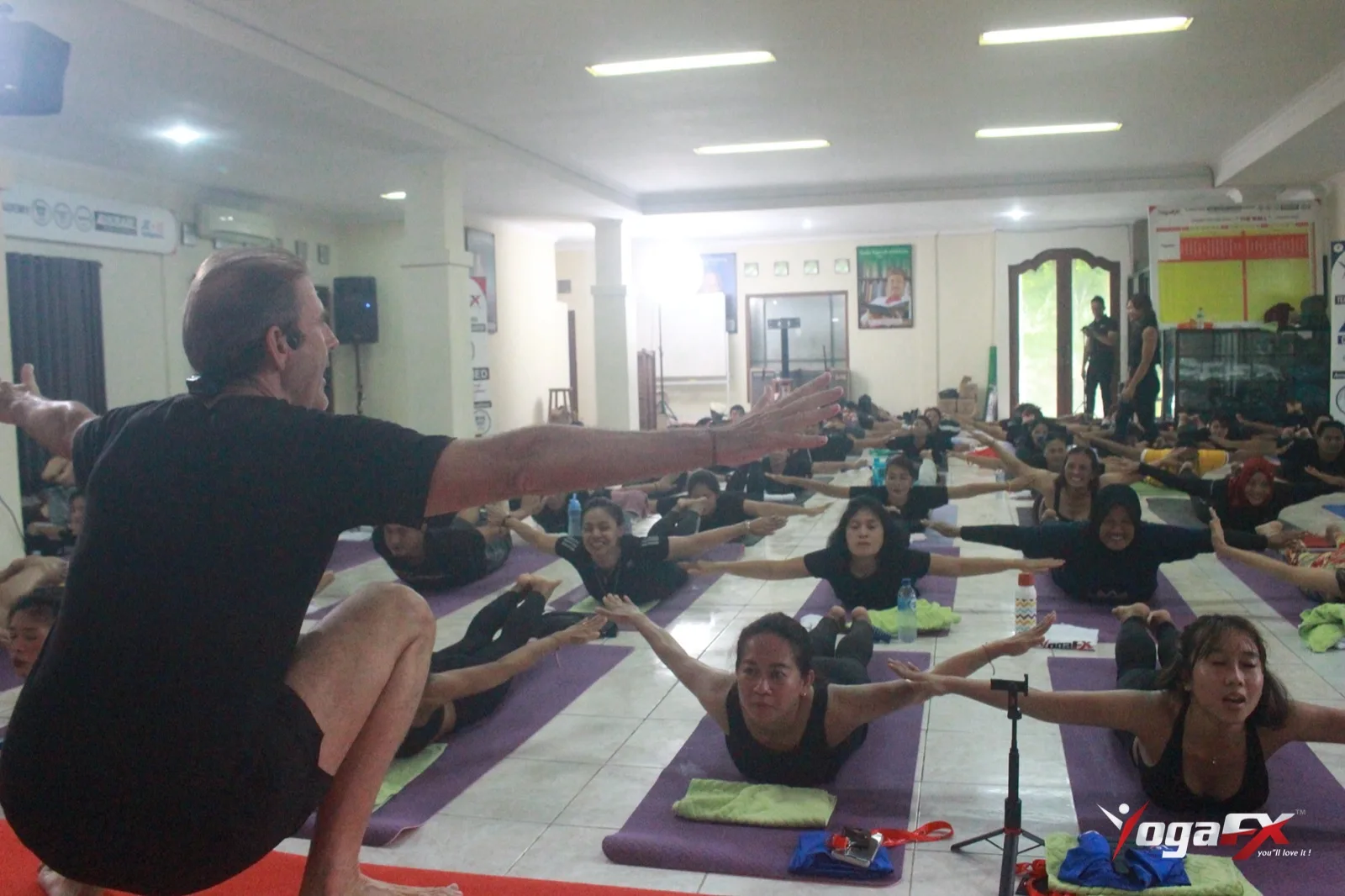
Mr. Ian Terry, E-RYT 500, adds a first-hand view. He spent five years (2014-2019) training alongside the founder of the Bikram Hot 26&2 method, and he has led YogaFX in Bali since 2017. For the complete timeline with the lawsuits and the full trademark register, see the full Bikram yoga history timeline on our sister site. This version asks a narrower question: how did the method survive?
Bikram Yoga History in Four Layers
Most articles tell Bikram yoga history as one long biography. That hides the useful part. The method was never one thing, so its protections did not fall away all at once. Splitting Bikram yoga history into layers shows exactly what was lost and what was kept.
| Layer | Where it came from | Position today | What it means for a teacher |
|---|---|---|---|
| Lineage (the postures) | Bishnu Ghosh's school in Calcutta, founded 1923 | Public heritage, never owned by a studio brand | You inherit it; nobody can license it to you |
| Sequence (26 postures, 2 breathing exercises, fixed order) | Shaped in Los Angeles from 1971 | Not copyrightable, per the 2015 Ninth Circuit ruling | You can teach it in full without permission |
| Name (Bikram, Bikram's, 26 & 2) | Filed as US trademarks from 2002 | No live US registrations in our records check; the "26 & 2" application was abandoned in 2016 | Names are free in the US, but trademark law is national |
| Class script (the dialogue) | Written down in the 1979 book | The published words are text; the method is not | Use your own words in class, and never copy a book wholesale |
This four-layer view is original to this article. It's a way of reading the history, not an official legal classification.
Hold on to that table, because every later section of this Bikram yoga history refers back to it. The rest of this guide takes each layer in turn.
Layer One: The Lineage From Calcutta
The roots of Bikram yoga history sit in Calcutta, not Los Angeles. Bishnu Charan Ghosh was born in 1903 and founded the College of Physical Education there in 1923. He was the younger brother of Paramahansa Yogananda, the author of Autobiography of a Yogi.
Ghosh was a physical culturist more than a devotional teacher. His interest was measurable change in the body: strength, mobility and recovery from injury. His students used Hatha postures as training and as therapy.
Who taught whom in Bikram yoga history
Bikram Choudhury, born in Calcutta in 1944, later said he trained with Ghosh from early childhood. Biographers place his regular training at Ghosh's gymnasium from about 1962. Ghosh died in 1970 and Choudhury left for the United States the following year.
That gap matters for Bikram yoga history. The postures came from Ghosh's school, while the fixed order, the heated room and the word-for-word script took shape later. So when someone asks who created this style, the careful answer has two names in it.
Why the heat is part of the story
The class runs in a room heated to about 40°C with roughly 40% humidity, for 90 minutes. Many people assume heat was a marketing idea. In fact it follows a simple logic: warm muscles stretch more safely, and the sustained sweat is part of the discipline. If you want the physiology behind it, our guide to what 26 and 2 yoga is walks through the room and the sequence.
Layer Two: How the Sequence Took Its Fixed Form
Choudhury arrived in Los Angeles in 1971 and began teaching. In the decades that followed, Bikram yoga history shows the class settling into the structure students recognise today.
- 26 postures and 2 breathing exercises, always in the same order.
- 90 minutes in a heated room.
- A scripted dialogue instead of demonstration or music, so every trained teacher delivers the same class.
The script is the clever part. Because the instruction is fixed, a newly certified teacher can run a complete class from the first day. That's why the method scaled so quickly, and why a student in Seminyak hears essentially the same class as a student in London.
The book that started the legal story
Choudhury published Bikram's Beginning Yoga Class in 1979 and registered it for copyright that year. Decades later, that book became the centre of a legal argument. If the order of the postures was his creative work, then teaching it without a licence would be infringement. By the early 2010s, his organisation was suing studios that taught the same postures under other names.
The 2015 Ruling: Why You Can Teach the Sequence
The turning point in the history of Bikram yoga came on 8 October 2015. The US Court of Appeals for the Ninth Circuit decided Bikram's Yoga College of India v. Evolation Yoga, and it ruled against the claim that the sequence was protected.
What the court actually said
The court held that "the Bikram Yoga Sequence is not a proper subject of copyright protection." In its words, the sequence is "an idea, process, or system designed to improve health." US copyright law excludes ideas, processes and systems from protection, so a system can be described in a book without the system itself being owned. You can read the full Ninth Circuit opinion on the court's own site.
The US Copyright Office had signalled the same view three years earlier, in a policy statement (77 Fed. Reg. 37605) about claims in compilations of exercises. The court's ruling then applied that logic to this specific sequence.
What the ruling did not change
It's worth being precise, because this point gets stretched in both directions. The ruling didn't say that the book can be photocopied. It said that the method described in the book cannot be monopolised. Copyright covers expression, not the idea underneath it.
For a teacher, the practical result is clear:
- You can teach the full 26 and 2 sequence anywhere in the United States without a licence.
- You can write your own dialogue and class notes, and they belong to you.
- You should not reproduce someone else's published script as your own.
Other countries have their own copyright laws. Before you build a business around a sequence, ask a local lawyer how those laws apply to you.
Layer Three: The Names That Lapsed in Bikram Yoga History
Copyright covers creative works. A trademark covers a name. So after the 2015 ruling, a second question remained: who owns the word "Bikram"?
What the register shows
We checked the US Patent and Trademark Office records filed in Choudhury's name. The two marks that reached the register, BIKRAM YOGA and BIKRAM'S YOGA COLLEGE OF INDIA, were cancelled in early 2014 because the 10-year declaration of use was not accepted. Several other filings never reached the register at all. They were refused or abandoned between 2004 and 2016.
The last filing is the interesting one in Bikram yoga history. In November 2015, a month after the court ruling, an application was filed for "26 & 2". It was abandoned in October 2016 after no response to the examiner. So the numbers that describe the method stayed a common name.
Why this explains the renaming wave
Dead marks give the former owner no registered rights in the US. Even so, many studios dropped the word "Bikram" voluntarily, and the reasons were more about reputation than law. Today the same class runs under several names: Bikram yoga, 26 and 2, Original Hot Yoga and Hot 26&2. The postures didn't change. Only the sign on the door did.
Trademarks are national, though. A US record says nothing about a filing in Indonesia, the UK or anywhere else. If you plan to name a studio or a training, ask a trademark lawyer in your country to run a search first. This is general information, not legal advice.
Layer Four: The Class Script and the Culture Around It
The fourth layer is the hardest to put on a table. It is the way the class is delivered, and the culture around the person who built it.
The founder's conduct
Several former students and employees brought civil lawsuits against Choudhury, which he denied. One case ended in a jury verdict in 2016. The details are in the public record and we cover them in the longer timeline on our sister site, so here we keep to one point. The legal troubles were one reason many studios changed names after 2016, and they shaped how a new generation of schools chose to teach.
Separating the method from the man
Mr. Ian trained through those years, from 2014 to 2019, so he saw the teaching and the surrounding culture at close range. His conclusion, which shapes how YogaFX teaches today, is that the two can be separated. The posture clinics were precise. The dialogue standard was exacting and produced teachers who could hold a room in their first class. The deference around the founder is something he chose not to carry forward.
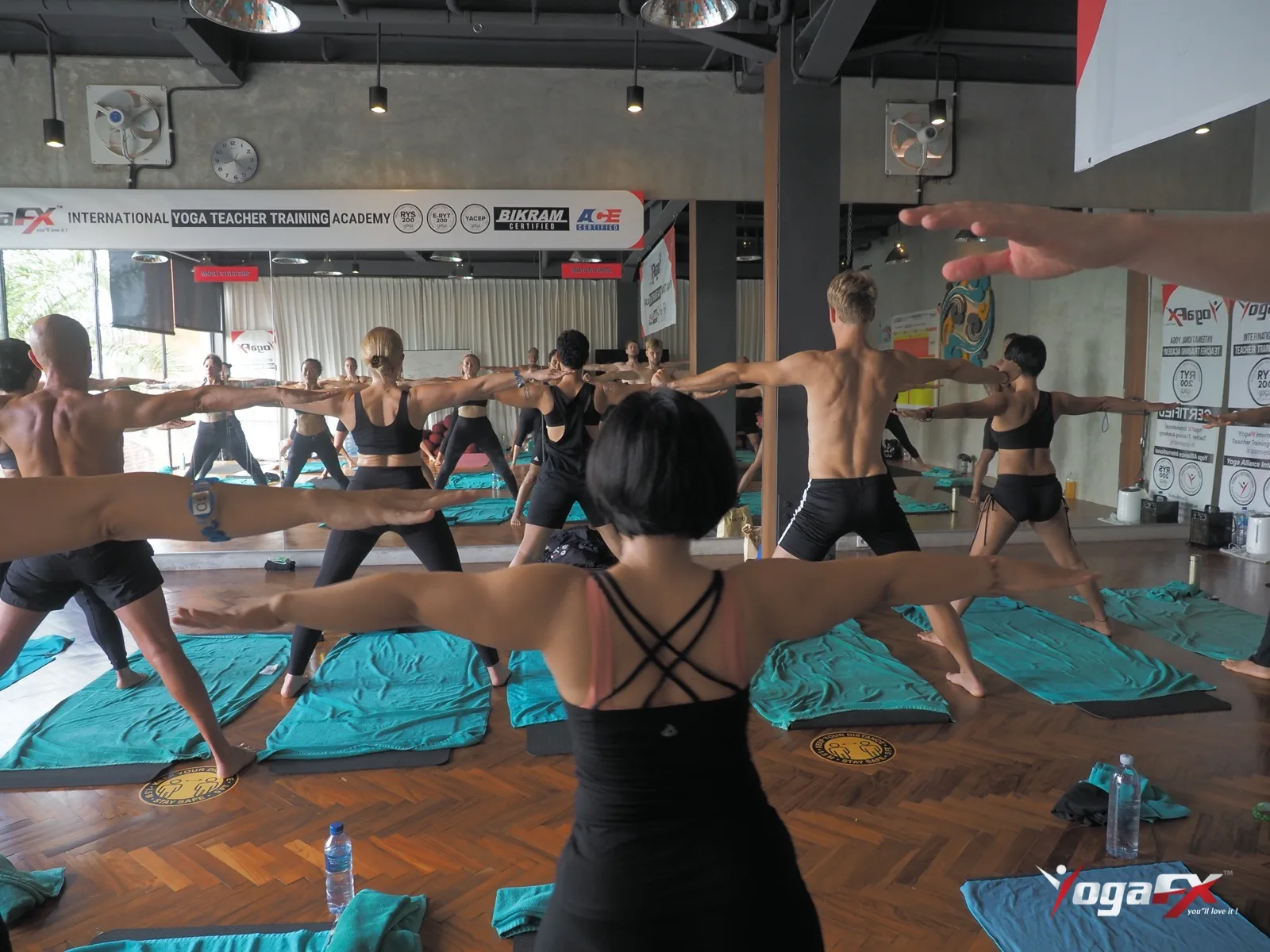
In practice, that means three things in the YogaFX training room:
- The method stays intact. The same 26&2 sequence, heat and dialogue structure.
- The culture changes. Trainees ask questions, set their own limits and get feedback in plain language.
- The record is honest. We teach the lineage, including the uncomfortable parts.
Why the Method Survived: What the Research Says
There is a twist in Bikram yoga history. The strongest evidence for the practice arrived after the founder's reputation had collapsed. Researchers studied the class, not the man.
The most cited example is a Harvard-affiliated randomised trial of heated yoga for depression, published in the Journal of Clinical Psychiatry in 2023 (Nyer and colleagues, Massachusetts General Hospital). After 8 weeks, 59% of the yoga group saw their depression symptoms fall by half or more, compared with 6.3% of the wait-list group.
Earlier work points in the same direction. A 2014 University of Wisconsin study by Porcari and colleagues measured calorie burn and heart rate in a 90-minute class. If you want the numbers, our calories burned in 26 and 2 yoga guide goes through them.
Still, research does not make this a treatment. Studies suggest a heated class may help, but heat adds real strain to the body.
Bikram Yoga History and Teacher Training Today
Bikram yoga history changed teacher training as much as it changed the names. The old model was a residential course of several weeks with hundreds of trainees in one room. Modern schools are smaller and more flexible.
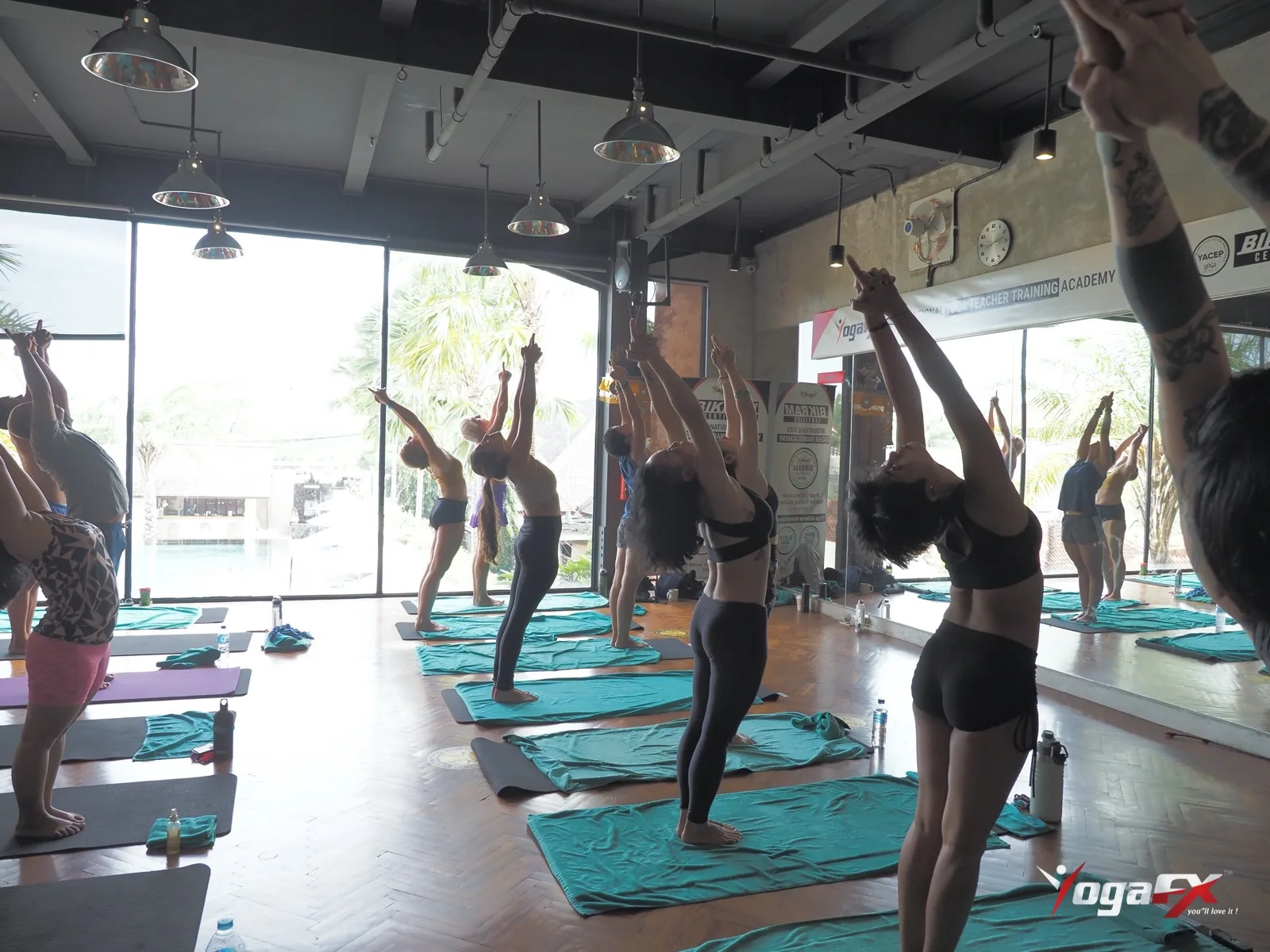
YogaFX runs the Bikram Hot 26&2 Yoga Teacher Training as a hybrid: an online pre-course for the dialogue, anatomy and history, then a 6-day intensive in Bali. Graduates leave with dual certification, a Yoga Alliance RYT 200 plus the Bikram Hot 26&2 200-hour International Yoga Certification.
If you wonder how different the method feels from other hot styles, our comparison of hot 26 vs hot hatha vs Bikram lays them side by side. And if you are weighing standards, read what an association can and cannot change in our guide to the Original Hot Yoga Association.
The batch, the price and the place
The next batch checks in on Sunday 24 January 2027 and checks out on Friday 29 January 2027, at Soham Wellness Center in Seminyak. The Early Bird price is US$1,899 (normal price US$1,999), and payment plans start from US$250 a month, interest-free. Our studios in Seminyak and Canggu are open from 06:00 to 22:00. See the teacher training and course dates pages for the full details.
What Graduates Say About the Lineage
Reviews are the best proof that the method still works for the people who learn it. Elvia followed the training in January 2023:
"Your passion for educating all students is extraordinary."
Elvia, Google review, 2023
Jade, who describes herself as a long-time student of the style, wrote in 2021:
"As a proud Bikram Yoga addict who has attended classes all over the world, I highly recommend YogaFX."
Jade, Google review, 2021
And Jeanett wrote in 2019:
"Great inspiration, a great way to learn!!"
Jeanett, Google review, 2019
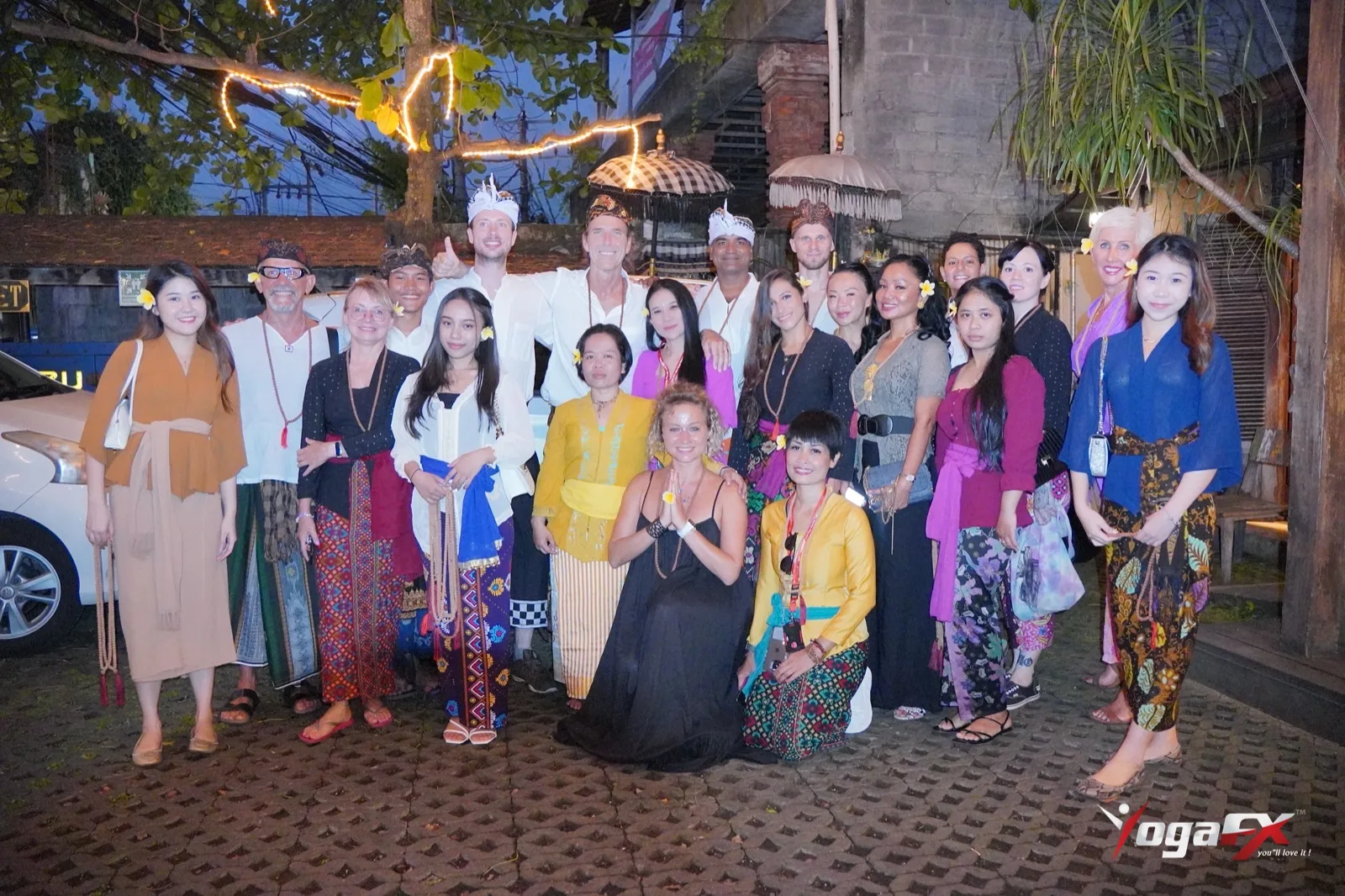
Our current numbers are 150 Google reviews, 50 Yoga Alliance reviews and 357 YouTube testimonials. Mr. Ian has 12,000+ teaching hours as an E-RYT 500 and has trained 1,500+ teachers from 80+ countries since 2017. Read more on our teacher's page.
What Bikram Yoga History Means for You
If you are a student, Bikram yoga history changes very little about your class. The same 26 postures, the same heat and the same dialogue are on offer under several names. If you are considering teaching, the history matters more.
- Check the school's honesty. A good school can explain the difference between lineage, sequence, name and script.
- Check what you actually receive. Look at the hours, the trainer's experience and the certifications, not at the brand on the door.
- Check the local law. Trademark rules differ by country, so a name that is free in the US may not be free where you live.
The lineage is old, the brand was recent and the protection around both fell away between 2013 and 2016. What remained is a teachable method. That's the core of Bikram yoga history, and it is why the class you attend today looks so much like the one taught half a century ago.
FAQ: Bikram Yoga History Questions Answered
Is Bikram yoga copyrighted?
No. In 2015 the Ninth Circuit held that the sequence of 26 postures and 2 breathing exercises is an idea, process or system, which copyright law excludes. A published book is still protected as text, but anyone can teach the sequence itself without a licence or permission.
Is Bikram yoga trademarked?
Not on the US register, according to our records check. The BIKRAM YOGA mark was cancelled in 2014, and later filings for the name and for 26 & 2 were abandoned. Trademark law is national, so check other countries separately and ask a local lawyer.
When did Bikram yoga history begin?
It begins at Bishnu Ghosh's college in Calcutta, founded in 1923. Bikram Choudhury began teaching in Los Angeles in 1971, where the postures became the fixed 26&2 sequence, heated room and scripted dialogue. His book about the class was published and registered for copyright in 1979.
Why do studios still use the 26 and 2 name?
The numbers describe the method, and the application to register them as a trademark was abandoned in 2016. That leaves them as a common name. Many studios prefer 26&2, Original Hot Yoga or Hot 26&2 because they separate the class from the founder's reputation.
Can I take a Bikram-style teacher training today?
Yes. The sequence is open to any trained teacher, and independent schools run their own trainings. YogaFX offers a hybrid course with an online pre-course and a 6-day intensive in Bali, with dual certification. Compare hours, trainer experience and certifications before you choose.