Hot yoga benefits are real but narrower than the hype. Research on hot yoga, mostly Bikram-style, links regular practice to better fitness, strength and flexibility, and possibly to mood. In a 26 and 2 class, each posture group trains something specific. This guide matches the postures to the evidence.
Table of Contents
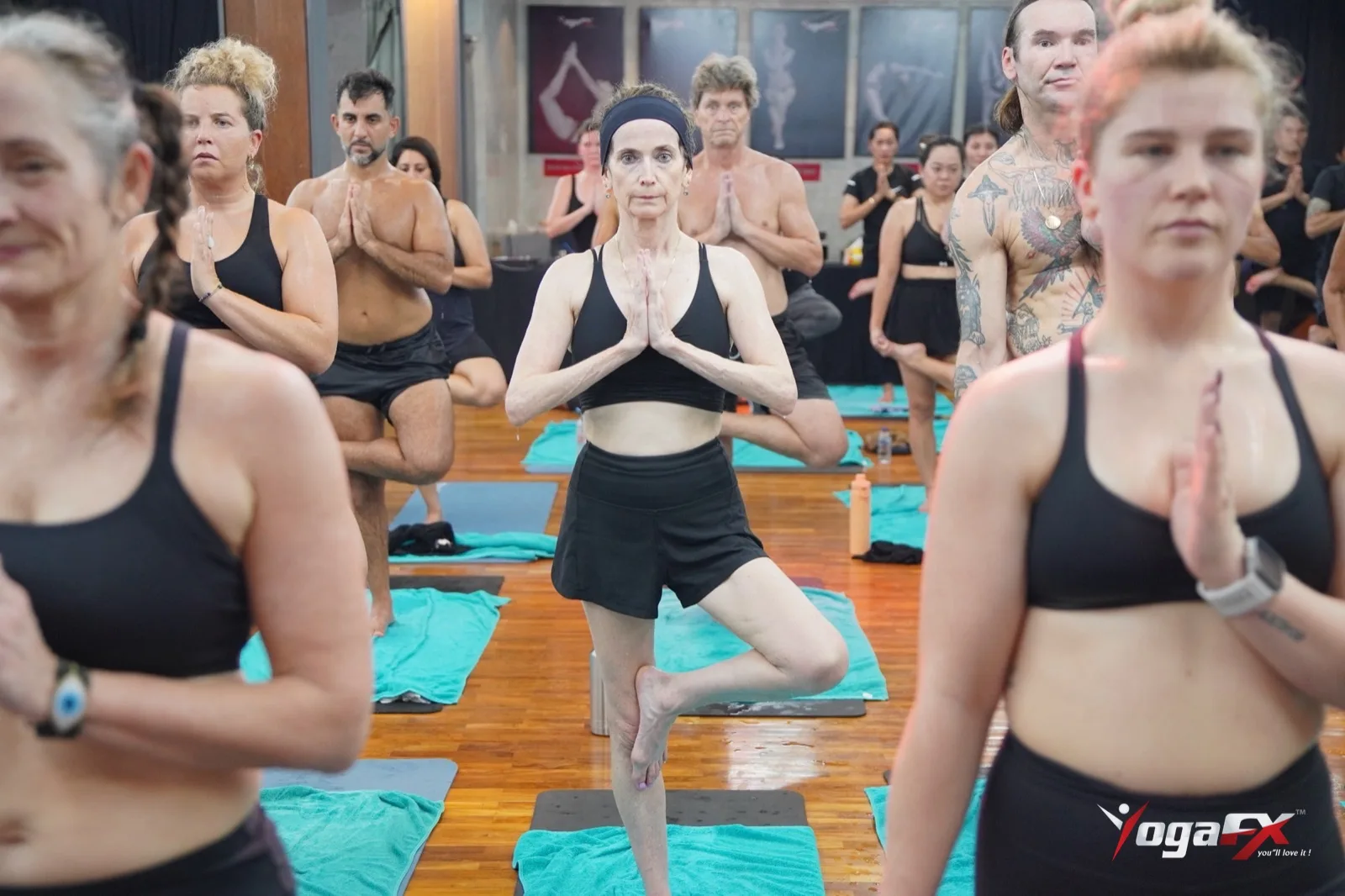
Hot yoga benefits at a glance: what the evidence supports
Most articles on hot yoga benefits list vague perks. This one sticks to what research and the class itself can support. First, the big picture.
A 2025 systematic review in Sports Medicine - Open by Willmott and colleagues pooled 43 studies with 942 participants. About three quarters of the sessions were Bikram-style. You can read the record through the Brunel University repository.
The review found that regular practice produced cardiometabolic, functional and performance adaptations. It called the psychological benefit "promising, albeit inconclusive". It also warned that many studies lack rigorous designs. So the honest summary is encouraging, not magical.
- Fitness and function. Regular practice showed adaptations in cardiometabolic health, strength and flexibility measures.
- Mood and well-being. Early trials look hopeful, but the evidence is still mixed.
- Bragging rights. The review says claims that hot yoga beats other forms of yoga or exercise are, for now, unsubstantiated.
If you want a wider overview of hot yoga benefits across the YogaFX network, our sister site has a general guide to the benefits of hot yoga. This page goes narrower. It follows the fixed 26 and 2 method, one posture group at a time.
Why the room matters: 40 °C and 40% humidity
A YogaFX class runs for 90 minutes at about 40 °C and 40% humidity. The heat comes from the tropical climate, not from electric heaters. There is no music and no demonstration. The teacher reads a scripted dialogue, so you hear the same instructions in the same order every time.
Mr. Ian Terry, Founder and Lead Instructor with E-RYT 500 credentials and more than 12,000 teaching hours, leads that dialogue at our Seminyak studio. He trained for five years, from 2014 to 2019, with the founder of the Bikram Hot 26&2 method. Because the dialogue is the same every class, you always know what comes next.
That repeatable format matters for hot yoga benefits. When the class never changes, your progress is easy to see. Last month's forward fold becomes your benchmark.
Humidity matters as much as heat. At about 40% humidity, sweat evaporates more slowly, so your body cools less efficiently than it would in dry air. That is why pacing yourself, sipping water and resting when you need to are part of the practice. They are not a sign of weakness.
The 26 and 2 class in numbers
26
Postures
The class works through the whole body in one fixed order.
2
Breathing exercises
Pranayama opens the class and Blowing in Firm closes it.
90 min
One class
Every class has the same length and the same sequence.
40 °C
Natural tropical heat
The warmth comes from the climate, with about 40% humidity.
59.3%
In one 8-week trial
Of heated yoga participants with depression cut symptoms by half or more, against 6.3% on a waitlist.
Hot yoga benefits posture by posture: what each series trains
The 26 and 2 has 26 postures and 2 breathing exercises. Instead of listing every one, the table groups them by what they train. It also rates how strong the research is for each group. Most research studies the whole class, not single postures, so these ratings are cautious.
| Series | Postures in the group | What it trains | How strong is the evidence? |
|---|---|---|---|
| Breathing | Pranayama, Blowing in Firm | Slow nasal breathing, calm focus, core engagement | Limited. Studied mostly as part of the whole class |
| Standing balance | Awkward, Eagle, Standing Head to Knee, Standing Bow, Balancing Stick, Tree, Toe Stand | Leg strength, balance, concentration | Moderate. Strength and function gains appear in the review |
| Standing stretching | Half Moon, Triangle, Separate Leg Stretching, Separate Leg Head to Knee | Hamstrings, hips, sides of the body | Moderate. Flexibility gains are the most consistent result |
| Spine strengthening | Cobra, Locust, Full Locust, Bow | Back muscles, shoulders, posture | Limited. Few studies isolate these postures |
| Backbend and fold | Fixed Firm, Half Tortoise, Camel, Rabbit, Head to Knee with Stretching | Spine mobility, hips, hamstrings | Limited to moderate. Flexibility results overlap |
| Twist | Spine Twisting | Rotation through the spine | Limited. Mostly reported by students |
Breathing: where the class starts and ends
Pranayama is the first exercise. You stand, breathe in through the nose, and breathe out through the mouth while moving the arms and elbows. It sets the pace for the whole class. Blowing in Firm closes the class with a series of sharp exhales through the nose.
Nobody has isolated these two exercises in a trial, so claims about them should stay modest. Still, students often describe the same thing. Once your breathing settles, the rest of the room feels more manageable.
Standing series: balance and leg strength
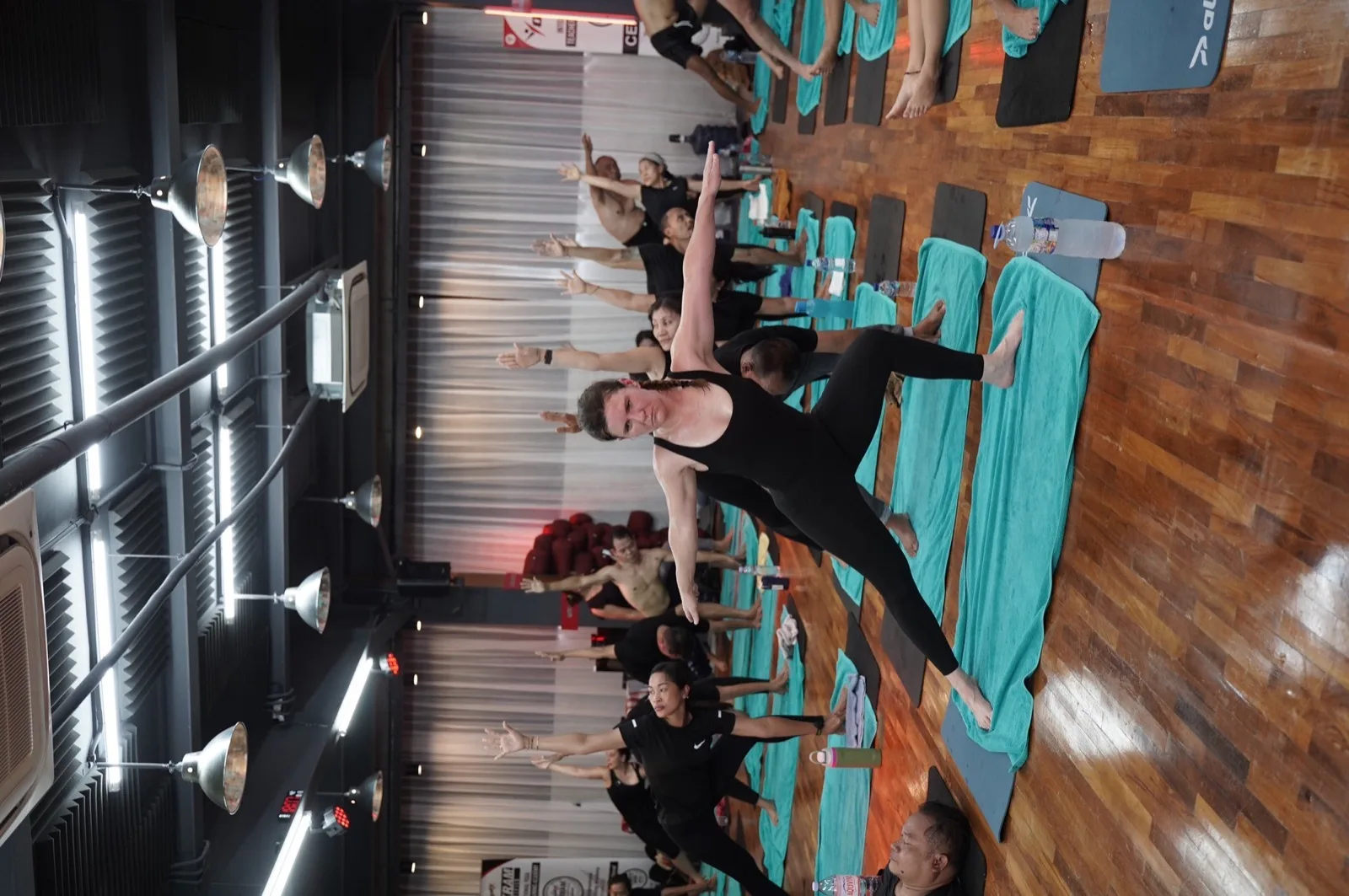
The first half of the class stays on your feet. Utkatasana (awkward pose) loads the thighs. Garudasana (eagle) asks for balance and shoulder mobility. Standing Head to Knee and Standing Bow combine balance with deep hip and hamstring work.
These postures are where the strength and function gains in the review most likely come from. The research does not prove it, because it measures whole classes. But the demand is obvious when you hold a standing posture for a full minute.
Standing stretches and triangle: hips and hamstrings
Half Moon, Separate Leg Stretching and Triangle lengthen the sides of the body, the hips and the back of the legs. Flexibility is among the first hot yoga benefits students notice. Warm, humid air makes muscles feel more willing to move, but that also hides the early signs of overstretching.
So aim for tension, never pain. You'll know you've gone too far if the breath breaks. Our guide to hot yoga for flexibility gives safe depth cues for each stretch. Fold from the hips and keep a soft bend in the knees.
Floor work: back strength, folds and twists
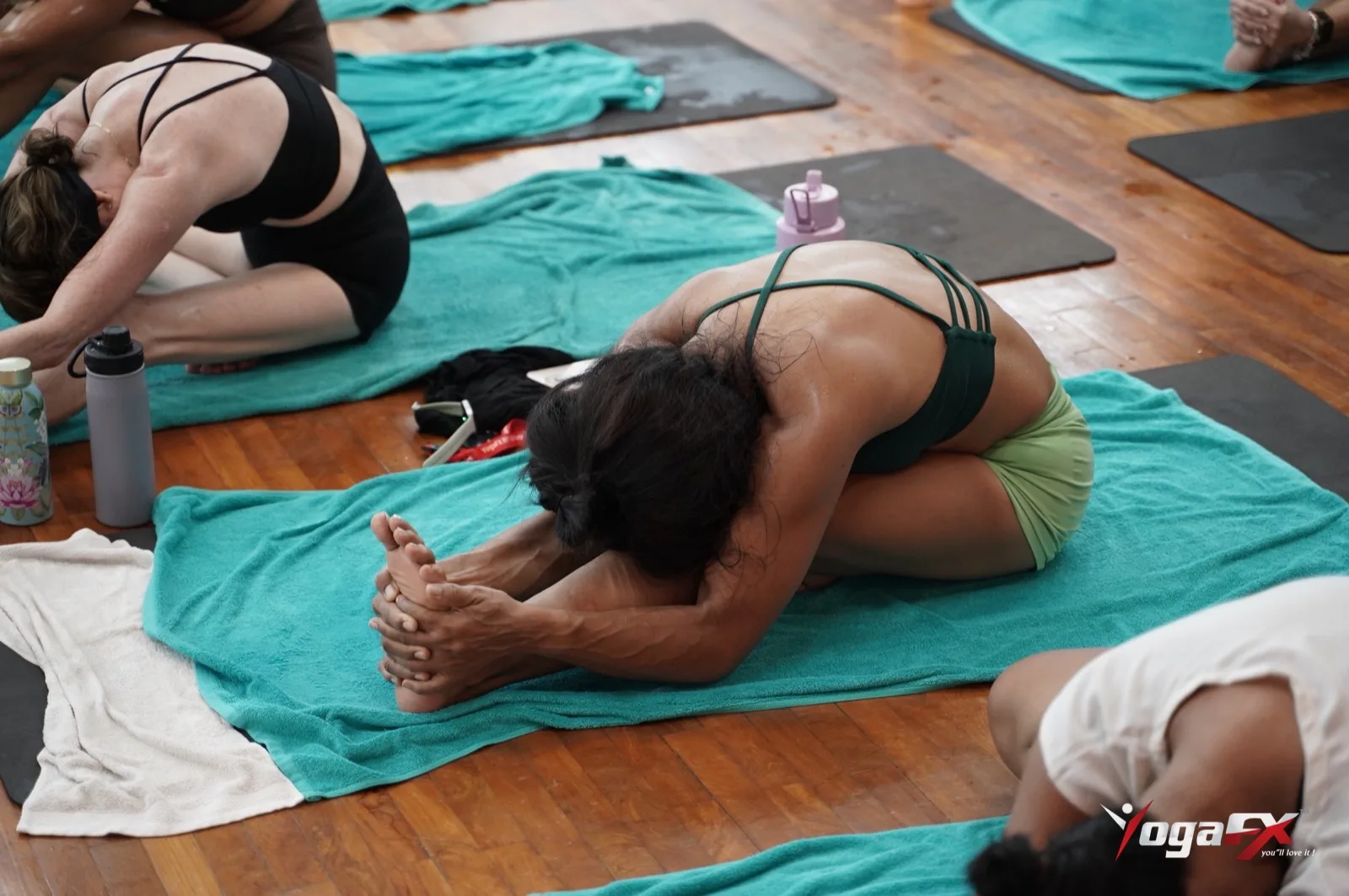
After a short rest in Savasana, the floor series begins. Cobra, Locust, Full Locust and Bow strengthen the back of the body. These postures work against the rounded posture that comes from long hours at a desk.
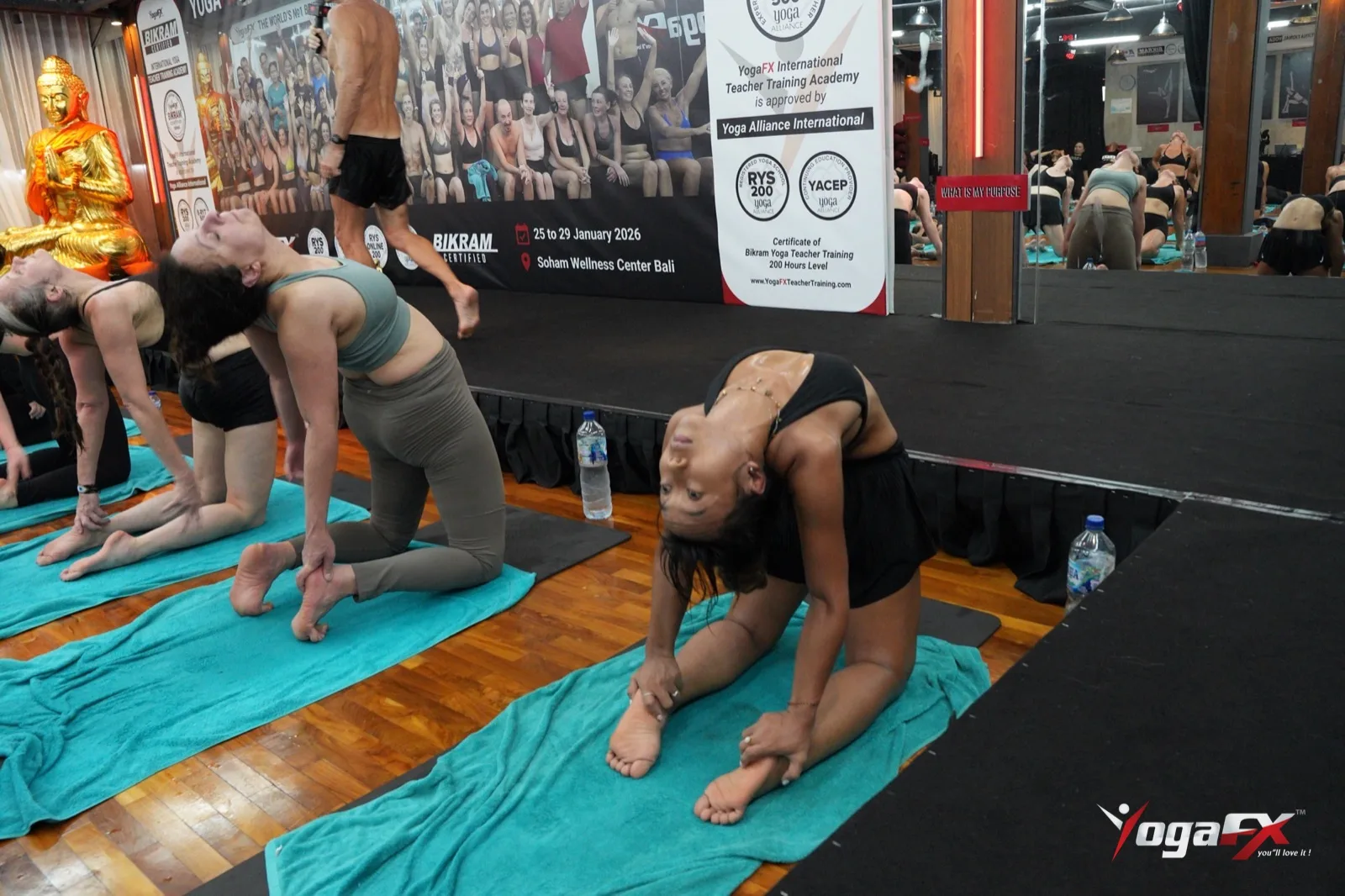
Camel and Rabbit then move the spine and neck in the opposite direction. Head to Knee with Stretching folds you forward over one leg, and Spine Twisting closes the sequence by rotating the spine. Together they move the spine through every direction in one class.
Hot yoga benefits for the heart and fitness
Fitness is the most measurable of the hot yoga benefits. The Willmott review found that an acute session raised body temperature and heart rate, but not energy demands. In plain words, hot yoga feels hard, yet the heat does not turn it into a high-calorie workout.
A 2014 University of Wisconsin study (Porcari et al.) measured about 333 kcal for women and 460 kcal for men over a 90-minute class, at around 80% of maximum heart rate. We cannot link that paper because the site blocked access. The Mayo Clinic also notes that yoga is not considered a high-intensity workout for burning calories.
So treat hot yoga as steady fitness, not a fat-burning shortcut.
Hot yoga benefits for mood and mind: what the trials show
Mood is the most talked about of all hot yoga benefits, and the most uncertain.
The strongest result so far is a 2023 randomised trial from Massachusetts General Hospital (Nyer et al.). It enrolled adults with moderate to severe depression. Over 8 weeks, 59.3% of the heated yoga group had a 50% or greater drop in symptoms, against 6.3% on the waitlist. The Harvard Gazette report adds that participants had no serious adverse effects.
Treat that carefully. The trial was small, with 80 people randomised, and compared yoga with a waitlist. The authors say future studies must compare heated with non-heated yoga. It shows promise. It does not make hot yoga a treatment.
A 2022 randomised trial by Hui and colleagues gave 290 healthy adults six weeks of free 90-minute classes. The hot yoga group improved on life satisfaction, general health, mindfulness and peace of mind compared with a waitlist. Those are well-being measures, not anxiety scores. For anxiety, see is hot yoga good for anxiety.
What students say about hot yoga benefits
Numbers only go so far when you weigh hot yoga benefits, so here is what students wrote after practising with YogaFX. These come from public reviews.
"I was able, day by day, to see significant improvements on my strength and flexibility."
Cinzia, Google review, 2022
"The improvement of my strength and flexibility is amazing in only 3 weeks."
Lucia, Google review, 2021
Both reviewers point to strength and flexibility, which matches the research direction. They are personal accounts, not trial data. Another student, Xuan, left a short video review in 2026 after a teacher training course. Their message is mostly joy and thanks.
What hot yoga does not do
Hot yoga is not a purification ritual. Sweat is for cooling you down, and it is not a measure of progress. It is also not proven to beat other kinds of yoga. The review is blunt on that point. Weigh the hot yoga benefits against the heat, and choose it because you enjoy the room and will keep coming back.
- It is not a treatment. Trials show promise for mood, but they do not replace medical care.
- It is not a high-calorie workout. Heat makes it feel harder without raising the energy cost much.
- It is not for everyone. Some medical conditions make heat risky, as the next section explains.
Comparing styles? Our page on hot yoga vs regular yoga lays out what the heat adds to the same postures.
Who should check with a doctor first, and how to stay safe
The Mayo Clinic says the intensity and heat of hot yoga have the potential to cause heat-related illness. It suggests skipping it if you have heart disease, dehydration problems, heat intolerance or a history of heatstroke. It also advises checking with your doctor if you are pregnant or have health concerns.
Know the warning signs. The CDC lists these among the symptoms of heat exhaustion:
- Head and stomach. Headache and nausea.
- Body. Dizziness, weakness and heavy sweating.
- What to do. Sit down, sip water and tell your teacher.
Don't push through any of these. Read our guide to hot yoga hydration before your first class.
This article is general education, not medical advice. Please consult a healthcare professional before you start hot yoga if you have a heart condition, an injury, or you are pregnant.
How often should you practise to notice hot yoga benefits?
Nobody can promise hot yoga benefits on a timetable, and no study gives one perfect number. The studies in the Willmott review ran between 6 and 36 sessions, 2 to 6 times per week, over 1 to 16 weeks. That is a wide range. Start with the number of classes you can recover from, and add more only when your joints feel fine the next day.
Small changes come first, such as a lower forward fold or steadier balance. Three simple checks make them visible. Test them before class, once a week, when your body is cold:
- Forward fold. Note where your fingertips land: knees, shins, ankles or floor.
- One-leg balance. Time how long you can stand on one leg with steady breathing.
- Breath. Notice how quickly your breathing settles after the first standing posture.
Write the results in your phone and compare them monthly, not daily. Our week-by-week results guide shows what to look for. Men who want a focused look can try hot yoga benefits for men.
Try the 26 and 2 at YogaFX Seminyak
Our studio in Seminyak is open from 06:00 to 22:00 every day, at Jl. Pangkungsari Gg Jepun No.888, Kuta Utara, Seminyak, Badung, Bali 80361. The first class is free with our Free 1-Day Guest Pass, so you can feel the room before you commit to anything.
If the method hooks you, the next step is teacher training. Since 2017, YogaFX has graduated more than 1,500 teachers from over 80 countries. The Bikram Hot 26&2 Yoga Teacher Training MasterClass is a 6-day hybrid course with an online part and an intensive in Bali.
The next batch checks in on Sunday 24 January 2027 and checks out on Friday 29 January 2027. Read more in our guide to original hot yoga teacher training.
Ready to start? Message Mr. Ian Terry on WhatsApp to book your Free 1-Day Guest Pass.
FAQ
Is hot yoga good for you?
For most healthy adults, yes, in moderation. Research links regular practice to better fitness, strength and flexibility, and early trials suggest mood benefits. The heat adds risk, so drink water, rest when dizzy, and check with a doctor if you have a heart condition or are pregnant.
Does hot yoga have the same benefits as a sauna?
Not quite. A sauna asks you to sit still in heat, while a 26 and 2 class has you work through 26 postures in a warm room. Both raise body temperature, but only a yoga class trains balance, strength and flexibility while you move.
How often should you do hot yoga to see benefits?
Studies in the Willmott review used between 2 and 6 sessions per week over 1 to 16 weeks, so there is no single rule. Begin with a number you can recover from. Many students start with two or three classes a week and add more only when their joints feel fine.
Who should not do hot yoga?
The Mayo Clinic suggests skipping hot yoga with heart disease, problems with dehydration, heat intolerance or a history of heatstroke. Pregnant people and anyone with health concerns should speak to a doctor first. If you feel dizzy or sick in class, stop, sit down and sip water.
Is hot yoga better than regular yoga?
Not proven. The 2025 systematic review says claims that hot yoga gives greater health benefits than other forms of yoga or exercise are currently unsubstantiated. Hot yoga may suit you if you like the heat and a fixed sequence. Choose the class you will attend consistently.
Still have questions? Message Mr. Ian Terry and the YogaFX team on WhatsApp and we will answer them personally.