Original hot yoga teacher training is a course in running one sequence, word for word. You study the 26 postures and 2 breathing exercises of the Original Hot 26&2 method, plus the script called the dialogue. This guide covers what you study, how posture clinics work and what 200 and 240 hours mean.
Table of Contents
It is information only. Prices, dates and enrolment live on our teacher training page and our online teacher training page.
Original Hot Yoga Teacher Training: What You Really Learn
Every class runs the same way. The room sits near 40°C with 40% humidity, and the class lasts 90 minutes. The teacher talks throughout, with no demonstration and no music. So the teacher leads by voice, pacing and observation.
That shapes the curriculum of any original hot yoga teacher training. Nobody asks you to create sequences. The skill is accuracy: saying the same script well, noticing mistakes through the heat and looking after everyone in the room.
Seven skills at a glance
| Skill | What it means in the room | How a trainer checks it |
|---|---|---|
| 1. Dialogue delivery | Saying the script at a steady pace, with the right pauses | You teach a segment aloud and the trainer times it |
| 2. Posture knowledge | Knowing the purpose and alignment of each of the 26 postures | You explain a posture without notes |
| 3. Posture correction | Giving one clear fix a student can use right now | You correct a peer in a posture clinic |
| 4. Class timing | Keeping all 26 postures and 2 breathing exercises inside 90 minutes | You teach to the clock |
| 5. Heat management | Reading students who are struggling in a hot room | You practise in the same conditions you teach in |
| 6. Safety boundaries | Knowing when to send a student to a doctor, not give advice | You answer health questions the safe way |
| 7. Teaching presence | Staying calm, clear and kind for 90 minutes | You get feedback after every practice class |
If you are new to the method itself, start with our guide on what 26 and 2 yoga is. Then come back here for the training side.
The conditions you train in
The Dialogue: The Part of Original Hot Yoga Teacher Training You Can't Skip
The dialogue is the script a teacher speaks from the first breath to the last posture. Because there is no demonstration, the words carry the whole class. Get the words wrong and students feel lost. Get them right and the room moves together.
Learn it in stages
Trainees in original hot yoga teacher training rarely learn the dialogue by reading it once. Most move through the same steps, and each step fixes a different problem.
- Read it. You learn what each line asks a student to do.
- Say it aloud. Silent reading doesn't build delivery, so your mouth needs the practice.
- Time it. You match your pace to the breath and the posture hold.
- Deliver it to a person. A real listener shows you where you rush or trail off.
Our guide to the 26 and 2 dialogue explains what the script is and why studios still use it.
What good delivery sounds like
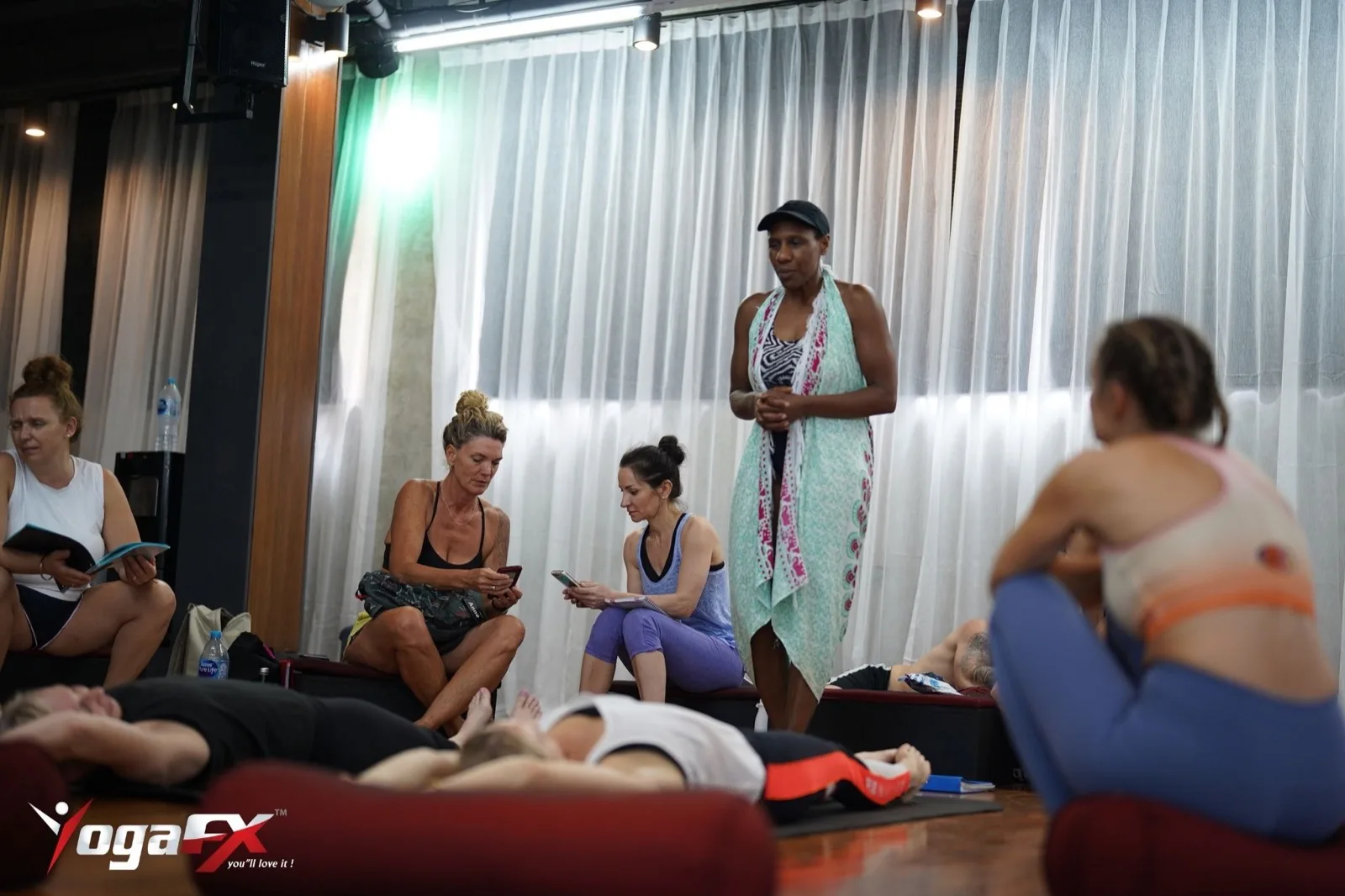
Good delivery sounds like speaking, not reciting. The pace is steady. The pauses give students time to move. And the voice stays calm even when the room is hot and the class is tired.
That is why trainees practise in front of each other. A peer will tell you that your voice drops at the end of every sentence. You can't hear that from inside your own head.
"gave me a voice to get my dialogue out"
Ben, Google review, 2025
Ben wrote that in a 2025 Google review. It sums up what the dialogue work is for: finding your own teaching voice inside a fixed script.
Posture Clinics: Learning to See What Is Wrong
A posture clinic is where original hot yoga teacher training teaches you to see. One posture is the focus. A trainee holds it while the others watch, and the trainer talks through what is working and what isn't.
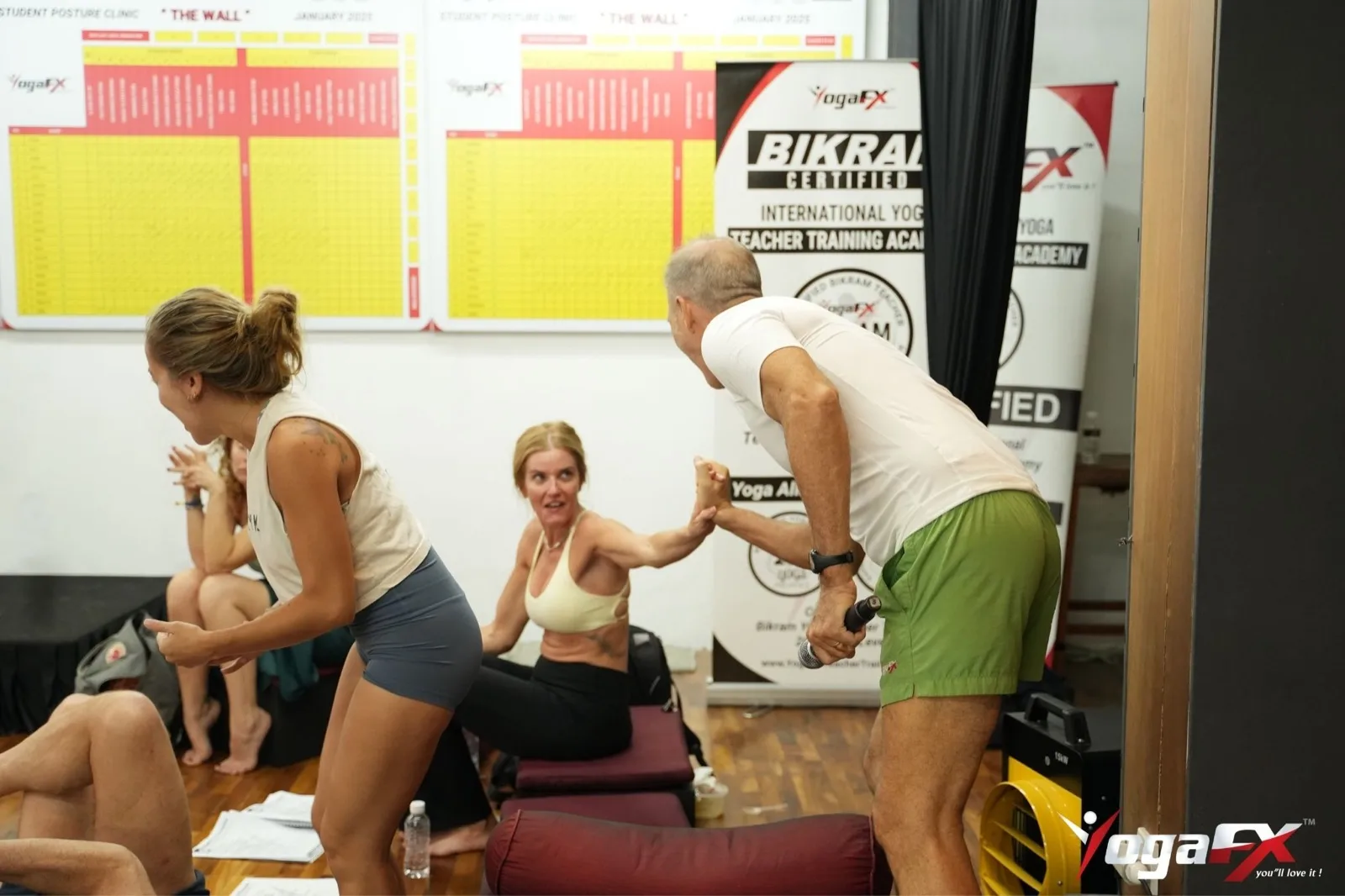
Then you take your turn as the teacher. You name one fix, say it in the words of the dialogue and watch whether the student changes. Mr Ian Terry, E-RYT 500, builds the week around this switch from student to teacher.
What you practise in a clinic
- Seeing. You learn the usual errors in each posture, from the feet up.
- Choosing. You pick the one correction that matters most, because five at once helps nobody.
- Saying. You give the fix in a few clear words, in a hot room, to a tired student.
- Checking. You watch for a change and know when to move on.
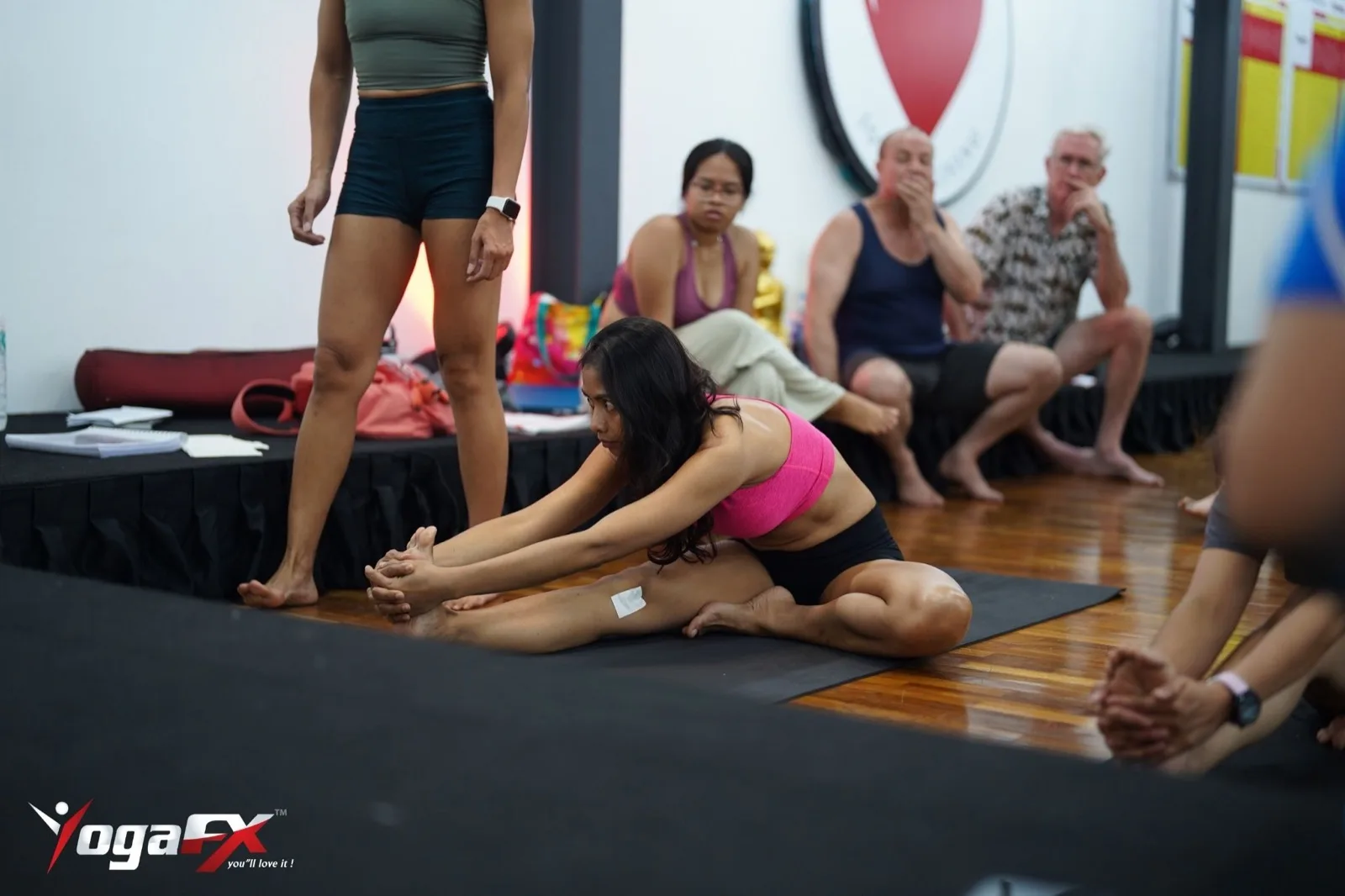
The same habit carries into class. A teacher who can see well makes the room safer and gives students a reason to come back. That is why original hot yoga teacher training spends so much time on this skill.
Original Hot Yoga Teacher Training or 26 and 2 Teacher Training: Same Thing?
Search results use several labels for the same kind of course. You will see 26 and 2 yoga teacher training, Bikram hot yoga teacher training and original hot yoga teacher training, often on one page. They all point to a training in the same fixed sequence. So the label alone tells you very little.
What differs is who trains you, how long it runs and what you receive at the end. Therefore, compare those three things instead of the name. A school that explains them plainly is usually a school that trains well.
- Who trains you. Ask for the lead trainer's years of teaching and who trained them.
- How it runs. Ask whether it is one block, several blocks or a hybrid of online and in-person study.
- What you receive. Ask which certificates you get and which registry, if any, recognises them.
A Week in the Room: Practice Teaching
Practice teaching is where original hot yoga teacher training joins up. First you teach a short segment to a small group. Next you teach a longer block. Finally you lead a full class while the trainer watches.
After each turn, you get feedback while the memory is fresh. As a result, you leave knowing which habits to fix, not just a vague sense that it went well.
Between turns, the rest of the cohort stays involved. You note what the teacher did well and what you would change. That habit of watching teachers critically is half the training.
Many trainees also find the practice classes change how they hear themselves. A voice that sounded fine in your head can sound hurried in a hot room. A few rounds of feedback fix that.
Hours Floor: What 200 and 240 Hours Really Mean
Hours are the first number most people compare when they shop for original hot yoga teacher training. Yet two trainings with the same total can look very different inside. So it helps to ask what each hour counts.
| Measure | What it counts | Question to ask the school |
|---|---|---|
| 200 hours | The standard length of a Yoga Alliance registered 200-hour programme | Is the school registered, and is the lead trainer registered too? |
| 240 contact hours | One published association standard: 150 for posture lab and teaching skills, 80 for practice, 10 for professional development | Which hours are spent with a trainer in the room? |
| Self-study hours | Reading, online lectures and workbooks done on your own | How many of the hours are self-study, and is it marked? |
| Internship | Practice teaching after the course, often logged by the teacher | Is it required, and does it delay the final certificate? |
The 240-hour figure comes from published association materials, as collated in our October 2026 research report. We explain what any association can and cannot change in our guide to teacher standards and associations. Check each body's own site for current figures, because rules change.
Why the internship matters
Some standards add an internship after the classroom hours. One published standard, for example, asks for a log of 75 self-recorded classes, and it says that takes 6 months to 2 years. That is a real extra commitment, so add it to your timeline before you compare.
Our hybrid format is different. You study online first, then train in person with the trainer in the room. Our full programme guide on our teacher training site sets out the schedule and certificates.
Three questions about any training's hours
- How many hours are contact hours? Contact hours mean time with a trainer, not time with a screen.
- What happens in the hours? Ask for the split between dialogue, posture clinics, anatomy and practice teaching.
- What comes after the last day? Ask about feedback, mentoring and any required internship.
What Research Says About the Class You Will Teach
Students ask teachers health questions every week. So a good original hot yoga teacher training course also teaches you what the studies do and don't say.
A controlled comparison of heat
In 2020, Lambert and colleagues in the International Journal of Exercise Science had 16 experienced practitioners do the same standard Bikram sequence twice, once at about 40°C and once at room temperature. You can read the full Lambert et al. study. Energy use was about the same in both rooms, at 156 versus 151 kcal. One range-of-motion measure, hip abduction, rose more in the heat, at 6.6 versus 2.3 degrees.
The takeaway for a teacher is simple. Heat may help some students feel looser, but you shouldn't promise a calorie result because of it. Keep in mind that this was a small study of experienced practitioners, so it can't speak for every student.
Wider evidence on benefits and limits
A 2025 systematic review in Sports Medicine - Open (Willmott et al.) looked at 43 studies with 942 participants. It found that regular hot yoga may support bone density, balance and flexibility. It also warned that claims of greater benefit than other exercise are, for now, unproven.
A 2014 University of Wisconsin study (Porcari et al.) measured a standard 90-minute class. It found an average burn of about 333 kcal for women and 460 kcal for men, with heart rate reaching about 80% of maximum. That is solid exercise, close to a brisk walk of the same length.
What you say to students
- Describe, don't promise. Say what studies found, and avoid guarantees about results.
- Send medical questions to a doctor. Heart, blood pressure and pregnancy questions belong with a healthcare professional.
- Respect the heat. New students build up slowly, and rest is always allowed.
This is general information, not medical advice. Please consult a healthcare professional before starting an intense heated practice.
What Graduates Say After the Week
Reviews are the quickest way to hear from people who have done it. Our public review count stands at 150 on Google, 50 on Yoga Alliance and 357 video testimonials on YouTube. Two more speak directly to original hot yoga teacher training.
"Mr Ian is a really great teacher. He is not only teach us the proper yoga move. He is a very passionate teacher, a great friend, a great mentor."
Junich, Google review, 2020
Dany, in a 2025 Google review, called Mr Ian a true life coach who pushes you to grow both on and off the mat, and said his motivation keeps you going through the training and beyond.
Video says more than text. Jilly shared her experience in 2019, and her video is still on our channel.
Who Leads the Training
Mr Ian Terry, E-RYT 500, has taught more than 12,000 hours. He leads the original hot yoga teacher training in person. Between 2014 and 2019 he trained with the founder of the method.
Since 2017, he has graduated 1,500+ teachers from 80+ countries at YogaFX in Bali.
He also serves as a Master Trainer of the Republic of Indonesia Yogasana Sports Federation. And he speaks with every student before enrolment, so you can ask your own questions about dialogue, clinics and hours first.
Where to Go Next
Pick the path that matches your question about original hot yoga teacher training. The in-person route and the study-at-home route each have their own page, linked at the top of this guide. Both hold the commercial details, so this article doesn't repeat them.
If you would rather talk first, message Mr Ian directly. He answers personally.
FAQ: Original Hot Yoga Teacher Training Questions Answered
What is original hot yoga teacher training?
It is a course for people who want to teach the Original Hot 26&2 class. You study the 26 postures, the 2 breathing exercises and the dialogue, then practise correcting students and teaching a full class while a trainer gives feedback. Everything is taught in the same heat you will teach in.
How many hours is original hot yoga teacher training?
A Yoga Alliance registered programme is 200 hours. One published association standard asks for 240 contact hours, with an internship afterwards. Hours can mean contact time or self-study, so ask each school how its hours split and what happens after the last day before you compare.
Can you do original hot yoga teacher training online?
Only in part. You can study theory, the dialogue and workbooks online, and our online teacher training page covers that route. The hands-on side, posture correction and practice teaching in heat, needs a live room and a trainer watching, so it can't be fully remote.
Can a beginner start original hot yoga teacher training?
Yes. Teaching experience isn't a requirement, though a steady practice and some comfort in the heat are. Because you train in the same heat you will teach in, a few weeks of regular classes beforehand makes the week far easier. Message Mr Ian your background and he will say honestly whether the timing is right.
Is this an official Bikram Choudhury teacher training?
No. YogaFX offers independent training, not an official Bikram Choudhury teacher training. Mr Ian trained for five years, from 2014 to 2019, with the founder of the method. In 2015 the Ninth Circuit held that the sequence is not copyrightable, so independent schools teach it openly.