Yoga teacher training reviews help most when they say what the graduate can now do, not only how the week felt. Among 482 YogaFX reviews, 24 mention the dialogue, the script a 26 and 2 teacher speaks word for word. Those few are the ones worth reading slowly.
Table of Contents
Mr. Ian Terry, E-RYT 500, trains teachers of the Original Hot 26&2 method in Bali. This guide counts what graduates actually write about the method, shows three of them in their own words, and explains why learning a fixed script is the part new trainees fear most. It is general information, not medical advice.
What Yoga Teacher Training Reviews Say About the Dialogue
Most people read yoga teacher training reviews for tone: was the trainer kind, was the room clean, was the food good. Those details matter. But in the 26 and 2 method, a teacher's job is narrow and exact. You deliver the same script, over the same 26 postures and 2 breathing exercises, in the same order, every class. So the most useful yoga teacher training reviews describe that job.
We searched the yoga teacher training reviews in our store for the words graduates use when they talk about the method. The store holds 129 Google reviews, 19 Yoga Alliance reviews and 334 YouTube video testimonials, 482 in all. The public totals are higher, at 150 on Google, 50 on Yoga Alliance and 357 on YouTube, so treat the store as a sample.
Here is how often certain method words appear. One review can fall into several rows, and a keyword search misses reviews that use other words, so these counts are a floor, not a ceiling.
Two things stand out. Posture words come first, which makes sense, because every student meets the postures before anything else. Next comes the dialogue, ahead of the sequence itself. That tells us graduates treat the script as a skill they had to earn, not as background noise.
The same counts as a table
The table adds the share of all 482 reviews and what each row tells a reader who is comparing schools.
| What the review mentions | Reviews | Share of 482 | What it tells you |
|---|---|---|---|
| Postures or poses | 40 | 8.3% | The graduate remembers the physical work, so the training was hands-on |
| The dialogue or script | 24 | 5.0% | The graduate had to learn the words, a sign the school teaches the script itself |
| Confidence | 21 | 4.4% | The course changed how the graduate feels about standing in front of a room |
| Practice teaching or the stage | 14 | 2.9% | Real teaching time, not only lectures |
| The sequence or 26 postures | 9 | 1.9% | The graduate sees the class as one fixed whole |
| Being a beginner | 7 | 1.5% | Proof that people start with little experience and finish |
Read the last column the way a buyer would. A school whose yoga teacher training reviews never mention practice teaching may not offer much of it. A school whose reviews never mention the script may not teach it. That's a better filter than star ratings.
Why So Few Yoga Teacher Training Reviews Name the Script
Only about 5% of our reviews mention the dialogue. At first that looks low. It's not a warning sign, and there are three plain reasons.
- Graduates write about change, not method. People thank a person or describe how they feel. Few stop to name the tool that got them there.
- The script is part of the room. After a few classes, the dialogue is just how a class sounds. Students stop noticing it, as you stop noticing a familiar road.
- Video reviews are spoken. Of the 24 mentions, 15 come from YouTube and 9 from Google. People who talk on camera tend to describe what they did, and what they did was speak the script.
So when a graduate does name the dialogue, it usually means it was hard. That's useful information, because it shows the script is a real skill. A teacher who struggled with the script, and then learned it, can tell you what the struggle was like.
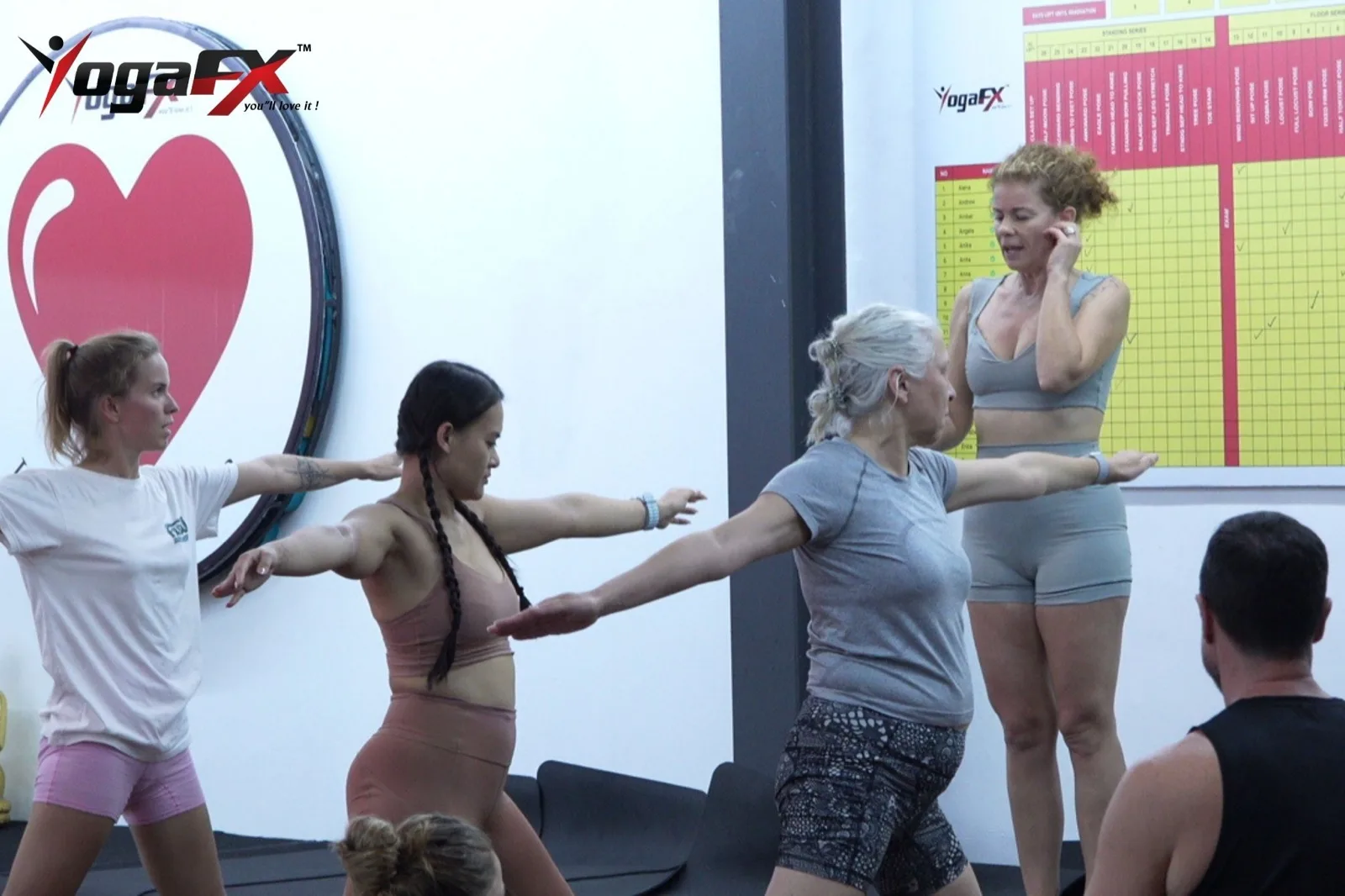
Notice the chart on the wall. In a practical training, every posture and every part of the dialogue gets ticked off person by person. That visible record is why reviews from these courses sound specific. Graduates know exactly which parts they passed.
Three Graduates, in Their Own Words
Numbers show a pattern, but people explain it. Here are three short yoga teacher training reviews from our store. We use first names only, with the source and year, and we have not changed what they mean. Each one touches a different part of learning the method.
Jamie: a beginner learns the script in two weeks
"He took me, a beginner and got me to learn the sequence, dialogue, how to teach on stage, and elevate my own practice in just two weeks time."
Jamie, Google review, 2024
Jamie's sentence lists four jobs in a row: the sequence, the dialogue, teaching on stage and personal practice. That is the real curriculum of a 26 and 2 training.
Jamie also started as a beginner, which echoes the seven reviews in our store that mention being new to yoga. Jamie adds that a little more practice with the dialogue will make the next step, teaching alone, possible. That honesty is a good sign, because a graduate who knows what is still left to polish is a safer teacher than one who thinks they are done.
Cherry: practice, repeated
"This is really really yoga teacher training because i did practice to teach yoga class many times in this training."
Cherry, Google review, 2019
Cherry's point is about repetition. Teaching a class many times, in front of real people, is what separates a teacher training from a long yoga workshop. Cherry also says the training taught awareness of mind and body. Our guide to what 240 hours of 26 and 2 cover shows where that practice time sits in the course.
Amanda: from practitioner to teacher
"I wasn't sure if I wanted to teach before and now I'm just positive that I do."
Amanda, YouTube review, 2019
Amanda was already a decent practitioner. Her review is about the step after that: feeling that people would follow her. She says she is not afraid to be in front of people, but that is not the same as feeling they should listen. By the end, she felt comfortable as a teacher. You can watch the full 94-second review below and judge the tone for yourself.
Yoga teacher training reviews are personal accounts. They do not promise that you will feel or learn the same, and a handful of stories cannot stand for every graduate.
How Learning the Dialogue Actually Works
Yoga teacher training reviews say the script is hard but learnable. Learning research explains why. A well-known 2006 study by Roediger and Karpicke, published in Psychological Science, asked students to study prose passages and then either re-read them or practise recalling them from memory. Both groups were tested later.
The result is worth knowing. After five minutes, re-reading helped more. But on tests given two days and one week later, the students who had practised recall kept substantially more. The authors concluded that testing is a powerful way to improve learning, not just to assess it.
That was prose, not a yoga script, so we apply it with care. Still, it fits what trainers see. A trainee who reads the dialogue ten times feels ready the same evening. A trainee who closes the page and says it aloud from memory feels clumsy at first, but keeps it longer.
What that means for a trainee
- Say it, do not just read it. Close the page after each short block and recite from memory.
- Space your practice. Short daily sessions beat one long night before a test.
- Speak to a listener. A friend, a mirror or a recording shows you where the words slip.
- Expect it to feel hard. That effort is the part that makes the words stay.
Our guide to the 26 and 2 dialogue explains what the script contains.
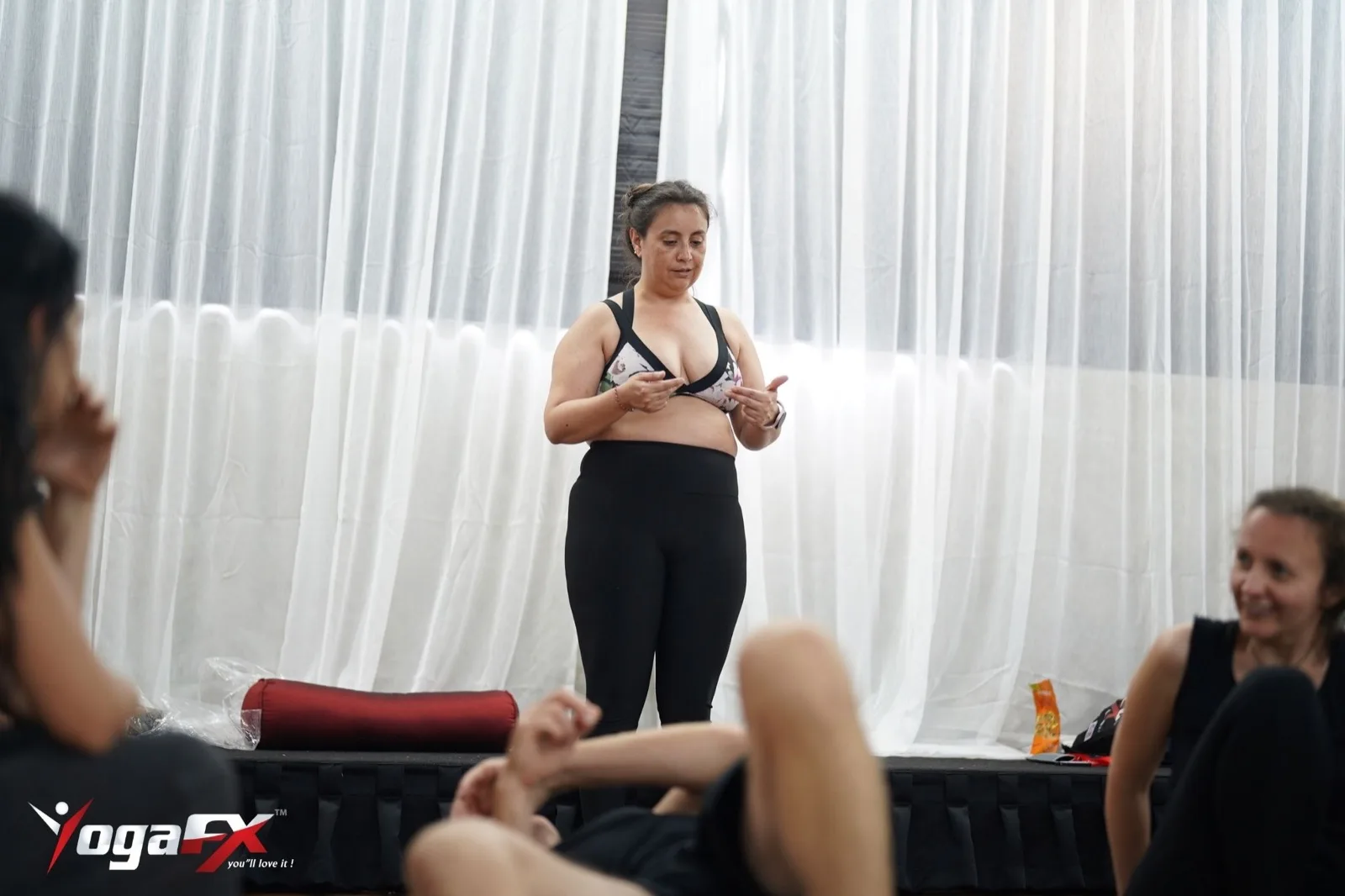
What the Reviews Say About Heat, Confidence and Mood
Many yoga teacher training reviews mention feeling calmer, stronger or more confident. It is fair to ask whether research backs the mood part. It does, in a limited way, and we should say exactly how far.
A randomised trial by Nyer and colleagues, published in 2023 in the Journal of Clinical Psychiatry, tested community-delivered heated hatha yoga against a waitlist for adults with moderate-to-severe depression. It ran for eight weeks. In the abstract, 59.3% of the yoga group had a treatment response, a symptom drop of at least 50%, against 6.3% of the waitlist group.
Three cautions before you rely on it
The trial was small. The class was heated hatha yoga, which is not the same as a full 26 and 2 class. And it studied people in a clinical trial, not teacher trainees.
So we read it as a sign that heated yoga may help mood for some people, not as a promise. If you live with depression or take regular medication, talk to a healthcare professional before you start any heated class.
What yoga teacher training reviews add is the human side. Twenty-one of the 482 mention confidence. Confidence is not a clinical outcome, but it is what a new teacher needs on the first day in front of a room.
Reading Bikram, Hot and Online Yoga Teacher Training Reviews
Not every review describes the same course. If you search for online yoga teacher training reviews, you will mostly read about screens, pacing and how quickly a tutor replies. Those reviews are useful, but they say little about teaching a live room at 40°C.
How the three types differ
Bikram yoga teacher training reviews are different again. They usually talk about the fixed class, the dialogue and the posture clinic. In our store, 24 of 482 mention the dialogue by name. If you want to teach the 26 and 2, search for reviews that do the same.
Hot yoga teacher training reviews cover many styles, from flowing classes to fixed sequences. So check which class the reviewer trained to lead. A review of a flow course will not tell you how well graduates can run a fixed, scripted class.
- Online reviews tell you about support, pacing and self-study.
- Bikram and 26 and 2 reviews tell you how well graduates can lead a fixed class.
- Hot yoga reviews tell you about the room and the style, so read them with care.
If you want to see who tends to name the trainer rather than the method, our sister site counted that in what a trainer's own name adds to the same review set. It is a different question from the one here, and the two pages fit together.
A Checklist for Reading Any School's Yoga Teacher Training Reviews
Use these checks on yoga teacher training reviews for any school, including ours. They take a few minutes.
- Look for method words. Do reviewers name the sequence, the script or the postures, or only the scenery?
- Look for practice teaching. Real teaching time shows up when a graduate describes teaching a class many times.
- Look for beginners. If people with little experience finish, the course probably teaches from the ground up.
- Mix the sources. Written reviews, registry reviews and video reviews each catch different things.
- Watch the tone. In a video, you can hear whether the person sounds relieved, proud or coached.
- Check the date. A review from 2019 describes an older batch, so look for recent ones too.
- Notice the doubts. A graduate who says what is still hard is usually telling the truth.
One more point. If you plan to teach for a living, ask which credential you leave with, and read our notes on how the 26 and 2 maps to RYT 200 hours and on the five tests of a hot yoga certification. Yoga teacher training reviews tell you how it felt. The syllabus tells you what was covered.
What These Yoga Teacher Training Reviews Mean for the YogaFX MasterClass
At YogaFX, the course behind these reviews is the Bikram Hot 26&2 Yoga Teacher Training MasterClass. It is a hybrid: you study the theory and the dialogue online first, then train in person in Bali, where the days go to practising, drilling the dialogue and teaching real classes in natural tropical heat. The format matches what Cherry and Jamie describe, with lots of repetition in front of real people.
Dates, credentials and price
The next batch checks in on Sunday 24 January 2027 and checks out on Friday 29 January 2027, at the Soham Wellness Center in Seminyak. Most students need only five days off work. Dates and venues can change, so confirm them with the team before you book flights.
Graduates earn two credentials: a Yoga Alliance RYT 200-Hour certificate and a Bikram Hot 26&2 200-Hour International Yoga Certification. The Early Bird price is US$1,899, normally US$1,999. A twin share room is US$1,999 and a single room is US$2,199. Interest-free instalments start from US$250 a month.
Who leads it
Mr. Ian Terry, E-RYT 500, leads the training. He holds 12,000+ teaching hours and spent five years, from 2014 to 2019, training alongside the founder of the Bikram Hot 26&2 method. Since 2017, YogaFX has trained 1,500+ graduates from 80+ countries. In the reviews above, Jamie calls him a master instructor and teacher trainer, which is the role he plays in the room.
FAQ: Yoga Teacher Training Reviews
What is yoga teacher training like?
It is a mix of practice, theory and teaching. In a 26 and 2 training you do the class yourself, learn the anatomy and the dialogue, and then teach parts of the class to the group with feedback. Expect early starts, heat and repetition, plus a lot of encouragement from the cohort.
Can you do yoga teacher training as a beginner?
Yes, many people do. Seven reviews in our store mention starting as a beginner, and one graduate says they learned the sequence and dialogue in two weeks. You do need to be willing to practise the script daily. Ask the school how much support it gives people who are new.
Is yoga teacher training worth it?
It depends on your goal. If you want to teach, a good training gives you a credential and real teaching practice. If you want to deepen your own practice, it can do that too. Read yoga teacher training reviews for method words and practice teaching, then ask the school what you will leave with.
How do I read Bikram yoga teacher training reviews?
Look for mentions of the dialogue, the posture clinic and practice teaching. Those show how graduates were trained to lead a fixed class. Then compare written and video reviews, check the dates, and notice honest doubts. A review that names what was hard is often more useful than pure praise.
Do online yoga teacher training reviews tell you the same things?
Not quite. Online yoga teacher training reviews mostly describe pacing, tutor replies and self-study. They say less about heat, hands-on correction and speaking in front of a live room. If you will teach in person, look for reviews from graduates who practised with a trainer and a group.