The international yoga sports federation (IYSF) is the global body that writes the rules for yoga as a judged sport. It publishes a code of points, lists international judges and coaches, and stages the World Championship of Yogasana Sports. National federations then choose the athletes. A fixed 26 and 2 class is not its rulebook, but the two meet in the postures.
Table of Contents
That short answer hides a messy picture. Several groups use the words "world", "international" or "federation", and they do different jobs. In this guide I separate who runs what, then show how a fixed sequence of 26 postures and 2 breathing exercises relates to competition rules. If you want the sport itself, start with our guide to how the 26 and 2 postures feature in yogasana sport.
I write this from the teaching room. Mr. Ian Terry, E-RYT 500 and founder of YogaFX, is a Master Trainer of the Republic of Indonesia Yogasana Sports Federation. He has taught more than 12,000 hours. So the rules below come from the federations' own pages, and the posture notes come from what we see in class.
What the International Yoga Sports Federation Does
On its official website, the IYSF says it establishes and maintains international rules, regulations and codes of points for yoga sport competitions. Its menu lists an Executive Committee, an Athletes' Commission and a Technical Committee. It also lists international judges and international coaches. In plain terms, one group governs, one speaks for athletes and one trains the people who score them.
The federation also stages the big event. The IYSF announces its 2026 World Championship of Yogasana Sports for 4 to 6 December 2026 at the Palazzetto dello Sport in Marina di Camerota, Italy. It expects more than 150 athletes from more than 30 countries over three days of competition.
A caution about dates and numbers
Sources disagree on history. The federation's own pages place its founding in 1989, while Wikipedia credits a 2003 founding for the US side of the story, and it dates the USA Yoga federation, a nonprofit, to 2009. Edition numbers also differ between pages. Because the sources conflict, check the current IYSF pages before you quote a date or an edition.
What a federation does not do
- It doesn't certify teachers. A teacher qualification comes from a school and a registry, not from a sport federation.
- It doesn't own a posture. Rulebooks describe posture groups and scoring, not a brand of yoga.
- It doesn't replace national bodies. Countries still select and train their own teams.
Who Runs What at the International Yoga Sports Federation and Beyond
The easiest way to keep the names straight is to think in layers. Each layer answers a different question, so mixing them up is what causes most of the confusion online. The international yoga sports federation sits at the top, but it is only one of four.
The four layers
- The international layer. The international yoga sports federation sets the code of points and runs the World Championship.
- The national layer. Bodies such as USA Yoga in the United States and the Republic of Indonesia Yogasana Sports Federation pick, train and send athletes. USA Yoga says on its rules page that it follows the IYSF's tabulation procedures.
- The event layer. A championship organiser handles venue, divisions, registration and timing, within the federation's rules.
- The teaching layer. Studios and teacher trainers, including YogaFX, prepare people to practise, coach and demonstrate postures well. This layer awards no medals.
The national layer connects to the world stage in one concrete way. The USA Yoga rules say the IYSF lets each national federation send up to six qualified athletes per division to the World Championships. So a country's federation is the gate, and the international yoga sports federation is the stage.
When two groups share a name
There is one more wrinkle. The same name can point to two different groups, for example when a news story mentions "the US yoga federation". It pays to read which body is quoted before you assume it is the international one. For a view from the teacher-training side of the same topic, see this companion guide on the federation, which covers the national layer in more detail.
How a Hold Is Scored Under Yoga Sport Rules
The rulebooks tied to the international yoga sports federation are built on stillness. According to the USA Yoga rules, each athlete picks six postures from the current guidelines and finishes within three minutes. The six come from six groups: backbends, forward compressions, tractions, twists, lifts and inversions. Judges score each posture out of ten. So the international yoga sports federation approach rewards a balanced athlete, not a one-posture specialist.
The clock matters just as much as the shape. A posture must be held in stillness for at least three seconds, and full marks need at least five. Time judges then deduct points when a hold falls short:
| Hold time | Time-judge result | What it means in training |
|---|---|---|
| 5 seconds or more | No time deduction | The target. Practise holding past the count, not up to it. |
| 4 to 4.99 seconds | Minus 0.5 | A near miss. Usually a wobble in the last second. |
| 3 to 3.99 seconds | Minus 1 | Scoring, but expensive. Balance postures suffer most. |
| Under 3 seconds | Zero for the posture | Treated as not held. Stillness, not speed, is the skill. |
Notice what is being rewarded. A judge does not give extra credit for rushing into a deep shape. Instead, the score goes to the athlete who arrives cleanly and then stops moving. That is a very different habit from a flow class, and it is one a fixed sequence trains almost by accident.
Where a Fixed Sequence Meets the International Yoga Sports Federation Rulebook
A 26 and 2 class runs 90 minutes in a room near 40°C. It has two breathing exercises and 26 postures, always in the same order. A competition routine is the opposite shape: six postures, three minutes, chosen by the athlete. So the sequence is not training for a routine. It is training for the things every routine needs. That's why the international yoga sports federation rules and a 26 and 2 teacher's corrections often sound alike.
Consider a first-time competitor. She may know six postures well, but a judge only sees what happens in the three-second window. Likewise, a 26 and 2 student learns to hold each posture through the whole count, because the dialogue tells them when to move and when to stay. As a result, stillness becomes automatic, and that is what a time judge counts.
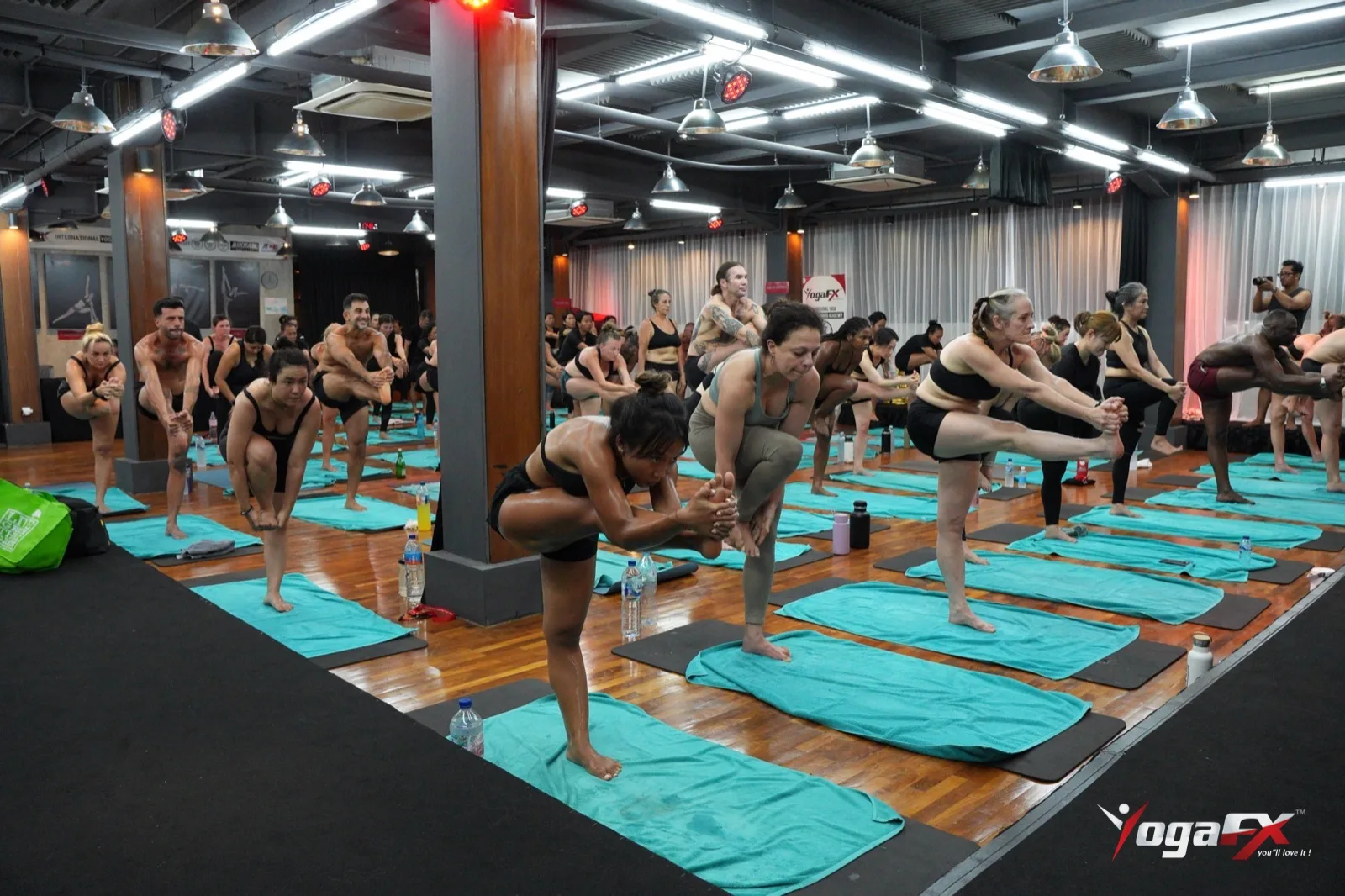
Posture groups against the 26 and 2
The table below pairs each scoring group with the closest 26 and 2 posture we teach. It is our teaching view, not an official crosswalk. As far as we know, the sequence has no inversions or arm balances, so those two groups are trained elsewhere.
| Scoring group | What a judge looks for | Closest 26 and 2 posture |
|---|---|---|
| Backbends | An even curve through the spine, hips forward, no collapse at the neck | Camel and Standing Bow Pulling |
| Forward compressions | A locked standing leg, steady balance, forehead moving towards the knee | Standing Head to Knee |
| Twists | Upright spine, rotation from the trunk, level hips | Spine Twisting |
| Tractions | See the current posture guidelines; we do not map this group here | Not mapped |
| Lifts and inversions | Strength or balance upside down or on the hands | No close match in the sequence |
The pattern is useful. A trained 26 and 2 student already knows what a straight standing leg feels like, because the fixed order of the sequence repeats it every class. Because the script names the same cues each day, the cue becomes a habit. That is a head start, not a guarantee. A judge still scores what they see on the day.
Why a studio cares about the rules
A rulebook shows what a posture must look like at its best. Teachers who know it can correct with a purpose. For example, a standing leg that bends by a few degrees costs an athlete marks, and it also costs a class student the full benefit of the posture. So the same correction serves both people. We don't push students toward competition, though. Most simply enjoy knowing what the sport asks for, and some decide to try it.
What the Federation Side Looks Like from Our Studio
Mr. Ian Terry was confirmed as a Master Trainer of the Republic of Indonesia Yogasana Sports Federation in June 2026. A Master Trainer trains other trainers and competitors, so it is a federation appointment rather than a teaching certificate. He brings 12,000+ teaching hours and more than 1,500 graduates from over 80 countries to the role.
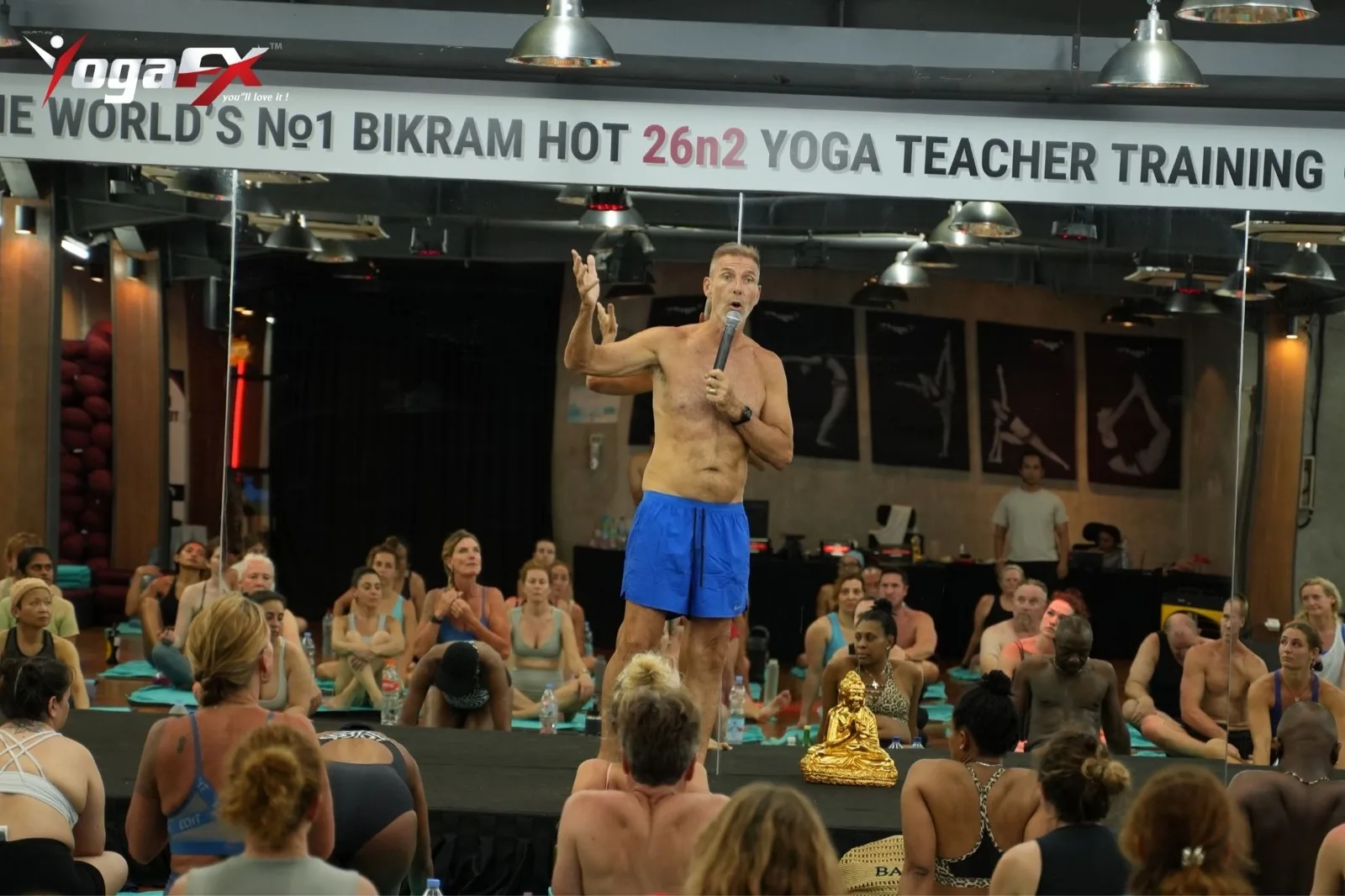
The results are on record. At the World Yogasana Championship in Ahmedabad on 4 to 8 June 2026, Indonesia won one gold, two silver and four bronze medals. Those seven medals all went to YogaFX graduates. Across all years, YogaFX students have won 12 medals: five gold, three silver and four bronze.
Two of those athletes show the pipeline. Ivara, a 2023 graduate, won gold at FORNAS VIII in July 2025 and silver at the Asian championships in the UAE in August 2025. Arkan Fauzan Riyanto, a 2022 graduate, took two silvers and three bronzes in Ahmedabad. Slamet Ariyanto, a 2024 graduate, now chairs PPYNI and manages the Yogasana team.
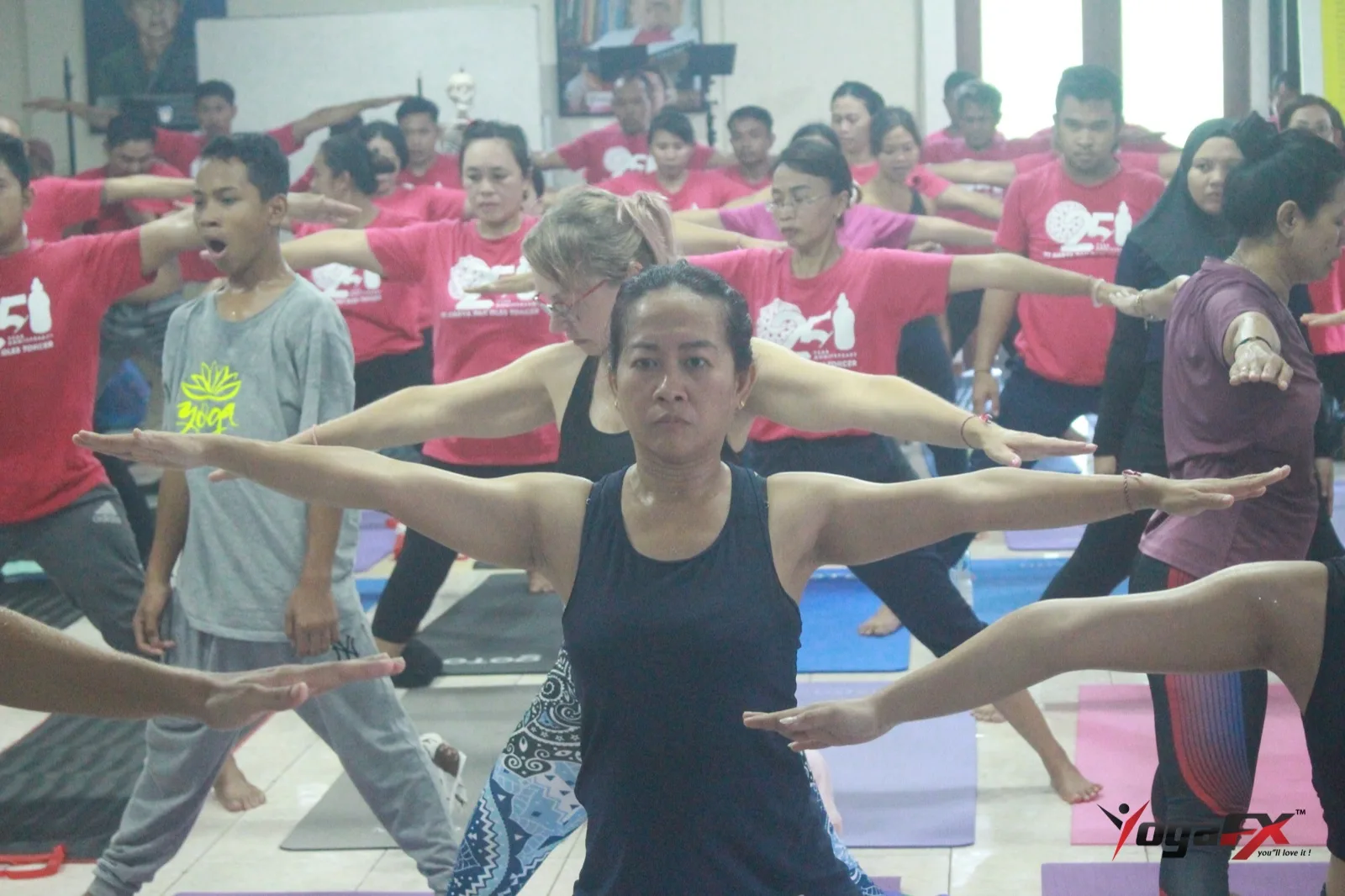
What Students Say About the Training
Federation rules sit far from daily practice, so here is how trainees describe the room where the habits form. These are real reviews, shown with first names only.
I loved every moment. Super supportive and nurturing Training.
Bronte, Yoga Alliance review, 2025
Bikram yoga makes the body healthier and more flexible, and loosens stiff muscles (translated).
Made, Google review, 2024
A trainee in our YouTube review, from 2023, says it in their own words:
They say they started the challenge with Ian, fell in love with Bikram and joined the training. These are personal experiences, not research results.
What the Research Says About Posture Training
Competition adds pressure, so it is fair to ask what regular posture practice does for the body. The international yoga sports federation rulebooks say nothing about health, so we turn to research. The evidence is encouraging but modest, and it covers hot yoga classes rather than elite routines.
A 2025 systematic review
A 2025 systematic review in Sports Medicine - Open by Willmott and colleagues pooled 43 studies with 942 participants. Most used the Bikram style. Regular practice was linked with adaptations in bone mineral density, balance and flexibility, without harm to kidney function or sleep quality. The authors also say claims that hot yoga beats other exercise are unsubstantiated, and they advise caution because case reports describe ill-health after hot yoga.
What health publishers say about balance
Harvard Health says yoga postures help reduce muscular tension, build flexibility and strength, add bone strength and improve balance. Its page on flexibility exercises adds that stretching can help prevent injuries, back pain and balance problems. For a simple way to practise, the NHS offers balance exercises you can do at home.
This article is general information, not medical advice. Hot yoga is not right for everybody. Please talk to a healthcare professional before you start, especially if you have a heart condition, are pregnant or take medication.
Your Next Step After the International Yoga Sports Federation: Coach, Judge or Teach
Federation backing is changing how the sport looks. Because the international yoga sports federation, national bodies and the USA Yoga championship season all need trained people, there are three clear doors for anyone who loves the postures:
- Coaching. Teams need people who can teach alignment to a scoring standard, not only lead a class.
- Judging. The IYSF lists international judges, and national bodies need trained judges too.
- Teaching the method. A teacher who can deliver the dialogue word for word gives students the stillness the sport rewards. Our guide to original hot yoga teacher training shows what the course covers, and the Original Hot Yoga Association guide explains what a standards body can and cannot change.
If you want to talk it through, message Mr. Ian on WhatsApp and ask which path fits your goals.
International Yoga Sports Federation FAQ
What does the international yoga sports federation do?
The international yoga sports federation sets international rules and codes of points for yoga sport, keeps lists of international judges and coaches, and runs the World Championship of Yogasana Sports. It works with national federations, which select and train their own athletes. It does not certify yoga teachers.
How long must a posture be held to score in yoga sport?
Under the USA Yoga rules, a posture must be held still for at least three seconds to score, and full marks need five seconds. Holds of four to five seconds lose half a point, and holds of three to four seconds lose one point. Other events may set different tables.
Is a 26 and 2 class the same as a competition routine?
No. A 26 and 2 class is a fixed 90-minute sequence of 26 postures and 2 breathing exercises in a heated room. A competition routine is six postures chosen by the athlete, finished within three minutes. They share posture standards, such as a locked standing knee, but they are different formats.
Where is the 2026 World Championship of Yogasana Sports?
The international yoga sports federation announces the 2026 World Championship of Yogasana Sports for 4 to 6 December 2026 at the Palazzetto dello Sport in Marina di Camerota, Italy. It expects more than 150 athletes from more than 30 countries. Check the federation website for current registration details.
Can a 26 and 2 teacher also work as a coach or judge?
A teaching certificate alone does not make you a judge or coach. The federation and national bodies set their own requirements and keep their own lists of qualified people. A trained 26 and 2 teacher has useful skills, such as clear cueing, but should ask the relevant federation about its pathway.
Still have questions about the method, the rules or the training that sits behind them? Message Mr. Ian directly on WhatsApp, or visit our contact page and tell us what you want to achieve, so we can point you to the right next step.