Hot yoga vs regular yoga comes down to the room, not the postures. A hot class runs the same sequence at about 40°C, while a regular class runs at room temperature. In lab tests the heat added a little hip range and some cell-level markers. It did not change the energy cost of the class.
Table of Contents
Ask a student which style is better and you get opinions. This guide gives the evidence instead, from a teaching room.
Mr. Ian Terry, E-RYT 500, has taught more than 12,000 hours of the Original Hot 26&2 method. He often tells new students that the heat is a tool, not a prize. So we follow one idea through the whole class: take the same 26 postures and 2 breathing exercises, change only the room, and see what moves.
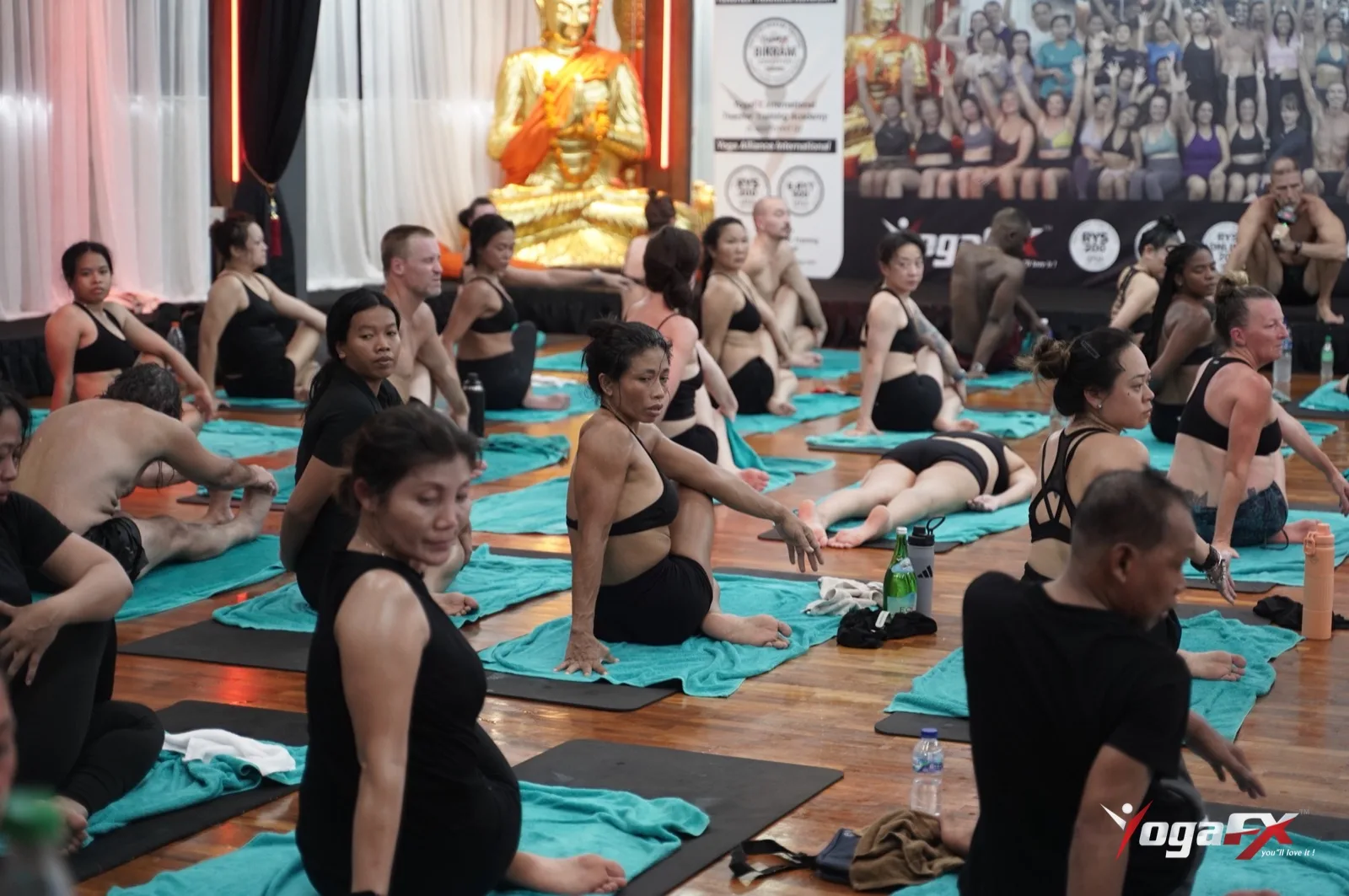
Hot Yoga vs Regular Yoga: Same Postures, Two Different Rooms
The simplest way to compare hot yoga vs regular yoga is to hold everything else still. In a 26 and 2 class the postures, the order, the script and the 90 minutes never change. A regular class changes with the teacher and the day. So when researchers wanted a fair test, they used a fixed sequence and moved only the thermostat.
Here is what that test tells you in four lines. Each one is unpacked below.
- What the heat adds: a small gain in hip range of motion, a higher heat-stress protein level, and a bigger demand on your cooling system.
- What it does not add: a higher energy cost, a better mood score, or a faster path to heat tolerance. Both room types helped the same brain marker.
- What it costs: more strain, more fluid to replace, and a steeper first month for a beginner.
- What decides the winner: the class you will actually attend, three times a week, for months.
So hot yoga vs regular yoga is a real difference, but a narrow one, and the difference between hot yoga and normal yoga is smaller than most labels suggest. If you want the wider map of styles first, our guide to hot vinyasa vs bikram sets the fixed sequence beside a flowing class.
Hot Yoga vs Regular Yoga, Series by Series: Where the Heat Shows Up
The heat does not act on every posture equally. A 26 and 2 class has four parts: an opening breathing exercise, the standing series, the floor series and a closing breath. Each part asks something different of your body, so each one meets the heat differently. The table below pairs them with what we see in the room and what the research covers.
| Part of the class | What you do | What the heat changes | Evidence we found |
|---|---|---|---|
| Opening breath | Standing Deep Breathing, slow and counted | Teaching view: breathing and heart rate settle more slowly in the first weeks | No room-temperature test of this exercise alone |
| Standing series | Eleven balance, hip and leg postures | Muscles feel looser, so hips open sooner; balance feels harder to hold | Hip abduction rose 6.6° in the heat vs 2.3° at room temperature (Lambert, 2020) |
| Floor series | Twelve back, hip and spine postures, with a rest between | Fatigue arrives earlier; the spine and hamstrings warm quickly | No study isolates the floor series |
| Closing breath | Blowing in Firm, a fast cleansing breath | Teaching view: heart rate drops more slowly after a hot class | No room-temperature test of this exercise alone |
Read the last column twice. Only one row has a direct measurement. The rest is what teachers see, and we label it that way. That is a useful warning in itself, because most online claims about the heat have no row at all.
The Opening Breath
The class starts with Standing Deep Breathing. You stand, lift your arms and breathe slowly through the nose. In a regular room this is a calm warm-up. In a 40°C room your body is already working to stay cool, so the same slow breath asks for more control. Students who rush it usually feel it by the second set.
That is why beginners often find the first few minutes the hardest part of a hot class. Nothing's wrong. Your system is learning two jobs at once: breathing steadily and cooling itself.
The Standing Series
Next come eleven standing postures, from Half Moon to Toe Stand. They train balance, leg strength and hip opening. Here the heat has the clearest measured effect. In a 2020 lab test, hip abduction (moving the leg out to the side) improved by 6.6° after a hot hour against 2.3° after a room-temperature hour.
In the hot yoga vs regular yoga test, that's a small edge on one measurement. That was the range-of-motion gain the authors reported as larger in the heat. So the heat may help your hips a little today, but it's not a shortcut to the splits.
The Floor Series
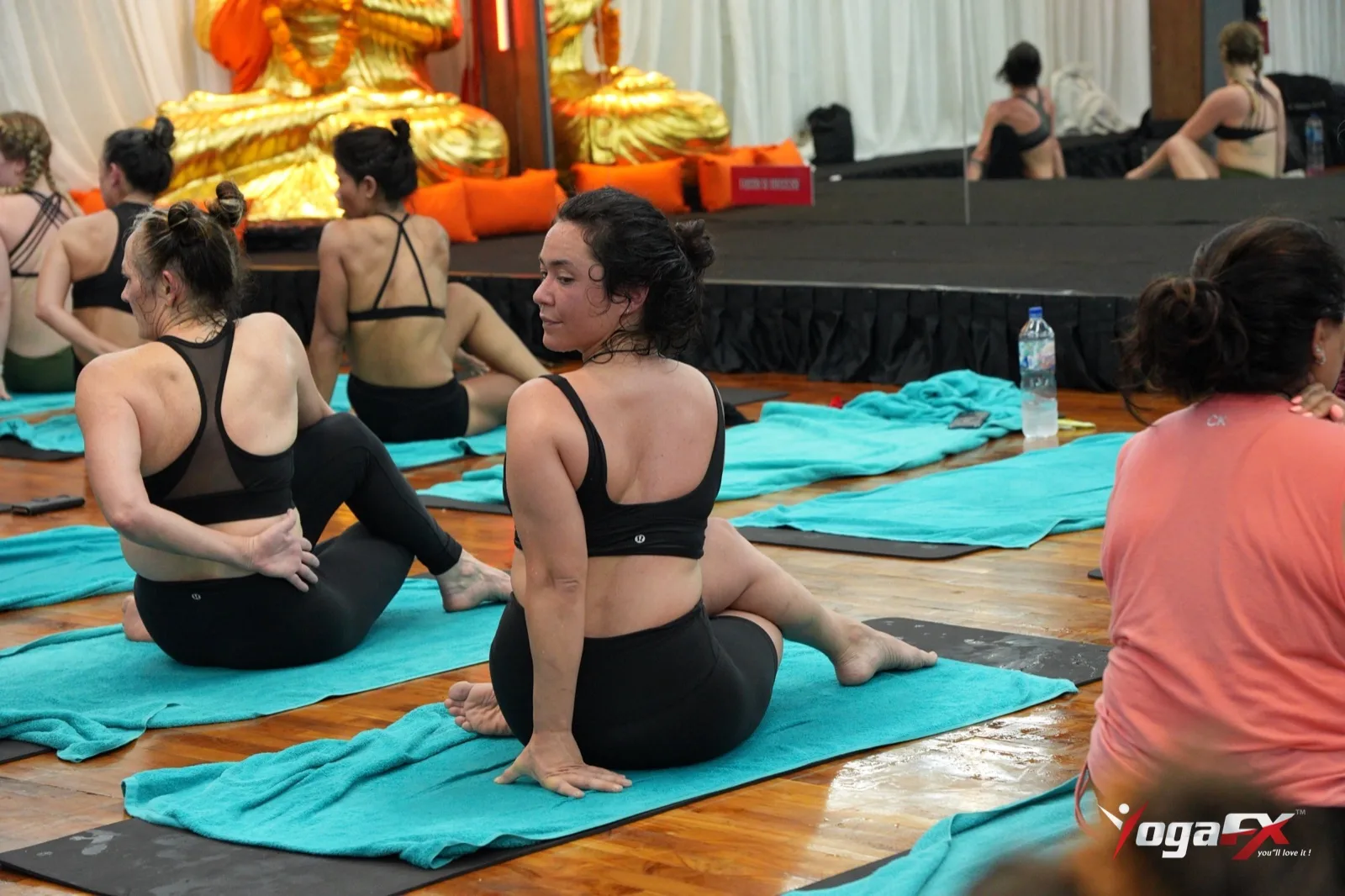
After a two-minute rest, the floor series begins. Here you lie, sit and kneel through backbends, a forward fold and a spinal twist. Warm muscles around the spine and hamstrings let many students fold deeper with less pushing. The catch is fatigue. By the middle of the floor series, the heat has been working on you for an hour.
This is where hot yoga vs regular yoga feels most different. At room temperature you can usually repeat a floor posture with fresher legs. In the heat, the rest between postures matters more, and a good teacher will tell you to take it. Our guide to is 26 and 2 yoga hard explains how students pace themselves through this half of the class.
The Closing Breath
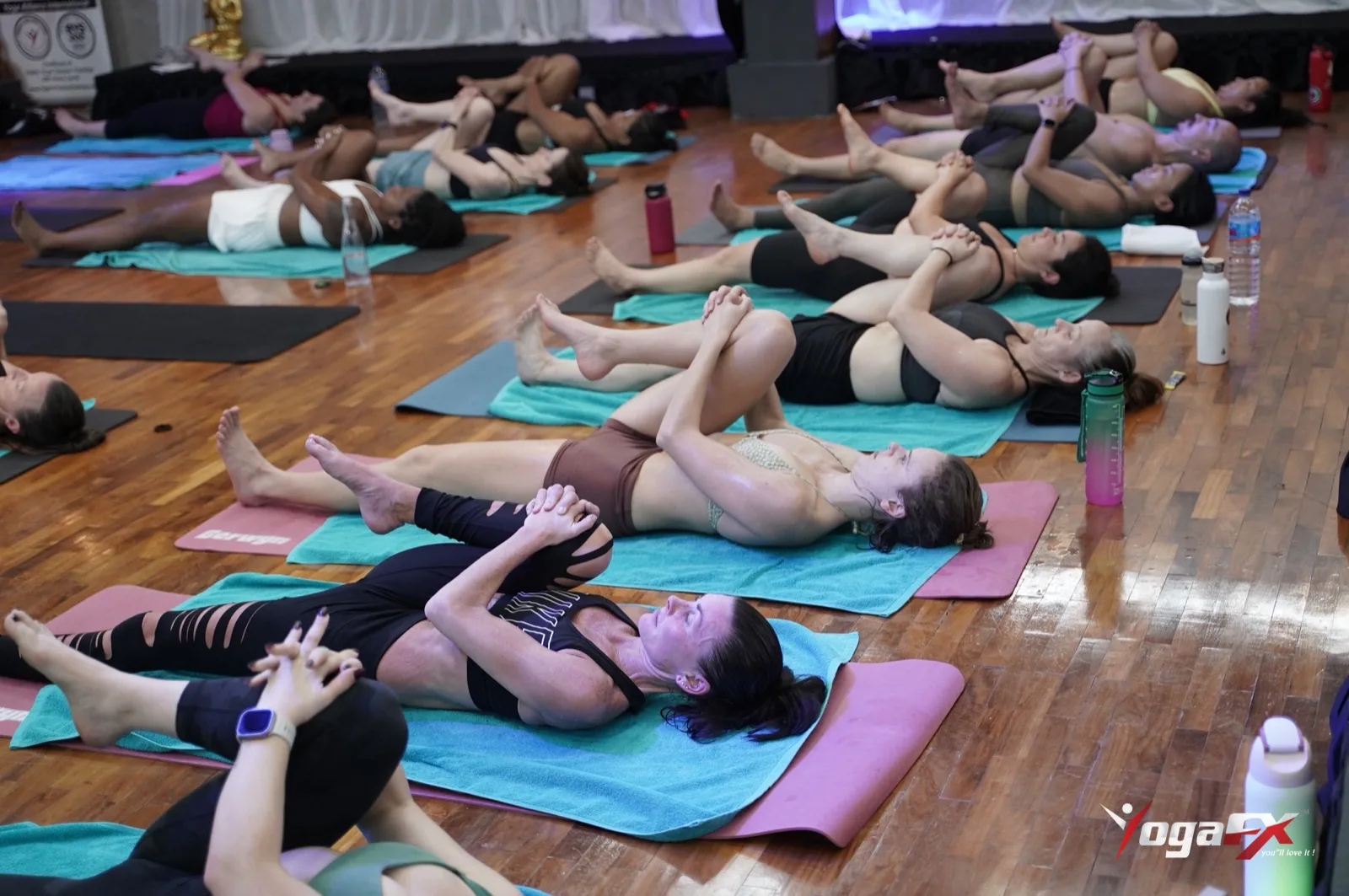
The class ends with Blowing in Firm, a quick breathing exercise that brings the heart rate down. After a hot class many students say they feel clear and quiet. We treat that as a teaching observation, not a trial result. If you want to see how the full order builds toward that moment, read why every posture comes in this exact order.
What Two Lab Rooms Measured: Hot Yoga vs Normal Yoga Under Test
Three studies give a direct view of hot yoga vs regular yoga. Each one put people through the same Bikram-style sequence in a hot room and a cooler room. We opened the full text of two and link them. We name the third because we could only read it second-hand.
Lambert 2020: One Hour, Two Rooms
In Lambert and colleagues' 2020 paper in the International Journal of Exercise Science, 16 experienced practitioners did the same one-hour Bikram sequence on two days at least 96 hours apart. One room was 105°F (about 40°C) and the other was 74°F (about 23°C), both at 40% humidity.
Oxygen use, heart rate and energy cost did not differ between the rooms. The respiratory exchange ratio was lower in the heat (0.89 against 0.95), which points to a little more fat used as fuel.
Hip abduction rose more in the heat. One blood marker, interleukin-6, climbed about 15-fold after the hot session only. The authors described the hour as low intensity, under 30% of maximal oxygen uptake.
Bourbeau 2021: Twelve Sessions in Beginners
Bourbeau and colleagues' 2021 trial in the International Journal of Yoga followed 22 adults through 12 sessions over four weeks, in a hot room or a cool one. Maximal aerobic fitness rose within the hot group only, from 3.22 to 3.46 litres per minute. However, the study found no significant difference between the two groups. A heat-stress protein called HSP70 was higher in the hot group.
Two results matter for a beginner. First, a brain-growth protein called BDNF rose in both groups combined, so it came from the yoga, not the temperature. Second, the study saw no sign of heat acclimation and no change in perceived stress after 12 hot sessions.
Boyd 2018: A Shorter Bout
Lambert's paper also describes an earlier 20-minute comparison (Boyd et al., 2018). As Lambert's team summarise it, the hot bout did not significantly raise oxygen use but did raise heart rate and perceived exertion. We could not open the original page, so we cite it only through that summary.
That matches the pattern in the first two studies: the heat changes how hard it feels more than how much work you do.
The Numbers at a Glance
Notice how modest the gaps are in this hot yoga vs regular yoga evidence. The studies are small, and the fitness gain in the hot group did not beat the cool group in a direct test. Treat these as careful early evidence, not final answers. For a second view of the same research, see a study-by-study breakdown of hot versus room-temperature yoga.
What the Heat Does Not Change About Hot Yoga vs Regular Yoga
The most common reason people pick hot yoga is weight loss. The sweat feels like proof. It isn't. Sweat is your body cooling itself, and the scale drop after class is mostly water you'll drink back.
In the 2020 test the energy cost matched between rooms. We keep the full numbers in our guide to hot yoga calories burned, so here is the short version: the class earns the calories, not the thermostat.
Three other things stay the same in both rooms:
- The mental load. A fixed script, a mirror and counted breathing give your mind one job in either room. That focus comes from the format, not from the temperature.
- The brain-growth marker. BDNF rose when both groups were combined, so a cool class gave you the same signal.
- The stress score. Perceived stress did not change in either group after 12 sessions.
Mood research tells a similar story. A 2023 Massachusetts General Hospital trial (Nyer and colleagues) found that 59.3% of people in an eight-week heated hatha course cut their depression symptoms by half or more, against 6.3% on a waiting list. It tested heated yoga against waiting, not against a cool room. So it shows that yoga can help, not that the heat is the reason.
This is information, not medical advice, so talk to a healthcare professional about low mood.
Is Hot Yoga Better Than Normal Yoga for You? A Decision Guide
So is hot yoga better than normal yoga? For most goals, no. In hot yoga vs regular yoga, one style is simply different, and the difference suits some people more than others. Use your goal, your health and your week, not the thermostat, to decide.
Hot Yoga Tends to Suit You If You
- Like a fixed sequence you can repeat and measure from one week to the next.
- Find that cool rooms leave you tight and want a deep, warm stretch.
- Enjoy a demanding 90 minutes with no music and no choices to make.
- Have cleared the heat with a doctor and feel well on the day.
Regular Yoga Tends to Suit You If You
- Are pregnant, have a heart or blood pressure condition, or react badly to heat.
- Prefer variety, flow or longer holds in a quieter room.
- Want to practise at home or in a gym without a heated studio.
- Are still building a base before you add the heat.
Here's a fair hot yoga vs regular yoga test you can run on yourself. Book three hot classes and three regular classes of similar length. Note how you feel the next morning: stiffness, sleep and mood. Keep the one you look forward to. A beginner who tries both will learn more in a month than from any article, including this one.
If you do try a hot class, arrive hydrated, bring a large towel and rest on the mat whenever you need to. Leave the room if you feel faint or confused. If you have a medical condition, consult a healthcare professional before any heated class.
What Students Say After the Training Room
These reviews aren't about hot yoga vs regular yoga. They come from people who trained with Mr. Ian, and they show what the teaching floor feels like. Each one comes from our review store, first names only.
I'm so happy, Mr. Ian, that you pushed me and put me back in the track of my dreams.
Christina, YouTube review, 2024
This has been wonderful and I am very grateful for this experience and for meeting every single individual here.
Dior, YouTube review, 2024
Thomas, in a 2022 graduation video review, said he had expected only a tough physical class, which is what he had prepared for, and found something broader (paraphrased).
Notice the common thread: students talk about the people and the teaching, not the temperature, which fits the hot yoga vs regular yoga evidence. In total, YogaFX students have left 150 Google reviews, 50 Yoga Alliance reviews and 357 YouTube video testimonials.
Teach the Heated Sequence With YogaFX
If your choice in hot yoga vs regular yoga ends with a hot class every day, you may start thinking about teaching it. The Bikram Hot 26&2 Yoga Teacher Training MasterClass at YogaFX is a six-day hybrid: you study online first, then join an intensive in Bali. Graduates earn the Yoga Alliance RYT 200-Hour and the Bikram Hot 26&2 200-Hour International Yoga Certification.
The next batch checks in on Sunday 24 January 2027 and checks out on Friday 29 January 2027 at Soham Wellness Center in Seminyak.
The Early Bird price is US$1,899 until 19 November 2026, and the usual price is US$1,999. Payment plans start from US$250 a month. Mr. Ian Terry trained for five years, from 2014 to 2019, with the founder of the method. Since 2017 he has guided more than 1,500 graduates from over 80 countries.
Read the full 26 and 2 yoga teacher training page, or message Mr. Ian on WhatsApp to ask what it involves.
FAQ
Why do people choose hot yoga over regular yoga?
Most people choose it for the fixed sequence and the focus, not for a proven health edge. The warm room loosens muscles and makes distractions fade. In lab tests the heat added little beyond a small hip range gain, so the best reason to choose it is that you enjoy it.
What is the difference between hot yoga and warm yoga?
The main difference is the thermostat. A traditional hot class runs near 40°C, while warm yoga usually runs cooler. There is no single standard for either name, so ask the studio for its temperature and class format before you book. The label alone tells you very little.
Does heat make you more flexible than regular yoga?
A little, and only in some joints. In a 2020 lab test, hip abduction rose 6.6° after a hot hour against 2.3° after a room-temperature hour, which the authors reported as the larger gain in the heat. Heat helps you stretch today, but regular practice builds lasting flexibility over months.
Can I move from regular yoga to a hot class?
Yes, with care. Start with one or two classes a week, arrive hydrated and rest on the mat whenever you need to. The first month is the steepest, because your body is learning to cool itself while you balance. If you have a heart or blood pressure condition, ask a healthcare professional first.
What are the pros and cons of hot yoga vs regular yoga?
Hot yoga offers a repeatable sequence, a deep warm stretch and strong focus. Its costs are more heat strain, more fluid to replace and a tougher first month. Regular yoga offers variety, easier recovery and no heat risk. Pick the one you will attend three times a week.
Still have questions? Message Mr. Ian and the YogaFX team on WhatsApp and we will answer them personally, whatever your level or your goal.