Competitive yoga is a judged sport where athletes hold set postures and score points for balance, flexibility and strength. Many of the postures judges look for already sit inside the 26 and 2 sequence, such as Bow, Camel, Cobra, Standing Bow Pulling and Standing Head to Knee. This guide maps the two, posture by posture.
Table of Contents
Mr. Ian Terry, E-RYT 500, is a Master Trainer with the Republic of Indonesia Yogasana Sports Federation. He has taught more than 12,000 hours, so he knows these shapes from both the hot room and the competition floor.
How Competitive Yoga Is Scored
Rules differ by federation, so we’ll use one clear public rulebook as our example: the one from USA Yoga. It is written down, it is detailed, and it shows what a judge actually sees. Other bodies follow similar ideas, but they do not copy it exactly.
Here is the short version. An athlete picks 6 postures and has 3 minutes to complete them. Each posture is scored from 0 to 10, and the judges start at 10 and take points away for errors. A posture needs at least 3 seconds of stillness to score at all, and 5 seconds for full marks.
So the sport rewards three physical qualities above all: balance, flexibility and strength. The USA Yoga rules even ask athletes to show each of those at least twice in a routine, or lose points for the missing one.
That is the link between competitive yoga and the 26 and 2 class. The sequence trains those same qualities in a fixed order, under heat, with a script that tells you exactly what to do. Nobody scores you in class, but you’ll know the shapes.
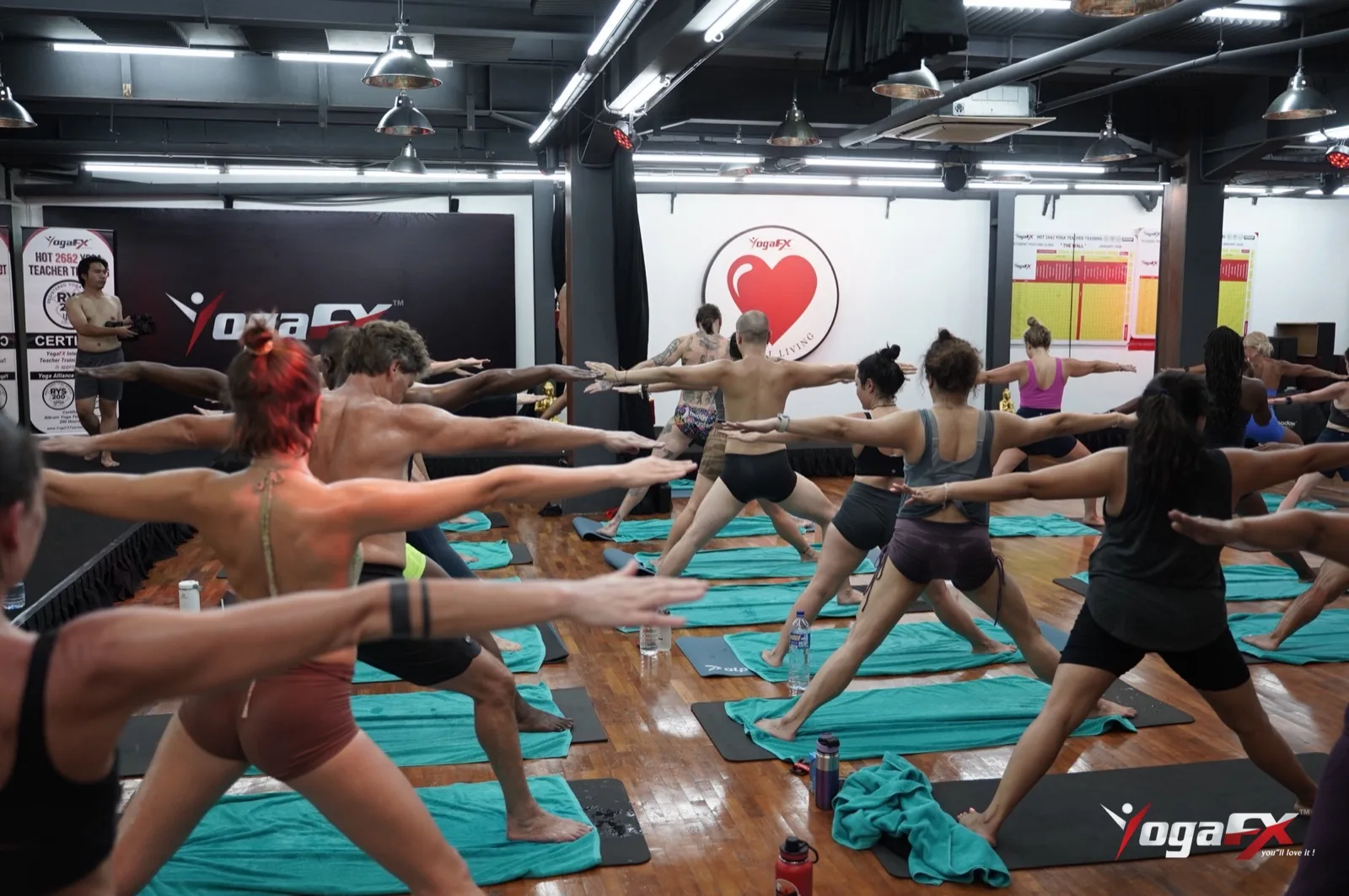
Competitive Yoga Posture Groups Mapped to the 26 and 2
USA Yoga sorts its postures into six compulsory groups, and its public posture guidelines list the postures in each one. We matched those names against the 26 and 2 sequence. The table shows where the two overlap by name, and where they do not.
| Competition group | Named in the USA Yoga lists | Matching 26 and 2 posture | What judges look at |
|---|---|---|---|
| Backbends | Bow, Full Camel, Full Cobra, Half Moon Backbend, Standing Bow Pulling | Bow, Camel, Cobra, Half Moon, Standing Bow Pulling | Even curve, open chest, control at depth |
| Forward compressions | Standing Head to Knee, Rabbit, Tortoise | Standing Head to Knee, Rabbit, Half Tortoise | Folded torso, straight working leg, calm face |
| Twists | Spine Twist | Spine Twisting | Rotation from the spine, level hips |
| Tractions | Splits, Standing Splits, Side Angle, Archer and others | Standing Separate Leg Stretching, Triangle (partial) | Wide stance, length through the legs |
| Lifts | Strength holds that lift the body off the floor (list not reviewed here) | None in the sequence | Strength to hold the body off the mat |
| Inversions | Upside-down postures (list not reviewed here) | None in the sequence | Control upside down |
Look at the last two rows. The 26 and 2 has no arm balances and no inversions, so a student who only practises the sequence is not ready for those groups. We say so plainly, because it matters for anyone planning to enter an event.
Backbends: Where the 26 and 2 Is Strongest
Backbends are the clearest overlap. The 26 and 2 floor series is built around them. Cobra, Locust, Full Locust and Bow come back to back, then Camel and Rabbit follow later in the class.
Why does that matter for competitive yoga? A backbend that looks easy in a photo is hard to hold for five seconds with a calm face. Class teaches exactly that. You lift, you hold, you release, and then you do it again, because every posture comes twice.
- Bow. Hands hold the ankles, the chest and thighs lift together. Judges want an even arc, not a collapsed lower back.
- Camel. Kneeling, hips forward, head back. It tests shoulder opening and nerve more than anything else in the group.
- Cobra. A low, controlled lift. The USA Yoga list uses the full version, so a student working toward it has a clear next step.
- Half Moon. In class it starts as a side bend, and the backbend version adds depth. Beginners should stay with the side bend first.
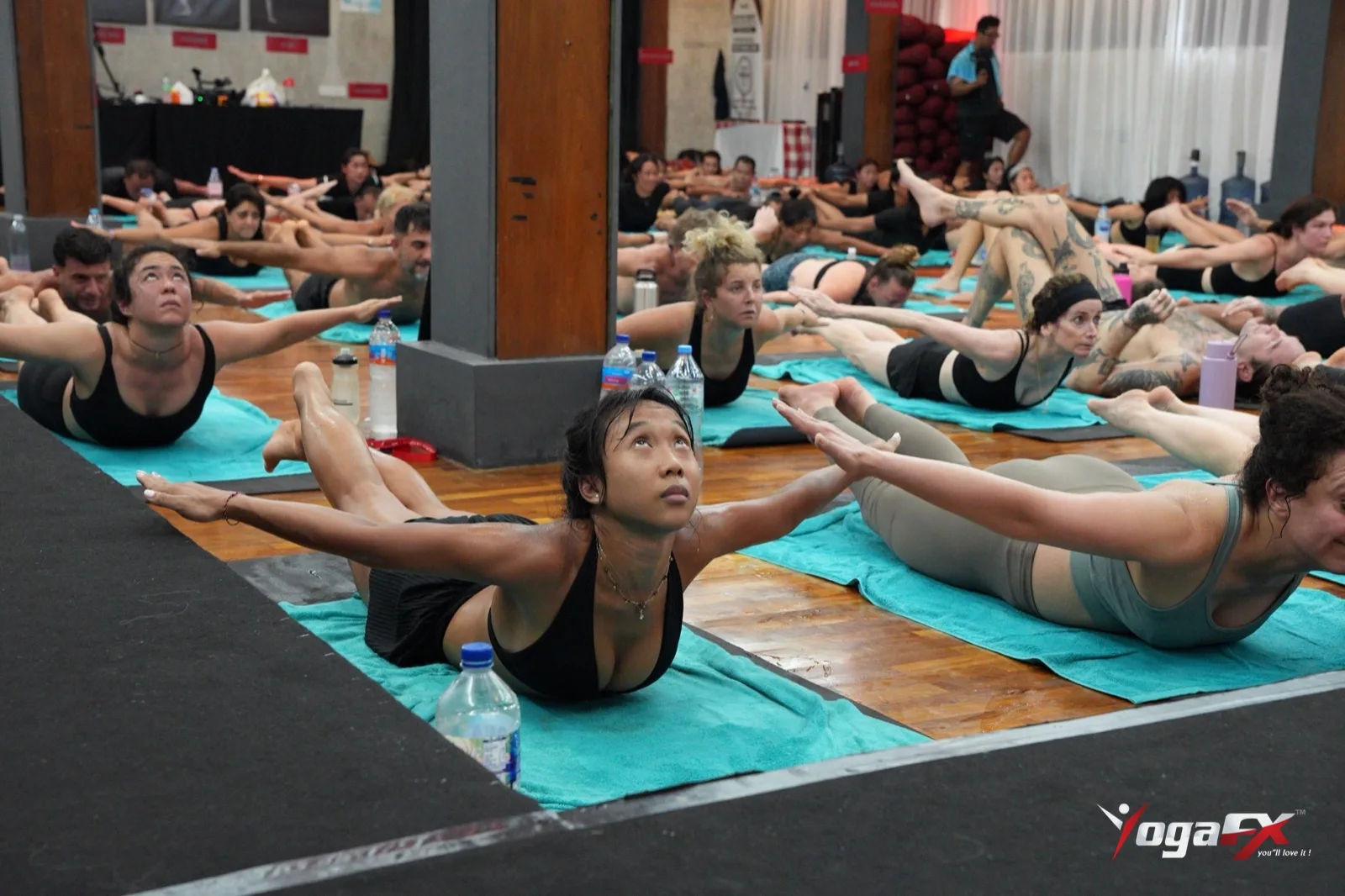
The risk is real, too. In competitive yoga, deep backbends held for a score are the usual way athletes hurt their lower backs. Good coaches build range slowly and tell athletes to stop at pain, not at the edge of the mat.
Balance and Forward Compression in Competitive Yoga
Balance is the third quality judges score, and the standing series is a balance workshop. Eagle, Standing Head to Knee, Standing Bow Pulling, Balancing Stick, Tree and Toe Stand all ask you to stand on one leg while the rest of the body does something difficult.
Two of those names also appear in the competition lists: Standing Bow Pulling sits with the backbends, and Standing Head to Knee sits with the forward compressions. They are the easiest bridge from a class to a routine.
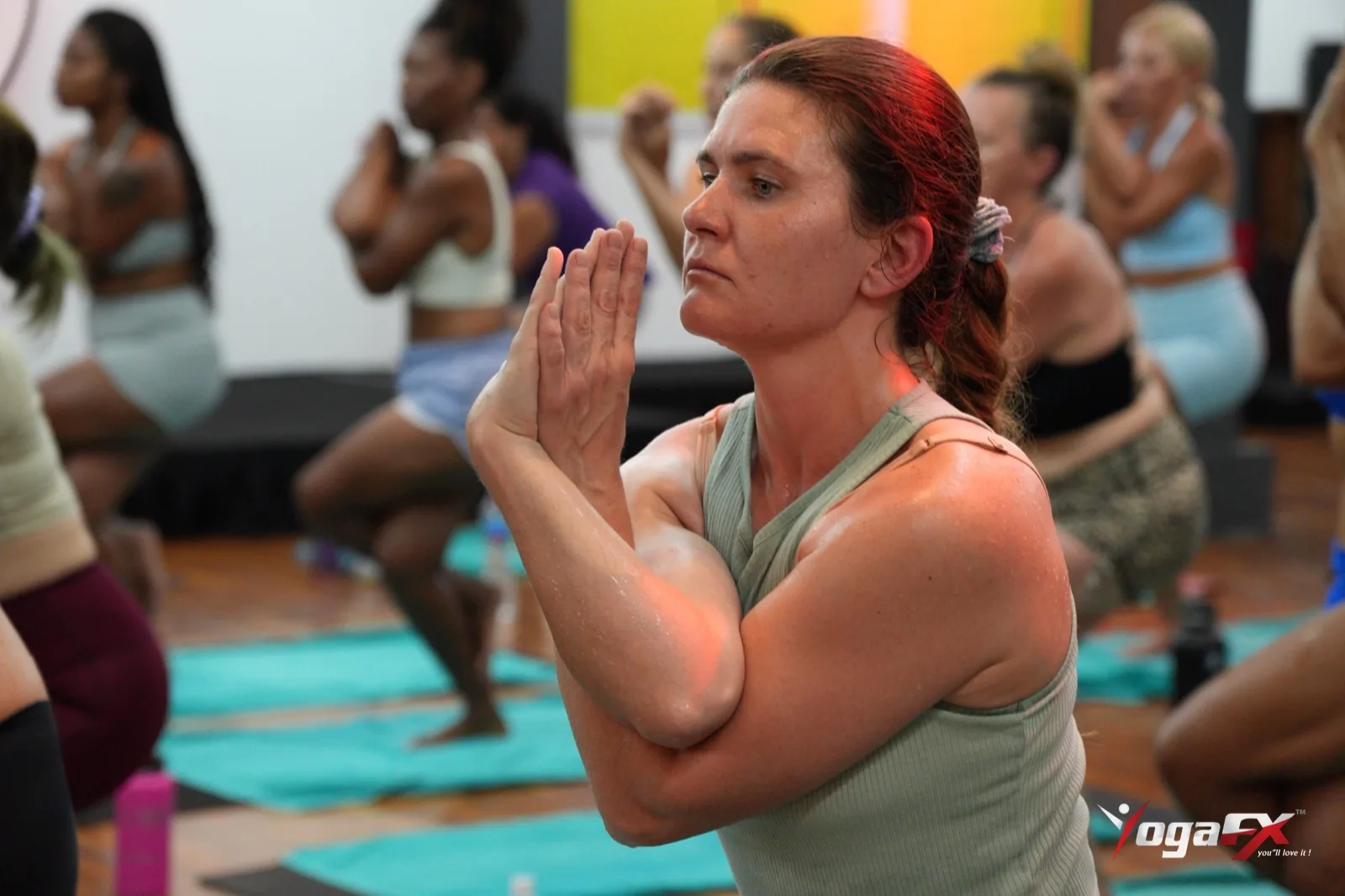
What a judge sees in a standing balance
- A straight standing leg, with no wobble at the knee.
- A fixed gaze, because wandering eyes mean a wandering body.
- A still torso while the free leg or arms do the work.
- A normal breath. The USA Yoga rules say breathing must stay normal during the hold.
Forward compressions are the other half. A fold like Standing Head to Knee needs hamstring length and a quiet core. It is also the posture many men fear, which is why we wrote a separate piece on why tight hamstrings make hot yoga harder for men.
Twists, and What the Sequence Leaves Out
The twisting group is small in our sequence. Spine Twisting is the one full twist, and it closes the floor series before the final breathing exercise. In competition lists, the twists group is wider, with variations that wrap the arms and legs in more complex ways.
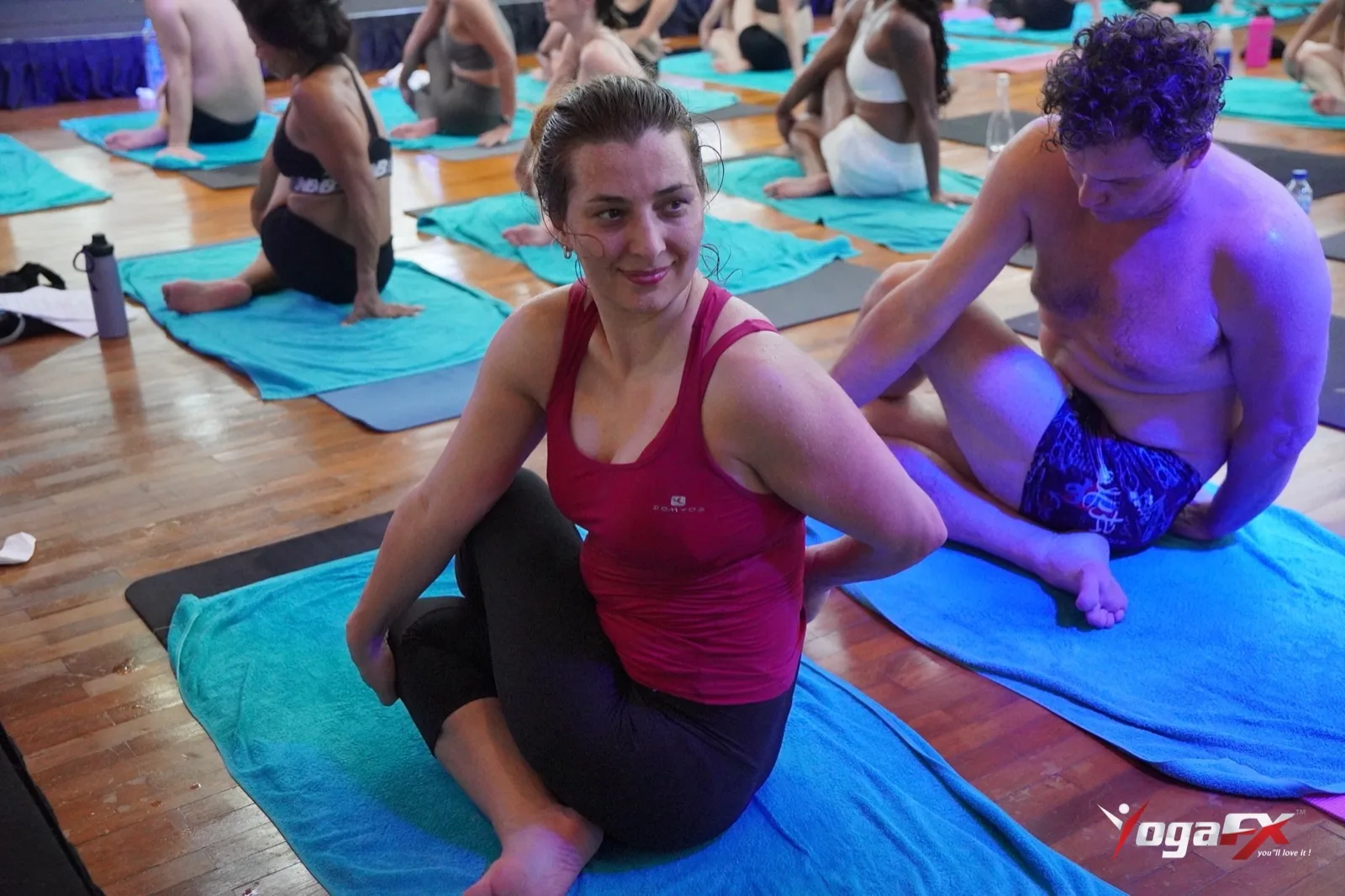
Here is what the 26 and 2 does not give a competitive yoga athlete. There are no lifts, no inversions and few of the deep tractions. An athlete would need extra training for those groups, with a coach who knows the competition lists.
That’s fine. The sequence wasn’t designed as a competition programme. It’s a conditioning tool, and a very consistent one. If you want to see how the full order works and why it is built that way, read our guide to the 26 and 2 yoga sequence.
What Research Says About the Qualities Judges Score
No study has tested competitive yoga athletes in a heated room, so nothing here proves that a 26 and 2 class will win medals. What research does measure are the qualities that judges reward. We name each source in the text, because PubMed and PMC blocked our automated link checks.
- Strength. Tracy and Hart (2013) reported about a 20% rise in posterior chain strength after regular Bikram practice, along with better flexibility and body composition.
- Overall benefit. A 2025 systematic review by Willmott and colleagues pooled 43 studies and 942 participants. It reported benefits for flexibility, bone density and well-being.
- Workload. A University of Wisconsin study led by Porcari (2014) measured about 333 calories burned for women and 460 for men in a 90-minute class, at roughly 80% of maximum heart rate.
- Nerves. Hui and colleagues (2022) found that hot yoga reduced state anxiety, which helps any athlete who freezes under pressure.
These findings come from regular practice, not from competition. Heat is not right for everyone, so please consult a healthcare professional before starting a heated practice or training for events, especially with a heart condition, pregnancy, low blood pressure or regular medication.
Why a Fixed Script Helps Before a Competition
Competitive yoga rewards repeatable form. A judge sees your Bow once, for a few seconds, so it has to be the same Bow you practise every day. A fixed class helps with that, because the cues never change, and competitive yoga athletes need that sameness.
In a 26 and 2 class, the teacher reads the dialogue word for word. You hear the same instruction for the same posture, in the same order, twice per class. After a few months, your body starts to answer before your mind does.
- Repetition builds a standard. You compare today's Camel with last week's Camel, not with a different sequence.
- Heat teaches pacing. At about 40°C, you learn to stay calm when your legs shake. That calm is what judges see as control.
- The mirror trains the eye. Watching your own alignment is close to how a coach reads a routine.
There is a catch. A competition floor is a different setting from a 40°C class, and the posture holds are short, often just five seconds. So the heat adaptation is a bonus, not a requirement. Think of the class as the base, and the competition work as the sharpening.
Arkan, Ivara and Ahmedabad: What the Medals Show
The best evidence we have is our own graduates. At the World Yogasana Sports Federation Championships in Ahmedabad (4 to 8 June 2026), Indonesia won 1 gold, 2 silver and 4 bronze, seven medals in all.
Two YogaFX graduates were part of that result. Arkan Fauzan Riyanto (graduate, 2022) won 2 silver and 3 bronze medals in Ahmedabad. He is also a three-time FORNAS champion, in 2022, 2023 and 2025. Ivara Candra Kartika (graduate, 2023) won 1 gold and 1 bronze in Ahmedabad, plus silver at the Asian Championships in the UAE in August 2025 and gold at FORNAS VIII in July 2025.
Across all events, YogaFX graduates have won 12 medals: 5 gold, 3 silver and 4 bronze. Slamet Ariyanto (graduate, 2024) now chairs PPYNI and manages the Indonesian yogasana team, so the link between our training room and the national team runs both ways.
We don’t claim the 26 and 2 alone makes a champion. Athletes train hard in competition-specific work as well. What the class gives them is precision under pressure, because a posture that falls apart when you are tired will fall apart on the mat in front of judges.
How to Start Competitive Yoga From a 26 and 2 Base
Competitive yoga is open to adults of many ages, and the first step is simpler than most people expect.
- Build a base first. Practise regularly for several months before you think about a scoreboard. Our guide to how hard 26 and 2 really is sets honest expectations.
- Find your federation. Search for the yogasana or yoga sport body in your country. Posture lists and age groups differ, so read the current rulebook.
- Learn the posture list. Pick postures from every group, and note the gaps. For most 26 and 2 students, the gaps are lifts and inversions.
- Train with a coach or judge. Small errors are hard to see in a mirror. Coaches who know the scoring will spot them.
- Enter a local event. Start in your age group. USA Yoga, for example, runs adult divisions from 18 to 34 up to 65 and over.
Looking further ahead, the International Yoga Sports Federation lists its 17th World Championship of Yogasana Sports for 4 to 6 December 2026 in Marina di Camerota, Italy. We found no confirmed Olympic recognition on federation pages, so treat any Olympic date you read with caution.
Sources also disagree on when some of these bodies began. USA Yoga says it was founded in 2003, while Wikipedia says the sport has run in the US since 2009 under a nonprofit federation. That is a sign of how young the sport is.
If you want the method-first view, our piece on the Original Hot Yoga Association explains who sets teacher standards, and this wider explainer on yogasana events and federations covers the sport from the teacher training side.
What Students Say About the Teaching
You do not have to compete to value precise teaching. Here is what two graduates wrote in their own reviews.
The training and advice he gave is utterly applicable to a real world teaching environment.
Amanda, Yoga Alliance review, 2019
Excellent school and amazing, very knowledgeable, and talented teachers. Mr. Ian is an excellent educator, and so is Mr. Ritest. I highly recommend the school.
Sammi, Yoga Alliance review, 2022
If teaching is your goal, our six-day hybrid MasterClass is the route. You can read the details on our 26 and 2 teacher training page. The next batch checks in on Sunday 24 January 2027 and checks out on Friday 29 January 2027, at Soham Wellness Center in Seminyak. It leads to Yoga Alliance RYT 200-Hour certification and a Bikram Hot 26&2 200-Hour International Yoga Certification.
FAQ
What is competitive yoga?
Competitive yoga is a sport where athletes perform set yoga postures and judges score them on balance, flexibility, strength and control. It is also called yogasana sport. Rules, age groups and posture lists vary by federation, so always check the current rulebook for the event you plan to enter.
How do you compete in yoga?
Join your national yoga sport federation, learn its posture list, and enter an event in your age group. Train with a coach who knows the scoring. Start at a local event before aiming higher. Many federations also run judge and coach courses for certified teachers.
Which 26 and 2 postures appear in competitive yoga?
By name, the closest matches are Bow, Camel, Cobra, Half Moon, Standing Bow Pulling, Standing Head to Knee, Rabbit and Spine Twisting. The sequence has no inversions or arm lifts, so athletes need separate training for those competition groups.
Is hot yoga a sport?
A normal hot yoga class is a practice, not a sport, because nobody scores or ranks you. Competitive yoga is the sport. It uses many similar postures, but it adds judges, time limits and a scoreboard, and it follows a judged format that a normal class does not.
Can a beginner try competitive yoga?
Yes, but build a base first. Practise regularly for several months, learn your federation posture list, and work with a coach. Some bodies run divisions for adults of every age, including 65 and over. See a healthcare professional first if you have a health condition.
Still have questions? Message Mr. Ian and the YogaFX team on WhatsApp and we will answer them personally.