How to choose a yoga teacher training comes down to eight method checks: whether the full dialogue is taught, whether a posture clinic teaches you to correct, how the school handles heat, the lead trainer's real teaching hours, practice teaching, assessment, the full path, and support after graduation. Ask all eight in writing before you pay a deposit.
Table of Contents
Most people start with price or location. Those matter, but they don't tell you whether you'll teach with confidence. The eight checks below do, because each one tests something you will actually do in front of a class. Here is how to choose a yoga teacher training program without relying on a brochure. Mr. Ian Terry, the lead trainer at YogaFX, built the training around these same checks, so we answer them at the end of this guide.
How to Choose a Yoga Teacher Training: Eight Checks at a Glance
Take this table into every discovery call when you decide how to choose a yoga teacher training. Score each answer from 0 to 2 as you go. Clear and written earns a 2. Vague earns a 0. A school that scores 13 or more out of 16 is worth a deposit.
| Method check | What it protects you from | Red flag |
|---|---|---|
| 1. Full dialogue taught | Standing in front of a class with a half-learned script | You get a summary or a handout, not the whole text |
| 2. Posture clinic | Cueing a posture you cannot see or correct | Postures are taught by demonstration only |
| 3. Heat protocol | Overheating, dehydration and unsafe modifications | No written heat or hydration rules |
| 4. Lead trainer's hours | A famous name who rarely teaches your room | Years are given, teaching hours never are |
| 5. Practice teaching | Your first real attempt being your first public class | Little or no feedback on your delivery |
| 6. Assessment | A certificate nobody can explain | Everyone passes automatically |
| 7. Format and full path | Hidden weeks of internship, travel or extra fees | No single total timeline in writing |
| 8. Support after graduation | Being alone after the last class | No named person to ask |
The first four checks are about method. The last four are about the path around it. That order is deliberate. A school can be cheap, close to home and well reviewed and still teach the method badly, so how to choose a yoga teacher training starts with what happens in the room.
Check 1: Is the Full Dialogue Taught Word for Word?
A 26 and 2 class is spoken, not demonstrated. In a 90-minute class the teacher reads a scripted dialogue, with no music and no demonstration. That means the script is the teaching. A trainee who learns only a summary will freeze the first time a student looks lost. This is the first thing to check when you work out how to choose a yoga teacher training.
What a full answer sounds like
- The whole text. Every posture's dialogue is taught in order, including the two breathing exercises.
- Time to speak. You say the dialogue aloud in front of people, not only read it silently.
- Corrections on delivery. A trainer fixes your timing, volume and pauses, not just your wording.
- A pre-course. You arrive having already read the script, so the live days are for practice.
Ask this directly when you are deciding how to choose a yoga teacher training: "Will I learn the whole dialogue, and who listens to me say it?" If the answer is a handout and a video, keep looking. At YogaFX, trainees finish an online pre-course first. Then they spend the six-day intensive saying the dialogue aloud and hearing it corrected. If you wonder how long that learning curve takes, our guide on how long it takes to become a yoga teacher walks through it.
Check 2: Does a Posture Clinic Teach You to See and Correct?
A posture clinic breaks one posture into steps and lets you practise cueing each step. It is where you learn to see errors. Because the class has no demonstration, your eyes and your words have to do all the work. For example, you learn why a student's hips drift in a balancing posture and which short phrase brings them back.
Many courses teach the postures well and skip this skill. As a result, graduates can do the postures but can't help a stranger do them. Questions to ask yoga teacher training schools should always include the clinic. A good clinic fixes the gap, so look for these signs:
- Posture-by-posture time. Each posture gets its own session, not one lecture covering all 26.
- A trainer who watches you cue. Someone corrects your correction, not only your own posture.
- Real bodies to practise on. You work with different shapes and levels, not only peers who already know the script.
Ask how clinic hours are counted and who runs them. Then ask how the clinic connects to the final assessment. Our post on what the final assessment tests shows how the clinic skills come back on the last day.
Check 3: How Does the School Teach Heat Protocol?
The 26 and 2 is practised at 40 degrees Celsius and 40% humidity. At YogaFX that is natural tropical heat, not an electric heater. A trainer must know how to keep a heated room safe, because you'll soon be the person responsible for one. How to choose a yoga teacher training that takes heat seriously is a safety question first.
The U.S. National Center for Complementary and Integrative Health says yoga is generally considered safe for healthy people when it is done properly under a qualified instructor. It also warns that hot yoga has special risks related to overheating and dehydration, and it advises you to ask about the training and experience of any instructor you consider. You can read it on the NCCIH yoga safety page.
The UK National Health Service lists the signs of heat exhaustion: tiredness, dizziness, headache, nausea, heavy sweating with pale clammy skin, cramps and strong thirst. Its first steps are to move to a cool place and drink plenty of water, as the NHS heat exhaustion guidance explains. MedlinePlus adds that you can lower your risk by drinking fluids, replacing lost salt and minerals, and limiting your time in the heat, in its heat illness overview.
Questions that test a school's heat protocol
- Written rules. Is there clear guidance on hydration before, during and after class?
- Early signs. Are trainees taught to spot dizziness, nausea and cramps in a student?
- Sitting out. What does a teacher say to a student who needs to rest, and when?
- Build-up. How does the week help trainees adapt to the heat, not just endure it?
This is general information, not medical advice. If you are pregnant or have a health condition, speak to a healthcare professional before any heated intensive.
Check 4: What Are the Lead Trainer's Real Teaching Hours?
Years in business hide more than they show. A school can run for a decade and still have a lead trainer who rarely teaches the room. So when you think about how to choose a yoga teacher training, ask for total teaching hours. Then find out who taught the trainer, and over how many years.
Here is how Mr. Ian Terry answers. He holds the E-RYT 500 credential and has taught 12,000+ hours. He trained for five years, from 2014 to 2019, with the founder of the Bikram Hot 26&2 method. He is also the Master Trainer of the Republic of Indonesia Yogasana Sports Federation, confirmed in June 2026.
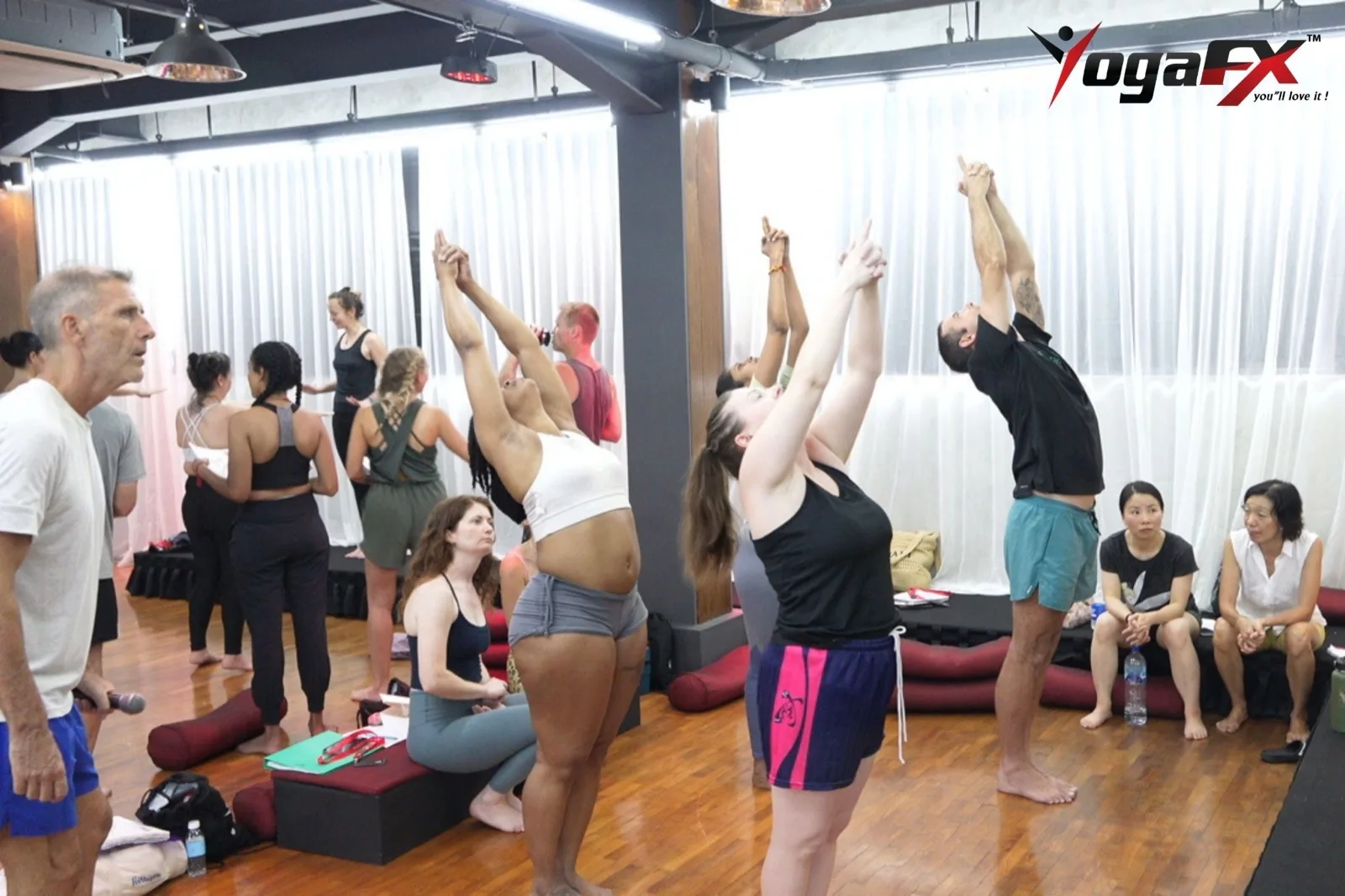
Hours matter because teaching is a skill built by repetition. A trainer with thousands of hours has heard every way a dialogue can go wrong. That means your corrections come from pattern recognition, not guesswork. Ask any school for videos of the trainer teaching. Then watch how they correct people.
Six numbers behind the method checks
How to Choose a Yoga Teacher Training: Practice, Assessment, Path and Support
The method checks tell you how well a school teaches. These four cover what happens around the teaching. They decide whether the week becomes a career step or a nice memory, so they belong in any plan for how to choose a yoga teacher training.
Check 5: Practice teaching with feedback
You don't learn to teach by listening to teaching. You learn by teaching, getting feedback and doing it again. Ask how many minutes each trainee spends delivering the dialogue to a real group. Then ask who gives the feedback and how quickly. Trainees usually improve fastest when someone names one fix at a time.
Check 6: Assessment and what the certificate means
Ask what the assessment tests and what happens if you do not pass first time. Then ask which outside bodies stand behind the certificate. At YogaFX, graduates leave with the Yoga Alliance RYT 200 and the Bikram Hot 26&2 200-Hour International Yoga Certification. Our posts on how the sequence maps to RYT 200 hours and on what accredited training qualifies you to teach explain the detail. No certificate can promise you a job, so judge it by what it lets you do.
Check 7: Format and the full path
A short headline can sit on top of a long path. Some courses add an internship that runs for months before the school's own seal arrives. Others stretch weekends across half a year. Ask for a single timeline in writing, from day one to the day you may teach alone.
The YogaFX format is a hybrid. You complete the online pre-course at home, then attend a six-day intensive in Bali. The next batch checks in on Sunday, 24 January 2027, and checks out on Friday, 29 January 2027, at Soham Wellness Center in Seminyak.
Check 8: Support after graduation
The last class is where your teaching life begins. Ask whether you keep the materials, whether former trainees stay in touch, and who you can message before your first public class. Nobody can promise you students. A school can promise you a person to ask.
What Graduates Say About These Checks
Reviews are the quickest way to test the answers a school gives you. Look for people who name the teacher and describe the training itself. Then check that they spread over several years. YogaFX has 150 Google reviews, 50 Yoga Alliance reviews and 357 YouTube testimonials, more than 550 in total. Here are three, with first names only.
Gorgeous and very challenging teacher training experience. The team is highly qualified, kind and disciplined. Come to Bali to change your mindset and your life!
Annabel, Google review, 2026
"This is beyond my expectations for the program." She added that she felt "privileged and I feel so grateful to be taught under one of the master teachers."
Cristine, YouTube review, 2024
"Ian is a fantastic teacher and um I just feel so privileged to have that this experience with him."
Shannon, YouTube review, 2024
Watch Cristine's full video below. Notice how she talks about the program and the team, not only the certificate.
For more graduate voices, read what 26 and 2 graduates say about learning the dialogue.
How to Choose a Yoga Teacher Training for Your Goal
How to choose a yoga teacher training changes a little with your goal. The eight checks stay the same for everyone, but the weight you give each one shifts. Decide which description fits you first, then compare schools through that lens. More checklists are collected in our Bikram yoga teacher training guides.
- Career changer. Weight assessment, the full path and support most heavily. You need a credential that travels and a clear route to your first class.
- Serious practitioner. Weight the dialogue and the trainer's hours. You already know the postures and want depth you cannot get from a video.
- Existing teacher. Weight the format and the posture clinic. You need minimum time away and sharper correction skills.
- Curious practitioner. Weight the heat protocol and the practice teaching. You want to understand the method from the inside, whether or not you teach.
If you also want a school-level checklist that covers registration, price and completion, try the nine-question school check on the YogaFX teacher training site. It pairs well with the eight method checks here.
How YogaFX Answers the Eight Checks
Hold us to the same standard, because how to choose a yoga teacher training should never rest on one brochure. The YogaFX training is the Bikram Hot 26&2 Yoga Teacher Training MasterClass: a six-day hybrid course with an online pre-course and a live intensive in Bali. Mr. Ian Terry leads it. Since 2017 we have certified 1,500+ graduates from 80+ countries.
The price starts at US$1,899 at the Early Bird rate, open until 21 November 2026, then moves to the normal US$1,999. Twin Share is US$1,999 and Single Room Premium is US$2,199. Instalments start at US$250 per month, interest-free, which is about US$8 a day.
If you want the method taught in natural heat by a trainer with 12,000+ teaching hours, YogaFX is built for that. If you would rather spread learning over several months, a different format may fit you better. Either way, ask the eight questions and write the answers down. That is how to choose a yoga teacher training you can trust.
FAQ
Can a beginner do yoga teacher training?
Most schools accept beginners, but a regular practice helps a lot. Build a baseline of consistent classes before a heated intensive, because your body and the dialogue both need preparation. Tell the school about any injury or health condition upfront so the team can advise you honestly.
How many hours do you need to become a yoga teacher?
The usual entry credential is a 200-hour training, which leads to registration as an RYT 200 with Yoga Alliance. Some people add more hours later. Ask a school how its hours are counted, and whether any part happens online before the live days.
How much should yoga teacher training cost?
Cost depends on format, location and whether the stay is included, so compare written quotes on the same basis. Our six-day hybrid course runs from US$1,899 at the Early Bird rate to US$2,199 for a Single Room Premium, with interest-free instalments from US$250 per month.
How do I prepare for yoga teacher training?
Start the online pre-course early and practise saying the dialogue aloud until it feels natural. Keep up regular classes so your body is ready for the heat. Sleep and drink water well in the week before you arrive, because turning up prepared makes the intensive far easier.
Which yoga teacher training is best?
There is no single best program, only the best fit for your goal. Use the eight method checks for how to choose a yoga teacher training: dialogue, posture clinic, heat protocol, trainer hours, practice teaching, assessment, path and support. The school that answers them most clearly, in writing, is usually the right choice for you.
Still have questions? Message Mr. Ian and the YogaFX team on WhatsApp and we will answer them personally.