Accredited yoga teacher training is a course run by a school that sits on a recognised registry, such as Yoga Alliance. For the 26 and 2 method, it should also cover all 26 postures and both breathing exercises, then test how you deliver the dialogue. Registration proves the hours. Assessment proves you can teach.
Table of Contents
Mr. Ian Terry, E-RYT 500, built the YogaFX course around that split. He has taught for more than 12,000 hours and spent five years, from 2014 to 2019, training with the founder of the Bikram Hot 26&2 method. This guide shows what a good course must teach, how it should test you, and what a graduate is qualified to do afterwards.
What accredited yoga teacher training really means
The word sounds official, but in accredited yoga teacher training it is not a legal title. As far as we know, no government body licenses yoga teachers in most countries. So "accredited" is a word schools borrow, and it can mean very different things from one website to the next.
The most widely used standard for accredited yoga teacher training is a registry. Yoga Alliance describes itself as the global registry for yoga teachers and schools. Its credentialing page explains that a school which becomes a Registered Yoga School (RYS) lets its graduates register as Registered Yoga Teachers (RYT). In plain terms:
- RYS. The school has registered its programme and agreed to the registry's standards.
- RYT. You finished a programme at that school and registered as a teacher.
- E-RYT 500. An experienced teacher, usually the lead trainer, who has logged many teaching hours.
- Your certificate. In most cases the school issues it, so the school's own standards matter.
A registry checks a school's paperwork. It does not sit in your practice-teaching session. That is why registration is a sensible minimum, not a finish line.
Two layers of credential, not one
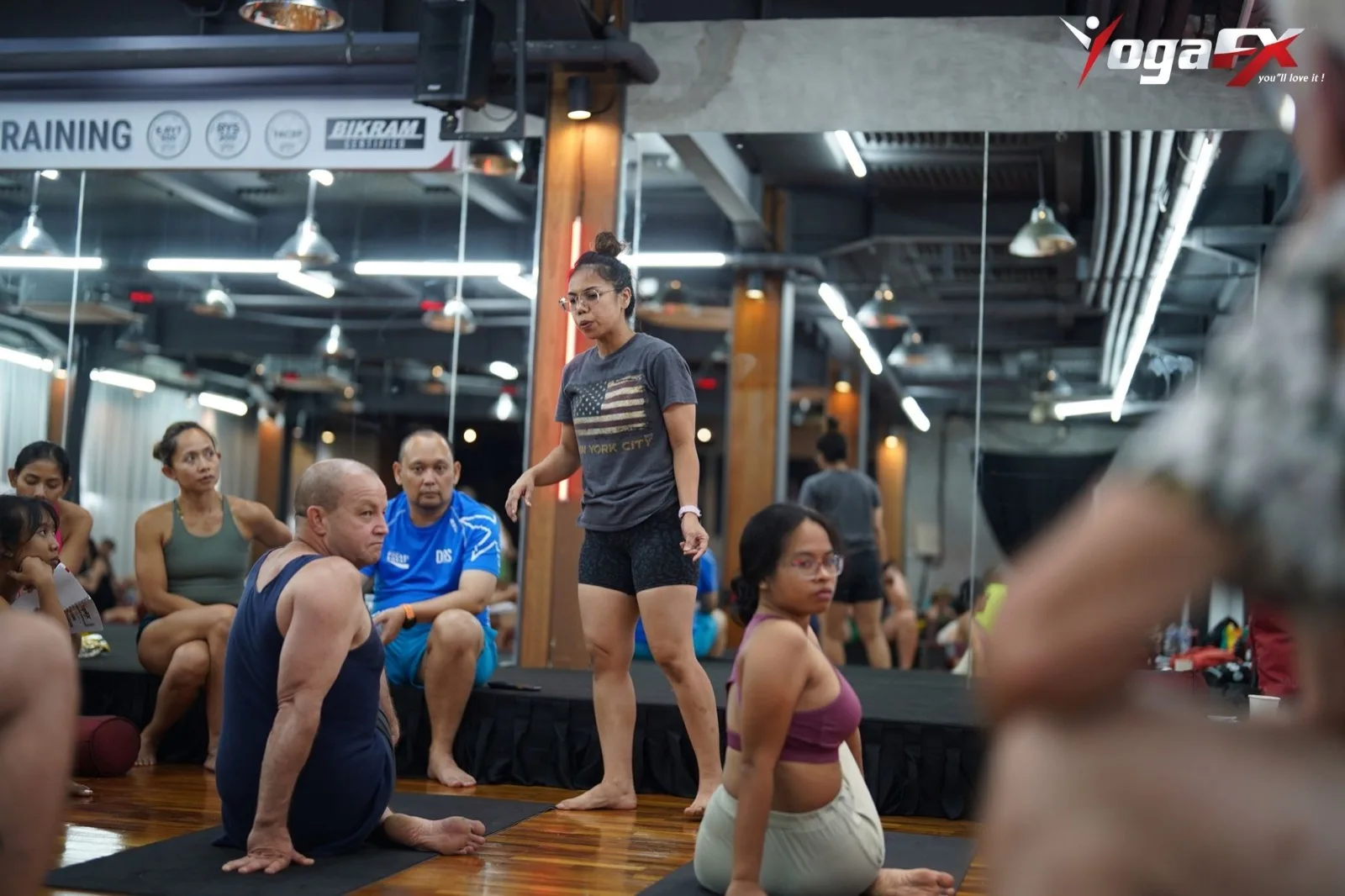
Good accredited yoga teacher training gives you two layers. The first layer is registration: a registered yoga school, a registered lead trainer and a set number of hours. The second layer is method certification: proof that you can teach this one sequence, in this one room, in the right words.
Most brochures sell the first layer and say little about the second. For the 26 and 2, the second layer is the one a studio owner cares about, because it tells them whether you can run a class tomorrow. That is why YogaFX graduates leave with both a Yoga Alliance RYT 200 and a Bikram Hot 26&2 200-Hour International Yoga Certification.
The gap shows up when you look at hot yoga schools as a group. In October 2026 we reviewed 19 hot yoga teacher trainings that link to one private trade association, and only 4 of them were registered with Yoga Alliance. The rest relied on a studio certificate or an association seal. You can read our analysis of that trade association for the detail.
If you want a step-by-step way to confirm a school's listing before you pay, the registry checklist for Bali schools on our teacher training site covers it.
What accredited yoga teacher training must cover in the 26 and 2
A 26 and 2 class has a fixed shape. It opens with a breathing exercise, moves through eleven standing postures, rests in a two-minute Savasana, works through twelve floor postures and closes with a second breathing exercise. If you are new to the method, what 26 and 2 yoga is explains the order.
Because the shape never changes, any accredited yoga teacher training can be checked against it. A graduate should be able to teach every part, in order, two sets of each posture. The table shows what that looks like and how a fair assessor would test it.
The six parts of a 26 and 2 class
| Part of the class | What a graduate must be able to teach | How a good assessor checks it |
|---|---|---|
| Opening breathing exercise | Standing Deep Breathing: the arm position, the breath count and how to coach a student who feels dizzy in the heat | Teaches it live to peers while the assessor listens for the exact script wording and watches student faces |
| Standing series (11 postures) | Half Moon, Awkward, Eagle, Standing Head to Knee, Standing Bow Pulling, Balancing Stick, Triangle and the rest, two sets each | Posture clinic: the trainee spots a misaligned student and corrects the posture with words and hands |
| Savasana | A two-minute rest in the middle of class, with calm and exact timing | Assessor times the rest and listens for tone and pace |
| Floor series (12 postures) | Cobra, Bow, Fixed Firm, Camel, Spine Twisting and the rest, with safe options for backs and knees | Teach-back of the whole series in order, with corrections along the way |
| Closing breathing exercise | Blowing in Firm, and a clean finish to the class | Teaches the final breathing exercise and closes the room without rushing |
| The whole class | 90 minutes at about 40°C and 40% humidity, with no music and no demonstration | Full-class teach-back with timing, voice and safety checks |
The class an accredited graduate must be able to teach
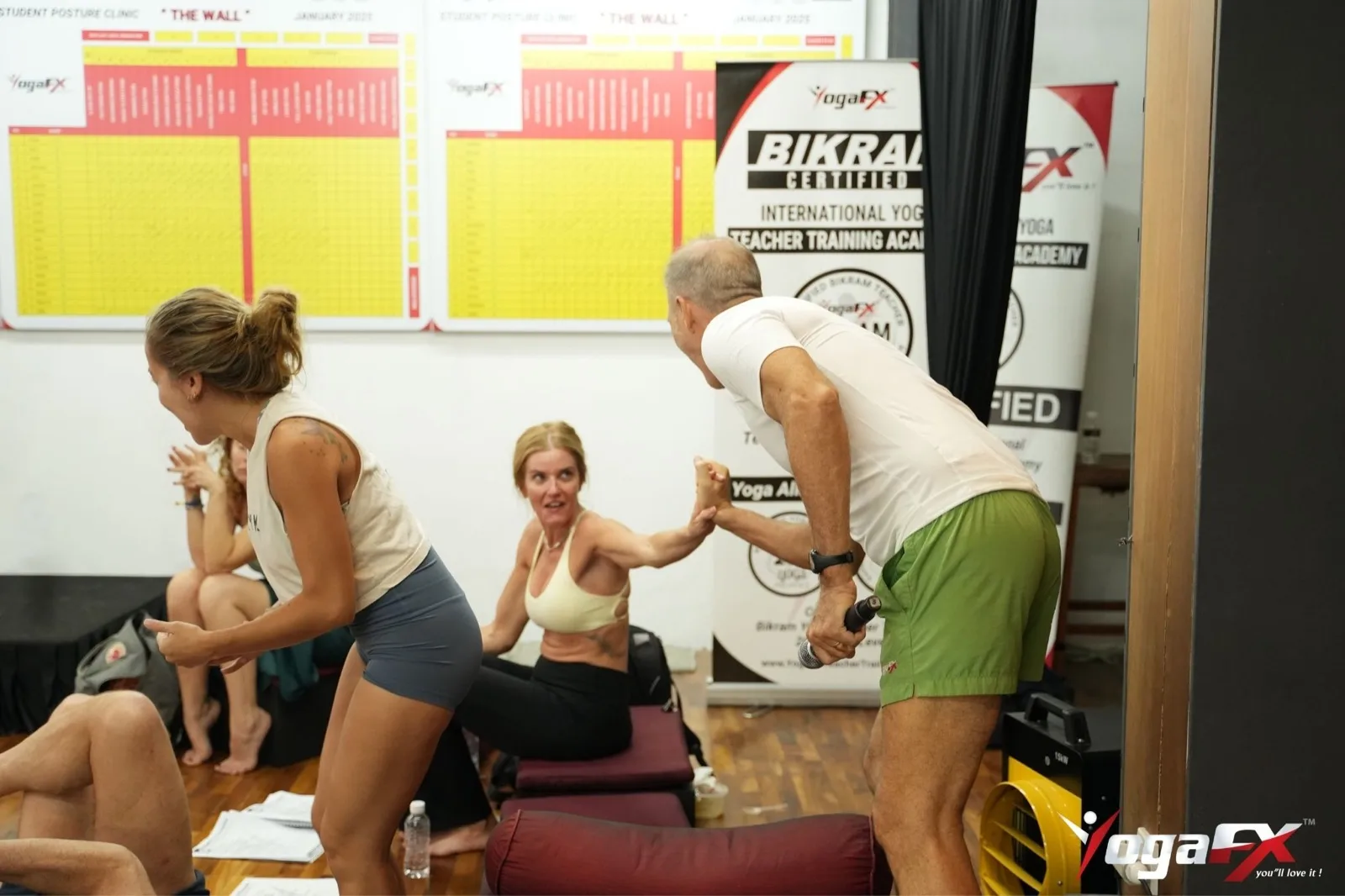
That is a lot to cover. For example, the standing series alone asks a teacher to cue eleven postures in a fixed order, so memory and delivery both matter. Registration also asks for hours in set categories. The registry names them as Techniques & Training, Anatomy, Philosophy, Professional Essentials and Practicum. Our RYT 200 guide shows how the 26 and 2 sequence maps onto those hours.
So ask one blunt question before you enrol: which of these six rows does the course actually test? If the answer is "none, you just attend", you have a registration, not an assessment.
Questions to ask before you enrol
Bring these questions to any call with a school that offers accredited yoga teacher training for the 26 and 2:
- Is the dialogue taught word for word, and is every trainee marked on it?
- How many trainees does one trainer watch during practice teaching?
- Do I teach a full 90-minute class before I graduate, or only sections of it?
- Who runs the posture clinic, and is it hands-on?
- What happens if I do not pass the final assessment the first time?
- Is the school listed as a registered yoga school under its exact name?
That list works for any school, including ours. A confident school answers these quickly and offers proof. A shaky one talks about the beach instead. Bali is lovely, but scenery is not a credential.
How dialogue delivery is assessed
Assessment is where accredited yoga teacher training earns its name. The dialogue is the script a 26 and 2 teacher speaks, word for word, in every class. Nobody improvises it. That makes it unusual to teach and, happily, easy to assess. Our guide to the 26 and 2 dialogue explains what it is and why studios keep it fixed.
What a fair assessment looks at
A fair assessment of dialogue delivery looks at five things:
- Accuracy. Does the trainee say the script as written, without swapping or skipping words?
- Pace and pauses. Does the timing match how long the posture is held?
- Voice. Can the back row hear and understand every cue?
- Recovery. What does the trainee do after a slip: stop, panic or carry on?
- Eyes and corrections. Does the trainee watch the room while speaking, and fix what they see?
Good courses build this in steps. First you say a short section aloud to one partner. Then you teach a series to a small group. Finally you teach a full class while an assessor marks you.
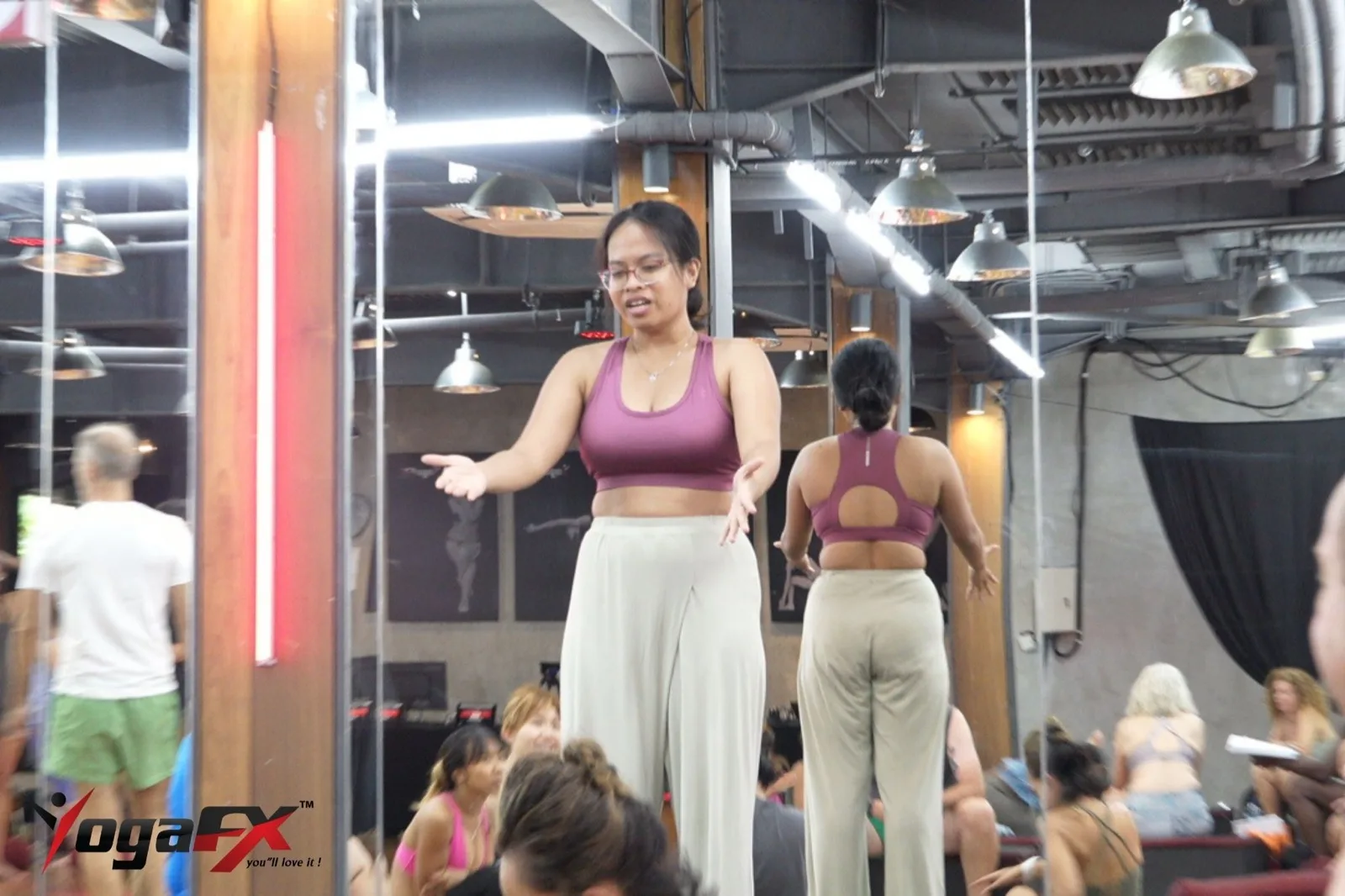
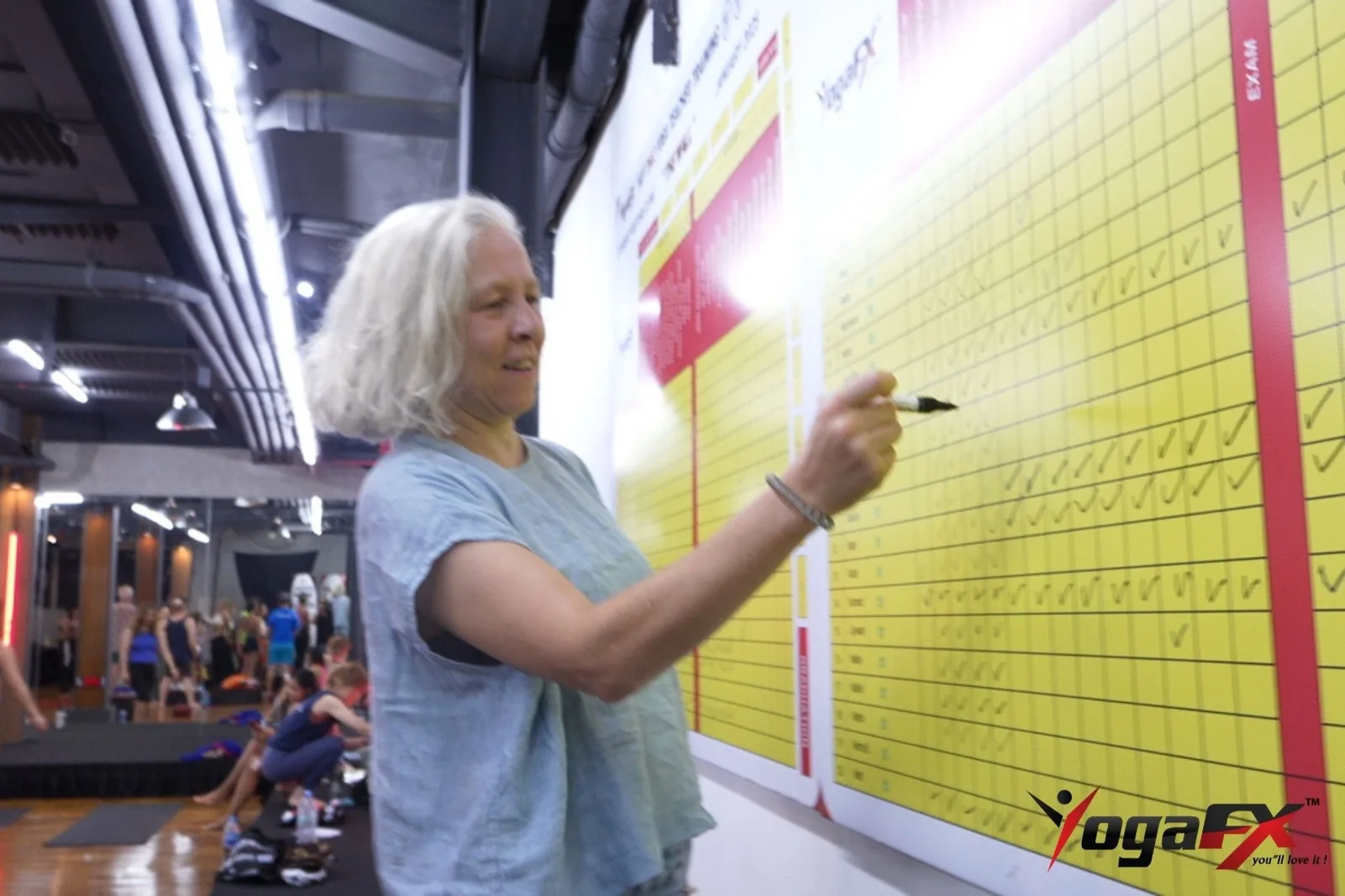
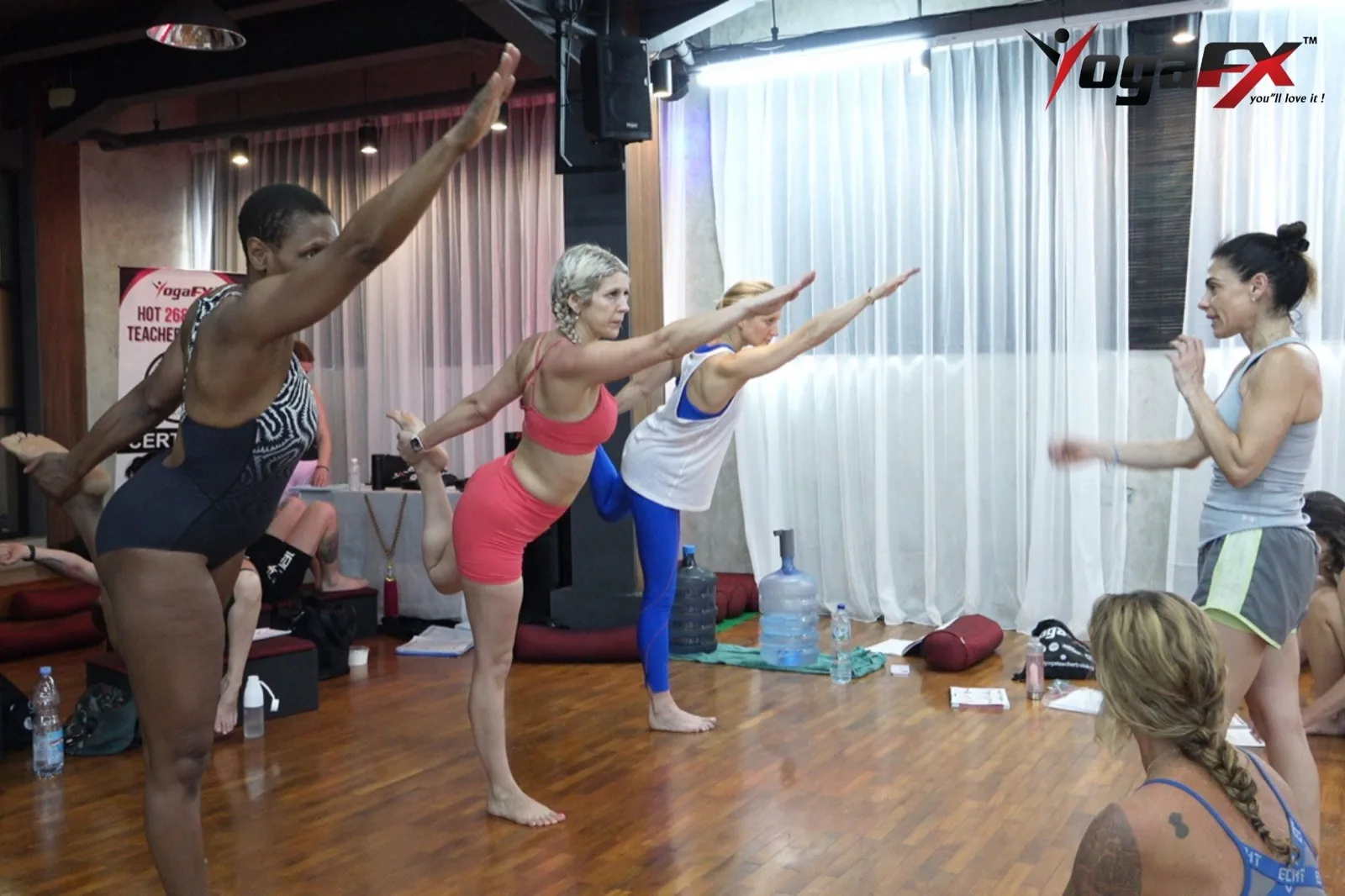
Each step gives the assessor something to record. At YogaFX, a wall chart in the training hall tracks every trainee through each check, and the last column on it is the exam. The chart gives every trainee a visible record of what is checked off and what is still open. That is the kind of record you should expect from any school that says it assesses delivery.
Mr. Ian Terry has taught more than 12,000 hours, and the course is built around speaking time. Delivery is a skill you build out loud. Silent reading feels fast, but a script only sticks once your mouth has said it many times. So any accredited yoga teacher training for this method should give you real speaking time, not just a manual.
For a fuller picture of what the final exam covers, read our guide to hot yoga certification.
What graduates say about the week
Graduates seldom describe the paperwork. Instead, they describe the week itself, because the assessment happens inside it. Here is what three of them wrote in Google reviews.
The yoga fx teacher training is truly life changing. Intense, hard working, pure therapy.
Rita, Google review, 2025
It was an amazing Life Changing Experience with YogaFX. It's not just teacher training but creating the NEW You.
Karen, Google review, 2018
Awesome training experience. Ian and his team are great and the event was really well organised.
Chris, Google review, 2024
Why heat safety belongs in accredited yoga teacher training
A 26 and 2 room sits near 40°C, and a registered yoga school has to plan for that. That is the whole point of the practice, and it is also the biggest safety job a teacher has. Any accredited yoga teacher training for this method has to teach graduates to spot heat trouble early.
The Mayo Clinic lists the signs of heat exhaustion: heavy sweating, faintness, dizziness, fatigue, a weak and rapid pulse, muscle cramps, nausea and headache. It adds that symptoms can start suddenly or build up during prolonged exercise. It defines heatstroke as a core body temperature of 104°F (40°C) or higher.
The same page says it can take several weeks for the body to adjust to hot weather. That matters in a studio. A student in week one is not the same as a student in month six, so a teacher has to read each person, not the average of the room. Safe accredited yoga teacher training teaches exactly that habit.
Signs to watch and what to do
The NHS gives the next step. For heat exhaustion, move the person somewhere cool, give them plenty of water to drink and cool their skin. It calls heatstroke a medical emergency. So a graduate should be able to show four things:
- Recognise the early signs in a student, even when the student says nothing.
- Respond by pausing the posture, moving the student to a cooler spot and offering water.
- Escalate by getting medical help when the signs do not settle.
- Prevent trouble by coaching new students to pace themselves and rest when they need to.
Heat skills also protect the teacher. A graduate who knows the signs can calm a room instead of freezing, and that confidence shows in an assessment. This is general safety information, not medical advice. If you have a medical condition, consult a healthcare professional before you start any heated class or training.
What a graduate of accredited yoga teacher training can teach
Once accredited yoga teacher training passes the checks above, what can its graduate actually do? The answer is narrower than most brochures suggest, and that is a good thing. It keeps your claims honest.
What you can teach
- The full 26 and 2 class, in its fixed order, with the dialogue as written.
- Registration as a teacher, because a graduate of a Registered Yoga School can apply to register as an RYT.
- Safe heated classes, with the heat checks described above.
What you cannot claim
- Treatment of any medical condition. A yoga teacher supports practice; a clinician treats illness.
- Other styles you have not trained in. A 26 and 2 course does not qualify you to teach a flow class.
- Your own teacher trainings. Running a school needs a registered school and a more senior credential.
YogaFX graduates leave with two credentials: Yoga Alliance RYT 200 and the Bikram Hot 26&2 200-Hour International Yoga Certification. YogaFX has graduated more than 1,500 teachers from over 80 countries since 2017.
Online accredited yoga teacher training or Bali in person?
Many people search for online accredited yoga teacher training first, and it can work for theory. The trouble comes with a scripted, heated method. Nobody can mark your voice, your timing or your hands-on corrections through a screen alone.
That is why YogaFX uses a hybrid format. You study online first, then attend a six-day intensive in Bali. If you want accredited yoga teacher training in Bali, the next batch checks in on Sunday 24 January 2027 and checks out on Friday 29 January 2027 at Soham Wellness Center in Seminyak.
Because the hours are shared between home study and the live week, working adults can fit the course around a job. The early bird price is US$1,899, and instalments start from US$250 a month with no interest. Before you pay for any accredited yoga teacher training, confirm that you are joining a registered yoga school and ask how the final assessment works.
FAQ
Can I teach yoga without certification?
In most places, no government body licenses yoga teachers, as far as we know, so you can legally teach without a certificate. Studios and insurers usually ask for one, though, and a registered course gives you proof of training. For the 26 and 2 method, assessed practice teaching matters more than the paper itself.
How long does it take to become a certified yoga instructor?
A registered 200-hour course covers 200 hours of study and practice, and schools deliver those hours in different ways. At YogaFX, you complete online preparation at home, then attend a six-day hybrid intensive in Bali. Longer residential courses run for several weeks. Ask any school how many of its hours are live.
Can you teach yoga with an online certification?
Some schools offer online courses, and you can learn theory that way. For a scripted, heated method, though, online learning alone cannot test hands-on corrections or live delivery of the dialogue. A hybrid course adds an in-person assessment, which is why YogaFX pairs online preparation with a six-day Bali intensive.
Is yoga teacher training worth it?
It is worth it if you want a structured way to learn a method and the confidence to teach it. A good course gives you assessed practice, feedback and a credential that studios recognise. It is not worth it if the school cannot show its registration or explain how it tests your teaching.
Still have questions? Message Mr. Ian and the YogaFX team on WhatsApp and we will answer them personally.