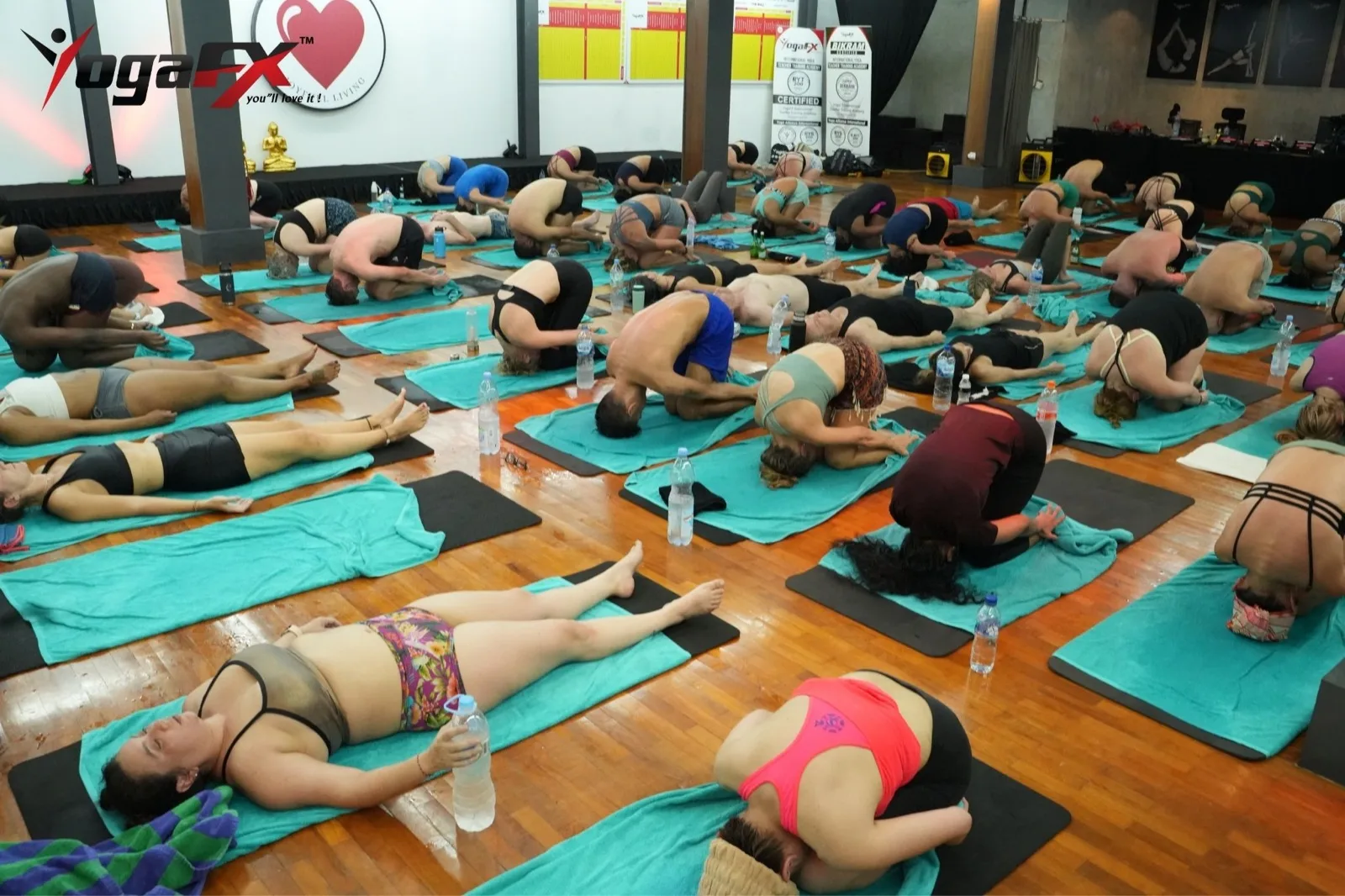
Is hot yoga good for anxiety? For many healthy adults it can feel calming, but the evidence is mixed and the heat doesn't suit everyone. In a 26 and 2 class, the calm comes from two skills you can learn: slow breathing and deliberate stillness. Here is what each one asks of you.
Table of Contents
This guide comes from the teaching room of Mr. Ian Terry, E-RYT 500, who has taught the 26 and 2 for more than 12,000 hours. He tells every new student the same thing: a class can sit beside good care, but it never replaces it. This article is general information, not medical advice.
We start with the short answer, then walk through the breath and the stillness in the order a class delivers them. After that we look at what the research does and doesn't show, who should be careful, and how to try a first class if your mind runs fast.
Is Hot Yoga Good for Anxiety? The Short Answer
It can be, for some people, as part of a wider plan. A 90-minute class gives a busy mind one clear job, and it trains two habits that many anxious people find hard: breathing slowly while effort rises and staying still when you'd rather fidget. Students often tell us they leave with a quieter head.
But "often" isn't "always". The room is about 40°C with about 40% humidity, and heat is a stressor in its own right. So is hot yoga good for anxiety? Our honest answer has three parts:
- It may help when you treat the class as practice in breathing and stillness, not as a fix.
- It may not help if you're dehydrated, run down or prone to panic, because heat can add to the physical feelings you're trying to calm.
- It isn't a treatment. Reviews of the research are encouraging for stress, but much less clear for diagnosed anxiety disorders.
If you want a different angle on the same question, a separate guide on our online training site looks at what the main hot yoga trials measured and what they left out. Below, we stay inside the class itself.
Is Hot Yoga Good for Anxiety? Start With the Breath
In our teaching experience, anxious students often breathe high in the chest, and many hold their breath when they brace. It's an old habit from stress, sport and lifting. In a heated room, the habit backfires fast, because a held breath makes effort feel bigger than it is. So is hot yoga good for anxiety if your breathing is poor? The class starts by fixing exactly that.
That's why a 26 and 2 class doesn't wait for the hard postures to teach breathing. It opens with Pranayama, called Standing Deep Breathing, and it closes with Kapalbhati, called Blowing in Firm. Those are the 2 breathing exercises in the name "26 and 2".
The 26 and 2 dialogue, the fixed script your teacher speaks, tells you when to breathe in, when to breathe out and when to stop. You don't have to plan anything. As a result, the breath becomes something you follow, not something you manage.
Standing Deep Breathing: Your First Minutes of Practice
Standing Deep Breathing comes first, before any posture, so it's the first place to ask is hot yoga good for anxiety for your own body. You stand tall, hold the position the dialogue describes, and breathe slowly through the nose while the teacher sets the pace. Nothing else is asked of you. There's no balance to find and no stretch to reach.
That simplicity is the point when you ask is hot yoga good for anxiety in real life. For a student whose mind is already racing, the first job is small enough to finish. Follow one breath. Then the next. When a thought pulls you away, the next spoken word brings you back. That return is the rep, and a class gives you dozens of them.
The UK's National Health Service teaches the same idea in its own breathing exercise for stress. It describes a calming technique for "stress, anxiety and panic" that takes just a few minutes. You breathe deep into the belly, in through the nose and out through the mouth, and count steadily from 1 to 5 on each breath.
The NHS adds that you get the most benefit if you do it regularly, and it suggests repeating it for at least 5 minutes.
The class version lets the teacher keep the pace. Even so, the skill is the same: a slow, steady breath you can find on purpose.
The Standing Series: Breathing While the Legs Burn
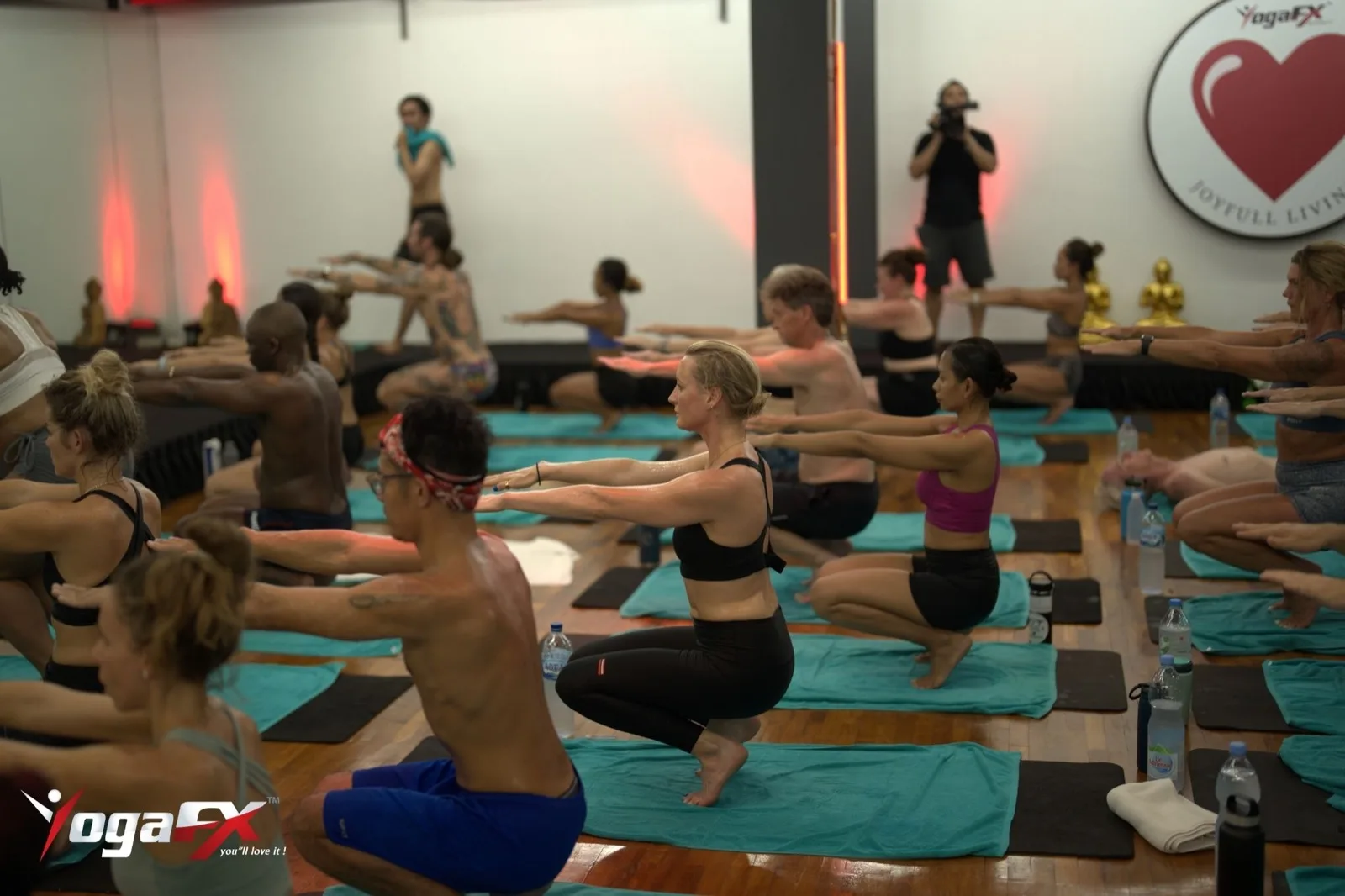
After Standing Deep Breathing, the class moves into the standing series. Postures such as Awkward Pose and Eagle Pose are strong holds. Your heart rate rises, and your mind offers a list of reasons to quit. This is where many first-timers feel anxious, and it's also where the practice happens. Is hot yoga good for anxiety in these hard moments? Often yes, because you learn to stay calm while the body works.
The dialogue doesn't ask you to ignore the discomfort. It asks you to keep the breath slow through it. Try this simple order in your next class:
- Breathe out first. A long exhale through the nose is easier to control than a big inhale.
- Keep your eyes still. The mirror gives your gaze one place to rest, so your attention follows.
- Name one fix. Pick a single instruction from the dialogue, such as "knees together", and do only that.
Stillness Between Postures: The Part Most People Skip
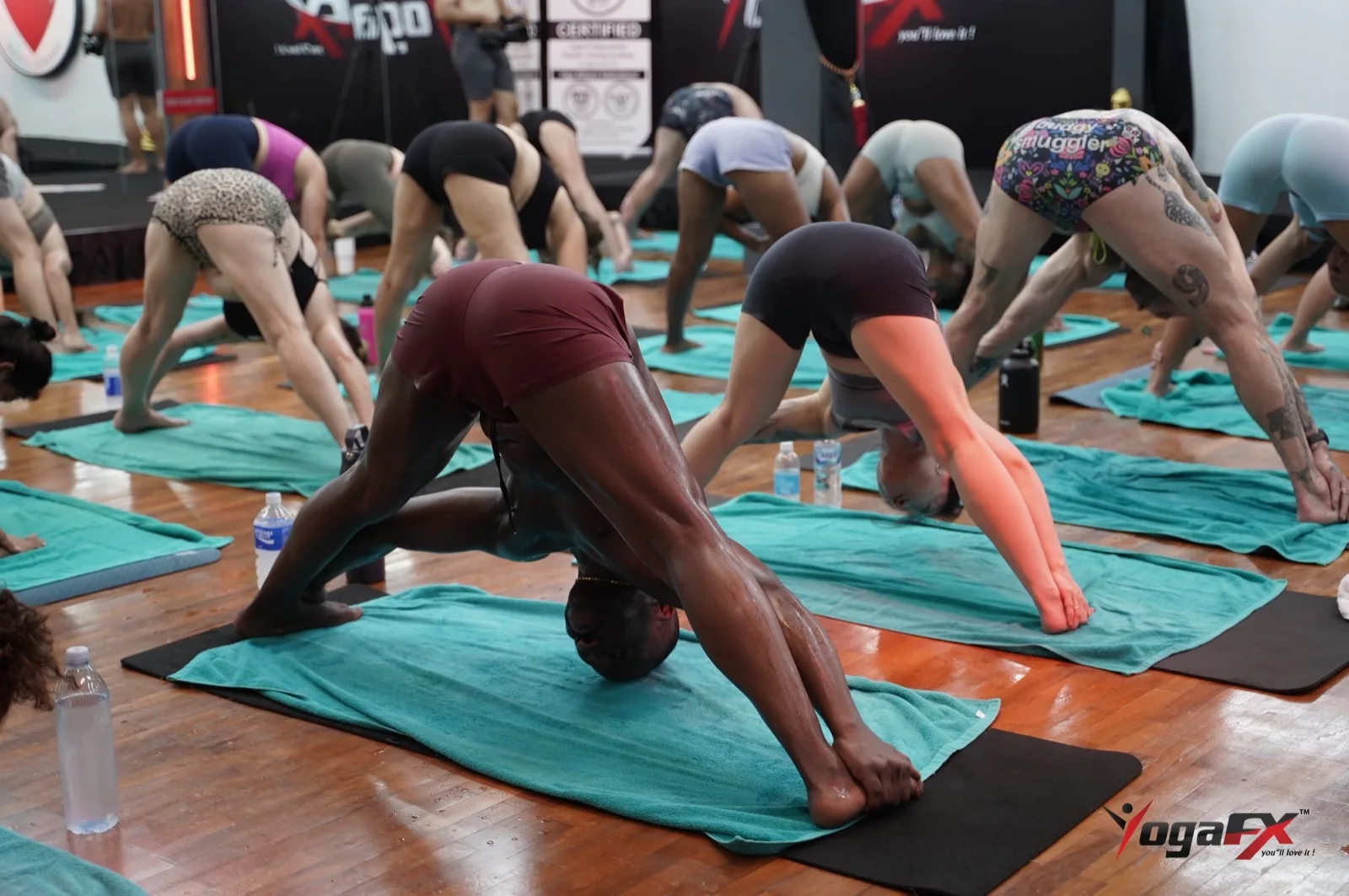
When people ask is hot yoga good for anxiety, they rarely mention the rests. Yet ask a new student which part of the class was hardest, and many say the pauses. After the standing series, the class lies down in Savasana for two minutes. Shorter rests follow between the floor postures. You're asked to lie flat, stay quiet and let the heart rate settle by itself.
For a restless mind, this feels odd at first. You've just worked hard, and now the teacher gives you nothing to do. Thoughts get louder. Your hand wants to wipe your face. Yet that moment is exactly what the stillness trains: noticing the urge to move and letting it pass.
In our experience, this skill travels. Few people feel anxious in Eagle Pose, but many feel it in bed at 2 a.m., when there's nothing to do and the mind fills the gap. Two minutes of practice with an urge is a gentle rehearsal.
One 2015 trial looks at the same skill. Medina and colleagues, writing in Cognitive Behaviour Therapy, tested an 8-week, twice-weekly hot hatha yoga course in 52 women who ate in response to stress. They looked at distress tolerance, the ability to stay with an uncomfortable feeling.
We've read only the design line of that abstract, so we don't quote its results. We mention it because distress tolerance is what stillness practises.
Where Breath and Stillness Appear in One 26 and 2 Class
To answer is hot yoga good for anxiety in practice, here is the whole class through one lens. The format is fixed, so each of these moments arrives in the same order every time you practise. Read the last column as our teaching view, not a research finding.
| Moment in class | What the dialogue asks | What it asks of you | Skill it practises (our teaching view) |
|---|---|---|---|
| Pranayama (Standing Deep Breathing) | Slow breaths, paced by the teacher | Follow, don't plan | Finding a slow breath on purpose |
| Standing series holds | Hold, keep the gaze, keep breathing | Stay with effort and heat | Steady breath under load |
| Savasana after the standing series | Lie still for two minutes | Do nothing, on purpose | Letting urges pass without acting |
| Rests in the floor series | Short pauses between postures | Settle quickly, then go again | Recovering between efforts |
| Kapalbhati (Blowing in Firm) | Quick, forceful exhales to close | Finish with a clear head | Ending the class with an active breath |
Notice what's missing. There is no music, no demonstration and no choice of pose. Because those decisions are gone, your attention has fewer places to wander. We cover that idea for men in particular in our guide to the dialogue as a focus tool.
Is Hot Yoga Good for Anxiety? What the Research Says
We opened each source below before using it. Where a page wouldn't open, we left the claim out.
The US National Institutes of Health summary
The National Center for Complementary and Integrative Health reviews the evidence in its page on yoga effectiveness and safety. For stress, it reports that a 2020 review of 12 studies in healthy adults found beneficial effects on perceived stress in all of them. For anxiety in general, a 2019 review of 38 studies found "a substantial beneficial effect", with the largest effects in studies done in India.
Then comes the caution. A 2021 review of people with diagnosed anxiety disorders couldn't reach conclusions, because too few rigorous studies exist. The page states that "there's little evidence of a benefit for people with anxiety disorders", and a 2021 trial of Kundalini yoga for generalised anxiety disorder found it less helpful than cognitive behavioural therapy.
So is hot yoga good for anxiety, according to the research? It looks promising for everyday stress and feeling calmer. It isn't proven as a treatment for an anxiety disorder, and none of these reviews was specific to hot yoga.
What this means for a 26 and 2 student
- Everyday stress: the evidence is the most encouraging here, so a class is a reasonable thing to try.
- A diagnosed anxiety disorder: treat the class as an addition to care, never a swap for it.
- Hot versus regular yoga: nothing we opened shows heat adds anything extra for anxiety, so don't pick the hot room for that reason alone.
For the depression side of the research, see our plain-English guide to the hot yoga depression study.
5 min
NHS calming breath
The NHS says to repeat its breathing exercise for at least 5 minutes.
2 min
Savasana in class
Two minutes of stillness after the standing series, with shorter rests later.
12 of 12
Stress studies
A 2020 review found benefits for perceived stress in all 12 studies of healthy adults.
38 studies
Anxiety in general
A 2019 review reported a substantial beneficial effect on anxiety.
Too few
Anxiety disorders
A 2021 review could not reach conclusions for diagnosed disorders.
When Hot Yoga Can Make Anxiety Feel Worse
Heat changes how the body feels. The US Centers for Disease Control and Prevention lists the symptoms of overheating on its page About Heat and Your Health: muscle cramping, unusually heavy sweating, shortness of breath, dizziness, headaches, weakness and nausea. Its warning is plain: "If your body gets too hot, you can get sick."
Read that list again as someone who's prone to panic. Shortness of breath, a pounding head and dizziness can feel a lot like a panic attack. In our teaching experience, students who are new to heat sometimes misread a normal reaction to the room as danger, and the worry then feeds itself. Knowing the pattern in advance helps.
The NCCIH page also warns that hot yoga carries risks of overheating and dehydration. It says pregnant women should see a health care provider first and avoid hot yoga. Older adults and people with health conditions should talk with their provider and the instructor too.
It adds a line we agree with: "Don't use yoga to postpone seeing a health care provider about a medical problem."
- Speak to a doctor first if you have a heart condition, high blood pressure, are pregnant, or take medication that affects how you handle heat.
- Skip the class on days you're ill, badly dehydrated or running on no sleep.
- Step out or lie down if you feel dizzy, nauseous or faint. No teacher will mind.
- Tell the teacher before class that you're anxious. They can point you to a spot near the door.
How to Try a First Class If Your Mind Runs Fast
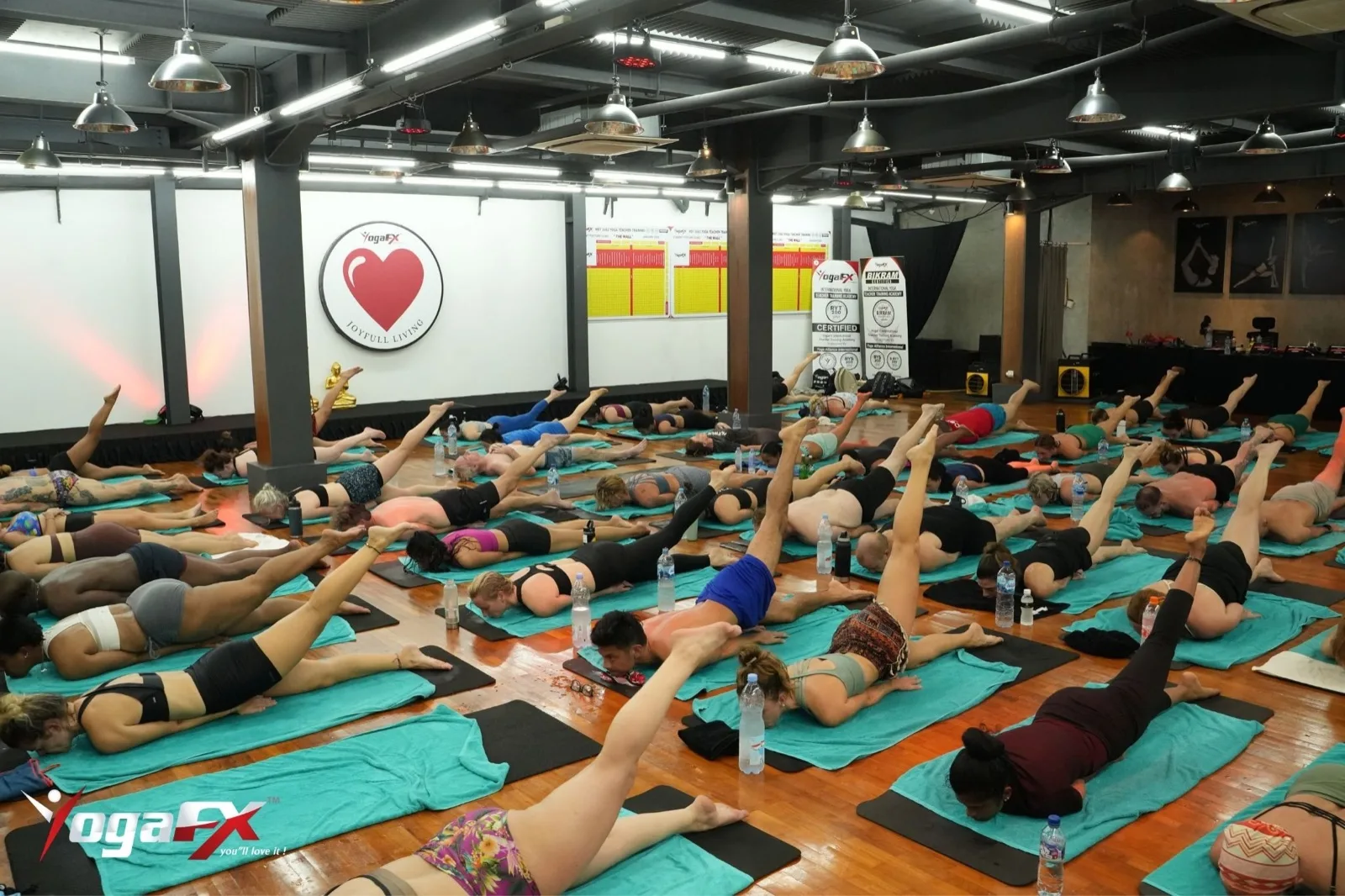
If you still wonder is hot yoga good for anxiety for you, run a small experiment. Treat the first class as a trial, not a test. Here is a plan that keeps the risk low:
- Check with your doctor first, especially with any heart, blood pressure or pregnancy question.
- Drink water well before class, and eat something light a couple of hours earlier.
- Choose a spot near the door or the back. Knowing you can leave removes a lot of pressure.
- Give yourself one job: the breath. Ignore your flexibility and your neighbour.
- Rest whenever you need to. Sit down, lie down, take a sip. Resting is part of the class.
- Stay for Savasana. Even if you do little else, the final stillness is where the practice sinks in.
Expect the first two or three classes to feel rough. Heat is the main challenge at first, and calm usually arrives once the body adapts. Most beginners do well with one or two classes a week while they learn. Our guide to how often to do 26 and 2 yoga covers the schedule in more detail.
What Students Say About the Experience
Is hot yoga good for anxiety? Students rarely answer that directly, and none of the reviews below is about treating anxiety, so we don't present them as proof. They show what students notice after a week of breathing, listening and standing still. The first comes from a video review recorded at the end of a teacher training.
Olga called her six-day course "very challenging" and "deeply rewarding", said it made her stronger physically, mentally and spiritually, and finished by saying "that was a good decision to come here." You can watch her review below.
Two Google reviewers put it in simpler terms. Yayuk, who reviewed in Indonesian, wrote that the teacher training experience helped her become more confident:
"Amazing... The teacher training experience really helped me become more confident."
Yayuk, Google review, 2024 (translated)
Ira thanked Mr. Ian for teaching her yoga so well and said she felt proud to be a student of YogaFX. She left her review in 2020 and, like the others, it speaks to confidence and care rather than to any medical result.
"I say thank you to Mr Ian, because he teaching me yoga very well."
Ira, Google review, 2020
The Bottom Line: Is Hot Yoga Good for Anxiety?
Is hot yoga good for anxiety? It can be a useful practice for stress, built on slow breathing and stillness, as long as the heat suits your body and you keep any care you already have. It isn't a treatment, and it isn't for everyone. Try one class, rest when you need to, and notice how you feel an hour later.
Learn the Breath and the Dialogue With Mr. Ian Terry
Some students come to the 26 and 2 for a calmer head and stay for the method. If you want to understand the breathing, the stillness and the dialogue from the inside, or teach them, that's what the YogaFX training is built for. Every cue in this guide is taught word for word, with the reasoning behind it.
- Your teacher: Mr. Ian Terry, E-RYT 500, with 12,000+ teaching hours and 1,500+ graduates from 80+ countries since 2017.
- Lineage: five years, from 2014 to 2019, training with the founder of the method.
- Format: a 6-day hybrid, with online pre-course study, then an intensive in Bali.
- Certification: Yoga Alliance RYT 200-Hour and a Bikram Hot 26&2 200-Hour International Yoga Certification.
The Bikram Hot 26&2 Yoga Teacher Training MasterClass next checks in on Sunday 24 January 2027 and checks out on Friday 29 January 2027, at Soham Wellness Center in Seminyak. See the 26 and 2 yoga teacher training page for dates and inclusions.
FAQ
Is hot yoga good for anxiety and panic attacks?
Not always. Heat can bring on dizziness, a pounding head and shortness of breath, and these feel a lot like panic. Drink water first, pick a spot near the door, rest whenever you need to, and leave the room if you feel unwell. Speak to a doctor if you worry.
Can hot yoga help with anxiety?
It may help with everyday stress and feeling calmer, mainly through slow breathing and stillness. Research on yoga for stress is encouraging, but evidence for diagnosed anxiety disorders is limited. Treat a class as a support alongside care, never a replacement, and speak to a healthcare professional if anxiety affects your daily life.
What type of yoga is best for anxiety?
No single style is proven best. A fixed class like the 26 and 2 suits people who like structure, because the dialogue sets every move and breath. A cooler, slower class may suit others better. Choose what you'll attend regularly, and tell the teacher you're anxious before you start.
Who should not do hot yoga?
Pregnant women, people with heart conditions or high blood pressure, and anyone who is unwell or badly dehydrated should speak to a health care provider first. The US National Institutes of Health advises pregnant women to avoid hot yoga. Older adults and people on certain medications should also ask their doctor and the instructor.
How long does it take to get used to hot yoga?
Most students feel the heat ease within two to three weeks of regular classes, though it varies. The first few classes often feel rough as your body adapts. Practise once or twice a week, drink water beforehand, rest when you need to, and don't judge your progress by the first class.
Still have questions? Message Mr. Ian and the YogaFX team on WhatsApp and we'll answer them personally. This article is general information, not medical advice. If anxiety or low mood affects your daily life, consult a healthcare professional. If you're in crisis, contact your local emergency number or a crisis line today.