Triangle pose (Trikanasana) is the ninth posture in the 26 and 2 yoga sequence. You stand wide, bend the front knee, reach long through the spine and look up past a straight top arm. This guide takes triangle pose cue by cue, with the common errors and how hard it is in the heat.
Table of Contents
Triangle Pose in the 26 and 2: Where It Sits and Why It Matters
A 26 and 2 class is 26 postures and 2 breathing exercises, in the same order, for 90 minutes at about 40°C. Triangle pose arrives late in the standing series. It follows Standing Separate Leg Stretching and comes just before Standing Separate Leg Head to Knee. Our guide to the 26 and 2 yoga sequence shows the whole order.
Like every posture in the method, triangle pose is done in two sets on each side. The teacher talks you in, you hold, you come out, and then you do it again. That repeat is the point. The second set shows you what you changed.
The Sanskrit name is usually written Trikonasana. The sequence lists it as Trikanasana, and both point to the same idea: a shape made of three angles. Your legs, your torso and your arms build that shape between them, and none of them can hide.
Why triangle pose feels harder than it looks
From the back of the room, triangle pose looks like a calm stretch. Inside, it is a lot of work. The front leg holds a deep bend, the back leg stays straight and strong, and the spine has to stay long while the chest turns toward the ceiling.
That is why many students are surprised when it lands as a hard posture. If you wonder whether the whole class is that demanding, read our honest answer to is 26 and 2 yoga hard. Triangle pose is one of the postures that makes the answer interesting.
Triangle Pose Cue by Cue: 8 Steps From Standing to Release
The exact dialogue is taught live, and we do not reproduce the script here. What follows is a plain-language map of the cues, in the order you hear them, so you know what each one is asking for. In the room, always follow your teacher and the full dialogue.
- Set the wide stance. Step your feet far apart, so that you have a base wide enough to bend the front knee without losing the back leg.
- Turn the front foot out. The front foot points to the side, and the back foot stays almost straight ahead. Line the heel of the front foot up with the arch of the back foot.
- Lift the arms and stay tall. Raise both arms to shoulder height, parallel to the floor, with the spine long before you move anywhere.
- Bend the front knee. The front knee bends deeply over the ankle while the back leg stays straight and strong. This is the cue that starts the heat in your thighs.
- Send the hips back and lean. Push the hips away from the front knee, so the chest can open instead of folding forward.
- Reach with the top arm. The top arm extends past the ear and stays straight, with the bicep close to the head.
- Turn the gaze upward. Look toward the ceiling past the top arm, without cranking the neck. Breathe slowly while you hold.
- Come out as one piece. Rise slowly with the arms still long, then reset your feet before you repeat on the other side and in the second set.
Notice how each step fixes the one before it. The wide stance makes the knee bend possible, and the knee bend makes the hips and chest work. Take one cue out and the whole shape wobbles.
| Cue theme | What the cue is for | What it feels like when it works | What goes wrong |
|---|---|---|---|
| Wide, even stance | Gives the front knee room to bend over the ankle | Both feet feel heavy and the legs feel like a base | Feet too close, so the knee drifts past the toes |
| Front foot turned out | Points the knee and hip the same way | The inner thigh and hip open without a twist in the knee | Foot pointing forward while the knee turns out |
| Deep front knee bend | Builds strength in the front thigh and hip | A strong burn in the front quad and glute | Knee caves inward or the bend is too shallow |
| Back leg straight | Anchors the stretch through the inner back thigh | The back hamstring and calf feel long, not locked | Back knee locked hard or bent without noticing |
| Hips sent back | Keeps the chest open and the spine long | The chest turns toward the ceiling with space | Hips pushed forward and the chest rounds down |
| Top arm past the ear | Lengthens the whole side body | One long line from the back foot to the fingertips | Arm drops forward or the shoulder shrugs up |
When the full shape is out of reach
Not everyone gets a deep knee bend on day one, and that is fine. A student with tight hips may keep the stance a little narrower and the bend shallower. A student with a sore knee should tell the teacher before class. Your teacher can adjust the shape, and you can still follow the cues in order.
Common Triangle Pose Mistakes and How to Fix Them
Most triangle pose mistakes come from rushing the setup. Students rush into the lean before the stance is right. Here are the five we see most often in class, with the first fix to try.
- Front knee falling inward. Press the knee toward the little-toe side of the foot and keep it over the ankle.
- Chest dropping toward the floor. Send the hips back and lift the chest, so the spine stays long.
- Back leg collapsing. Push through the outer edge of the back foot and keep the leg straight.
- Neck cranking up. Turn the gaze only as far as the neck allows, and let the eyes find a spot, not the head.
- Holding the breath. A tense breath tightens everything, so slow the exhale and let the shoulders drop.
For example, a student who locks the back knee often feels it behind the knee after class. A soft but strong back leg is safer and still works the inner thigh. If any joint pain shows up, back out of the posture and tell your teacher.
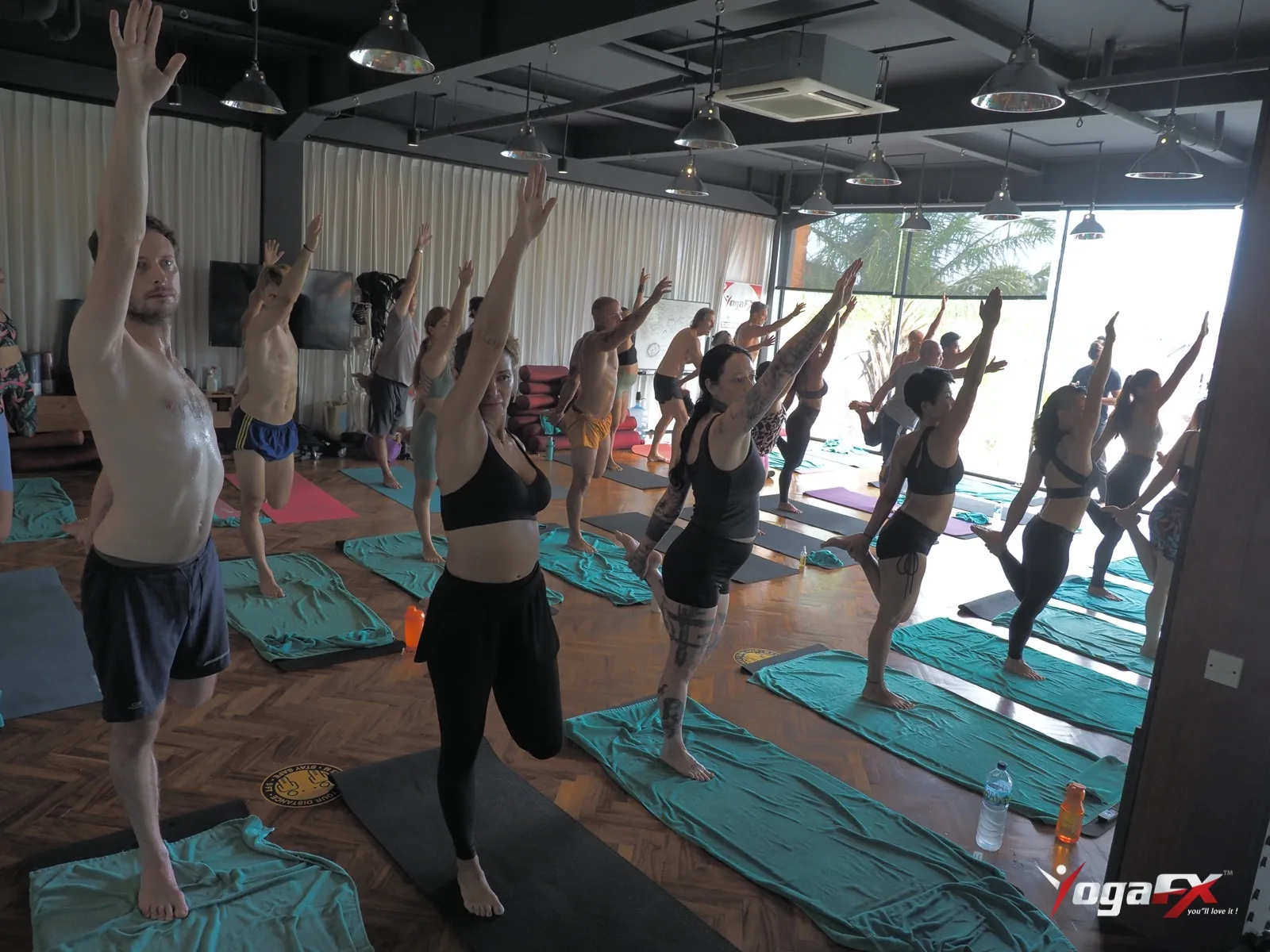
If you are a runner or play sport, triangle pose is a useful test of how your hips share the load. Our guide to hot yoga for athletes explains where else the standing series fills training gaps.
Triangle Pose Intensity: Why It Sits in Zone 3 to 4 in the Heat
Heart rate zones are bands of your maximum heart rate, and the common estimate for that maximum is 220 minus your age. On our working map of the class, triangle pose sits in Zone 3 to 4, roughly 70 to 90% of maximum. That is a working estimate from published study ranges, not a measurement of this posture alone.
Why is it that high? Because triangle pose combines a deep knee bend, a long hold and deep breathing in a 40°C room. The big leg muscles do the work, and the heat asks your heart to beat faster so you can cool down. Our article on whether hot yoga is a cardio workout unpacks how heart rate and oxygen cost can disagree.
| Stage of class | Postures | Working zone (estimate) |
|---|---|---|
| Opening breath | Standing Deep Breathing | Zone 1 |
| Early standing series | Half Moon, Awkward, Eagle | Zone 3 to 4 |
| Mid standing series | Standing balances and stretches | Zone 4, brief Zone 5 |
| Late standing series | Triangle pose and related wide-leg work | Zone 3 to 4 |
| First half of floor series | Cobra, Locust and variations | Zone 2 to 3 |
| Closing breath | Blowing in Firm | Zone 1 to 2 |
For a sense of the whole class, a 2014 University of Wisconsin study (Porcari et al.) measured a standard 90-minute hot class at about 333 kcal for women and 460 kcal for men. That figure covers the full class, not triangle pose alone.
Heat, stretch and staying safe
Mayo Clinic advises stretching when your muscles are warm, because you may hurt yourself if you stretch cold ones. It also says to stretch in a smooth movement without bouncing, and to expect tension, not pain. That advice fits triangle pose well, since it comes late in the standing series, after fifteen minutes of full-body work.
On flexibility itself, Harvard Health notes that the more often you stretch your muscles, the longer and more flexible they become. So regular practice can lengthen the hamstrings and hips that triangle pose asks for. The hot room makes the stretch feel easier, but heat can also hide how far you are pushing, so let tension, not depth, be your guide.
This is general information, not medical advice. If you have a knee, hip, back or neck problem, high or low blood pressure, or you feel dizzy in the heat, speak to a healthcare professional before you practise, and tell your teacher before class.
Triangle pose at a glance
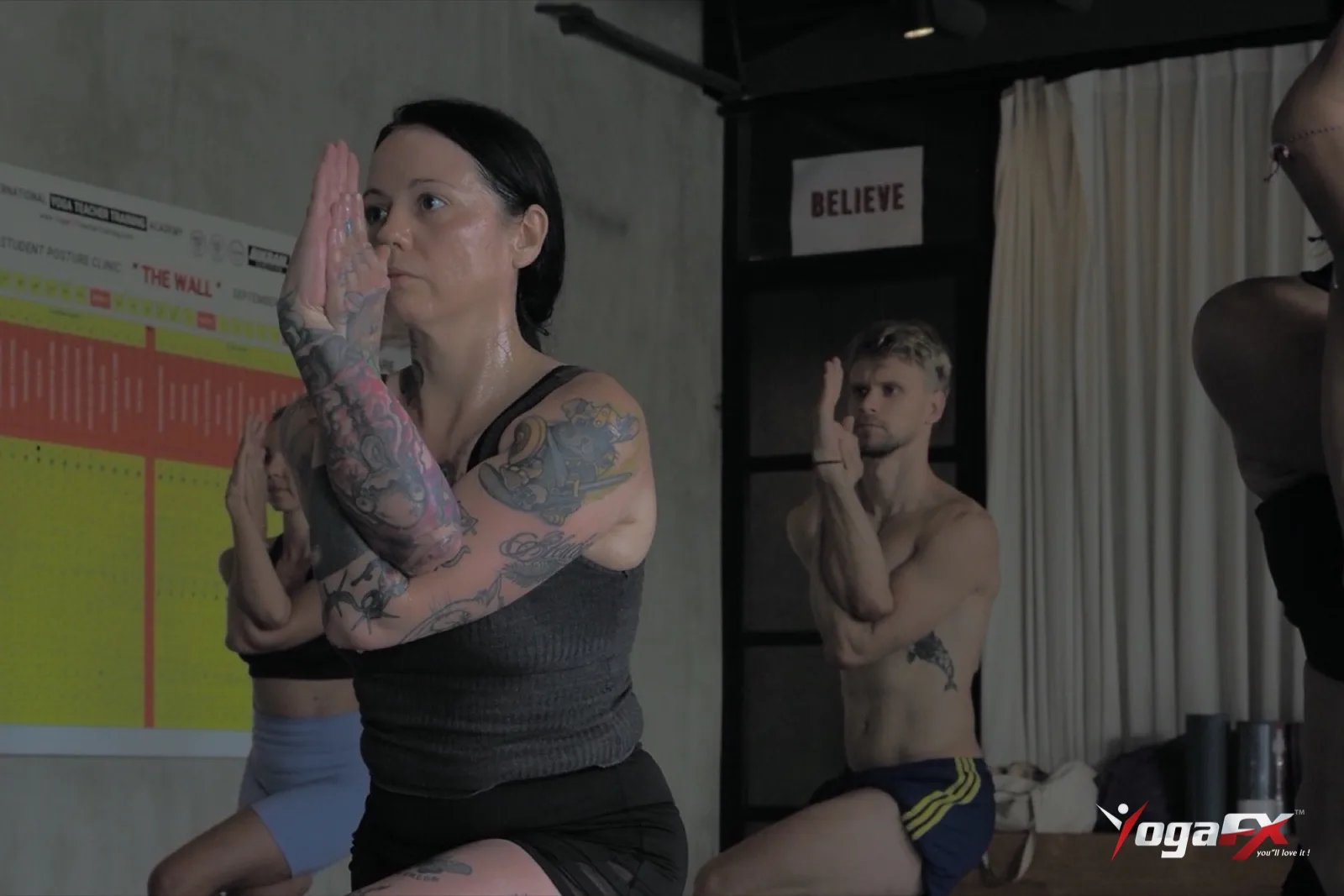
Triangle Pose vs the Triangle Pose in a Flow Class
Many people meet triangle pose in a vinyasa or hatha class first. The shape has the same name, but the teaching is different. In a flow class the cues change from teacher to teacher, and the stance and arm position can vary. In the 26 and 2, triangle pose is taught from a fixed script in a fixed place, with the same words every class.
That fixed script matters for learning. When you hear the same cues in the same order, you notice your own changes, not the teacher's. If you already know triangle pose from another style, expect the 26 and 2 version to feel more precise and, in the hot room, more demanding.
How Mr. Ian Terry Teaches Triangle Pose to Trainees
Mr. Ian Terry, E-RYT 500 with more than 12,000 teaching hours, leads the teacher training at YogaFX in Bali. He trained for five years, from 2014 to 2019, with the founder of the Bikram Hot 26&2 method. For a posture like triangle pose, that history shows up in how trainees learn to speak.
Trainees learn to cue the posture with words alone. They practise naming where the weight sits in the front foot, where the knee points and where the hips drift. In the posture clinic, a trainee spots a misaligned student and corrects the shape with voice and hands. A video cannot teach that, because a video cannot tell which cue the student needed.
If you want to learn to teach it, our guide on how to choose a yoga teacher training lists the questions to ask any school, and the 26 and 2 teacher training page shows how the course is built.
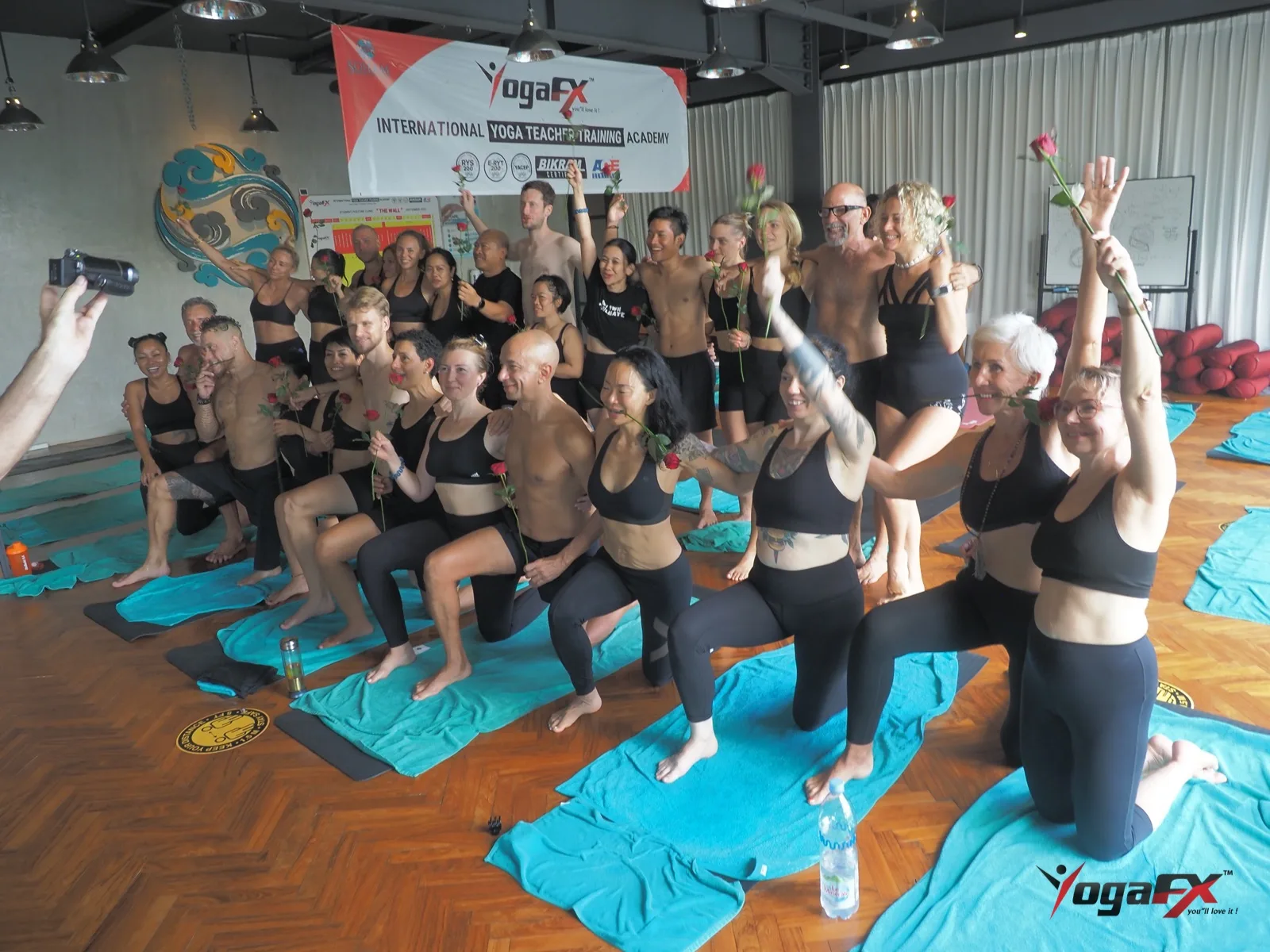
What Trainees Say About Learning the Postures in Bali
Students rarely describe one posture when they look back. They describe the group, the effort and the days they stuck with it. Here are three reviews from YogaFX trainees, with first names only.
I think this was my biggest challenge in all of my life. ... Now I'm so proud of me and to believe in myself.
Franci, YouTube review, 2026 (transcript, lightly edited)
I couldn't imagine doing it with another group of people, but I am looking so much forward to coming back.
Lisa, YouTube review, 2026 (transcript, lightly edited)
Grateful for all of you. I don't think I could have made it without you.
Zainab, YouTube review, 2026 (transcript, lightly edited)
Franci's full video review is below. She talks about travelling alone, learning in English and finishing the training.
How to Prepare for Triangle Pose Before Your Next Class
You do not need a special routine. A few habits make triangle pose feel steadier when it arrives in class. Keep the preparation modest, and stop if anything hurts.
- Hydrate before class. Drink water earlier in the day so you are not catching up in the room.
- Practise the stance. At home, stand wide, turn the front foot out and bend the front knee a little. Hold for a few breaths each side.
- Listen for the order. In class, notice which cue comes first and which comes last. The order is the map.
- Compare your two sets. After the first set, ask what you could soften or lengthen. The second set is your answer.
Expect the first weeks to feel clumsy. That is normal, because your legs and hips are learning a new shape. Two or three classes a week are plenty for most students, and rest days matter as much as the work.
Where to Go Next
Triangle pose is one posture in a longer chain. Once it feels familiar, read how the rest of the order fits together, and notice how the heat changes what each posture asks of your legs. If balance is your weak spot, try balancing stick pose next.
If you would like to learn to teach these postures in your own voice, message Mr. Ian on WhatsApp and he will explain how the training runs and what the next batch looks like.
FAQ
What is triangle pose in yoga?
Triangle pose is a standing posture with a wide stance, a turned-out front foot and a long spine. In the 26 and 2 method the front knee bends deeply, the back leg stays straight, and the top arm reaches past the ear. It is the ninth posture in the sequence and is done twice on each side.
What is the Sanskrit name for triangle pose?
The usual Sanskrit name is Trikonasana, and the 26 and 2 sequence lists it as Trikanasana. Both names point to a triangle shape made by the legs, torso and arms. In English it is simply called triangle pose, and teachers in the 26 and 2 use that name in class.
What muscles does triangle pose stretch?
Triangle pose stretches the hamstrings, inner thighs and hips, and it lengthens the side body. It also works the front thigh and glute, which hold the deep knee bend. The exact feeling varies by student, so follow tension, not pain, and tell your teacher about any injury before class.
How hard is triangle pose in hot yoga?
Triangle pose is demanding in a hot class. On our working map it sits in heart rate Zone 3 to 4, roughly 70 to 90% of maximum, because of the deep knee bend, the hold and the heat. That is an estimate, not a measurement, so use your breath and effort as your guide.
How do you cue triangle pose?
Cue it in order: set a wide stance, turn the front foot out, lift the arms, bend the front knee, send the hips back, reach the top arm and turn the gaze up. Each cue fixes the one before it. In the 26 and 2, teachers follow a fixed script for the exact words.
Still have questions? Message Mr. Ian and the YogaFX team on WhatsApp and we will answer them personally.