Eagle pose (Garudasana) is a standing balance. You stand on one bent leg, wrap the other leg over it, wrap the arms in front of the chest, and sit low while the eyes stay fixed. In the 26 and 2 it is the third standing posture, and this guide gives the cues, the common errors and a safe depth.
Table of Contents
Eagle Pose in the 26 and 2: Where It Sits and What It Asks
A 26 and 2 class is 26 postures and 2 breathing exercises, in the same order, for 90 minutes at about 40°C. Eagle pose comes in the standing series, after Half Moon and Awkward Pose and before Standing Head to Knee. Our guide to the 26 and 2 yoga sequence shows the whole order.
Like every posture in the method, eagle pose is done in two sets, and you do it on both sides. The teacher talks you in, you hold, you come out, and then you go again. The first set shows you where you wobble. The second set lets you fix it. That is how we teach it at YogaFX in Bali.
Eagle pose looks like a small shape. In a 40°C room it is not. The standing leg has to stay bent, the hips have to stay level, the shoulders have to stay down, and the breath has to stay slow. That is a lot of jobs for one body, so most students feel it long before they feel graceful.
Why the name matters
Garudasana comes from Garuda, the Sanskrit name for the eagle, the king of birds in Indian stories. Asana means pose. The picture is a bird perched on a branch, wings folded tight across its chest, eyes locked on one point.
That picture is a useful cue in itself. The legs hold like a perch, the arms stay close like folded wings, and the gaze does not wander. In English you will hear eagle pose, and in a 26 and 2 class the teacher uses the English name while the dialogue does the rest.
Eagle Pose Step by Step: 8 Cues From Standing to Release
The exact dialogue is taught live, and we do not reproduce the script here. What follows is a plain-language map of the cues in the order you hear them, so you know what each one is asking for. In the room, always follow your teacher and the full dialogue.
- Stand tall with the feet together. Let the weight fall evenly through both feet and lift the chest.
- Bend the knees and sit back. Lower the hips as if you were sitting on a low chair, and keep the spine long.
- Shift the weight onto one leg. Press the standing foot into the floor and keep the standing knee bent the whole time.
- Cross the other leg over the thigh. Lift it, place it over the standing thigh, and hook the foot behind the standing calf if it reaches.
- Cross the arms in front of the chest. One elbow goes under the other, then the forearms and palms come together.
- Lift the elbows and drop the shoulders. The elbows rise to about chest height while the shoulders stay away from the ears.
- Sit lower and fix the eyes. Settle the hips down a little more, keep the back straight, and stare at one point in the mirror.
- Unwrap slowly and rest. Release the arms, uncross the leg, stand tall, and breathe before you switch sides.
Notice how each cue protects the next one. The bent standing leg gives the hips something to sit on, the sitting hips give the wrap a stable base, and the fixed gaze keeps the balance quiet. Take one cue out and the whole shape gets shakier.
What each cue is for
| Cue theme | What the cue is for | What it feels like when it works | What goes wrong |
|---|---|---|---|
| Feet together, then sit back | Builds a low, stable base for the balance | Thighs and hips feel switched on | Standing up tall too early and losing the seat |
| Standing knee stays bent | Keeps the weight over the leg and protects the knee | The standing leg feels strong, not locked | Locking the knee straight and wobbling more |
| Cross leg over the thigh | Wraps the outer hip and thigh and shortens the lever | A stretch across the outer hip of the top leg | Forcing the foot behind the calf and twisting the knee |
| Arms crossed, elbows up | Stretches the upper back and shoulder blades | A wide pull across the upper back | Shrugging the shoulders up around the neck |
| Eyes fixed on one point | Gives the brain one steady reference | The wobble gets smaller and the breath slows | Looking down or around and tipping over |
The two wraps in plain words
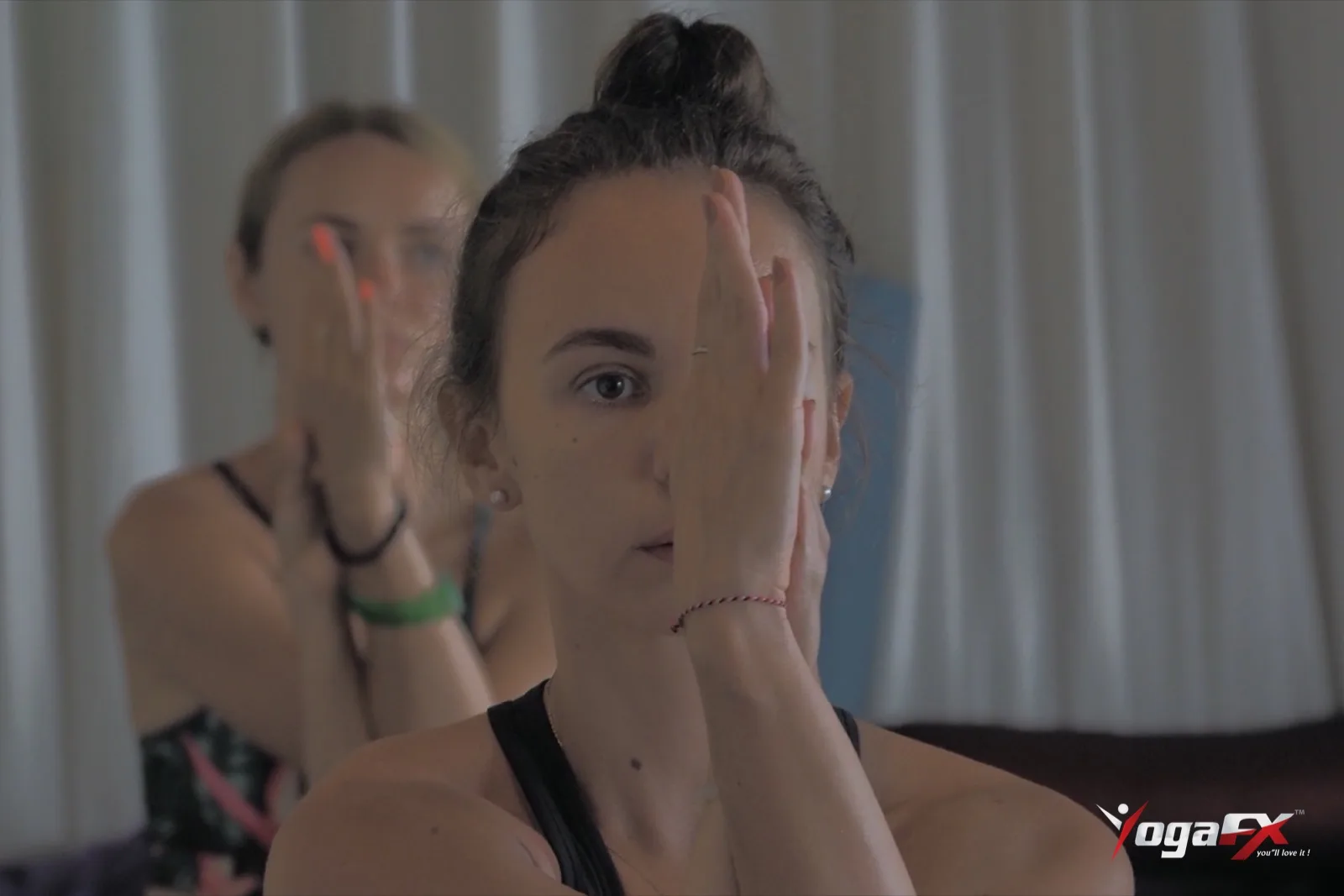
Two wraps decide most of the shape. The first is the leg wrap. Cross the top leg over the thigh, not over the knee, so the joint does not take a twist. If the foot does not hook behind the calf, let the toes rest on the floor and treat that as a perfectly good eagle pose.
The second is the arm wrap. Cross the elbows, bring the forearms together, and lift the elbows to chest height. If the palms will not touch, press the backs of the hands together or hold opposite shoulders in a hug. Depth does not matter here. Control does.
Common Eagle Pose Errors and How to Fix Them
Most eagle pose errors come from chasing the wrap. Students see the tight twist on the next mat and think tighter is better. Here are the six we see most often in class, with the first fix to try.
- Standing knee locked or caved in. Keep the knee soft and point it over the second toe, so the leg stays strong.
- Leaning the chest forward. Sit the hips back and lift the chest, because the body only balances when the weight stays over the foot.
- Shoulders hiked to the ears. Slide the shoulder blades down the back and lengthen the neck.
- Forcing the foot behind the calf. Rest the toes on the floor instead, because a forced hook twists the knee.
- Holding the breath. Breathe slowly through the nose and keep the jaw soft, since a held breath tightens the whole body.
- Eyes drifting around the room. Pick one point at eye level and keep it, because the gaze steadies the legs.
For example, a student who always falls out of eagle pose to the same side is usually leaning away from the standing leg. A lower seat and a steady point of focus fix both at once. If you feel sharp pain, pinching or tingling, come out, rest, and tell your teacher.
Eagle Pose Benefits: What It Trains and What We Do Not Claim
Eagle pose is a balance posture, a hip and upper back stretch, and a lesson in staying calm under load. We do not claim it treats any condition. We can say what it asks of the body, and what trusted health sources say about balance and stretching, because both shape how we teach it.
- Single-leg balance. The standing leg, ankle and hip all work to keep you upright, which trains the small stabilising muscles.
- Outer hip and thigh stretch. The wrapped leg stretches the outer hip, so many students feel it where they sit all day.
- Upper back and shoulder stretch. The crossed arms open the space between the shoulder blades.
- Focus under load. A fixed gaze while the legs burn is a small, daily practice in keeping your mind on one thing.
What health sources say about balance and stretching
The NHS describes a simple one-leg stand: lift one leg, keep the hips level, keep a slight bend in the standing leg, hold for 5 to 10 seconds, and do 3 on each side. It also says to do balance exercises near a wall or a stable chair in case you lose your balance, and to aim for at least twice a week. See the NHS balance exercises page. Eagle pose is a deeper version of the same idea.
On stretching, Harvard Health says that the more often you stretch your muscles, the longer and more flexible they become. It also calls it crucial to warm up the muscles before you stretch them. That is one reason eagle pose sits in the standing series and not at the start of class.
Mayo Clinic advises that you stretch in a smooth movement without bouncing, and that you should expect tension while you stretch, not pain: "If it hurts, you've pushed too far." In a hot room the stretch can feel easier than it is, so let tension, not depth, be your guide.
A 2014 study from the University of Wisconsin-La Crosse (Porcari et al.) measured a 90-minute hot class. It reported about 333 calories burned for women and 460 for men, at around 80% of maximum heart rate. So by the time you reach eagle pose, your heart is already working, and the balance is harder than it looks on a still mat.
Eagle pose at a glance
Eagle pose at a glance
This is general information, not medical advice. If you have a knee, hip, shoulder or balance problem, a recent injury or surgery, you are pregnant, or you feel dizzy in the heat, speak to a healthcare professional before you practise, and tell your teacher before class.
Easier and Harder Eagle Pose Shapes: A Safe Depth Ladder
There is no medal for the tightest wrap. A safe depth is the height where your standing knee stays soft, your breath stays slow, and you feel work in the muscles, not a pinch in the joints. Use this ladder and move up only when the step below feels steady.
| Level | What it looks like | Who it suits | Check before you go further |
|---|---|---|---|
| Kickstand eagle | Top leg crosses the thigh and the toes rest on the floor | First classes, tight hips, nervous balance | Standing knee soft and hips level |
| Arms only hug | Arms cross in a hug, legs stay in a one-leg stand | Stiff shoulders or a tender knee | Shoulders down and breath slow |
| Working eagle | Full leg cross with the arms wrapped and elbows lifted | Students who have practised for a few weeks | The gaze is steady and no knee pinch |
| Deep eagle | Foot hooks behind the calf and the seat sits low | Students with open hips and a calm mind | No pain at all and the wobble is small |
Moving up the ladder
Start with the kickstand and stay there for a while. Many students find that even the easiest shape gives a clear stretch across the outer hip. Balance holds like eagle pose often wobble less around weeks three and four. If a week feels worse than the last, go lower without any guilt.
Eagle Pose Compared With Other Standing Balance Postures
The 26 and 2 has several postures on one leg, and they ask for different things. Search results often blur them, so it helps to separate them. If balance is your weak spot, read our guide to tree pose as well.
| Pose | The standing leg | The other leg and the arms | Where the challenge sits |
|---|---|---|---|
| Eagle pose | Bent, with the hips low | Leg and arms both wrap tight | Staying calm while everything is compressed |
| Tree pose | Straight and strong | Foot rests on the thigh, hands at the chest | Quiet concentration and hip rotation |
| Standing Head to Knee | Locked straight | Leg lifts in front, hands hold the foot | Strength and a long, steady spine |
| Standing Bow Pulling | Straight and strong | Back leg kicks into the hand | Balance and a deep backbend |
| Balancing Stick | Straight and strong | Arms and back leg stretch long | Holding a long line without sinking |
If you come from a flow class
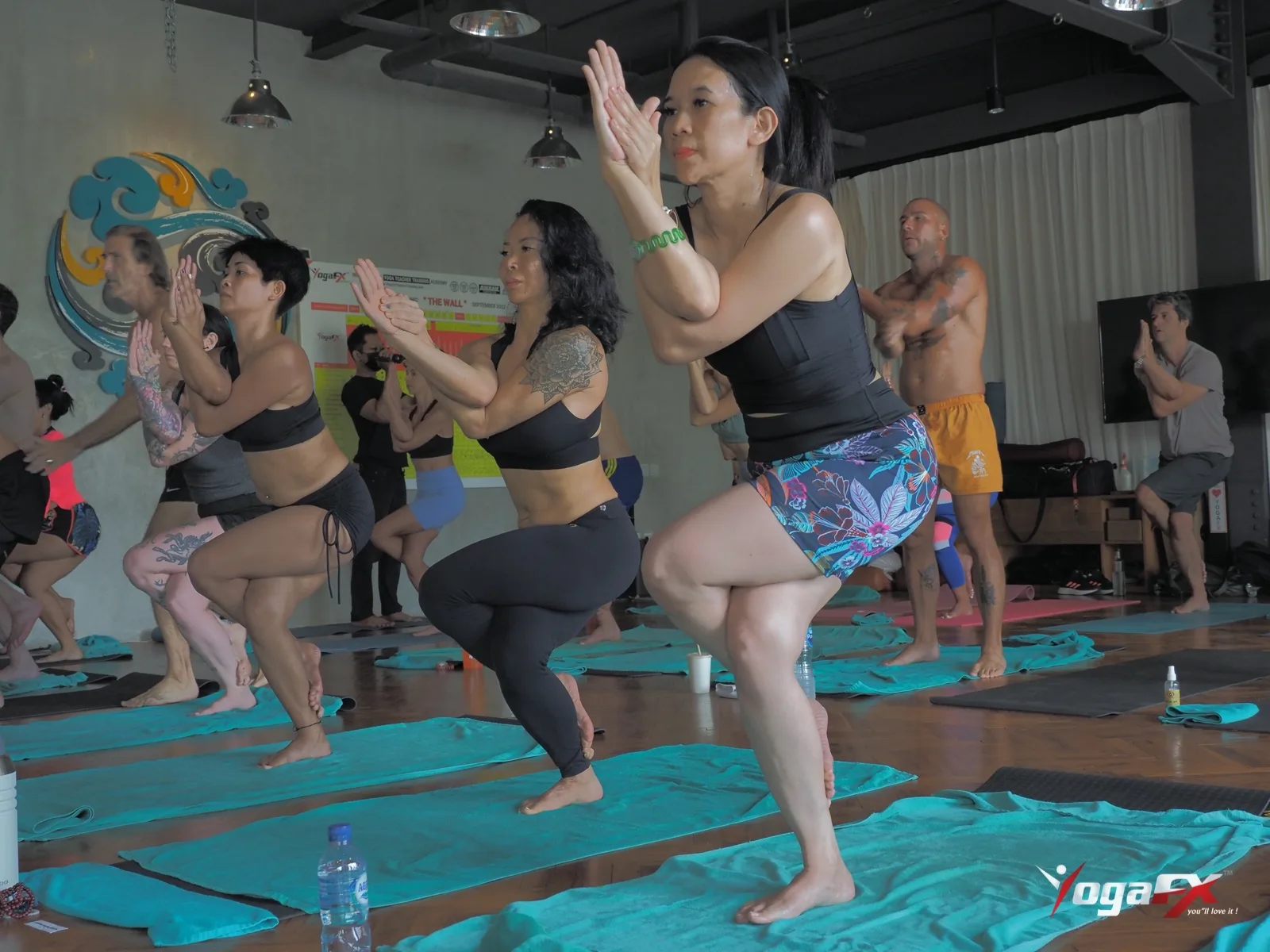
If you come from a flow class, expect eagle pose to feel slower and more precise. You will not swing through it on the way to another pose. Instead you hold the wrap, breathe, and then rest before the next side. Athletes in particular like it, especially runners and footballers who need steady single-leg control.
Why a Fixed Gaze and a Bent Knee Beat Muscle Alone
Balance is not only strength. It is also feedback, and proprioception, the body's sense of where its limbs are, plays a big part. Eagle pose uses that feedback hard, because the wrap hides your own limbs from view.
That is why the gaze matters so much. When the eyes lock onto one point, the brain gets a steady reference and the small corrections in the ankle get quieter. When the eyes dart around, the wobble grows. Try it at home with a still object at eye level, and you will see the difference within a minute.
It also explains the bent standing knee. A locked knee passes every small movement straight up the leg. A soft knee absorbs it. So the cue to keep the knee bent is not about difficulty. It is about giving the leg room to adjust. Eagle pose also appears among the postures used in yogasana sport.
What Students Say About Balance and Focus in Bali
Students rarely describe one posture when they look back. They describe the effort, the group and the teacher. Here are two reviews from YogaFX students, with first names only.
I'm so fortunate to have chosen the right yoga course, it's been educational, supportive, life-changing and very realistic.
Chelsea, YouTube review, 2019 (transcript, lightly edited)
Everything is so smooth and very well organised and very professional.
Lilywati, Google review, 2025
Chelsea's full video review is below. She talks about how the training helped her feel more comfortable in her own skin, which is the same quiet confidence a steady eagle pose builds.
How Mr. Ian Terry Teaches Eagle Pose to Trainees
Mr. Ian Terry, E-RYT 500 with more than 12,000 teaching hours, leads the teacher training at YogaFX in Bali. He trained for five years, from 2014 to 2019, with the founder of the Bikram Hot 26&2 method. For a balance posture like eagle pose, that background shows up in how trainees learn to speak.
Trainees learn to cue the shape with words alone. They practise naming where the knee should point, where the hips should sit, and when a student has started to lean. In the posture clinic, a trainee spots a student whose standing knee has locked and corrects it with a calm voice and a clear cue. A video cannot teach that, because a video cannot tell which cue the student needed.
That is why our trainees spend so long on the standing series. Learning to teach a balance safely means learning when to say less. If you want to see how the course is built, read our guide on how to choose a yoga teacher training or visit the 26 and 2 teacher training page.
How to Prepare for Eagle Pose Before Your Next Class
You do not need a special routine. A few habits make eagle pose steadier when it arrives in class. Keep the preparation modest, and stop if anything hurts.
- Hydrate before class. Drink water earlier in the day, so you are not catching up in the room.
- Practise the one-leg stand. At home, stand near a wall and balance on one leg for 5 to 10 seconds, three times each side, as the NHS suggests.
- Pick a gaze point. In class, choose one spot in the mirror before the posture starts, and stay with it.
- Compare your two sets. After the first set, ask what you could soften or lengthen. The second set is your answer.
Expect the first weeks to feel clumsy. That is normal, because your hips and ankles are learning a new habit. Two or three classes a week are plenty for most students, and rest days matter as much as the work.
Where to Go Next
Eagle pose is one posture in a longer chain. Once it feels familiar, notice how it prepares you for Standing Head to Knee, which comes next. If you want a floor posture to balance the standing work, our guide to cobra pose is a good next read.
If you would like to learn to teach these postures in your own voice, message Mr. Ian on WhatsApp and he will explain how the training runs and what the next batch looks like.
FAQ
What is eagle pose good for?
Eagle pose trains single-leg balance, stretches the outer hip and the upper back, and teaches you to stay calm under load. In the 26 and 2 it is the third standing posture. It is not a treatment for any condition, so follow tension, not pain, and tell your teacher about any injury before class.
Why is eagle pose so hard?
Eagle pose asks the body to balance on one bent leg while the leg and arms are wrapped and the room is hot. The wrap hides your limbs from view, so balance feels harder. A bent standing knee, a low seat and a fixed gaze make it much steadier for most students.
Which arm goes on top in eagle pose?
Either arm can go on top. The choice is about comfort, not safety. Pick the side that feels natural, then switch so both shoulders get the same work. In class, the teacher cues the order, so listen for it and follow along. If the palms will not meet, press the backs of the hands.
Is eagle pose hard on the knees?
It can be if you force it. Keep the standing knee soft and pointing over the second toe, and cross the top leg over the thigh, not the knee. If the foot will not hook behind the calf, rest the toes on the floor. Stop if you feel sharp knee pain.
What is the Sanskrit name for eagle pose?
The Sanskrit name is Garudasana, from Garuda, the eagle, and asana, meaning pose. The picture is a bird perched with its wings folded tight across its chest and its eyes fixed on one point. In English it is called eagle pose, and a 26 and 2 teacher uses that name when cueing it.
Still have questions? Message Mr. Ian and the YogaFX team on WhatsApp and we will answer them personally.