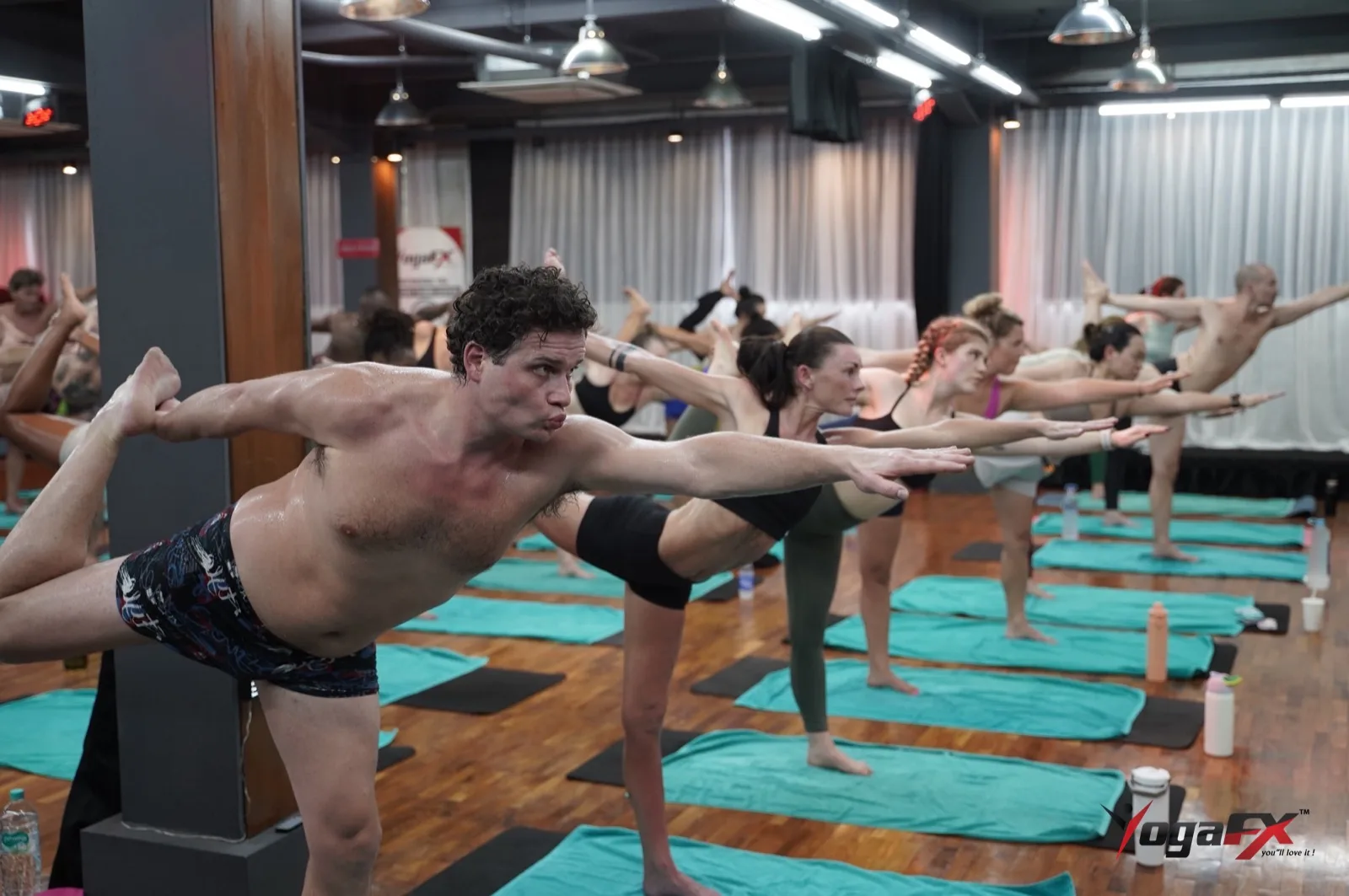
Hot 26 and 2 yoga is a fixed 90-minute class made of 26 postures and 2 breathing exercises, taught in the same order every time. The room sits near 40°C with about 40% humidity. A scripted dialogue guides you, so nobody demonstrates and no music plays. That fixed structure is the whole method.
Table of Contents
This guide shows how the system fits together, posture by posture and breath by breath. It comes from the classroom of Mr. Ian Terry, E-RYT 500, and from the students who practise with him at YogaFX in Seminyak, Bali. If you want every posture in order, our 26 and 2 yoga sequence guide goes deeper.
What hot 26 and 2 yoga is, and what it is not
Most hot classes change every day. A teacher picks a flow, adds music and demonstrates new shapes. Hot 26 and 2 yoga does the opposite. Because the postures and the words never change, the class becomes a fixed measuring stick. You practise the same thing today as you did last month, so progress is easy to see.
The format has four fixed parts:
- 26 postures held for set times, standing first and then on the floor.
- 2 breathing exercises, one near the start and one at the end.
- A scripted dialogue that tells you what to do instead of a demonstration.
- A heated, humid room, around 40°C and 40% humidity.
People also call it Bikram yoga, Hot 26, hot 26&2 yoga or the Bikram 26 and 2 sequence. The names differ, but the structure is the same. For the naming story, read what 26 and 2 yoga is. A class that changes its postures or adds music is something else, even when the room's hot.
That difference matters for a simple reason. A fixed class lets your body and mind learn one thing deeply. A changing class asks you to learn something new every day.
The method in five numbers
Five numbers describe a real hot 26 and 2 yoga class. Learn them and you'll spot the genuine format in any studio.
These numbers never move. That's why two students in two different rooms can compare notes on the same class.
The 26 postures and 2 breathing exercises, stage by stage
The sequence follows a clear logic. It opens with breath, works the legs and balance while you are fresh, then moves to the floor for backbends, folds and a twist. It ends with a second breathing exercise. The table groups the class into its stages.
| Stage | What happens | Example postures | Why it sits here |
|---|---|---|---|
| Opening breath | Standing deep breathing, the first of the 2 breathing exercises | Pranayama (Standing Deep Breathing) | Sets slow nasal breathing and focus before the heat builds. |
| Standing series | Balance, leg strength and endurance on your feet | Awkward, Eagle, Standing Head to Knee, Standing Bow Pulling, Balancing Stick, Triangle, Tree | Works the large leg muscles and balance while energy is high. |
| First floor series | Lying down, with backbends on the stomach | Cobra, Locust, Full Locust, Bow | Moves the spine into extension after the standing work. |
| Second floor series | Kneeling and seated postures, folds and a twist | Fixed Firm, Camel, Rabbit, Head to Knee with Stretching, Spine Twisting | Opens the back and hips, then twists the spine to finish. |
| Closing breath | Blowing in Firm, the second breathing exercise | Kapalbhati-style breathing in a kneeling position | Brings the class to a calm, deliberate end. |
Notice how the stages build on each other. Standing postures warm the legs. Backbends then open the front of the body. Folds and the twist follow because the spine is ready for them by that point.
Short rests in Savasana, the lying-down rest posture, sit between the series. They let your heart rate settle before the next block begins.
How the dialogue holds hot 26 and 2 yoga together
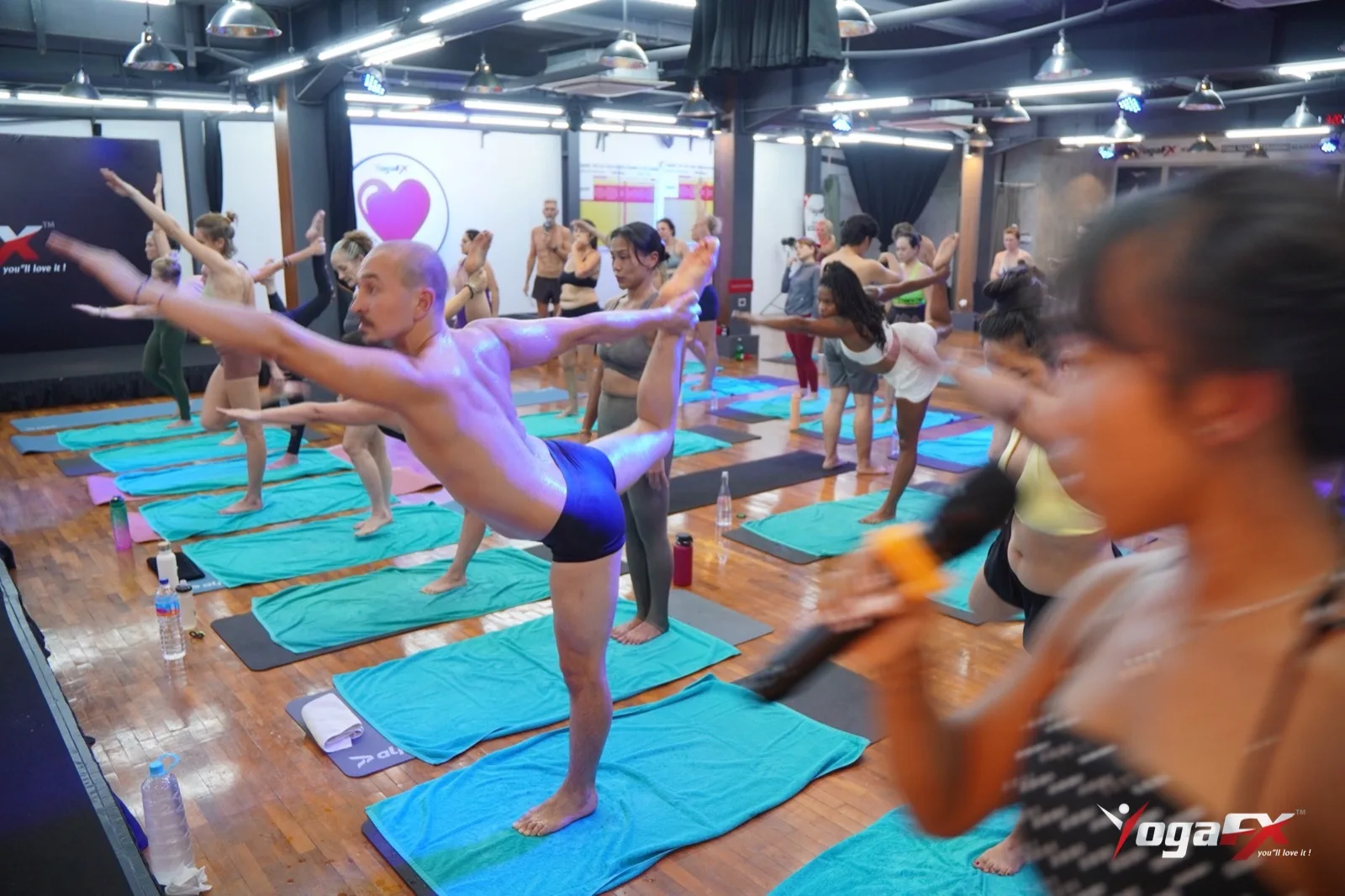
The dialogue is the script that makes the fixed system work. The teacher speaks the same words, in the same order, every class. Our guide to the 26 and 2 dialogue covers the text itself. Here is what it does for you as a student.
Why nobody demonstrates
There's no demonstration, so you have to listen. The words describe where to put your hands, how far to bend and when to breathe. Because your eyes are free, you can watch yourself in the mirror instead of watching the teacher.
Why the mirror matters
The front wall mirror works as an alignment tool, not a vanity tool. You can check your hips, your knees and your balance without guessing. Many students find that the mirror also steadies the mind, because a single point of focus calms wandering thoughts.
Why stillness between postures counts
Unnecessary movement spends energy and lifts the heart rate. So the class asks you to stand still between postures, breathe through the nose and wait. In Mr. Ian's experience, most students need about three to five classes before the heat and the stillness feel familiar.
Why the heat is part of the design
The heat is not decoration. In the method, the warm, humid room is a working part of the class. It loosens muscles, raises the heart rate and makes the 90 minutes demanding in a steady, sustained way.
In Bali, the tropical climate already supplies much of the warmth, so the class feels natural here. If you want the full story, read why the 26 and 2 room is heated.
Respect the heat all the same, and don't ignore warning signs. Drink water before and after class, rest when you need to, and never push through dizziness. People with a heart condition or another health concern should speak to a healthcare professional before starting any hot class.
What the research says about hot 26 and 2 yoga
Research on heated yoga is growing, but it is not all about this exact sequence. Many trials test heated hatha yoga in general. We name the limits as we go, so you can judge the evidence yourself.
A Massachusetts General Hospital trial on depression
In 2023, researchers led by Nyer at Massachusetts General Hospital published an eight-week randomized trial in the Journal of Clinical Psychiatry. Adults with moderate to severe depression practised community-delivered heated hatha yoga or joined a waitlist. About 59% of the yoga group (59.3%) showed a treatment response of at least 50% fewer symptoms, against 6.3% of the waitlist group. Read the study record on Europe PMC or PubMed.
Two cautions apply. The classes were heated hatha yoga, not necessarily the fixed 26 and 2 sequence. And participants attended about one class a week on average, so yoga is a support, not a replacement for medical care.
Wider evidence on hot yoga
A 2025 systematic review by Willmott and colleagues pulled together the hot yoga research across 43 studies. Johns Hopkins Medicine also lists stress reduction among the benefits of regular yoga. Neither source says that this one sequence is better than another. They show that guided, regular practice is worth taking seriously.
Always consult a healthcare professional before using yoga alongside treatment for any health condition.
What students say about the class
Numbers only go so far, and they can't tell you how it feels. The students who finish a hard week of practice describe it best. These three come from YouTube reviews recorded by trainees with Mr. Ian.
Louise (YouTube review, 2025) said she felt drawn to the training and knew she was in the right place the moment she arrived. She learned that she does not have to be perfect, and she called the classes the best she had taken.
Jamasb (YouTube review, 2026) described a rollercoaster. Day two felt like he had collapsed on the mat two or three times. By day three he felt like he was shining, and day four was much easier.
Shelley (YouTube review, 2026) said it had been a mission to get there. She could not have wished for a better group to train with, and she and her friend had already decided to come back the following year.
Hot 26 and 2 yoga next to other hot classes
Hot yoga is an umbrella term. It covers any yoga in a heated room, including flowing styles. The fixed 26 and 2 class sits inside that umbrella, but it differs in a few clear ways:
- The sequence: the same 26 postures and 2 breathing exercises every class, never a new flow.
- The guidance: a scripted dialogue instead of a demonstration or a playlist.
- The measure: you track progress against a class that stays the same.
- The length: one 90-minute block with no variations.
None of this makes other styles wrong. It just tells you what to ask a studio. If a studio near you uses another label, ask whether it teaches the full fixed sequence.
Who hot 26 and 2 yoga suits, and who should wait
Hot 26 and 2 yoga suits people who like structure. If you enjoy knowing exactly what comes next, you'll probably enjoy it. Many athletes use it to build leg endurance and balance. Busy professionals use it to put the phone away for 90 minutes. Aspiring teachers use it to learn one system deeply.
It may not suit you yet if you dislike heat, if you're pregnant, or if you have a heart or blood pressure condition. In those cases, speak to your doctor first. A gentler, unheated class can be a good first step, and you can return to the hot room later.
Five mistakes in the first month
- Skipping water until class. Dehydration makes the heat feel worse, so sip steadily all day.
- Chasing depth. Forcing a posture deeper before it's stable invites strain. Aim for clean alignment first.
- Leaving the room. It's tempting, but standing still and breathing teaches more than stepping out.
- Comparing yourself. The person beside you has a different body and different years of practice. Watch your own mirror instead.
- Practising once a month. Rare visits mean the heat never becomes familiar, so a steady rhythm beats occasional heroics.
None of these mistakes is serious, because every student makes them. Notice the pattern, adjust, and the class becomes steadier week by week. Whether a studio writes hot 26&2 yoga or Hot 26 on its door, the same advice applies.
Your first hot 26 and 2 yoga class, step by step
A first class can feel intense, so a little preparation helps. Follow these steps:
- Eat light. Finish a small meal a couple of hours before class.
- Hydrate early. Drink water through the day, not just before you walk in.
- Arrive early. Settle on your towel and let the heat start to feel normal.
- Stay in the room. Rest on your mat if you need to, but try not to leave.
- Breathe through the nose. Slow breathing keeps the heart rate steadier.
Is it hard? Yes, at first, and that's normal. Our honest answer to whether 26 and 2 yoga is hard explains which postures challenge people most and when it gets easier.
If you are in Bali, the Seminyak studio is at Jl. Pangkungsari Gg Jepun No.888, Kuta Utara, Seminyak, Badung, Bali 80361. It is open from 06:00 to 22:00 daily, and your first class is free with the Free 1-Day Guest Pass. Not in Bali? Ask any studio whether it teaches the full fixed sequence in the same order.
From practising the method to teaching it
Some students fall for the class and want to teach it. That is where YogaFX comes in. Mr. Ian Terry is Founder and Lead Instructor, E-RYT 500, with more than 12,000 teaching hours. He spent five years on the founder's staff at large teacher trainings before building YogaFX in 2017.
Since then, YogaFX has graduated more than 1,500 teachers from over 80 countries. The next live MasterClass runs from Sunday 24 January to Friday 29 January 2027. If you cannot travel yet, the Online Course costs USD 329 (or 4 x USD 82), and the Starter Kit costs USD 98 (or 2 x USD 49).
Mr. Ian puts it this way: "There can be no greater investment than the one that you make in your health, because without it, nothing else matters." For more YogaFX data, tools and training pages, visit the YogaFX Official Hot 26&2 hub.
FAQ
What is hot 26 and 2 yoga?
Hot 26 and 2 yoga is a fixed 90-minute class of 26 postures and 2 breathing exercises, practised in a room near 40°C with about 40% humidity. A scripted dialogue guides every class in the same order. Nobody demonstrates, and no music plays, so you listen and follow.
Is hot 26 and 2 yoga the same as Bikram yoga?
The class structure is the same: 26 postures, 2 breathing exercises and a scripted dialogue. Studios use different names, such as Hot 26, 26&2 or original hot yoga. YogaFX is independent training, not official Bikram Choudhury Teacher Training. Always ask a studio whether it teaches the full fixed sequence.
Is hot 26 and 2 yoga good for beginners?
Yes, because the class never changes, a beginner can learn it by repetition. Most students need about three to five classes before the heat feels familiar. Rest whenever you need to, drink water, and stay in the room. Check with a doctor first if you have a heart or health condition.
What are the 26 postures in hot yoga?
The class starts with standing deep breathing, then moves through standing postures such as Awkward, Eagle, Balancing Stick, Triangle and Tree. Floor postures follow, including Cobra, Bow, Camel and Spine Twisting. The class ends with Blowing in Firm, the second breathing exercise. Our sequence guide lists them in order.
How often should I practise hot 26 and 2 yoga?
Start with what you can recover from, such as one or two classes a week, and build up slowly. YogaFX suggests working toward three to five classes a week as your body adapts. In the Nyer trial, participants averaged about one class a week over eight weeks.
Still have questions? Message Mr. Ian and the YogaFX team on WhatsApp and we will answer them personally.