Hot yoga vs sauna comes down to effort. In a sauna you sit still in dry heat of 65 to 90°C for 15 to 20 minutes. In a 26 and 2 class you work through 26 postures and 2 breathing exercises for 90 minutes at about 40°C and 40% humidity.
Table of Contents
Both rooms are hot, and both make you sweat. That is where the similarity ends. One is passive heat, where the room does the work. The other is active heat, where you do the work while the room makes it harder. That's the heart of the hot yoga vs sauna question. This guide sets out seven real differences, what the research does and does not show, and how to choose.

Hot Yoga vs Sauna: Seven Real Differences
Start with the numbers. Here's how the two compare. The table below puts a typical 26 and 2 class next to a traditional sauna, using published ranges from medical sources and the class format we teach. If you want a studio's view of the same question, there is also a Seminyak studio's side-by-side breakdown.
| Factor | 26 and 2 class | Traditional sauna | Why it matters |
|---|---|---|---|
| Type of heat | Active: you move and breathe through the heat | Passive: you sit or lie in the heat | Only the class asks your body to work while hot |
| Air temperature | About 40°C (104 to 105°F) | Traditional: 65 to 90°C (150 to 195°F). Infrared: about 43 to 57°C | The sauna is hotter, but you stay far shorter |
| Humidity | About 40% | Traditional: under 20%, so very dry | Humid heat slows sweat evaporation and feels heavier |
| Session length | 90 minutes | Typically 15 to 20 minutes | The class is a much longer dose of heat |
| What you do | 26 postures and 2 breathing exercises, guided by a scripted dialogue | Sit or lie still | Balance, strength and flexibility only come from movement |
| Heart rate | Averaged about 75% of predicted maximum in one university study | Pulse rises 30% or more, according to Harvard Health | Both raise the heart rate, for very different reasons |
| Best-known evidence | An 8-week randomised trial on depression symptoms | Observational studies linking regular sauna use with lower cardiovascular risk | Different questions, so the results do not compare directly |
In hot yoga vs sauna, temperature is the least useful number. Notice the row on it. Many people assume the hotter room must be the harder session. In practice the opposite is often true, because you leave a sauna after 15 to 20 minutes and you stay in a class for 90.
The same comparison as a picture
Active Heat vs Passive Heat: What Your Body Does
In a sauna, the heat is the whole event. Your blood vessels widen, more blood flows to the skin, and your pulse climbs. Harvard Health reports that pulse rate can jump by 30% or more, and that blood pressure is unpredictable: it rises in some people and falls in others.
What happens in a class
In a 26 and 2 class, the same heat response sits underneath real exercise. You stand on one leg, fold forward, bend back and hold shapes for a set count. Your heart serves the muscles and the skin at the same time. That is why the class feels so different from the sauna, even though the room is cooler.
What a university study measured
Because the class is a workout, researchers at the University of Wisconsin-La Crosse measured what that looks like in a class held at about 105°F and 40% humidity. Heart rates averaged 75% of predicted maximum, and core temperature rose to an average of 103.2°F by the end of class. Seven participants passed 103°F, and one reached 104.1°F.
The same report is careful about what that means. It notes that at around 104°F heat-related illness can occur, and that its results did not raise concerns for typical hot yoga rooms of about 90 to 95°F. For students, the practical lesson is simple: the class is a heat load as well as a workout, so rest when you need to and drink water.

What a sauna cannot give you
A sauna has no movement, so it cannot build strength, balance or flexibility. It also doesn't ask for focus. Nobody tells you to lock the knee, square the hips or keep your eyes on one point. The class does, and that scripted instruction is part of what makes it training rather than waiting.
Mr. Ian Terry, E-RYT 500 and founder of YogaFX, has taught more than 12,000 hours. He teaches the dialogue as a work order for 90 minutes: breathe, move, hold, repeat. A sauna gives you warmth. The class gives you something to do with it. That is the practical core of hot yoga vs sauna.
What the Research Says About Hot Yoga vs Sauna
Evidence is where hot yoga vs sauna gets interesting, because the two have been studied for different things. That's why the benefits of hot yoga vs sauna can't be ranked from the studies alone. Treat the studies below as signals, not promises. None of them is a treatment plan.
Sauna: a promising link, mostly observational
A 2018 review in Mayo Clinic Proceedings by Laukkanen, Laukkanen and Kunutsor reviewed the evidence on sauna bathing. It reported links between regular sauna use and lower risk of vascular disease, including high blood pressure and cardiovascular disease. The authors describe the mechanisms, such as improved vessel function, as postulated rather than proven.
A 2018 cohort study in BMC Medicine followed 1,688 middle-aged and older adults for a median of 15 years. People who used a sauna four to seven times a week had a much lower risk of fatal cardiovascular events than people who used one once a week. The confidence range was wide, and observational studies cannot show cause and effect.
Hot yoga: a trial on depression, with an honest limit
The best-known hot yoga trial comes from Massachusetts General Hospital. In the 8-week study, 80 people were randomised to 90-minute Bikram yoga classes in a 105°F room or to a waitlist. According to the Harvard Gazette report, 59.3% of the yoga group had a 50% or greater drop in depression symptoms, against 6.3% of the waitlist.
The same report states a clear limit. Future research is needed to compare heated with non-heated yoga, to see whether the heat adds anything beyond the yoga itself. In other words, the trial supports the practice, but it does not prove the heat is the active ingredient. So anyone managing depression should work with a healthcare professional.
What this means for hot yoga vs sauna
- Different questions. Sauna research mostly asks about heart and vessel health. Hot yoga research asks about mood, fitness and flexibility.
- Different study types. The sauna evidence is observational. The hot yoga depression result comes from a randomised trial, although a small one.
- Neither side wins on paper. No study we know of compares the two head to head, so be wary of anyone who says one is proven better.
Why 40°C and 40% Humidity Change the Comparison
A 26 and 2 room is set at about 40°C with about 40% humidity. That is cooler than a sauna and far more humid. Cleveland Clinic describes a traditional sauna as 150 to 195°F with humidity under 20%, so the air is hot and dry. Infrared saunas, it says, usually sit between 110 and 135°F.
In the hot yoga vs sauna comparison, humidity is the quiet variable. It changes how heat feels.
Sweat evaporates more slowly in humid air, so you feel hot sooner, and the body has a harder time cooling itself. Dry sauna air lets sweat evaporate quickly, which feels different even at a higher temperature. That's the main reason a 40°C class can feel tougher than 15 minutes in 80°C dry air.
If you are comparing other kinds of heat, our guides cover the hot yoga vs steam room and the infrared sauna comparison in detail. Both show, for instance, how air moisture and heat source change the experience.
However, not every room that calls itself hot yoga uses these conditions. If you want to try the original format, read how to find an authentic 26 and 2 studio and check its room conditions.
Where a Sauna Is the Better Choice
The sauna isn't the loser in hot yoga vs sauna. It does a different job, and it does it with almost no effort. That makes it useful on rest days, after a long flight, or when your legs are too tired for a full class.
- Low effort. You can use a sauna when you cannot face a 90-minute class.
- Short sessions. Cleveland Clinic says new users may need to start with five minutes, and that most people stay around 15 to 20.
- Possible heart benefits. The observational research above is encouraging, although the evidence is not settled.
- Pure rest. There is no sequence to follow and no instruction to listen to, which some people need.
So treat the sauna as recovery, not as a weight loss tool. Cleveland Clinic states that using a sauna for weight loss is not recommended, because the water you lose is dehydration, not fat loss. The class, which keeps you moving for 90 minutes, is the better route to fitness goals.
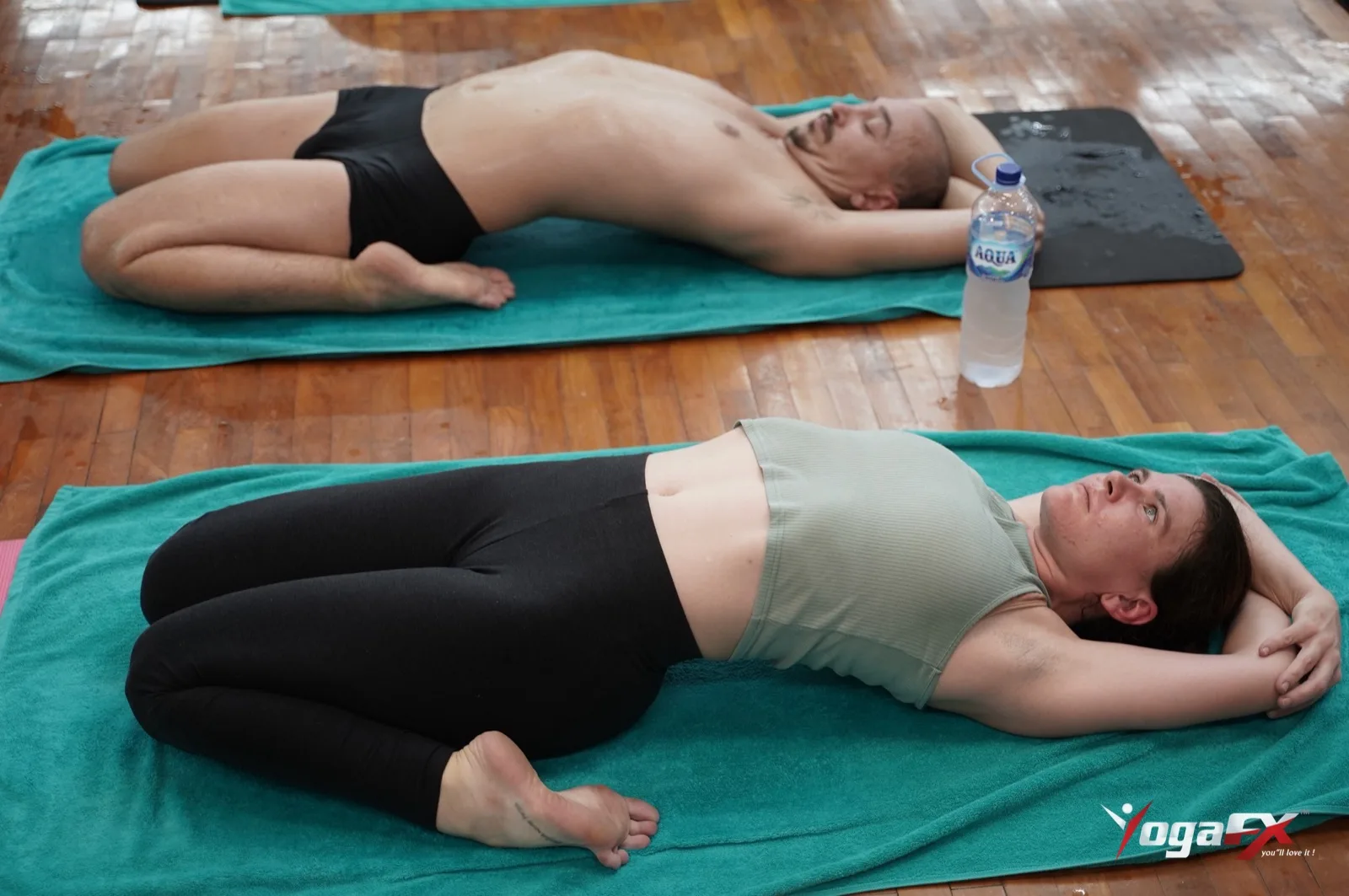
Can You Do Hot Yoga and a Sauna in One Day?
Doing both in one day is a common hot yoga vs sauna question. Many healthy people can, but the order matters. A long sauna before class stacks two heat loads, and the class already pushes core temperature up. That's why you should take the class first, rehydrate, and keep any sauna short. Our guide to timing a sauna around your class goes through the timing in more detail.
- Class first. Start cool and fresh, not already overheated.
- Rehydrate. Harvard Health advises two to four glasses of cool water after each sauna, and the same sense applies after class.
- Keep the sauna short. Five to ten minutes is plenty after a 90-minute class.
- Stop if you feel unwell. Dizziness, headache, cramps or confusion are signs to leave and cool down.
Safety comes first
Dehydration is the main risk in both. Cleveland Clinic lists thirst, headaches, muscle cramps and confusion as warning signs. It also advises checking with a doctor first if you are over 65, pregnant, or have heart conditions, high or low blood pressure, or take regular medication. Harvard Health gives similar advice for uncontrolled high blood pressure and heart disease.
One myth is worth clearing up. People often say sweating cleans the body out. Sweat is mostly water and salt, and your liver and kidneys do the filtering. We explain what sweat actually does in a class in a separate guide.
What Students Say About Working Inside the Heat
A sauna rarely changes how someone sees their own effort. Regular practice often does. These three students went on to train as teachers with YogaFX, but each describes the same thing: hard work inside the heat, with a teacher guiding the way.
We had to work so hard but it was so worth it.
Celia, Yoga Alliance review, 2025
If you are looking to take an honest look at yourself, do some very hard work, and come out a changed person for the better, this is the program for you.
Matt, Google review, 2025
Jamie, in a YouTube review from 2024 (close paraphrase), says he is grateful for the chance to work hard and push himself for something he is finding a real passion in.
None of these students says hot yoga vs sauna was about temperature. Notice what they describe. It isn't the warmth, which a sauna also gives you. It is the change that comes from doing something demanding in the heat, week after week.
Hot Yoga vs Sauna: Which Should You Choose?
The honest answer depends on what you want from that hour. Use this short guide.
- You want to get fitter, stronger or more flexible: choose the class. Only movement changes range of motion and builds muscle.
- You are sore and need rest: choose the sauna, or a gentle walk and plenty of water.
- You want a structured hour that holds your attention: choose the class, where a scripted dialogue guides every posture.
- You want warmth with minimal effort: choose a short sauna session, and respect the time limits.
- You want both: do the class first, rest, then keep any sauna brief.
If you are weighing bikram yoga vs sauna for a specific goal, remember that both are tools. The class is training. The sauna is recovery. Many students use each for what it does best, and you'll probably find your own mix.
Try the Original Format with Mr. Ian Terry
Reading about hot yoga vs sauna only goes so far. One class tells you more than a table can, and you don't need to commit to anything first. YogaFX teaches the original 90-minute Hot 26&2 class at its Seminyak studio, with a Free 1-Day Guest Pass so your first class is free.
If the class draws you in and you start to think about teaching it, Mr. Ian Terry also runs the 6-day hybrid MasterClass. The next batch runs from check-in on Sunday 24 January 2027 to check-out on Friday 29 January 2027. Message him on WhatsApp and he will answer your questions personally.
FAQ
Can a sauna replace exercise?
No. A sauna raises your pulse, but it does not train muscles, balance or flexibility. Cleveland Clinic notes that sauna heat raises heart rate and sweating in a way that mimics exercise, but says more research is needed. Use a sauna for recovery, and keep your movement for the mat.
Is hot yoga as good as a sauna for your heart?
We cannot say either is better, because the evidence differs. Sauna studies are mostly observational and link regular sessions with lower cardiovascular risk. In a University of Wisconsin-La Crosse study, a hot yoga class raised heart rate to about 75% of predicted maximum. Ask your doctor before relying on either.
Is hot yoga harder than a sauna?
For most people, yes, because you work as well as sit. The room is cooler than a typical sauna, about 40°C against 65 to 90°C, yet you stay for 90 minutes and keep moving. A University of Wisconsin-La Crosse study found average core temperature rose to 103.2°F, so rest and drink water.
Is hot yoga or sauna better for a first-timer?
Start with the one that matches your goal. If you want movement, flexibility and a structured hour, try one 26 and 2 class and rest whenever you need. If you only want warmth, try a short sauna. Cleveland Clinic suggests new sauna users start with five minutes. Check with a doctor if you have a heart condition.
Should I use a sauna before or after hot yoga?
After is the safer order. Hot yoga already raises core temperature, and one University of Wisconsin-La Crosse study measured an average of 103.2°F. Rehydrate first, wait until you feel normal, then keep any sauna short. Harvard Health advises two to four glasses of cool water after each sauna.
Still have questions? Message Mr. Ian Terry and the YogaFX team on WhatsApp and we will answer them personally.
This article is general information, not medical advice. Please consult a healthcare professional before starting hot yoga or regular sauna use, especially if you are pregnant or have a heart condition, high or low blood pressure or another health concern.