Hot yoga vs infrared sauna is a choice between a class and a rest. A 26 and 2 class is 90 minutes of movement in a room near 40°C and 40% humidity. An infrared sauna is a short, quiet sit under radiant heaters. Both make you sweat. Only one is a workout.
Table of Contents
Plenty of people search hot yoga vs infrared sauna because a nearby studio sells "infrared hot yoga". That’s a fair thing to check, because the answer changes what you are paying for. Mr. Ian Terry, E-RYT 500, has taught more than 12,000 hours of the Original Hot 26&2 method. He tells new students that the heat is the setting, and the practice is the work.

So this hot yoga vs infrared sauna guide follows one idea. We ask what each kind of heat actually does to you, using what the studies measured and what we see in the room every week. We also say plainly where nobody has run the test yet. For a closer look at the panel question from the teacher-training side, see this longer guide to infrared panels and humid air.
Hot Yoga vs Infrared Sauna: The Short Answer
In the hot yoga vs infrared sauna decision, the class wins if you want strength, balance and a skill. If you want to unwind in gentle heat and your doctor agrees, the sauna is a fine choice. They do different jobs, so the real mistake is treating one as a stand-in for the other.
Here is how the two split in four lines:
- Who makes the heat. In class, your own muscles do most of it, and the room sets the conditions. In a sauna, the heaters do all of it while you sit still.
- How long you stay. A class runs 90 minutes. Cleveland Clinic suggests 5 to 10 minutes for a sauna beginner and 20 to 30 minutes for an experienced user.
- What you leave with. A class leaves you with practice: 26 postures, 2 breathing exercises and a script you can learn. A sauna leaves you with rest.
- What the evidence covers. Studies of the 26 and 2 sequence measure strength, range and mood. Studies of sauna bathing mostly find links, not proof.
If you are also weighing hot against room-temperature classes, our guide to hot yoga vs regular yoga covers what the heat adds to the same 26 postures. If you plan to add a sauna after class, see sauna after your 26 and 2 class.
Hot Yoga vs Infrared Sauna Side by Side, Question by Question
A hot yoga vs infrared sauna table helps most when each row answers a question you would really ask before booking. Use the one below as a checklist. The last column says where each answer comes from, so you can tell a measurement from a teaching view.
| Question you would ask | 26 and 2 class | Infrared sauna session | Where it comes from |
|---|---|---|---|
| How hot is the air? | About 40°C, with 40% humidity held on purpose | 43 to 57°C for infrared; 66 to 91°C for a traditional sauna | Class: YogaFX studio standard. Sauna: Cleveland Clinic |
| How long are you in it? | 90 minutes, with a rest between the standing and floor series | 5 to 10 minutes to start; 20 to 30 for experienced users | Class: studio timetable. Sauna: Cleveland Clinic |
| Do you move? | Yes: 26 postures and 2 breathing exercises, in a fixed order | No: you sit or lie down | Method definition |
| Does it count as exercise? | It does the work of a class; a 2020 lab test measured its energy cost for one hour | Cleveland Clinic says it is not a substitute for a workout | Lambert et al., 2020; Cleveland Clinic |
| What did a study measure? | Hip abduction rose 6.6° after a hot hour, against 2.3° at room temperature | Sauna reviews report links with heart and other health benefits, with gaps in the evidence | Lambert et al., 2020; Laukkanen et al., 2018 |
| What skill do you keep? | The sequence, the breath and the dialogue | None; it is rest, not training | Teaching view |
Read the fourth and fifth rows twice. In the hot yoga vs infrared sauna question, they hold the most useful difference. A class can be measured as work, and a sauna session cannot. That does not make the sauna bad. It makes it a different tool.
Hot Yoga vs Infrared Sauna: How the Heat Itself Differs
An infrared sauna uses radiant heaters. Cleveland Clinic puts its air temperature at 43 to 57°C, which is lower than a traditional sauna at 66 to 91°C. You sit in it for a short time and you stay still. Because you are not moving, nearly all the heat on you comes from the cabin.
A class room works the other way round. The room sits at about 40°C, and you add heat by moving for 90 minutes. Your own muscles do much of the warming. That is why the same thermometer reading feels so different in the two places.
What "Infrared Hot Yoga" Usually Means
Search for infrared hot yoga and you will find studios that fit radiant panels to the ceiling or walls and run flow or sculpt classes under them. The name is a studio label, not a standard. Different studios choose different temperatures, and many do not say how humid the room is.
So before you book, ask three plain questions, because they tell you what you’re buying:
- What is the air temperature? A number, not "warm".
- What is the humidity? If the studio does not measure it, you have your answer.
- Is the sequence fixed? A fixed order of postures lets you compare one class with the next.
None of this makes an infrared class a bad choice. Some people like a drier, gentler room. It just means the research on a 40°C room at 40% humidity should not be assumed to carry over to a panel-heated room. We cover the naming mess in our guide to hot 26, hot hatha, Bikram or hot flow.
Why the 26 and 2 Room Uses Humid Heat, and What We Can Claim
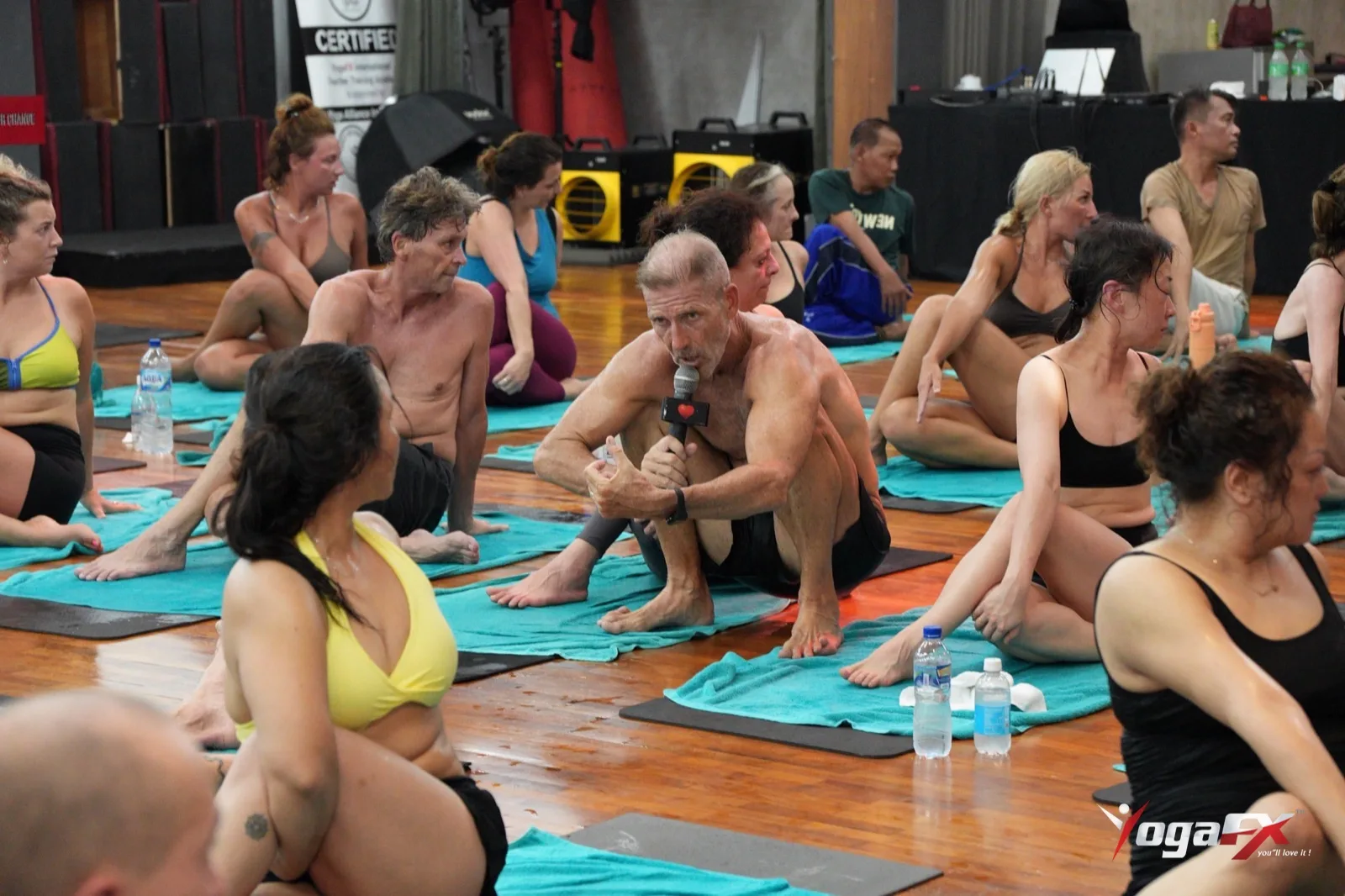
The 26 and 2 standard is a warm room with moderate humidity: about 40°C and 40%. Mr. Ian teaches it that way because the pacing of every posture, rest and breath in the script is built around that room. The room is part of the design, just like the sequence and the dialogue. That is why hot yoga vs infrared sauna is more than a temperature question.
Here’s where we want to be careful. We could not find a study that sets hot yoga vs infrared sauna heat head to head for the same yoga class. So we do not claim humid air is measurably better. What we can say is narrower, and we think it is more useful:
- The tested class used humid heat. The lab studies of this sequence held the room near 40°C and 40% humidity, so their results describe that room.
- The teaching worked in that room. Mr. Ian has taught the script, the pacing and the rest breaks in it for years, and students learn to read their own limits there.
- Humid heat is not a steam room. At 40% the air is warm and damp, not saturated. You still sweat, and the room still lets you move for 90 minutes.
The class is not defined by the heat alone. It is defined by what you do inside it.
Why the Teacher Matters More Than the Thermostat
A sauna has a timer and a door, so nobody is watching you. A class has a teacher who watches the whole room. The dialogue tells you when to breathe, when to move and when to rest, and a trained teacher spots a student who looks pale before the student says anything.
That supervision is a real difference in safety terms, for example when a student looks pale. It is also a reason people who train to teach this method spend a week on the script and the posture clinic, not on the heaters. Our guide to the 26 and 2 sequence shows how the order of postures paces the heat across the class.
What the Research Says About Hot Yoga vs Infrared Sauna
Three papers give a fair view of hot yoga vs infrared sauna. We opened each one and read the numbers before writing this section. We link them so you can read them too.
Hot Yoga in the Lab: Lambert 2020
Lambert and colleagues, in the International Journal of Exercise Science in 2020, tested 16 experienced yoga practitioners. Each did the same one-hour Bikram sequence twice, once at about 40°C and once at about 23°C, with humidity held at 40%.
The energy cost did not differ between rooms. Heart rate and oxygen use were similar too. The respiratory exchange ratio was lower in the heat, 0.89 against 0.95, which points to slightly more fat used as fuel.
Hip abduction gained 6.6° in the heat and 2.3° at room temperature. The authors reported that the hot room gave a larger change in only one of thirteen range-of-motion measures. One inflammation marker, interleukin-6, rose about 15-fold after the hot session only, and the authors flagged it for further study.
Hot Yoga in Beginners: Bourbeau 2021
Bourbeau and colleagues, in the International Journal of Yoga in 2021, followed 22 adults through 12 sessions over four weeks. One group practised in a hot room and the other in a cool one. Maximal aerobic fitness rose in the hot group only, from 3.22 to 3.46 litres of oxygen per minute, and a heat-stress protein called HSP70 rose there too.
A brain-growth protein, BDNF, rose when both groups were combined, so it came from the yoga rather than the temperature. The study found no difference in heat tolerance and no change in perceived stress. The groups were small, so treat the result as a clue, not a verdict.
Sauna Bathing in Review: Laukkanen 2018
Laukkanen and colleagues reviewed the sauna evidence in Mayo Clinic Proceedings in 2018. They wrote that, beyond its use for pleasure, sauna bathing may be linked to several health benefits. They also pointed to areas of real uncertainty. That is a careful way of saying the findings are associations, and more work is needed.
Cleveland Clinic is just as careful, so the two sources agree. It describes sauna use as viewed as safe, though heat exposure brings some risk. It also says not to assume a sauna session is a substitute for a workout.
The Heat Dose at a Glance
Notice what the cards show about hot yoga vs infrared sauna. A sauna session is short and the cabin air is cooler than a traditional sauna. A class is long, and the demand comes from the movement. Nothing in the numbers says one is better. Instead, they show two different doses of heat.
If you live with depression, anxiety or a heart condition, please speak with a healthcare professional before you change your routine. Neither a sauna nor a class replaces medical care.
Hot Yoga vs Infrared Sauna Safety: What to Watch For
Both options expose you to heat, so hot yoga vs infrared sauna safety comes down to respect. Cleveland Clinic says to be aware of dehydration and to leave a sauna right away if you feel dizzy or nauseated. It also lists pregnancy as a time to avoid sauna use, citing guidance from the American College of Obstetricians and Gynecologists.
The same common sense applies in class. Drink water before you come, and sip during the rest breaks because the room is warm. Sit down on your mat when you need to. Tell the teacher if you feel faint, because that is exactly what the teacher is there for.
- Before you go in: eat lightly, drink water and skip the session if you feel unwell.
- While you are in: rest the moment you feel dizzy, nauseated or confused, in either place.
- After you leave: replace fluids slowly. Fluid you sweat out is not weight you have lost for good.
- If you have a condition: ask your healthcare provider first, especially for heart, blood pressure or pregnancy questions.
This article is general education, not medical advice. Please consult a healthcare professional about your own situation.
Can You Use a Sauna and a Hot Class in the Same Week?
Many healthy people do. In hot yoga vs infrared sauna terms, the question is order and dose. Both raise your heart rate and your fluid loss, so stacking them on one tired day is the part to avoid.
One 2024 Google review, from a graduate named Adam, describes exactly this mix at the teaching venue. He wrote that after an intense class there was "unlimited access to the Wellness Centres facilities such as the ice bath, steam room and Sauna" before the learning day began. In his telling the class came first and the heat bath afterwards, which is a sensible order for most people.

A simple weekly pattern looks like this:
- Class days: keep the class as your main session, and add heat afterwards only if you feel fresh.
- Rest days: a short sauna session is a reasonable way to unwind, if your doctor agrees.
- Hard weeks: drop the extra heat. The class already asks a lot of your cooling system.
Our guide to whether hot yoga is a good workout shows what the class itself asks of your muscles, so you can judge how much extra heat your week can hold.
Hot Yoga vs Infrared Sauna: How to Choose for Your Week
Start with the goal, not the heat. The hot yoga vs infrared sauna table earlier gives the facts. This section turns them into a decision.
Choose the Class If You
- Want a skill and a measurable practice, the same 26 postures each time.
- Like a teacher, a script and a room that carries you through 90 minutes.
- Are ready to build heat tolerance slowly, with one or two classes a week at first.
- Hope to teach the method one day, because only the class route leads there.
Choose the Sauna If You
- Want quiet time and gentle heat without movement.
- Have your doctor's agreement, and none of the conditions Cleveland Clinic lists as reasons to avoid it.
- Prefer a short, easy session you can fit between other things.
If you cannot decide, run a small test. Book three classes and three sauna sessions across a month. Note how you feel the next morning: sleep, stiffness and mood. Keep the one you look forward to. A month of real experience will tell you more than any article, including this one.
What YogaFX Students Say About the Heat and the Work
These reviews are not about hot yoga vs infrared sauna. They come from people who trained with Mr. Ian in Bali, and they show what the teaching room feels like. Each one comes from our review store, first names only.
We began the day with an intense yoga class that left you with the most amazingly satisfying feeling of achievement once it concluded.
Adam, Google review, 2024
Chris, in a 2024 graduation video review, called the course an awesome, well-organised experience that took him to his limits and beyond (paraphrased). You can watch it below.
Jeanett, in a 2019 video review, thanked the team for the inspiration she took home (paraphrased). Notice the words these students use: achievement, limits, inspiration. Nobody describes a quiet sauna session that way, and that is the point of the class. In total, YogaFX students have left 150 Google reviews, 50 Yoga Alliance reviews and 357 YouTube video testimonials.
Learn the Heated Sequence With YogaFX in Bali
If the hot yoga vs infrared sauna question leaves you curious about the room itself, you may want to learn how to teach it. The Bikram Hot 26&2 Yoga Teacher Training MasterClass at YogaFX is a six-day hybrid. You study online first, then join an intensive in Bali. Graduates earn the Yoga Alliance RYT 200-Hour and the Bikram Hot 26&2 200-Hour International Yoga Certification.
The next batch checks in on Sunday 24 January 2027 and checks out on Friday 29 January 2027 at Soham Wellness Center in Seminyak.
The Early Bird price is US$1,899, and the usual price is US$1,999. Payment plans start from US$250 a month with no interest. Mr. Ian Terry trained for five years, from 2014 to 2019, with the founder of the method. Since 2017 he has guided more than 1,500 graduates from over 80 countries.
Read the full 26 and 2 yoga teacher training page, or message Mr. Ian on WhatsApp to ask what it involves.
FAQ
Is hot yoga the same as an infrared sauna?
No. Hot yoga is a 90-minute class where you move through postures in a heated room. An infrared sauna is a short, passive session under radiant heaters. Both make you sweat, but only the class works your balance, strength and focus, and only the class teaches a skill.
Is infrared hot yoga the same as 26 and 2 yoga?
No. Infrared hot yoga is a studio label for classes heated by radiant panels, and temperature and humidity vary by studio. A 26 and 2 class holds the room near 40°C and 40% humidity and runs the same 26 postures and 2 breathing exercises every time.
Is hot yoga as good as a sauna?
They do different jobs. Cleveland Clinic says a sauna session is not a substitute for a workout, while hot yoga is a workout. A sauna suits rest and gentle heat. A class builds strength and range. Check with your doctor if you have a heart or blood pressure condition.
How hot is an infrared sauna compared with a hot yoga room?
Cleveland Clinic gives 43 to 57°C for infrared saunas and 66 to 91°C for traditional ones. A 26 and 2 room sits near 40°C with 40% humidity. The class feels harder because you move for 90 minutes, not because the thermometer reads higher.
Can I do a sauna after hot yoga?
Some healthy people do, but both raise your heart rate and fluid loss. Keep the sauna short, drink water, and stop if you feel dizzy or nauseated. Skip it if you are pregnant, unwell or advised against heat, and ask your healthcare provider first if unsure.
Still have questions? Message Mr. Ian and the YogaFX team on WhatsApp and we will answer them personally, whatever your level or your goal.