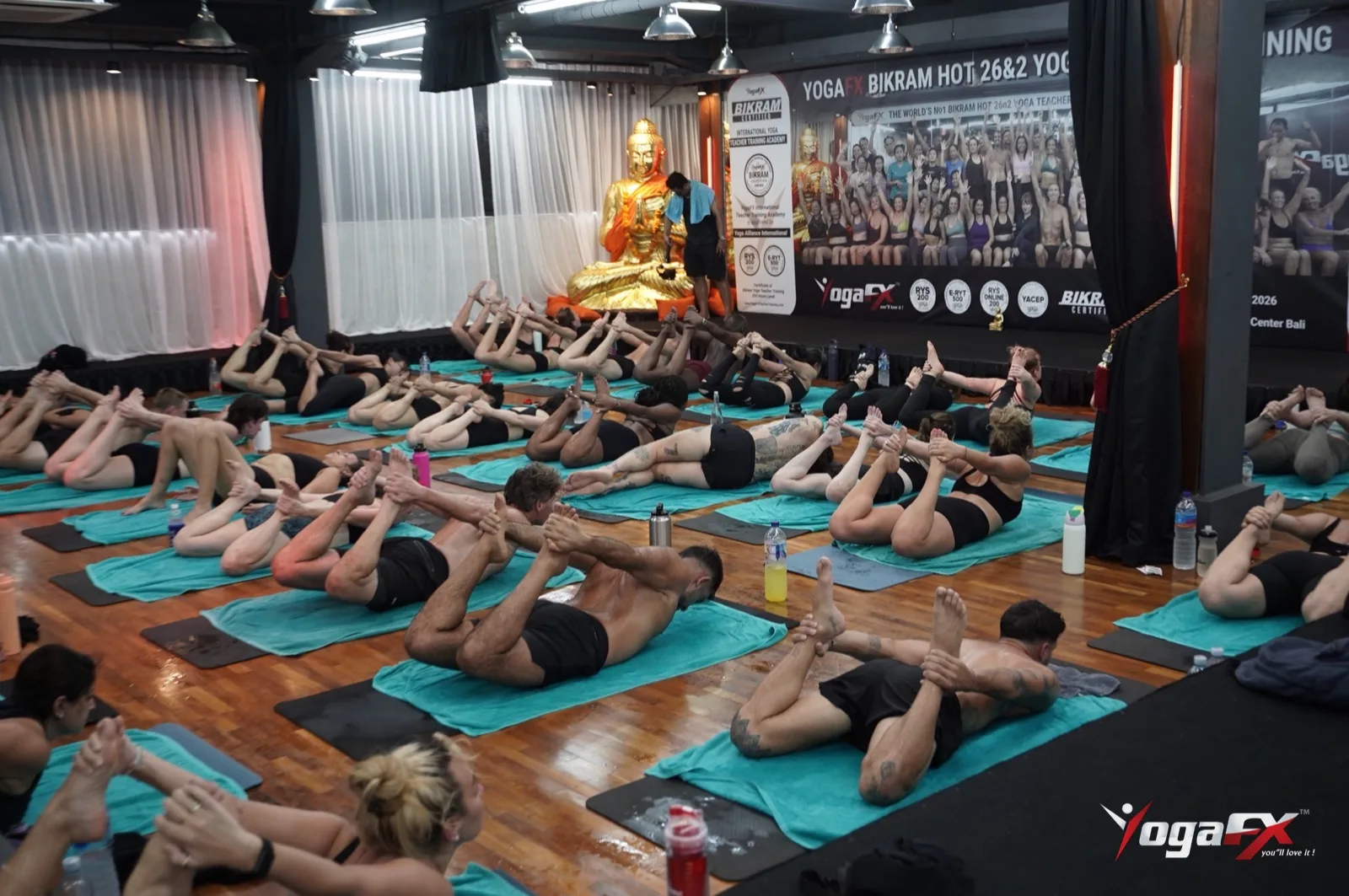
Bikram vs hot yoga comes down to the sequence, not the heat. Both happen in a heated room, but a Bikram class, also called Hot 26&2, follows one fixed 90-minute script of 26 postures and 2 breathing exercises. Hot yoga is any class in a warm room, so its postures change with the teacher.
Table of Contents
That one difference shapes everything else. Mr. Ian Terry, E-RYT 500, has logged more than 12,000 teaching hours in the original method, and new students often ask whether it is all just hot yoga. It isn't.
This guide is for the practitioner, traveller or future teacher who wants a clear answer to the bikram vs hot yoga question before choosing a class. We compare the two styles moment by moment, then look at what the research does and does not say.
Bikram vs Hot Yoga at a Glance
Most bikram vs hot yoga comparisons list temperatures and class lengths. Those numbers vary by studio, so they tell you less than you would expect. A more useful view follows a single class from the door to the last breath, and then asks what happens on your next visit.
| Class moment | Fixed 26 and 2 class | Typical free-form hot class | What it changes for you |
|---|---|---|---|
| Arriving at the door | You know the order before you unroll the mat | You learn the plan once class starts | Less guessing, more focus |
| The opening minutes | A standing breathing exercise starts every class | Varies: a flow warm-up, a seated start, or music | The same signal every time |
| The middle of class | 26 postures in a set order, each held and repeated | The teacher builds a sequence, often a new one | You can compare one posture week to week |
| How you are guided | A scripted spoken dialogue, no demonstration | Demonstration, hands-on cues or free cueing | You learn to listen, not to copy |
| The closing minutes | A breathing exercise ends the class | A cool-down or rest in the teacher's own style | A predictable finish |
| Your next visit | The same class again | A different class | Steady progress or fresh variety |
What a fixed 26 and 2 class settles before you arrive
Each one comes in a set order, so no one is waiting to hear what comes next.
One opens the class and one closes it, like bookends.
The whole class has one length, from first breath to final rest.
The heat is set, not left to the whim of the day.
A damp heat that feels different from a dry one.
What Stays the Same: Both Rooms Are Hot
Before the differences, the overlap. A Bikram class and a free-form hot class both ask your body to work in a warm, humid room. That means the safety basics are identical, whatever you choose.
The Mayo Clinic lists dizziness, faintness, muscle cramps, nausea and headache among the symptoms of heat exhaustion. It also explains that exercising hard in hot, humid conditions makes it harder for the body to cool itself, because sweat evaporates less easily when the air is damp. Those points apply to both styles, so they are worth taking seriously on day one.
- Drink water before class, not only during it.
- Step back and rest the moment you feel faint or nauseous. Lying down is always allowed.
- Tell your teacher if you take regular medication, are pregnant, or have a heart or blood pressure condition. Speak to a healthcare professional first.
Once the shared basics are covered, the real bikram vs hot yoga contrast is easier to see. It lives in what happens between the first and last breath.
Bikram vs Hot Yoga: Seven Real Differences
Here are the seven differences we see most clearly in a Seminyak class, in the order a student tends to notice them.
1. The sequence never changes
A fixed class repeats the same 26 postures in the same order every time.
If you want the full order and the reasoning behind it, our guide to the 26 and 2 yoga sequence walks through why each posture sits where it does. A free-form class does the opposite on purpose: the teacher decides, and tomorrow's plan may look nothing like today's. This is the heart of bikram vs hot yoga.
2. Breathing frames the whole class
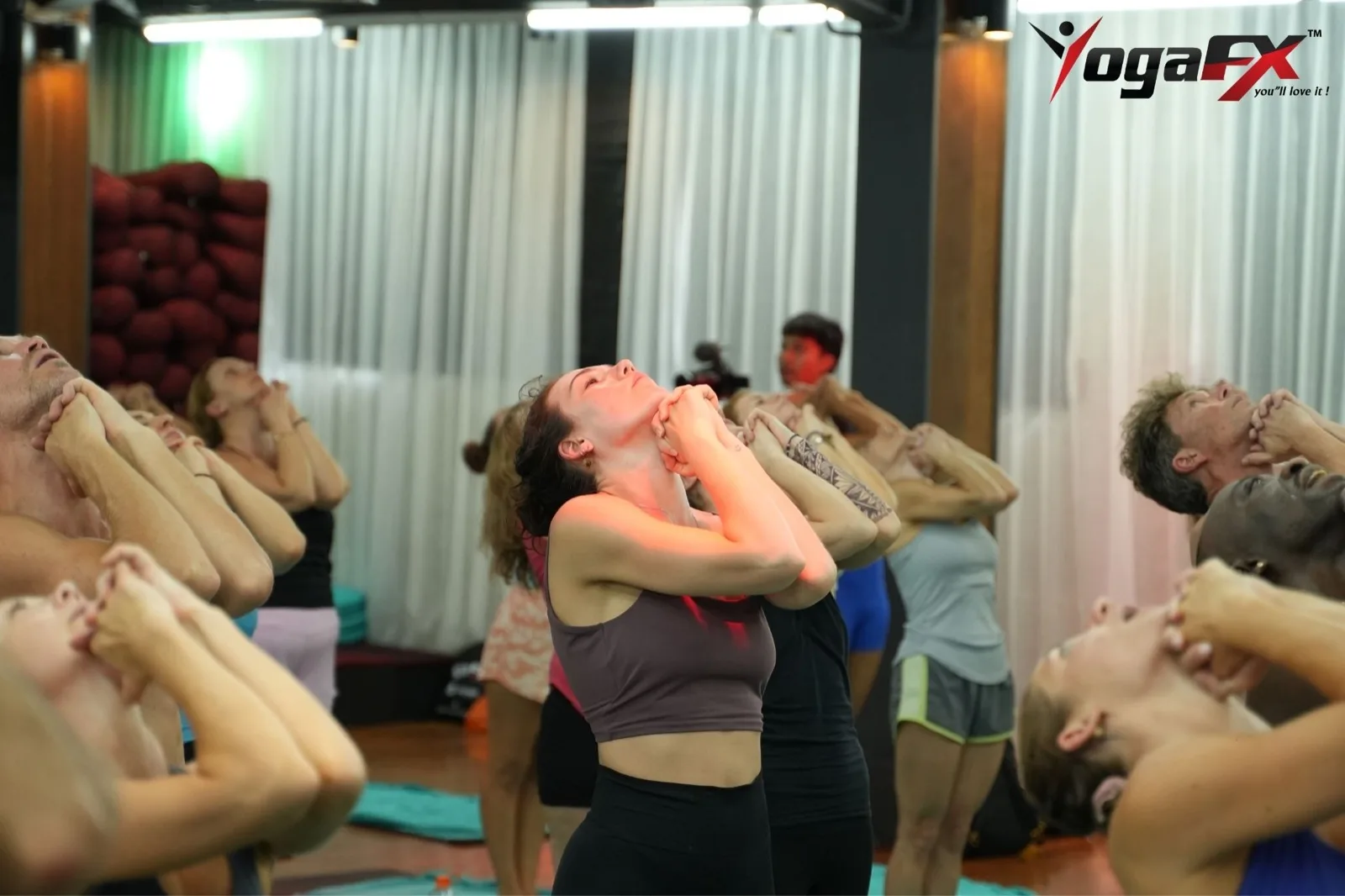
Two pranayama breathing exercises bookend a 26 and 2 class. The first one, a standing deep breathing exercise, is where most students notice the room for the first time. Free-form hot classes may skip formal breathwork or place it anywhere.
3. The teacher speaks a script
The 26 and 2 is taught through a spoken dialogue. The teacher uses the same words in the same order, and does not demonstrate. That sounds strange until you try it, because you stop watching someone else and start feeling your own body. We cover this in detail in the 26 and 2 dialogue. In most hot flow classes, the teacher demonstrates and improvises.
4. There is no music
A fixed class runs without a playlist. The only sounds are the teacher's voice, the room and your own breath. Many free-form classes use music to set the pace, which some students love. Neither choice is wrong. They simply ask for a different kind of attention.
5. The room is set, not decorated
A 26 and 2 class is taught at 40°C and 40% humidity for 90 minutes. At our Seminyak studio, that heat comes from the natural tropical climate, not electric heaters. A free-form class can sit anywhere from lightly warm to very hot, and the studio chooses. When the room changes from day to day, it is harder to tell what your body is responding to.
6. You can measure your own progress
Because the class is identical each time, your own results become the benchmark. Last month's Standing Head to Knee against this month's is a fair comparison. In a class that changes daily, you get variety, but you lose that clean yardstick. Students who like to track their progress often find the fixed version easier to follow for that reason.
In the bikram vs hot yoga debate, this is often the deciding point.
7. The teacher's job is different
In a free-form class the teacher is a designer who builds a new sequence. In a 26 and 2 class the teacher is a guide who delivers a tested one and watches how you move through it. That is why the original method has its own teacher training, with a long list of postures to learn precisely, rather than a flexible template.
Bikram vs Hot Yoga: What the Research Does and Does Not Say
Claims in the bikram vs hot yoga debate run ahead of the evidence, so it helps to separate what we know from what we hope. Three points stand out.
Heated yoga and depression
First, a randomised trial from Massachusetts General Hospital (Nyer et al., 2023) tested heated yoga on adults with moderate-to-severe depression. After eight weeks, 59% of the yoga group saw their symptoms fall by half or more, against 6% on the waitlist, as reported by the Harvard Gazette. The study was small, with 65 people analysed.
Its own authors say heat and yoga were not separated, so it cannot tell us whether a fixed or free-form sequence matters. That limit matters for anyone weighing bikram vs hot yoga on health grounds.
Bikram yoga and physical fitness
Second, a 2015 review by Hewett and colleagues at Western Sydney University looked at the effects of Bikram yoga on health. It found the style has been shown to improve lower body strength, range of motion and balance in healthy adults. The same review points out that large, well-designed randomised trials were still missing.
What is still unknown
Third, none of the sources above compares a fixed sequence directly with free-form heated classes.
So the summary of bikram vs hot yoga research is modest. Both styles use heat and sustained effort, and early research on heated yoga looks promising. Anyone who tells you one style is proven better than the other is going beyond the evidence. This article is for education only, and it is no substitute for medical advice.
Four Myths About Bikram vs Hot Yoga
Some ideas about bikram vs hot yoga come up so often that they deserve a direct answer. Here are the four that come up most often.
- "Bikram is just hot yoga with a famous name." Not quite. The name points to a specific class: 26 postures, 2 breathing exercises, one script. Hot yoga is a description of the room, not of the class.
- "Hot yoga is the easier option." Not necessarily. Difficulty depends on the teacher, the pace and the heat, and some free-form classes are very demanding. A fixed class is hard in a different way, because you cannot skip the postures you dislike.
- "The heat is what makes it Bikram." Heat is part of it, but the sequence and the dialogue are what define the class. That is why bikram vs hot yoga is a question about structure first and temperature second.
- "A fixed class must be boring." Some students find the opposite. Because the order is familiar, attention shifts from "what comes next?" to "how am I doing this posture today?"
None of these myths is entirely wrong, and that is why they last. Each one holds a grain of truth, which is worth remembering when you read any bikram vs hot yoga comparison, including this one.
A final point on goals. People often ask which style is best for flexibility, strength or stress. The research above does not rank one over the other, so choose the class you will actually return to. Regular practice matters more than the label on the door, and the bikram vs hot yoga choice should serve that habit, not replace it.
What Students Say After Practising the Fixed Sequence
Numbers only go so far. Here is what three students said in their own words about training with Mr. Ian and the YogaFX team. We have shortened them, kept the wording, and used first names only.
"I learned more in those four days than in the previous two months of classes elsewhere."
Jonathan, Google review, 2026
"When Mr. Ian says 'Not today mind' you believe it wholeheartedly."
Lisa, Google review, 2026
Rachel, a graduate from January 2024, put it this way in her graduation video on YouTube: she came for healing and found family, community and new dreams for herself and her son. (YouTube review, 2024)
These are personal experiences, not clinical results. They do show what the fixed structure feels like from the inside: demanding, clear and shared.
Bikram vs Hot Yoga: How to Choose a Class
Neither side of bikram vs hot yoga is the better one. The right class depends on what you want from the next 90 minutes. A few direct questions help.
- Choose the fixed 26 and 2 if you like a clear plan, want to track one posture over months, or plan to teach the method one day.
- Choose free-form hot yoga if you enjoy variety, like music, or want a class that changes with the teacher's mood.
- Try both if you are unsure. One fixed class a week gives you a benchmark, and a free-form class adds variety around it.
- Start gently if you are new to heat. Rest whenever you need to, and build up.
If your question is about the wider picture, such as what counts as the real method and what is a lookalike, read which class is actually 26 and 2. And for the basics, what 26 and 2 yoga is is the best starting point.
Try the Fixed Sequence at YogaFX Seminyak
The quickest way to settle bikram vs hot yoga for yourself is to feel the difference. At YogaFX, Mr. Ian Terry teaches the Original Hot 26&2 method at our Seminyak studio, open daily from 06:00 to 22:00. Your first class is free with the Free 1-Day Guest Pass. You will find us at Jl. Pangkungsari Gg Jepun No.888, Kuta Utara, Seminyak, Badung, Bali 80361.
More than 1,500 graduates from over 80 countries have trained with YogaFX, and we hold over 550 reviews and testimonials across Google, Yoga Alliance and YouTube. If the method makes you want to teach it, our teacher training builds on exactly this fixed sequence. To compare schools rather than classes, start with our guide on how to choose a yoga teacher training.
FAQ
Is Bikram yoga the same as hot yoga?
No. Bikram yoga, taught today as Hot 26&2, is one fixed 90-minute class of 26 postures and 2 breathing exercises in a set order. Hot yoga is a broad label for any class in a heated room, so the sequence, length and temperature change from studio to studio and teacher to teacher.
Can you do Bikram yoga without heat?
You can practise the postures without heat, but the class is built around a warm, humid room, so it feels different. The pace may change too. If you are new to the method, try the heated class first with a teacher, then decide what suits you.
Is Bikram hot yoga hard?
Many first-timers find it demanding, mostly because of the heat and the length. The postures are simple, but you hold them for a while in a warm, damp room. You may rest whenever you need to. Many students find it gets easier with regular practice.
Which is better, Bikram or vinyasa?
Neither is better for everyone. Bikram suits people who like a repeatable plan and a clear benchmark, while vinyasa suits people who enjoy flowing movement and variety. Choose by what you want from the class, and try each one a few times before you decide.
How hot should a Bikram yoga class be?
A 26 and 2 class is taught at about 40°C (105°F) with around 40% humidity for 90 minutes. At our Seminyak studio the heat comes from the natural tropical climate. Drink water beforehand and rest whenever you feel dizzy, faint or nauseous.
Still have questions? Message Mr. Ian and the YogaFX team on WhatsApp and we will answer them personally.