Awkward pose is the second posture of the 26 and 2 sequence, and it is a held squat with your arms out in front of you. Its Sanskrit name is Utkatasana. You sit back as if a chair were behind you and stay there while your thighs burn. The challenge is endurance, not flexibility.
Table of Contents
Awkward Pose in the 26 and 2: What It Asks of You
In a 26 and 2 class, awkward pose arrives right after Half Moon. Your legs are fresh, the room is about 40°C, and your teacher asks you to sit down and stay. That is the whole task. Nothing else in the first few minutes of class demands this much from your thighs for this long.
The posture belongs to the standing series. If you want the full order, our guide to the 26 and 2 yoga sequence explains why every posture sits where it does. Awkward pose comes before eagle pose and long before the floor work, so it sets the tone for how you'll breathe under load.
It's also one of the first places beginners ask whether they can really do this class. If that's you, our honest answer to is 26 and 2 yoga hard covers the hardest postures and when they get easier. Awkward pose is on that list for a reason.
What the posture trains
Here is what the posture trains, in plain terms:
- Thigh endurance. The quadriceps hold your weight in a deep bend, so they tire first.
- Hip and glute control. Your hips stay back and your knees stay in line with your feet.
- Steady breathing. You keep a calm nasal breath while the legs complain.
- Mental staying power. You practise not quitting at the first strong sensation.
Mr. Ian Terry, our Founder and Lead Instructor (E-RYT 500), has taught this posture across more than 12,000 teaching hours. In his classes the words stay the same every day. That consistency is the point, because the posture changes, not the script.
How the Dialogue Builds Awkward Pose Step by Step
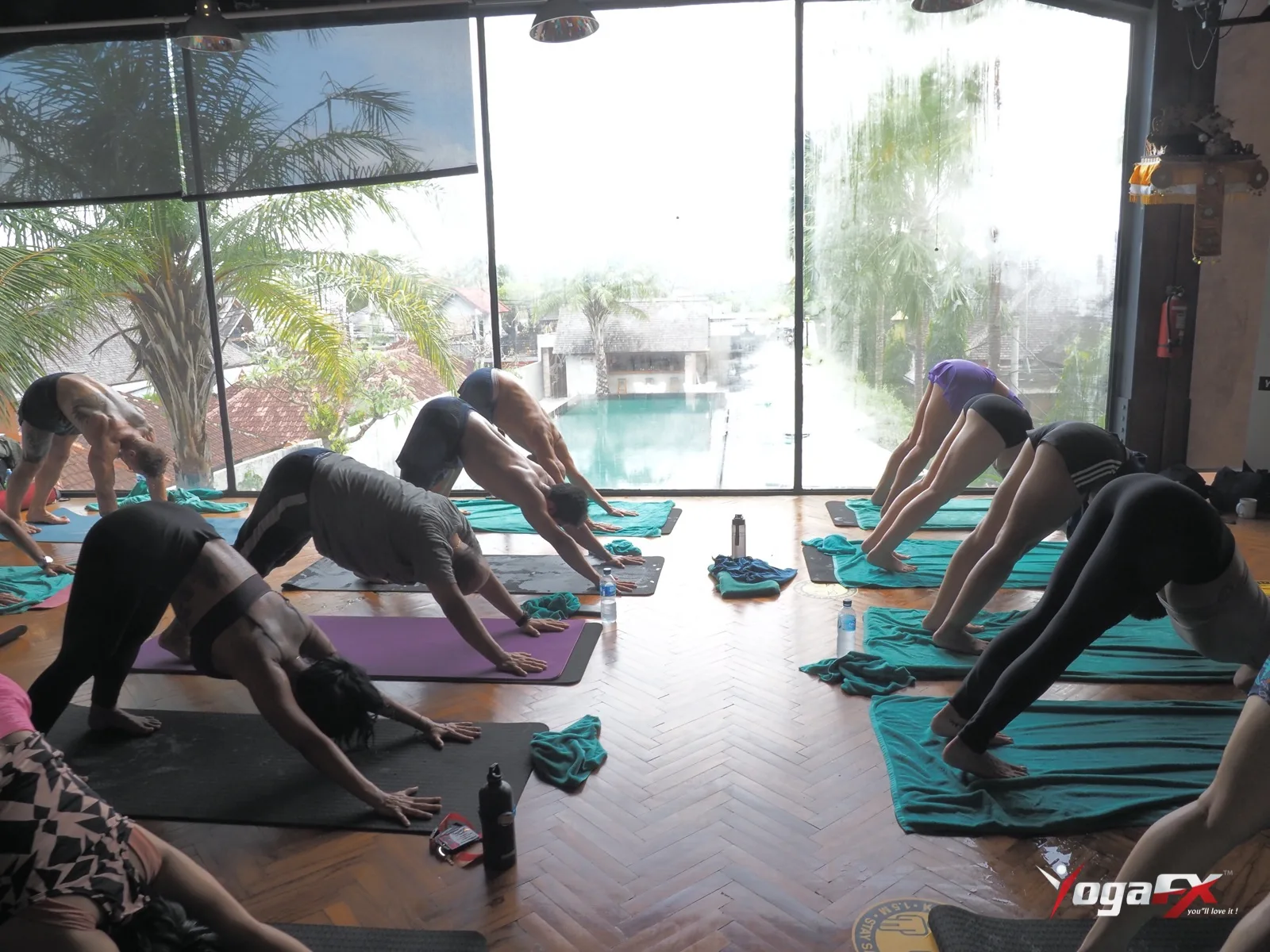
Your teacher talks you into the posture through the 26 and 2 dialogue. You don't watch a demonstration, and there's no music. You listen, and you move when the words tell you to. This matters for awkward pose because the cues arrive in a fixed order, and each one fixes a different part of the squat.
The posture builds in three parts. The first part has you sit down with your feet together. The second lifts your heels. The third changes the shape again. The exact wording lives in the dialogue, so listen to your teacher rather than a written list. Here is the general flow you'll feel:
- Set your feet. You stand tall, feet together, and arms come up parallel to the floor.
- Sit back. Your hips travel down and back, as though you're lowering onto a chair.
- Lift your chest. Your spine stays long instead of folding over your thighs.
- Hold and breathe. You stay still, with a slow breath through your nose.
- Stand up with control. You rise without pushing off your hands or jerking your back.
The posture is done twice, and the second set usually feels different from the first. Some students find it easier because they know what's coming. Others find it harder because their thighs are already tired. Both reactions are normal.
Knee Tracking in Awkward Pose: What to Watch For
Knee tracking means your knees point the same way as your toes. It's the most common thing students get wrong in awkward pose, and it usually happens because the thighs are tired, not because anyone is careless. When the muscles fade, the knees drift.
Here are the faults we see most often, with the simple fix for each:
| What you see | What it looks like | Why it happens | The fix |
|---|---|---|---|
| Knees cave inward | Knees move toward each other and past the big toes | Thigh and hip muscles fatigue | Press your knees gently out over your toes and sit a little higher |
| Weight falls on the toes | Heels feel light and shins lean far forward | Hips are not travelling back | Send your hips back first, then down |
| Rounded back | Chest drops toward the thighs | Trying to sit too low too quickly | Lift your chest and shorten the hold depth |
| Arms drop | Arms sag below shoulder height | Shoulders tire before legs do | Reach long through the fingertips, even if arms sit slightly lower |
| Held breath | Face tightens and jaw clenches | Effort spikes in the first set | Exhale slowly through the nose and soften your face |
Depth is where students get into trouble. You do not have to reach a perfect right angle in your first month. A higher squat with clean knee tracking beats a deep squat with collapsing knees. Your teacher may offer a small adjustment, and you should take it.
If you have a knee injury, have had one, or feel sharp pain (not the usual muscle burn), come up and talk to your teacher after class. Talk to a doctor or physiotherapist before you continue. Burning thighs are normal. Pain in the joint is a different signal.
Breathing Through Awkward Pose When Your Legs Burn
Awkward pose is where many students first notice that they hold their breath. The thighs start to shake, the mind gets loud, and the breath goes shallow. That's a habit, and it can change.
The trick is to give your attention a job. Count five slow breaths in and out through the nose. When the count ends, count five more. This turns a vague wish to escape into a short, doable task. It also keeps your shoulders from creeping up toward your ears.
In practice, the first set is about getting through. The second set is about staying calm. If you can keep your face soft while your legs work, you've learned something that carries to the next posture, and the one after that.
Why Awkward Pose Feels Harder in a 40°C Room
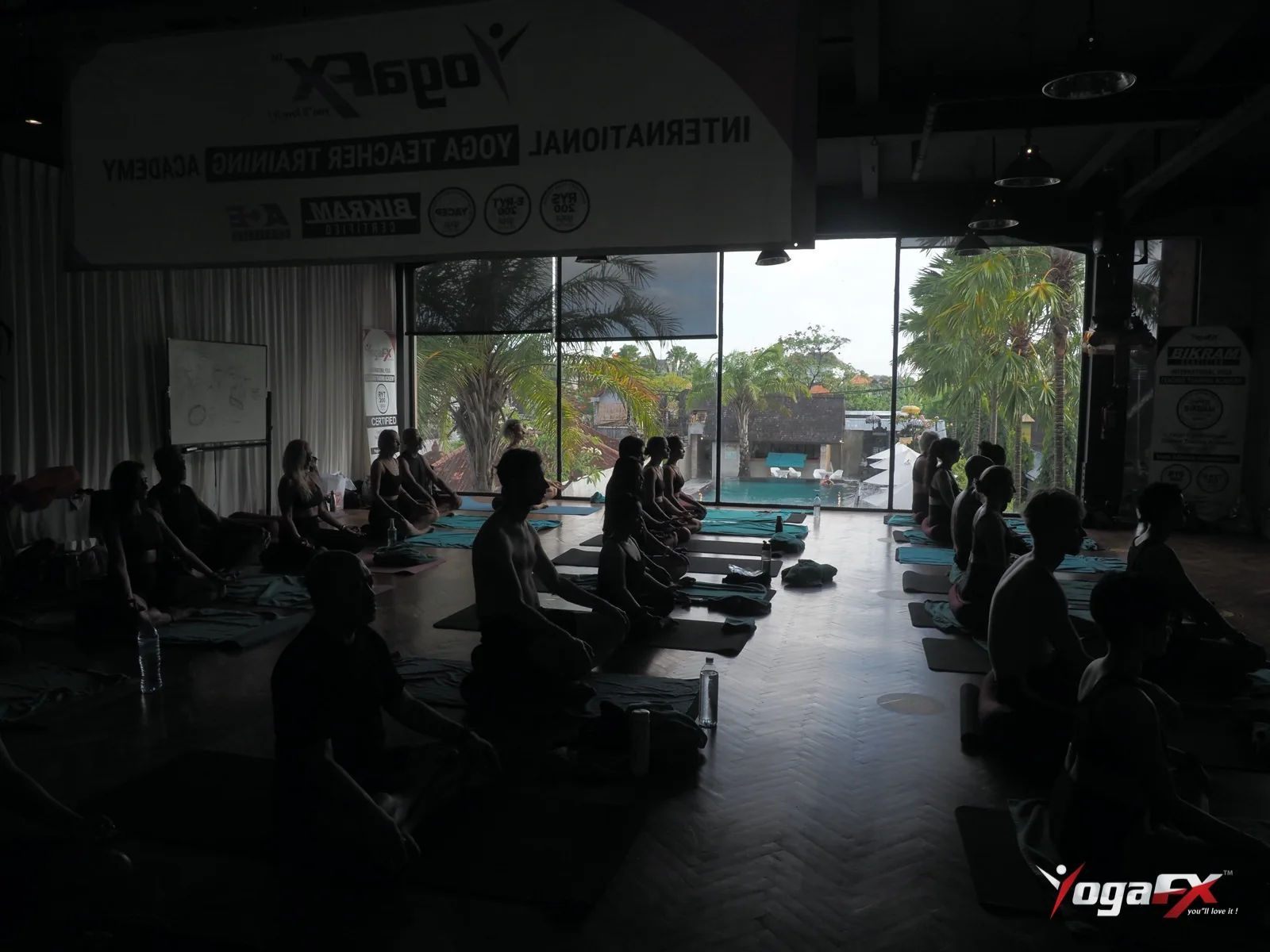
The heat makes everything feel bigger. A class runs 90 minutes at about 40°C with 40% humidity. Your heart rate is already up before you sit down, and the squat then asks your large leg muscles for a lot of blood and oxygen at once.
That's why a posture that feels fine on a cool mat at home can feel brutal in class. The posture hasn't changed. Your body is simply doing it while also managing heat. This is also why we say students should hydrate before class and rest between sets when needed.
The infographic below sums up where awkward pose sits in the class.
Awkward pose comes right after Half Moon, early in the standing series.
Every posture in the method is done twice, so you sit down twice.
The room is warm and humid for the full 90-minute class.
Average across a whole 90-minute class in a University of Wisconsin study (Porcari et al., 2014).
The posture builds through three parts, each set by the teacher's words.
What the Science Says About Holding a Squat
Research on this exact posture is thin, so we'll be careful about what we claim. Here's what the evidence supports, and what it doesn't.
Isometric holds and blood pressure
Awkward pose is an isometric hold, meaning your muscles work hard without the joints moving. Harvard Health reported in 2023 that exercise which engages muscles without movement, such as wall squats and planks, may help lower blood pressure.
That report drew on a British Journal of Sports Medicine analysis of 270 trials and more than 15,000 people. Isometric training was the most effective type, especially for people with high blood pressure.
There's a caution. Only 18 of those 270 trials included isometric exercise, and none compared it directly with other types of exercise. So treat it as a promising signal, not a prescription. If you have high blood pressure, talk to your doctor before starting a heated class.
Glutes and single-leg work
A 2021 study in the International Journal of Sports Physical Therapy used surface electromyography on 31 healthy adults to measure gluteal activation in five poses. Chair pose was not one of them. The study did find that single-leg standing poses worked the glutes hard, with the half moon pose from that study reaching 63.3% of maximum voluntary contraction in the lifted leg.
We can't borrow that number for awkward pose. It does show, though, that standing poses can load the hips strongly.
Heart rate and strength in hot yoga
A University of Wisconsin study (Porcari et al., 2014) of Bikram yoga found students worked at about 80% of their maximum heart rate across a 90-minute class. That's a whole-class figure, so it doesn't isolate awkward pose. A 2013 study of healthy young adults (Tracy and Hart) also reported gains in lower-body strength and flexibility after Bikram yoga training.
Put together, the picture is modest but sensible. Awkward pose is a demanding hold that probably builds leg endurance, and it fits into a class that raises heart rate. It isn't a fix for any condition, and this article isn't medical advice. Speak with a healthcare professional if you have heart, blood pressure or joint concerns.
7 Ways to Stay in Awkward Pose Longer
Staying power is a skill. These seven habits help most students, and none of them need extra flexibility.
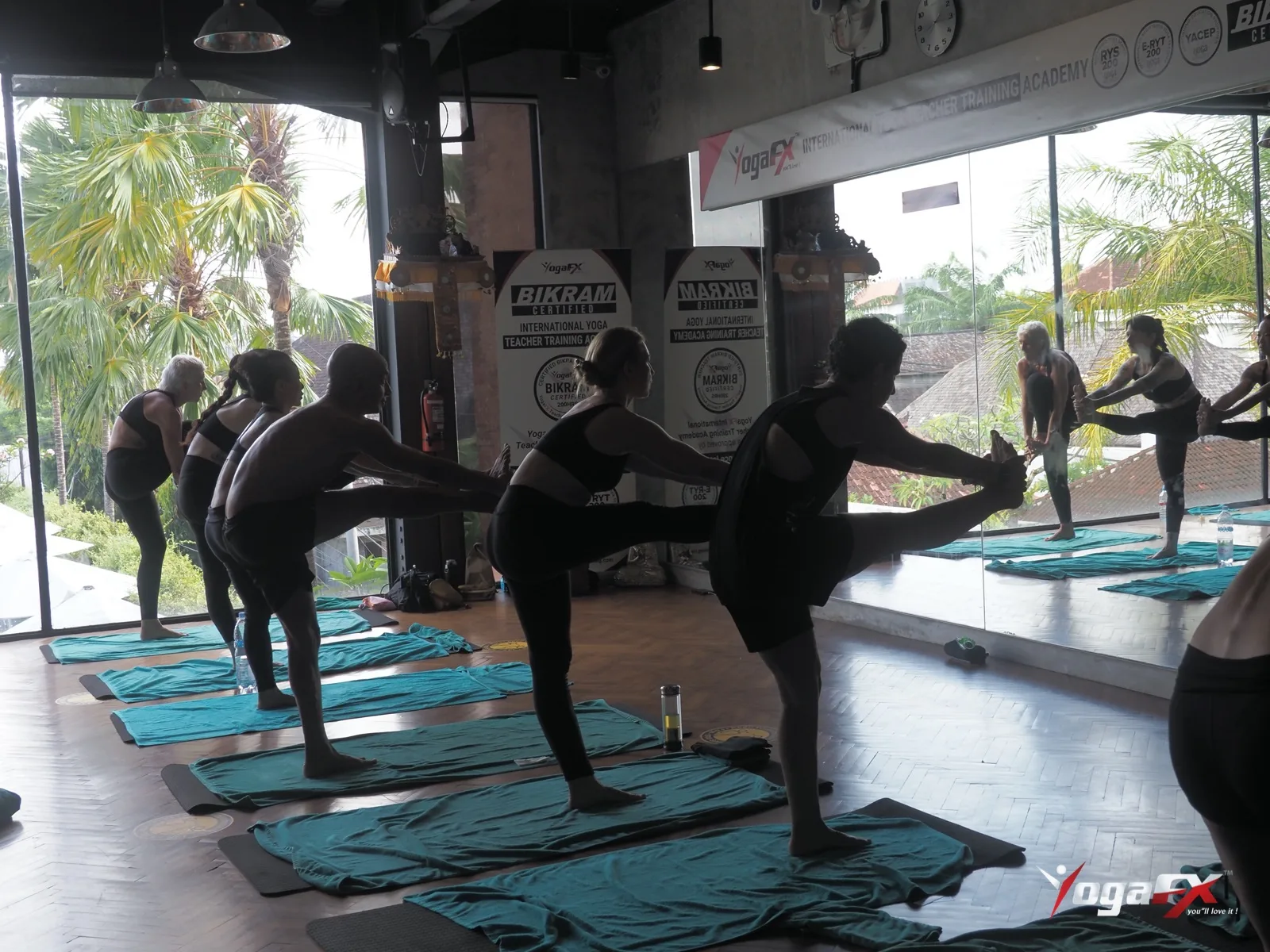
- Start higher than you think. A shallow squat you can hold beats a deep one you drop out of.
- Send your hips back first. This takes load off your knees and puts it in your thighs and glutes.
- Keep your knees over your toes. If they drift in, press them out a little.
- Lift your chest. Your back stays long, and your breathing space stays open.
- Breathe in counts. Five slow nasal breaths, then five more.
- Look at one steady point. A fixed gaze calms the mind in a noisy moment.
- Rest between sets. Stand quietly, breathe, and let your heart rate settle before the second one.
None of these are tricks. They're habits, and they work because they give your body fewer things to fight at once.
Awkward Pose Over Your First Three Months
Most students ask how long it takes to feel better in awkward pose. Our teaching notes suggest a gradual change. In the first weeks, you're mainly learning the shape and getting used to the heat. Then the legs start to hold a little longer.
| Stage | What students usually notice | Focus for that stage |
|---|---|---|
| Weeks 1 to 2 | Thighs shake early, and the hold feels short | Learn the cues and keep a higher squat |
| Weeks 3 to 6 | Knee tracking gets easier to catch | Press knees over toes and breathe in counts |
| Weeks 7 to 8 | The second set feels less scary | Rest well between sets and stay calm |
| Weeks 9 to 12 | Awkward pose holds longer with control | Sit a little lower, only if the knees stay clean |
Frequency matters here. Practising a few times a week gives your legs time to recover and adapt. Practising once a month tends to feel like starting over each time.
What Students Say About Learning With Mr. Ian
Our students don't often write about one posture, but their reviews show what the training room feels like. These come from our Google and Yoga Alliance reviews, and one is translated from German.
I especially appreciated for Ian and Ritesh who have been two of the most important mentors in my life.
Katy, Google review, 2019
Very amazing experience with Yogafx, i learn a lot from the training. Thankyou Yogafx
Komang, Yoga Alliance review, 2019
I have just finished the 200-hour yoga teacher training at YogaFX in Bali. I really enjoyed the course and we had a lot of fun. I thank our teacher Ian.
Uyanga, Google review, 2019 (translated from German)
We chose these because they speak to the teaching, which is what makes a hard posture like awkward pose manageable. A clear dialogue and a steady teacher make the burn easier to sit with.
From Awkward Pose to Teacher Training
If awkward pose has you curious about the method, there are two next steps. You can try a class at our Seminyak studio, and the Free 1-Day Guest Pass makes your first class free. The studio is at Jl. Pangkungsari Gg Jepun No.888, Kuta Utara, Seminyak, Badung, Bali 80361, open 06:00 to 22:00 daily.
If you want to teach the posture, our 26 and 2 yoga teacher training programme trains you to deliver the dialogue yourself, with Mr. Ian Terry teaching. Teaching awkward pose well means knowing the cues, the common faults and how to talk a student through the burn.
FAQ
What is awkward pose in yoga?
Awkward pose, or Utkatasana, is a held squat where you sit back as if on a chair, with your arms out in front of you. In the 26 and 2 it is the second posture. It builds thigh endurance, hip control and steady breathing under heat.
Is awkward pose the same as chair pose?
They look similar, and both are called Utkatasana. In the 26 and 2, awkward pose is taught through a fixed dialogue in three parts, and it is held in a heated room. Other styles may teach chair pose with different cues, depth and timing.
Why do my knees shake in awkward pose?
Shaking usually means your thigh muscles are tiring under load. It's common, especially early on. Raise your hips slightly, keep your knees over your toes, and breathe slowly. If you feel sharp joint pain instead of muscle burn, come up and ask your teacher.
How long should you hold awkward pose?
Your teacher sets the timing through the dialogue, so you don't have to count yourself. Beginners can sit higher and still follow the class. Over weeks, the hold usually feels steadier. Rest between the two sets, and hydrate well before and after class so your legs recover properly.
Is awkward pose good for your legs?
It works the thighs and hips hard, so it can build leg endurance over time. Research on this exact posture is limited. Studies on isometric holds and on hot yoga are encouraging, but not conclusive. Check with a healthcare professional if you have knee or heart concerns.
Still have questions? Message Mr. Ian and the YogaFX team on WhatsApp and we will answer them personally. Ask about the posture, the heat, the Free 1-Day Guest Pass or teacher training, and we will point you to the right next step.