What is Bikram yoga? It is a fixed 90-minute hot yoga class made of 26 postures and 2 breathing exercises, always in the same order and led by a scripted dialogue. This walkthrough follows the sequence one posture at a time, so you know what happens in the room before you step into it.
Table of Contents
Mr. Ian Terry, Founder and Lead Instructor at YogaFX (E-RYT 500), has taught this class for more than 12,000 hours. Everything below comes from that classroom, not from a brochure. We call the method Original Hot 26&2, and many studios now use the names Hot 26&2 or 26 and 2 yoga for the same class.
What Is Bikram Yoga? The Sequence in Plain Terms
So, what is Bikram yoga in practice? Most yoga classes change from one teacher to the next. This one does not. The postures, the order and the words the teacher speaks stay the same every time, which is why a regular student can predict almost every minute of the class.
That predictability is the point of what is Bikram yoga. Because you know what is coming, you can spend your attention on breath, balance and the heat instead of guessing the next shape. Here is how the Bikram yoga sequence is built:
- One opening breathing exercise. Standing Deep Breathing (Pranayama) starts every class.
- A standing series. Eleven balance, strength and stretching postures, from Half Moon to Toe Stand.
- A short rest and a floor series. Dead Body Pose, then twelve postures on the back, belly, knees and seat.
- One closing breathing exercise. Blowing in Firm ends the class.
In the traditional numbering, the two breathing exercises count as the first and the last of the 26. That is why you will see them at number 1 and number 26 in the table below. For the wider story of how the method is laid out, our guide to the method behind the 26 postures and dialogue is a good companion read.
All 26 Postures at a Glance
Here is the whole sequence in order, the short answer to what is Bikram yoga when someone asks for the list. Postures are listed by their usual English name, with the Sanskrit name and a plain description of what you do. Think of it as a map of what is Bikram yoga, in order. The sections after the table walk through each part of it.
| No. | Posture | Sanskrit name | Part of class | What you do |
|---|---|---|---|---|
| 1 | Standing Deep Breathing | Pranayama | Opening breath | Slow inhale and exhale with arms raised |
| 2 | Half Moon with Hands to Feet | Ardha-Chandrasana with Padahastasana | Standing | Side bends, a back bend, then a forward fold |
| 3 | Awkward Pose | Utkatasana | Standing | Sit back as if into a chair, arms forward |
| 4 | Eagle Pose | Garudasana | Standing | Balance on one leg with arms and legs wrapped |
| 5 | Standing Head to Knee | Dandayamana-Janushirasana | Standing | Balance on one leg, forehead toward the knee |
| 6 | Standing Bow Pulling | Dandayamana-Dhanurasana | Standing | Kick back into a bow while balancing |
| 7 | Balancing Stick | Tuladandasana | Standing | Body parallel to the floor in a T shape |
| 8 | Standing Separate Leg Stretching | Dandayamana-Bibhaktapada-Paschimotthanasana | Standing | Wide-legged forward fold |
| 9 | Triangle Pose | Trikanasana | Standing | Wide stance with a deep side stretch |
| 10 | Standing Separate Leg Head to Knee | Dandayamana-Bibhaktapada-Janushirasana | Standing | Wide stance, fold with the head toward the knee |
| 11 | Tree Pose | Tadasana | Standing | One-leg balance with the hands in prayer |
| 12 | Toe Stand | Padangustasana | Standing | Balance on the toes in a low squat |
| 13 | Dead Body Pose | Savasana | Rest | Lie still on the back and let the breath settle |
| 14 | Wind Removing Pose | Pavanamuktasana | Floor | Hug one knee, then both, to the chest |
| 15 | Sit-up | Sit-up | Floor | Roll up from lying to sitting with a forward fold |
| 16 | Cobra Pose | Bhujangasana | Floor | Chest lift on the belly |
| 17 | Locust Pose | Salabhasana | Floor | Lift one leg at a time on the belly |
| 18 | Full Locust Pose | Poorna-Salabhasana | Floor | Lift both legs and the chest |
| 19 | Bow Pose | Dhanurasana | Floor | Hold the ankles, kick and lift |
| 20 | Fixed Firm Pose | Supta-Vajrasana | Floor | Sit between the heels and lean back |
| 21 | Half Tortoise Pose | Ardha-Kurmasana | Floor | Fold forward from the heels, arms reaching ahead |
| 22 | Camel Pose | Ustrasana | Floor | Kneeling back bend |
| 23 | Rabbit Pose | Sasangasana | Floor | Curl forward from the heels with the crown down |
| 24 | Head to Knee with Stretching | Janushirasana with Paschimotthanasana | Floor | Seated fold over one leg, then both legs |
| 25 | Spine Twisting Pose | Ardha-Matsyendrasana | Floor | Seated twist, one side then the other |
| 26 | Blowing in Firm | Kapalbhati in Vajrasana | Closing breath | Quick, sharp exhales while sitting on the heels |
The Opening Breath: Standing Deep Breathing
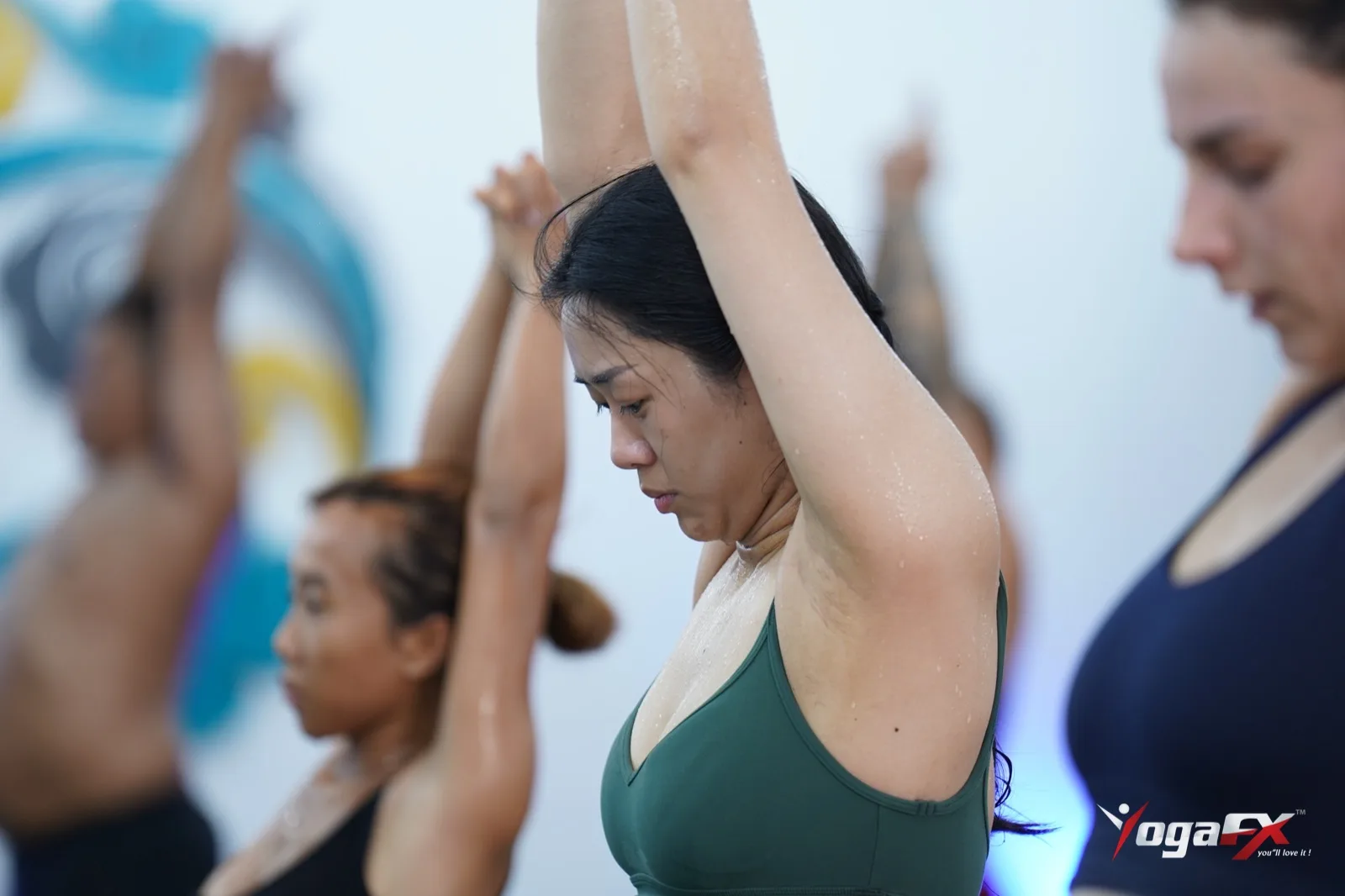
What is Bikram yoga at the very start of class? It is you on your feet, facing the mirror, with the first of the two breathing exercises. You lift your arms, breathe in through the nose and breathe out through the mouth, with your head tipping back and then forward. It looks simple. In a heated room, it isn’t.
This is where most first-timers meet the heat. The teacher keeps talking you through each breath, and that voice is what keeps your attention from drifting. If you want the full breakdown of the breathing technique, read our guide to pranayama breathing in the 26 and 2.
The Standing Series: Postures 2 to 12
If you are still asking what is Bikram yoga going to feel like, the standing series answers it. It is the longest stretch of the class, and balance, leg strength and concentration are tested together. Most postures are done twice, so you get a second attempt to improve on the first. That second try is a big part of what is Bikram yoga for a beginner.
Postures 2 to 6: Build the Base
- Half Moon with Hands to Feet. You bend to each side, back, then fold forward. It warms the spine and sets the tone for the series.
- Awkward Pose. You sit back on your toes, then your heels, with your arms out in front. Your thighs work hard and your breath shortens.
- Eagle Pose. You balance on one leg with your arms and the other leg wrapped around. Your eyes stay on one point in the mirror.
- Standing Head to Knee. You hold one foot in both hands, straighten the leg and bring your forehead toward the knee.
- Standing Bow Pulling. You kick one leg back into your hand while the other arm reaches forward. Balance and effort pull against each other.
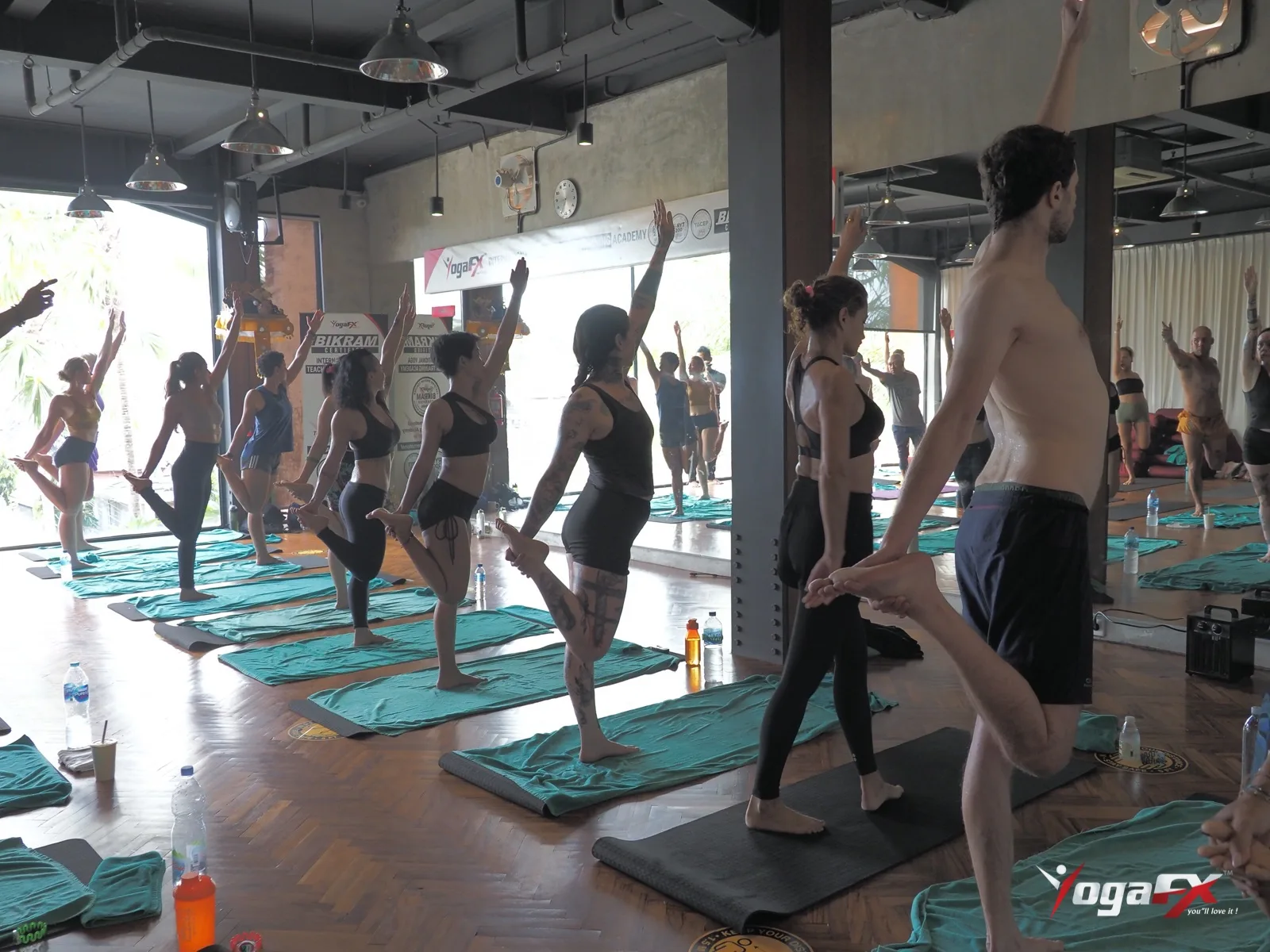
Postures 7 to 12: Wide Stance and Stillness
Balancing Stick is a T shape, with your chest and one leg parallel to the floor. After that, the class opens into a wide stance for Standing Separate Leg Stretching, a fold with the hands on the floor between your feet.
Next comes Triangle Pose, a deep side stretch with the feet wide apart. It is followed by Standing Separate Leg Head to Knee, which asks you to fold deeper with your head toward your knee. Because your legs are tired by now, these two postures demand patience more than flexibility.
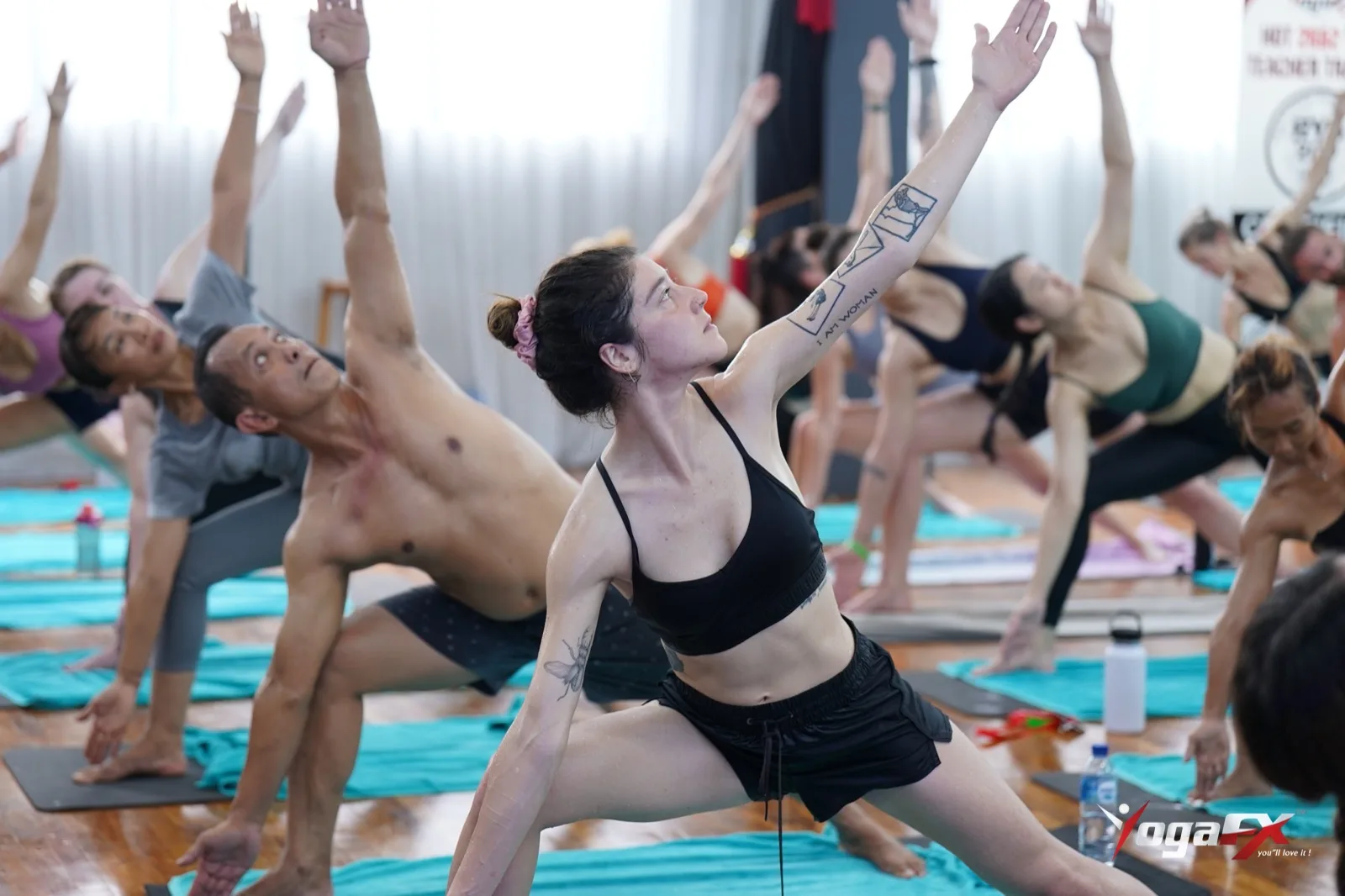
The standing series closes with Tree Pose, a one-leg balance with the hands in prayer (Tadasana), and Toe Stand, where you balance low on your toes. Both ask for stillness after a lot of effort. Then you lie down for the first rest of the class. That is what is Bikram yoga for the first twelve postures.
The Class in Four Stages
Numbers help when you are trying to picture the class. This is how the 26 are divided across the 90 minutes. Notice that the standing series and the floor series carry almost the same number of postures, with a single rest in the middle.
The Floor Series: Postures 13 to 25
What is Bikram yoga doing between the halves? It is resting. After Toe Stand, you lie on your back for Dead Body Pose. The room is quiet, your heart rate settles and the teacher reminds you to stay still. This short rest repeats between floor postures, and it is what makes the second half of what is Bikram yoga manageable.
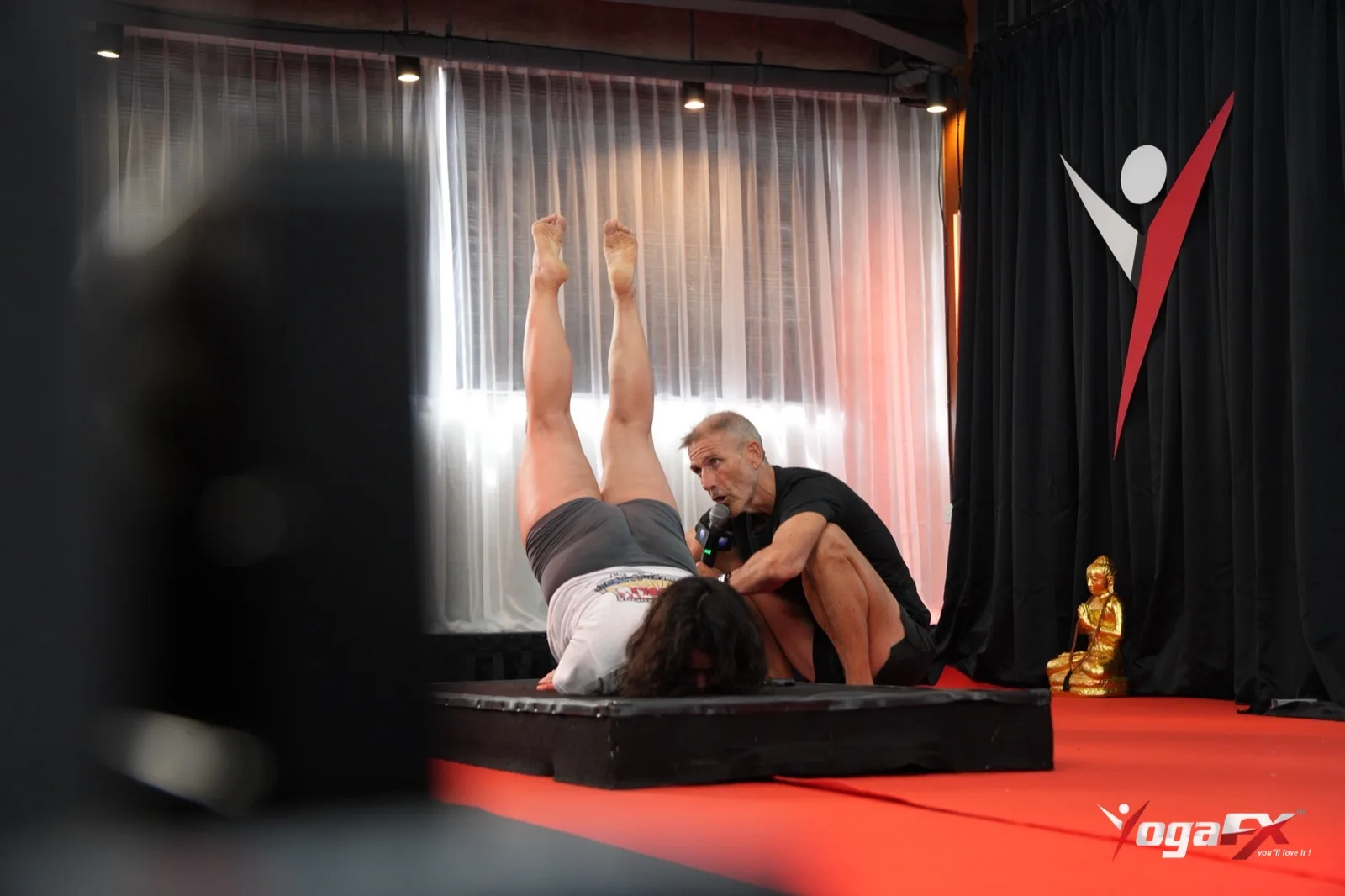
On the Back and Belly
- Wind Removing Pose and the Sit-up. You hug your knees to your chest, then roll up to sit with a forward fold.
- Cobra, Locust and Full Locust. On your belly, you lift your chest, then one leg, then both legs. Cobra is the gentlest of the three.
- Bow Pose. You hold your ankles and kick back to lift your chest and legs together.
On the Knees and Seat
Fixed Firm Pose has you sit between your heels and lean back. Half Tortoise folds you forward from the heels, and Camel Pose opens the front of the body in a kneeling back bend. Rabbit Pose then rounds the spine the other way, with your head down and your hands on your heels.
The last two postures are seated. Head to Knee with Stretching folds you over one leg, then both. Spine Twisting Pose turns you to each side. Our trainees spend many hours on safe, simple instructions for this half, because the cues here matter more than the shape. For a teacher, what is Bikram yoga comes down to clear words.
The Closing Breath: Blowing in Firm
What is Bikram yoga’s last word? Breath. The class ends the way it began. You sit on your heels and exhale in quick, sharp bursts, drawing the belly in on each one. It is the second of the 2 breathing exercises, and it brings the class to a close with the same structure it started with.
After the final breath, most students lie down for a last rest and feel clear-headed rather than flat. That calm finish is what is Bikram yoga for many regulars. Rehydrate and eat something light afterwards, and give yourself a few minutes before you stand up quickly.
The Script, the Room and the Pace
Two things answer the question of what is Bikram yoga compared with other hot yoga. The first is the dialogue. The teacher speaks a scripted set of instructions for each posture, with no demonstration and no music. Because the words are the same every time, you learn to follow them like a map. You can read more in our guide to the 26 and 2 dialogue.
The second is the room. A YogaFX class runs near 40°C with about 40% humidity, and the heat comes from Bali’s tropical climate, not from electric heaters. So what is Bikram yoga in the heat? You sweat early and often. That is part of the practice, not a sign that something is wrong.
Because the sequence is fixed, you can also track your own progress, which is part of what is Bikram yoga at its best. You don’t compare yourself with the person on the next mat. You compare this week’s Triangle Pose with last week’s, in the same posture, at the same point in the class. That is the quiet advantage of a method that never changes.
What the Science Says and How to Stay Safe
What is Bikram yoga good for? Research on heated yoga is still growing, so it pays to keep claims modest. One of the better-known studies is an 8-week randomized controlled trial of heated yoga for adults with moderate-to-severe depression, led by Maren Nyer and colleagues at Massachusetts General Hospital (Journal of Clinical Psychiatry, 2023).
In that trial, adults assigned to heated yoga had a significantly greater drop in depressive symptoms than adults on a waitlist. The Harvard Gazette summary describes 80 people randomized, with 65 analyzed, and sessions of 90 minutes in a heated room.
The same article also notes a limit. The senior author said future research is needed to compare heated and non-heated yoga. In other words, when people ask what is Bikram yoga good for, the results are encouraging, but they do not prove that heat itself is what helps.
Heat is also a real load on the body. According to MedlinePlus, heat exhaustion can bring heavy sweating, rapid breathing and a fast, weak pulse, and heat stroke needs medical help right away. Its prevention advice is to drink fluids, replace lost salt and minerals, and limit time in the heat.
- Drink water early. Start well before you walk into the room.
- Sit out when it’s too much. Pausing is a skill, not a failure.
- Keep the last meal small. A full stomach and 40°C are a poor pair.
- Tell your teacher about any condition before you start.
This article is education, not medical advice. Please consult a healthcare professional before starting hot yoga, especially if you have a heart condition, high blood pressure or take regular medication.
What Students Say About the Method
What is Bikram yoga like to learn? Trainees describe the course in their own words in video reviews on YouTube. Here are three, from the 2025 intensive in Bali.
“Mr Ian and his whole team have been amazing.”
Annemarie, YouTube review, 2025
“It’s been an amazing experience.”
Samantha, YouTube review, 2025
Judith, in her 2025 YouTube review, said she had stopped waiting until she felt perfect before she started teaching, and that she planned to teach the method that year (paraphrased).
Across platforms there are 150 Google reviews, 50 Yoga Alliance reviews and 357 YouTube testimonials, so you can hear from many trainees before you decide.
Try the Sequence at YogaFX in Seminyak
You don’t have to take our word for what is Bikram yoga. The easiest way to understand what is Bikram yoga is to do it once. YogaFX offers a Free 1-Day Guest Pass, so your first class is free. The studio is at Jl. Pangkungsari Gg Jepun No.888, Kuta Utara, Seminyak, Badung, Bali 80361, and it is open daily from 06:00 to 22:00.
If you want to teach the original Bikram yoga method, the sequence above is exactly what you learn. Our six-day hybrid course combines online theory with an intensive in Bali, and the next batch checks in on Sunday 24 January 2027 and checks out on Friday 29 January 2027. You finish with the Yoga Alliance RYT 200-Hour certificate and the Bikram Hot 26&2 200-Hour International Yoga Certification. Read more about what 240 hours of the Original Hot 26&2 cover.
For a shorter overview of the method and how it connects to a teacher career, see this introduction on our teacher training site.
FAQ
How many postures are in Bikram yoga?
A Bikram class has 26 postures and 2 breathing exercises. In the traditional numbering, the two breathing exercises are the first and the last of the 26. The sequence lasts 90 minutes, and a teacher guides every posture with the same scripted dialogue in each class, so the structure stays familiar from one visit to the next.
What type of yoga is Bikram yoga?
Bikram yoga is a form of hatha yoga, which means it works with physical postures and breath. What sets it apart is the fixed structure: the same 26 postures and 2 breathing exercises, in the same order, in a heated room, with a scripted dialogue and no music. That structure is why people describe it as a method rather than a mood.
What order are the Bikram yoga postures done in?
The class opens with Standing Deep Breathing, then moves through eleven standing postures from Half Moon to Toe Stand, rests in Dead Body Pose, then completes twelve floor postures from Wind Removing to Spine Twisting. It closes with Blowing in Firm, a breathing exercise that gives the class the same frame at both ends.
What makes Bikram yoga different from other yoga classes?
Most yoga classes change every week, with different postures, music and pacing. Bikram yoga does not. The postures, the order and the teacher’s words stay the same in every class, so you always know what comes next and can track your own progress over time, week after week.
What is Bikram yoga based on?
It draws on classical hatha yoga postures, arranged by its founder into one fixed sequence. Mr. Ian Terry trained for five years, from 2014 to 2019, with the founder of the method, and now teaches it as the Original Hot 26&2 method in Bali, where every trainee learns the full sequence.
Still have questions? Message Mr. Ian and the YogaFX team on WhatsApp and we will answer them personally. Tell us where you are in your journey, and we will point you to the right next step.