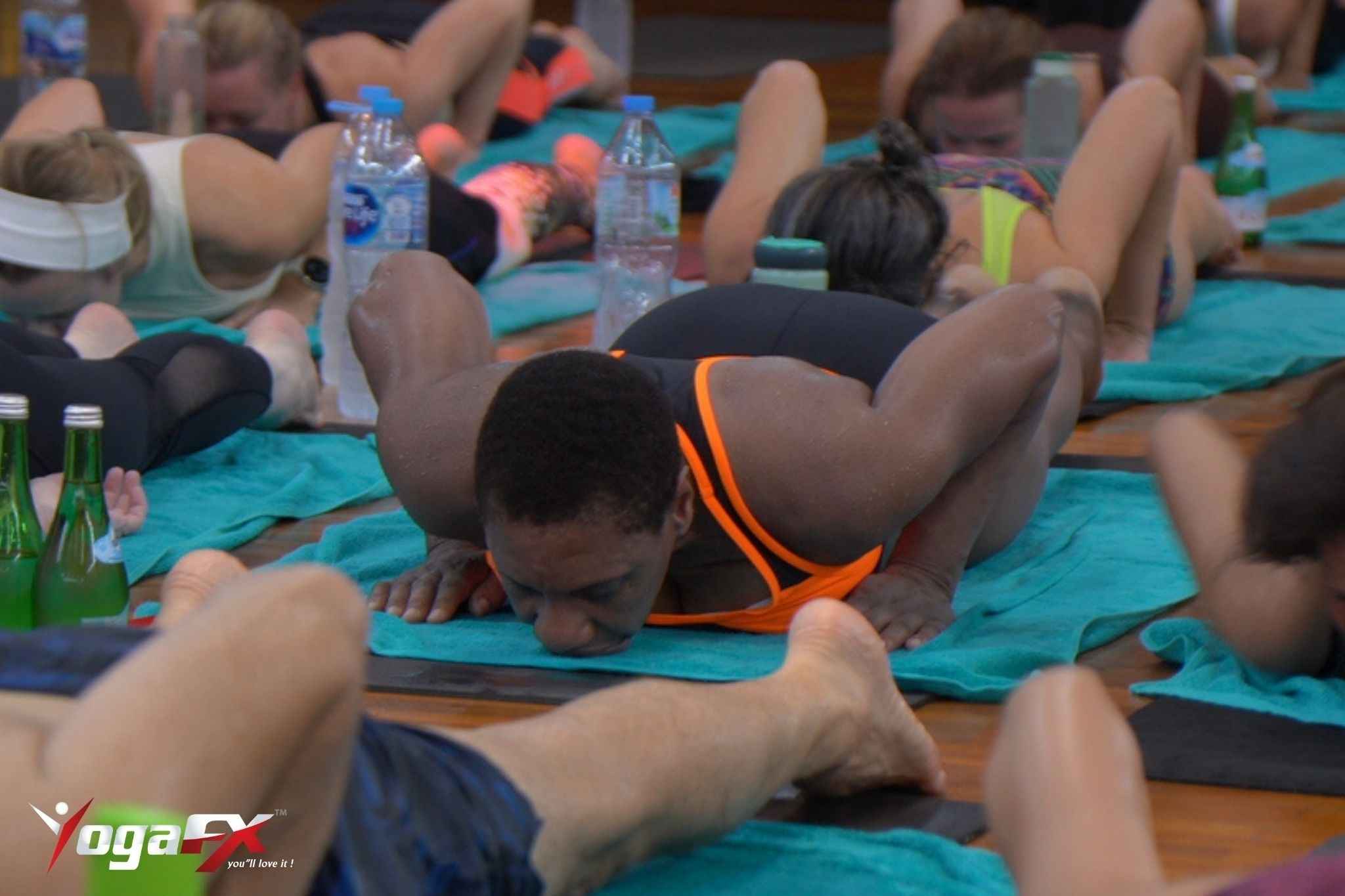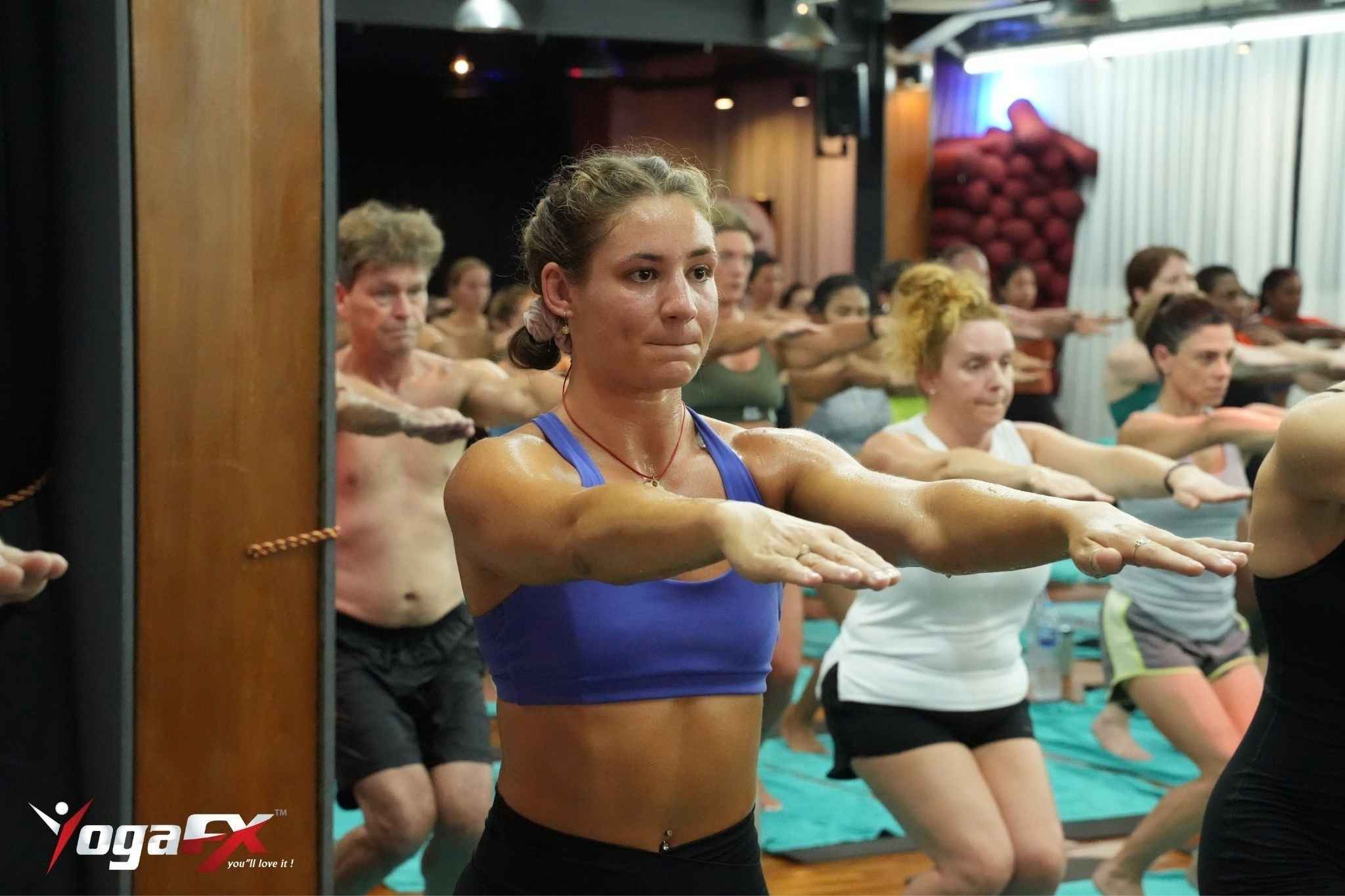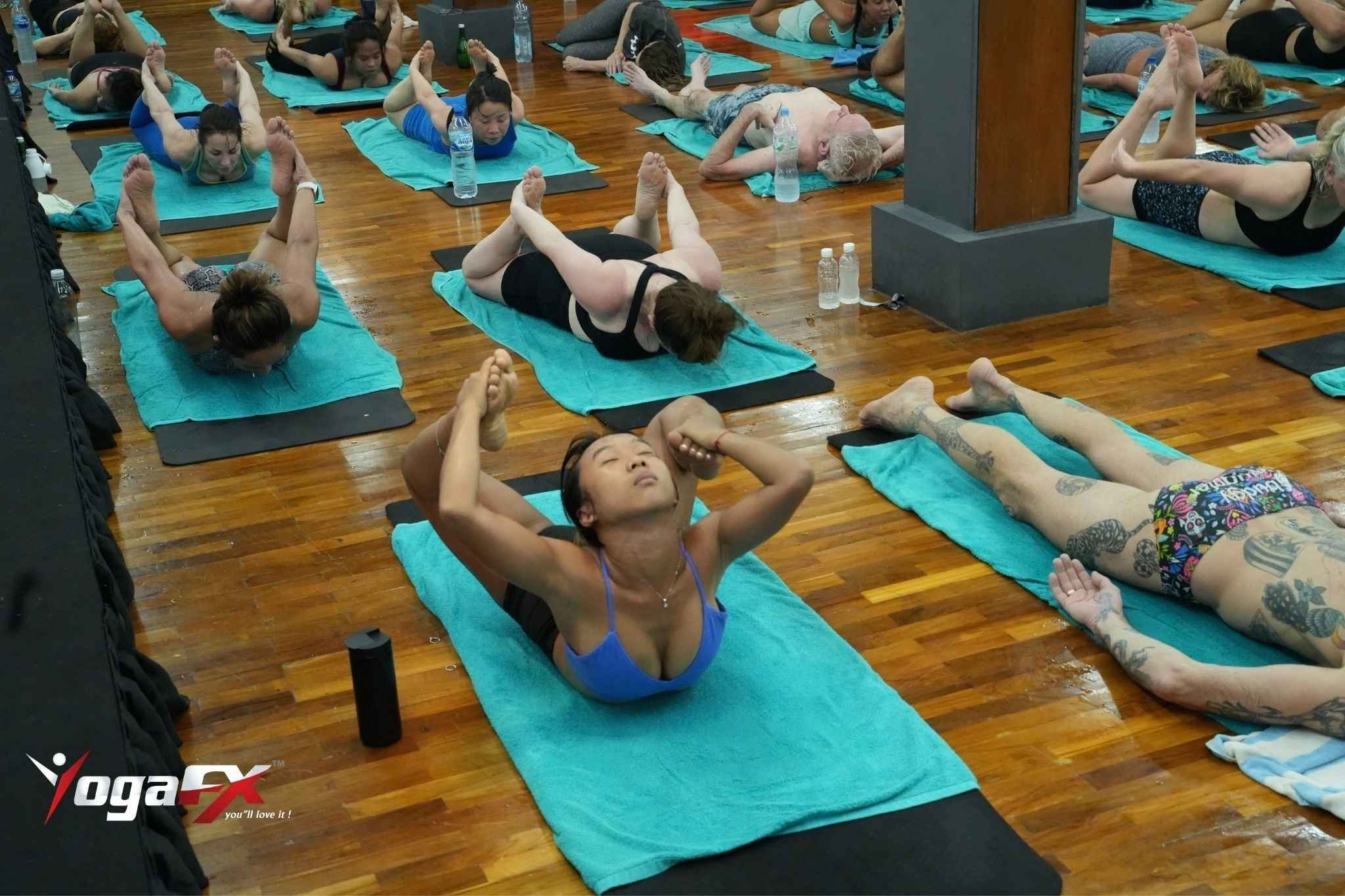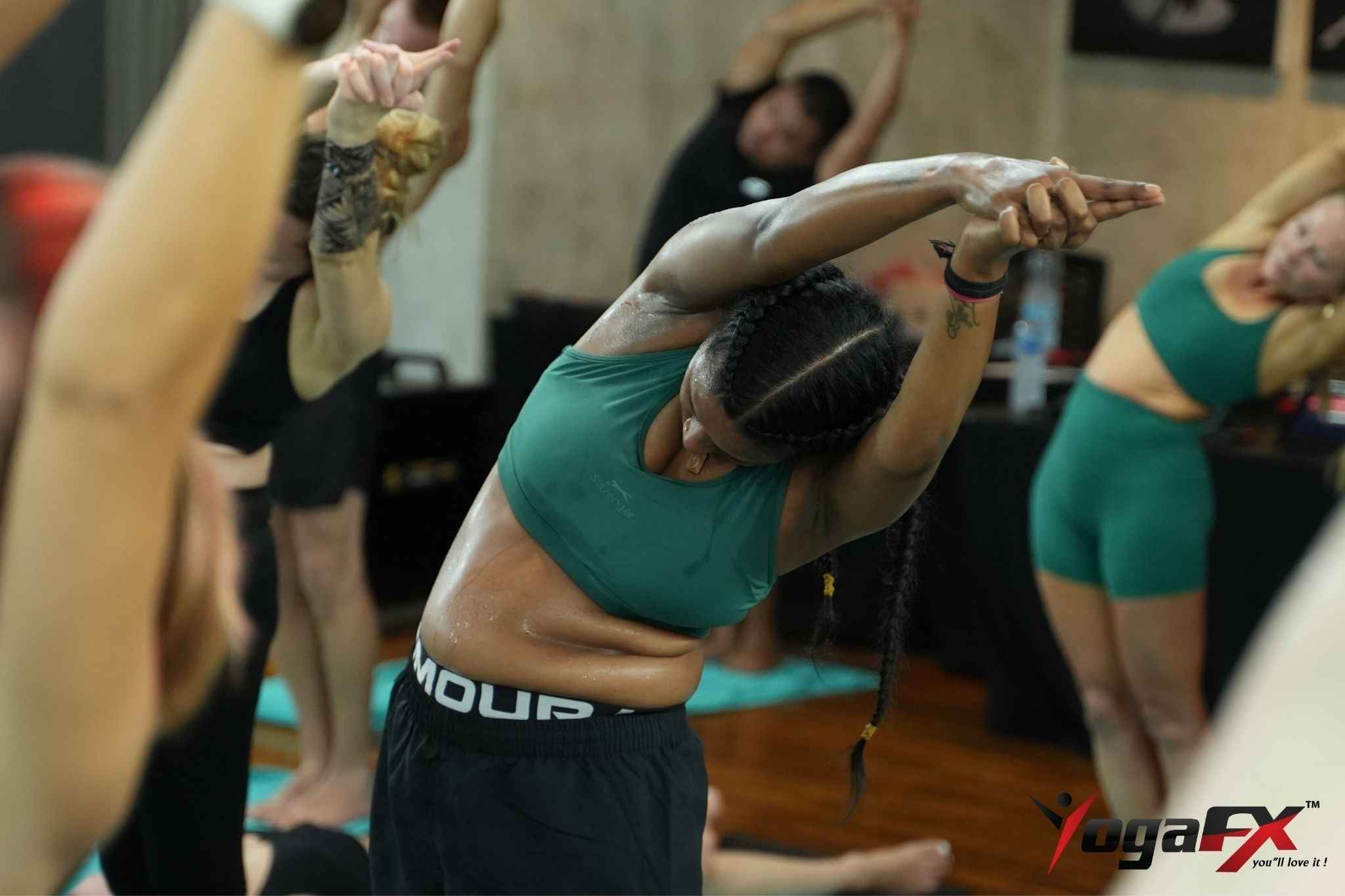
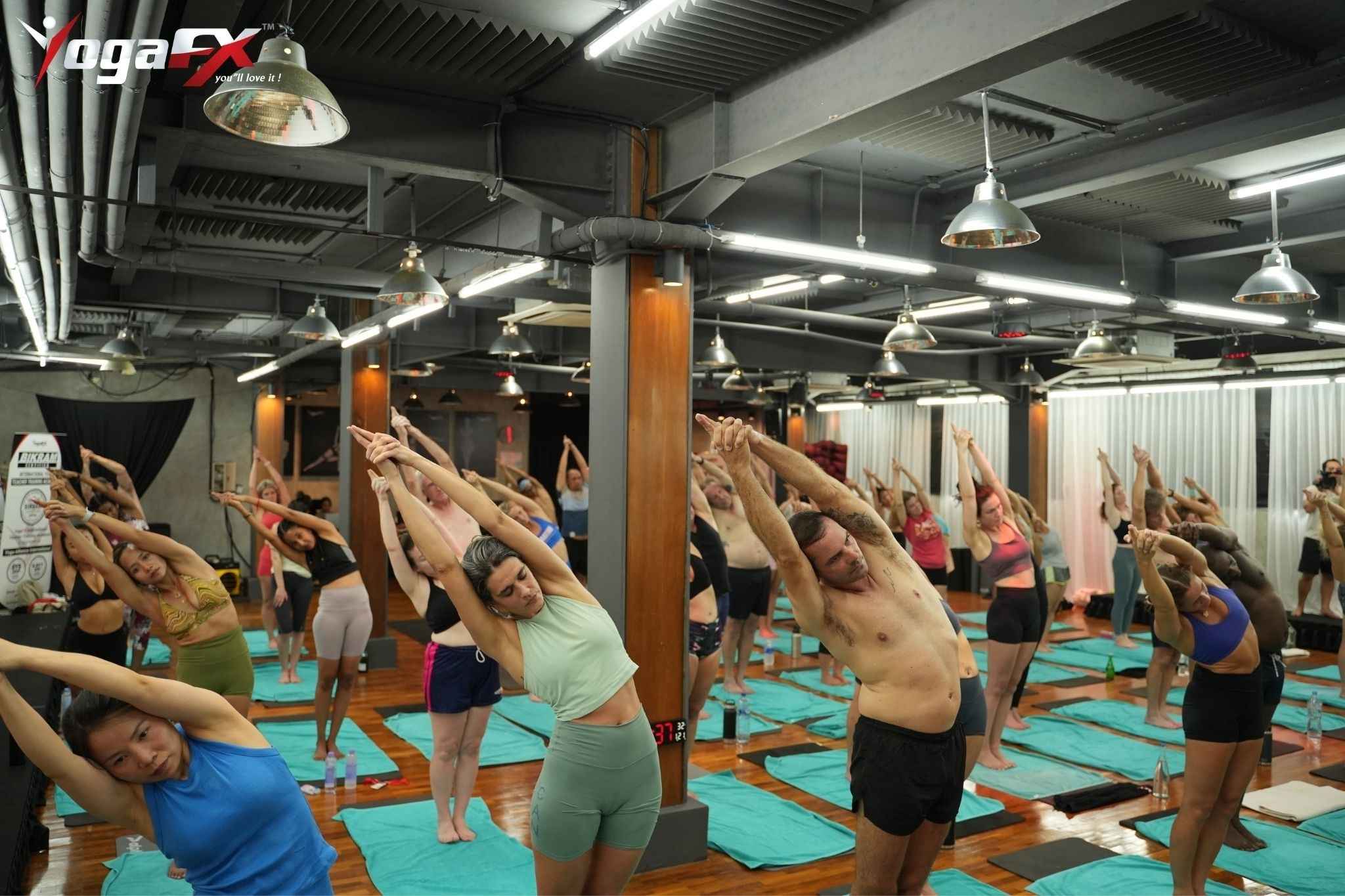
The 26 and 2 yoga sequence always runs in the same order: Standing Deep Breathing, eleven standing postures, a two-minute Savasana, twelve floor postures, and Blowing in Firm breathing to close. The order is not tradition for its own sake. It builds heat and heart rate first, then spends that heat on progressively deeper spine work, and finishes by bringing the nervous system back down.
Most guides stop at the list. This one explains the logic, because once you understand why Awkward comes before Eagle or why Rabbit always follows Camel, the class stops feeling like 90 minutes of random suffering and starts reading like a single, deliberate piece of work. The explanations below reflect how Mr. Ian Terry, E-RYT 500 and founder of YogaFX, teaches the sequence after more than 12,000 hours in the hot room. If you want a pose-by-pose description of each posture instead, our complete guide to the 26 and 2 yoga poses covers them one at a time.
The 26 and 2 Sequence at a Glance
Here is the full sequence as it is taught in a standard 90-minute class. The number column follows the classic numbered list, which counts the two breathing exercises as positions 1 and 26. The sets column shows what is typical in a 90-minute class; some teachers adjust hold times slightly for the group in front of them, but the order never changes.
| # | Posture | Sanskrit | Series | Sets (typical 90-min class) |
|---|---|---|---|---|
| 1 | Standing Deep Breathing | Pranayama | Breathing | 2 sets |
| 2 | Half Moon with Hands to Feet | Ardha Chandrasana with Pada Hastasana | Standing | 2 sets |
| 3 | Awkward Pose | Utkatasana | Standing | 2 sets, 3 parts |
| 4 | Eagle Pose | Garurasana | Standing | 2 sets each side |
| 5 | Standing Head to Knee | Dandayamana Janushirasana | Standing (balancing) | 2 sets each side |
| 6 | Standing Bow Pulling | Dandayamana Dhanurasana | Standing (balancing) | 2 sets each side |
| 7 | Balancing Stick | Tuladandasana | Standing (balancing) | 2 sets each side |
| 8 | Standing Separate Leg Stretching | Dandayamana Bibhaktapada Paschimotthanasana | Standing | 2 sets |
| 9 | Triangle | Trikanasana | Standing | 2 sets each side |
| 10 | Standing Separate Leg Head to Knee | Dandayamana Bibhaktapada Janushirasana | Standing | 2 sets each side |
| 11 | Tree | Tadasana | Standing | 1 set each side |
| 12 | Toe Stand | Padangustasana | Standing | 1 set each side |
| 13 | Dead Body | Savasana | Transition | 2 minutes, then short rests between floor postures |
| 14 | Wind Removing | Pavanamuktasana | Floor | 2 sets, 3 parts |
| 15 | Sit-Up | Pada Hastasana (seated) | Floor | Between floor postures |
| 16 | Cobra | Bhujangasana | Floor (spine strengthening) | 2 sets |
| 17 | Locust | Salabhasana | Floor (spine strengthening) | 2 sets, 3 parts |
| 18 | Full Locust | Poorna Salabhasana | Floor (spine strengthening) | 2 sets |
| 19 | Bow | Dhanurasana | Floor (spine strengthening) | 2 sets |
| 20 | Fixed Firm | Supta Vajrasana | Floor | 2 sets |
| 21 | Half Tortoise | Ardha Kurmasana | Floor | 2 sets |
| 22 | Camel | Ustrasana | Floor | 2 sets |
| 23 | Rabbit | Sasangasana | Floor | 2 sets |
| 24 | Head to Knee with Stretching | Janushirasana with Paschimotthanasana | Floor | 2 sets each side, then 2 sets stretching |
| 25 | Spine Twisting | Ardha Matsyendrasana | Floor | 1 set each side |
| 26 | Blowing in Firm | Kapalbhati | Breathing | 2 sets |
Why "26 and 2" Can Mean 26 or 28 Items
If you have compared a few lists online, you have probably noticed they do not agree on the count. That is not a mistake on anyone's part. There are two counting conventions in use, and they describe exactly the same class.
- The classic numbered list (the one in the table above) has 26 numbered positions, and the two breathing exercises are numbers 1 and 26. Half Moon and Hands to Feet share one number, and the Sit-Up gets its own. Count this way and you get 24 physical postures plus 2 breathing exercises inside a total of 26.
- The modern studio description says "26 postures and 2 breathing exercises", which is where the name "26 and 2" comes from. Studios that use it count the physical shapes separately from the breathing, so the total reads as 28 elements.
Neither convention adds or removes a single movement. What matters to you on the mat is that the order is fixed, the room is hot, and the class lasts 90 minutes. YogaFX describes the method as 26 postures and 2 breathing exercises because that is how most students search for it, and our introduction to what 26 and 2 yoga is explains how the name itself came about.
The Logic Behind the Order: Six Principles
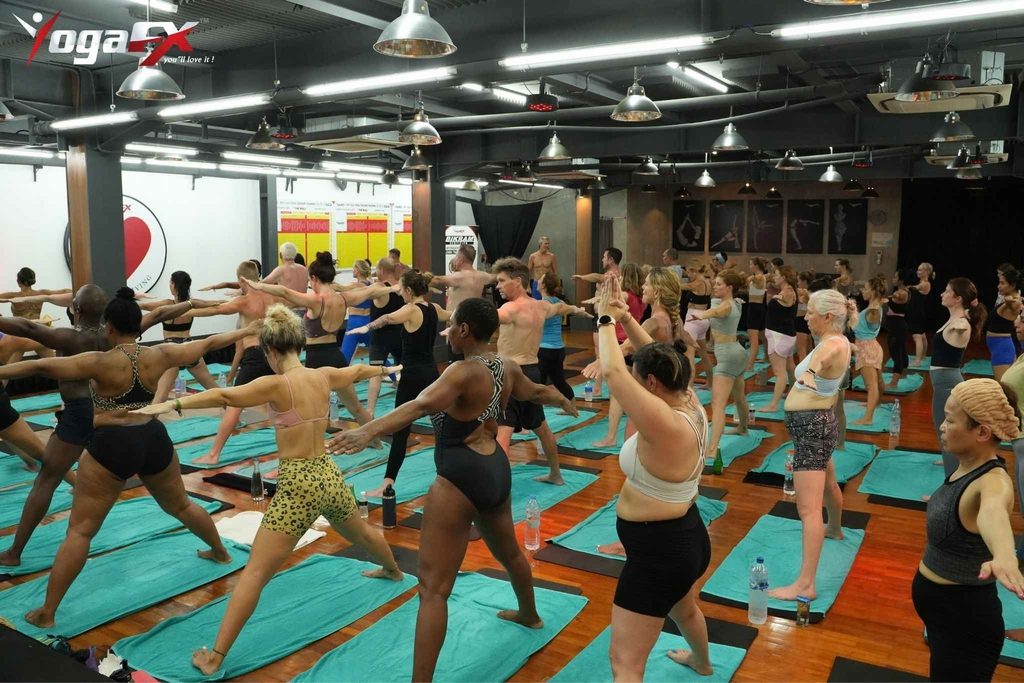
Every teacher who has learned the sequence properly can explain it through a handful of rules. Once you see them, you can predict what comes next in almost any part of the class.
1. Warm the body before asking it to stretch
The class opens with breathing and the big standing postures because cold muscles and connective tissue resist stretch. By the time you reach Standing Separate Leg Stretching, the combination of the 40°C room and fifteen minutes of full-body work means your hamstrings are far more willing than they were at the door. Stretching comes after heat, never before.
2. Every backbend is answered by a forward bend
Extension is followed by compression throughout the class. Half Moon bends backward, then Hands to Feet folds forward. Camel opens the whole front body, then Rabbit rounds the spine the opposite way. This pairing keeps the spine balanced and is why Rabbit feels like relief after Camel rather than another demand.
3. Intensity peaks in the balancing series, then comes down
Standing Head to Knee, Standing Bow Pulling and Balancing Stick sit in the middle of the standing series for a reason. They are the most demanding stretch of the class for concentration and heart rate, and Balancing Stick, only ten seconds long, is where most people feel their pulse climb fastest. It is also one of the postures new students find hardest, as we explain in is 26 and 2 yoga hard. After it, the sequence moves into forward folds and hip work that lower the intensity while still using the heat.
4. Standing work first, floor work second
The standing series builds strength, balance and heat. The floor series uses that heat for spine work that would be far less accessible cold. Putting the floor series second also means you reach the deepest backbends, Camel especially, when your body is at its warmest and most prepared.
5. Short Savasana between floor postures
The floor series is broken up by brief rests on your back. Those pauses are part of the sequence, not a break from it. They give your heart rate a moment to settle before the next posture and teach you to recover quickly, which is a skill in its own right.
6. The twist comes last
Spine Twisting is the only rotational posture in the class, and it sits at the very end. By then your spine has been worked in every other direction: sideways in Half Moon, backward in the spine strengthening series and Camel, forward in the folds. Rotation arrives once the spine is fully warm and has already moved every other way.
The Standing Series, Stage by Stage
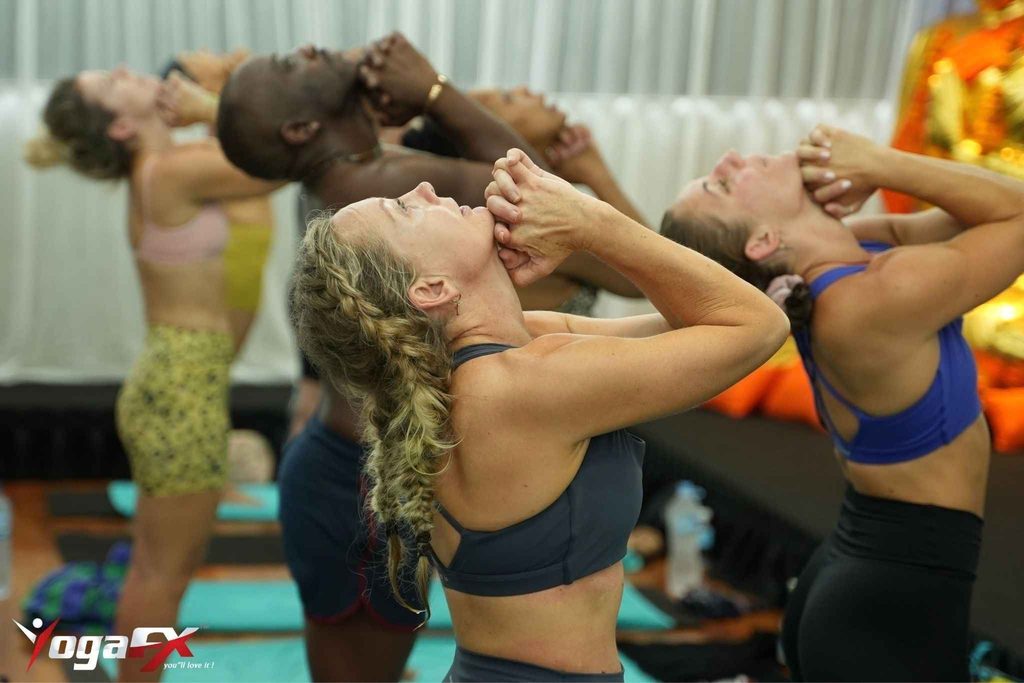
The standing series takes roughly the first 50 minutes of a 90-minute class. It breaks naturally into five stages, and each one sets up the next.
Opening: Standing Deep Breathing and Half Moon
Standing Deep Breathing expands the lungs and focuses attention before any physical load arrives. Half Moon then takes the spine through three directions (right, left and back) before Hands to Feet folds it forward. Within the first ten minutes, the spine has moved in four directions, which is why this pair is often described as the warm-up for everything that follows.
Legs and joints: Awkward and Eagle
Awkward works the thighs, knees and ankles in three parts, building heat through the legs. Eagle then wraps the arms and legs tightly across the body, working the shoulders, hips and knees from the opposite angle. One posture opens and loads the legs; the next binds and compresses them.
The balancing block: Standing Head to Knee, Standing Bow Pulling, Balancing Stick
These three are single-leg balances, and they demand the most concentration in the class. Standing Head to Knee builds a locked standing knee and core strength. Standing Bow Pulling combines a backbend with a kick, and Balancing Stick stretches the body into one long line parallel to the floor. Together they are the cardiovascular peak of the standing series.
Stretch and compress: Standing Separate Leg Stretching, Triangle, Standing Separate Leg Head to Knee
After the balancing block, the sequence turns to wide-legged postures. Standing Separate Leg Stretching is a deep forward fold that uses all the heat built so far. Triangle is widely considered the most complete standing posture, working the legs, hips and torso at once. Standing Separate Leg Head to Knee then compresses the body forward over one leg.
Closing the standing series: Tree and Toe Stand
Tree and Toe Stand bring the focus to the hips and to balance at a slower pace. They are held for one set each side, and they finish the standing work with calm, steady concentration rather than a final burst of effort.
The Floor Series, Stage by Stage
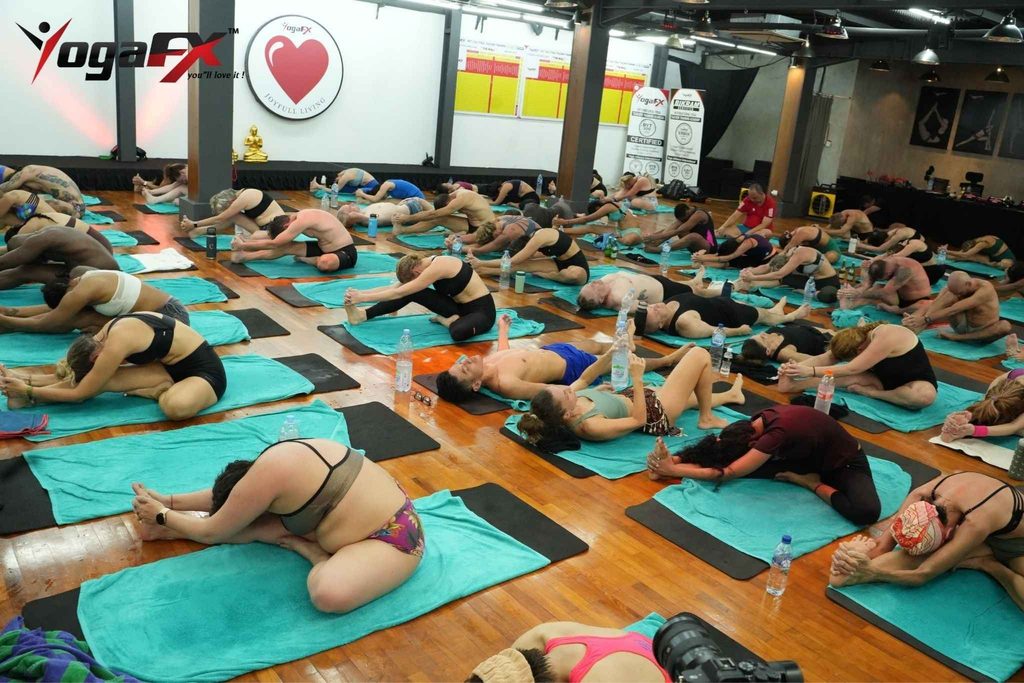
After a two-minute Savasana, the class moves to the floor for the remaining 40 minutes or so. The floor series is where the heat built during the standing work pays off.
Settling in: Savasana, Wind Removing and the Sit-Up
Savasana lets your heart rate come down before floor work begins. Wind Removing then compresses each leg into the abdomen and works the hips and lower back while you lie down. The Sit-Up links the floor postures together, bringing you up with an exhale and a forward stretch each time you move from lying on your back to lying on your front.
The spine strengthening series: Cobra, Locust, Full Locust, Bow
These four backbends are done lying on the stomach, and each one asks a little more of the spine than the last. Cobra lifts the upper back with the arms. Locust lifts the legs, first one at a time and then together. Full Locust lifts both ends of the body at once, and Bow pulls the whole body into a curve. The progression strengthens the back step by step before the deeper backbends later in the series.
Knees and hips: Fixed Firm and Half Tortoise
Fixed Firm stretches the front of the thighs and the knees while lying back between the feet. Half Tortoise follows as a forward bend with the arms stretched long. Once again, a backward-leaning posture is answered by a forward one.
The deepest pairing: Camel and Rabbit
Camel is the deepest backbend in the class, and it comes late for a reason: the spine has been prepared by everything before it. Rabbit follows immediately, rounding the spine forward with the crown of the head on the floor. It is the clearest example of the extension and compression principle in the whole sequence.
Finishing: Head to Knee with Stretching, Spine Twisting, Blowing in Firm
Head to Knee with Stretching works the hamstrings one side at a time, then both together. Spine Twisting adds the one direction the spine has not yet moved in. Blowing in Firm, a fast exhale-driven breathing exercise, closes the class the same way it opened, with the breath.
What the Research Says About Practising the Full Sequence
The studies on this style of yoga test the full sequence in the heat, not individual postures, which is useful when you are deciding whether a complete class is worth the effort.
- Strength and flexibility. Tracy and Hart (2013) found measurable gains in strength and flexibility, including lower back and hamstring flexibility, after eight weeks of regular practice.
- Energy use and heart rate. A 2014 study led by Porcari measured an average of about 333 calories for women and 460 for men across a 90-minute class, with heart rates reaching the moderate-to-vigorous range. The balancing block and the spine strengthening series are where most of that effort sits.
- The wider picture. Willmott et al. (2025), a systematic review covering 43 studies and 942 participants, found improvements in body composition, lipid profiles and vascular function, along with gains in bone mineral density, balance and flexibility. The authors also noted that claims of hot yoga being superior to other forms of yoga or exercise are not yet substantiated.
None of these studies isolate the order itself, so it would be an overstatement to say research proves the sequence is optimal. What they do show is that the complete class, practised regularly, produces measurable physical change. If you have a heart condition, are pregnant, or have any medical concerns about exercising in heat, please consult a healthcare professional before starting.
90 Minutes vs 60 Minutes: What Changes When the Sequence Is Shortened
Many studios now offer 60-minute versions of the class. The postures usually stay the same and stay in the same order; what changes is how much time each one gets.
| Traditional 90-minute class | Typical 60-minute class | |
|---|---|---|
| Order of postures | Fixed, all 26 positions | Usually the same order, sometimes with postures removed |
| Sets | Most postures done twice | Many postures reduced to one set |
| Savasana | Full two minutes after the standing series, short rests on the floor | Shorter rests throughout |
| Heat adaptation | Time for the body to settle into the heat | Less time to adjust, so the class often feels more rushed |
| Best for | Learning the method properly and building consistency | Busy schedules and experienced students keeping a routine |
A 60-minute class is still valuable, especially for a lunchtime practice, and it often appears on timetables under names like Hot 26 or Hot 60 (our guide to Hot 26 vs Hot Hatha vs Bikram decodes the labels). But the second set of each posture is usually where you go deeper, because the first set has done the preparation. That is why YogaFX keeps the full 90 minutes for every class and every training.
How YogaFX Teaches the Sequence in Bali
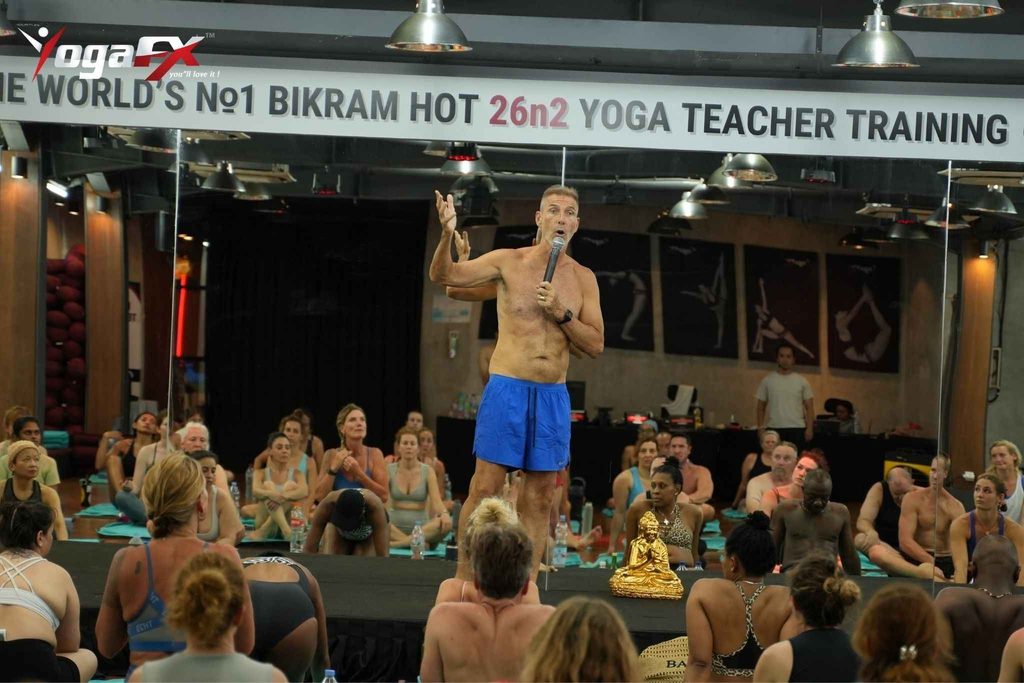
At YogaFX, the sequence is taught exactly as described above: in natural tropical Bali heat of around 40°C and 40% humidity, for 90 minutes, through a spoken dialogue with no music and no demonstration from the teacher. Classes run at our studios in Seminyak and Canggu.
The training is led by Mr. Ian Terry, E-RYT 500, who trained directly at five teacher training events between 2012 and 2019 and has since taught more than 12,000 hours and certified over 1,500 graduates from more than 80 countries. In 2026 he was appointed Master Trainer of the Republic of Indonesia Yogasana Sports Federation. When Ian teaches the order of the postures, he teaches the reason behind each transition, because a teacher who understands why Rabbit follows Camel will cue it with far more conviction than one who has only memorised the words.
That understanding is the core of our 26 and 2 yoga teacher training. Graduates earn a dual certification, Yoga Alliance RYT 200 plus a Bikram Hot 26&2 certificate, with a maximum of 19 students per intake so every trainee is heard delivering the dialogue. The format combines online study before arrival with an intensive week in Bali. The next intake runs from 24 to 29 January 2027, and 2027 pricing is USD 1,999 in a twin-share room or USD 2,199 in a single room, with accommodation included. See all upcoming course dates. Not sure you are ready? Take the two-minute readiness quiz and the YogaFX team will follow up with dates and pricing for the next cohort.
If you want to talk through whether the training fits your practice, message Mr. Ian on WhatsApp and he will answer you directly.
FAQ
What are the 26 postures in 26 and 2 yoga, in order?
The sequence opens with Standing Deep Breathing, then Half Moon, Awkward, Eagle, Standing Head to Knee, Standing Bow Pulling, Balancing Stick, Standing Separate Leg Stretching, Triangle, Standing Separate Leg Head to Knee, Tree and Toe Stand. After Savasana come twelve floor postures from Wind Removing to Spine Twisting, and Blowing in Firm closes the class.
Why does the 26 and 2 sequence never change?
The fixed order is what makes the method work. Each posture prepares the body for the next: heat builds before deep stretching, backbends are always followed by forward bends, and the only twist comes last. A fixed order also lets students measure genuine progress, because every class compares against exactly the same sequence.
Is 26 and 2 yoga hard for beginners?
It is demanding, mainly because of the heat, but it is designed for all levels. Every posture has a beginner version, and the teacher talks you through each one. Most first-timers rest several times and skip a few postures. Hydrating well beforehand and pacing yourself matter far more in the first few classes than flexibility.
Is there a 60-minute version of the 26 and 2 sequence?
Yes. Many studios offer 60-minute classes that keep the same postures in the same order but reduce most of them to one set and shorten the rests. They suit busy schedules, but the traditional 90-minute class gives more time for heat adaptation and for the deeper second set of each posture.
What does the name 26 and 2 actually count?
It refers to 26 postures and 2 breathing exercises, Standing Deep Breathing at the start and Blowing in Firm at the end. The classic numbered list counts the two breathing exercises inside its 26 positions, which is why some sources give 26 and others 28. Both describe the identical class.
Is YogaFX official Bikram Choudhury teacher training?
No. YogaFX is independent training, not official Bikram Choudhury Teacher Training. Mr. Ian Terry trained directly at five events between 2012 and 2019 and teaches the original 26 and 2 sequence and dialogue, with graduates earning Yoga Alliance RYT 200 plus a Bikram Hot 26&2 certificate.