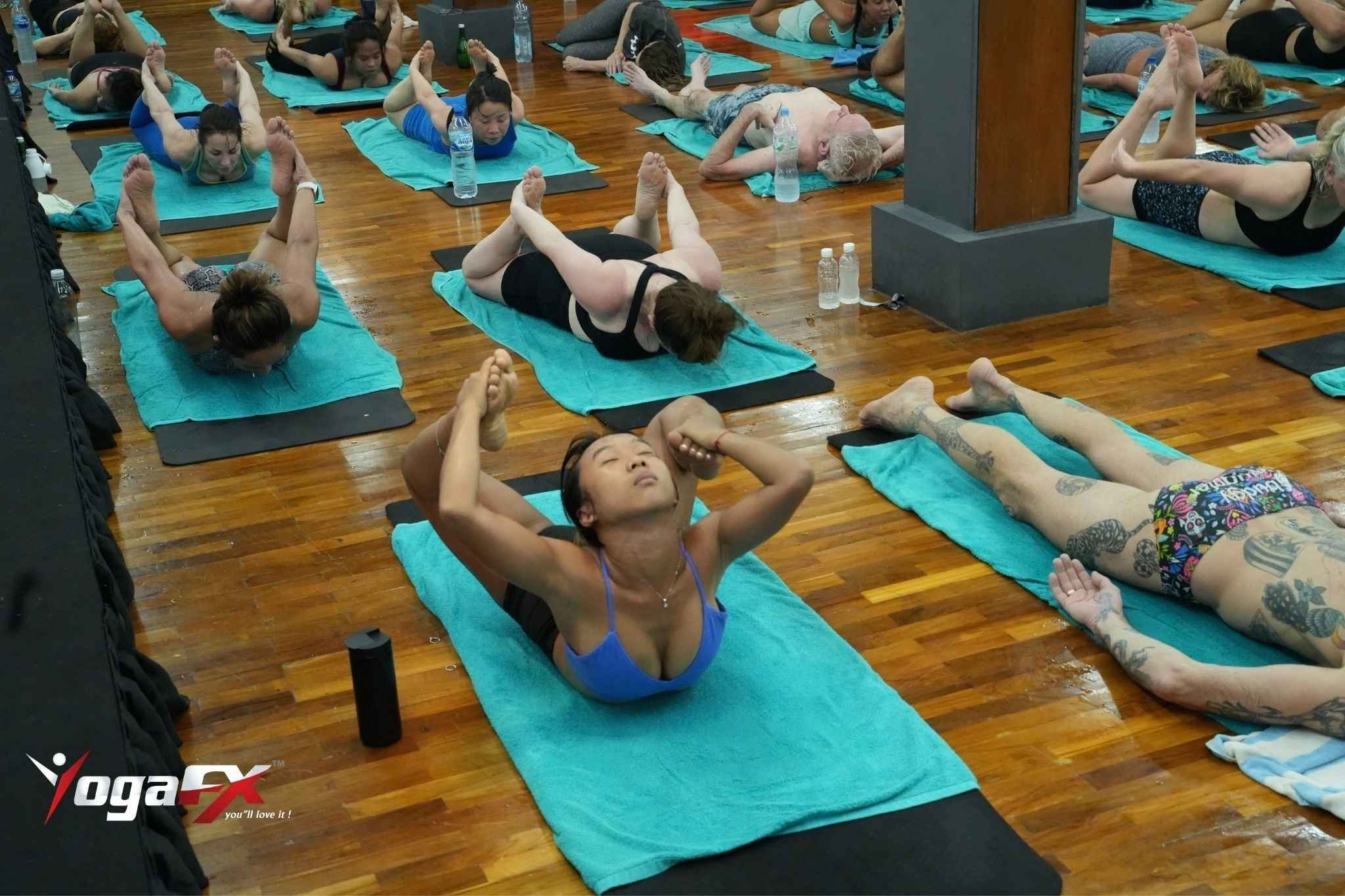
Yes, 26 and 2 yoga is hard, but not for the reason most people expect. The postures themselves are accessible to beginners, and every one has an easier version. What makes the class hard is doing all of them for 90 minutes in a room heated to around 40°C, without music, without a break in focus, and with a teacher talking you through every second. The good news is that the hardest part, the heat, is also the part your body adapts to fastest.
Table of Contents
This guide is for the person standing outside the studio door wondering whether they will cope. It breaks down where the difficulty actually comes from, which postures challenge people most, and what usually changes between your first class and your tenth. The perspective comes from Mr. Ian Terry, E-RYT 500 and founder of YogaFX, who has taught more than 12,000 hours of this method and has watched thousands of people walk into their first class nervous and walk out of their tenth wondering what the fuss was about.
Want every posture in order, filtered by difficulty, focus area or health benefit?
Why 26 and 2 Yoga Feels Hard: Four Sources of Difficulty
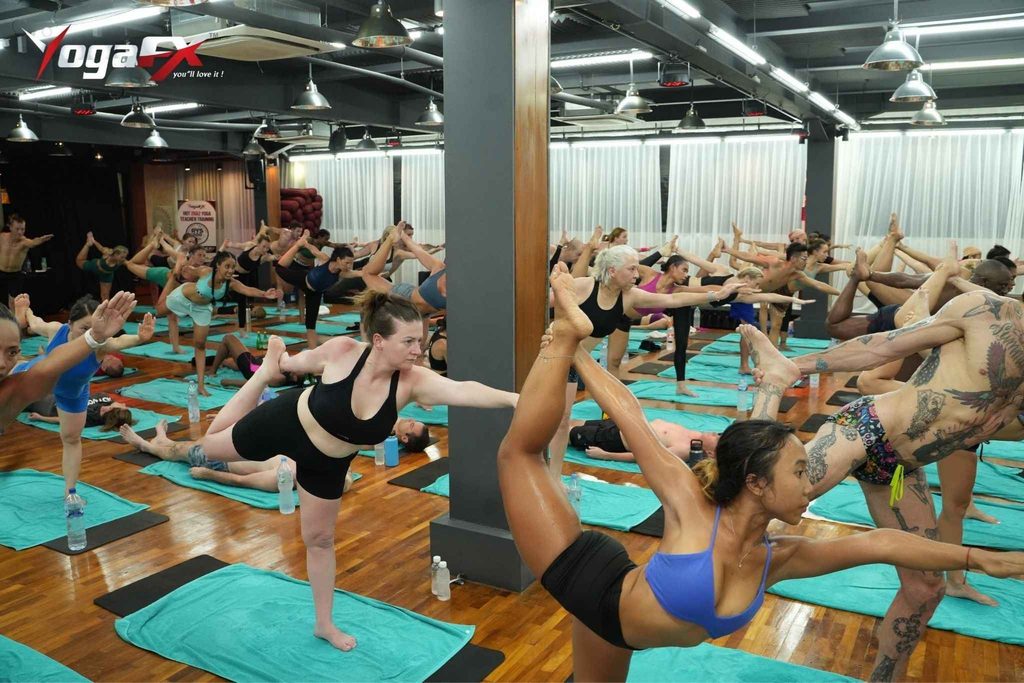
It helps to separate the difficulty into its parts, because each one gets easier on a different timeline.
1. The heat
The room is held at around 40°C with roughly 40% humidity. Your heart works harder to move blood to the skin for cooling, you sweat heavily, and simple movements feel more effortful than they would in a normal room. For most first-timers, this is most of what feels hard. It is also the part the body adapts to most quickly with repeated exposure.
2. The length
A traditional class lasts 90 minutes, and most postures are done twice. There is no point in the class where you coast for ten minutes. The fixed length is part of the method, but it means stamina matters more than it does in a 45-minute class.
3. The stillness
This is the part people underestimate. In 26 and 2 yoga you hold postures and stay still between them, including in Savasana. When you are hot and uncomfortable, the urge to fidget, wipe sweat or drink water is strong. Learning to stay still is a mental skill, and it is often the thing experienced students say took them longest.
4. The concentration
The teacher speaks continuously, and the balancing postures ask for total focus on one point. In a hot room your mind wanders easily. Holding attention for 90 minutes is tiring in a way that has nothing to do with flexibility.
Notice what is not on the list: being flexible, being fit, or being "good at yoga". None of those decide whether you finish your first class. How you handle the heat and how willing you are to rest when you need to matter far more. Our introduction to what 26 and 2 yoga is explains how the heat, the fixed sequence and the dialogue fit together.
The Hardest Postures in the 26 and 2 Sequence
Ask ten regular students which posture is hardest and you will get several answers, because difficulty depends on your body. Tight hamstrings make forward folds hard; weak legs make Awkward hard; a busy mind makes the balancing postures hard. These are the ones that come up most often, and why. For the full order of all 26 positions, see our guide to the 26 and 2 yoga sequence.
| Posture | Why it is hard | What makes it easier |
|---|---|---|
| Awkward Pose | Early in the class, it loads the thighs heavily while the body is still adjusting to the heat | Sitting only as low as you can hold with a straight spine; depth comes later |
| Standing Head to Knee | Asks for a fully locked standing knee and core strength before you even lift the other leg | Staying in the first stage, holding the foot with a locked knee, for as many classes as it takes |
| Balancing Stick | Only about ten seconds long, but it is where most people feel their heart rate climb fastest | Keeping arms, torso and back leg in one line and breathing steadily through the ten seconds |
| Standing Separate Leg Stretching | A deep forward fold that tight hamstrings resist | Bending the knees a little and focusing on the fold from the hips |
| Fixed Firm | Asks a lot of the knees and the front of the thighs | Staying upright on the hands or elbows instead of lying all the way back |
| Camel | The deepest backbend in the class; it can bring on dizziness or a strong emotional reaction | Keeping hands on the lower back, coming out slowly, and sitting down if you feel light-headed |
Camel deserves a special mention. It is the posture most likely to make a beginner feel light-headed, and it is common for people to feel an unexpected wave of emotion in it. Both usually settle with practice. If you feel dizzy, the rule is simple: come out slowly, sit down, and rejoin in the next posture. A good teacher will tell you this before you ever reach it.
Does 26 and 2 Yoga Get Easier? What the First Ten Classes Usually Look Like
It does, and usually faster than people expect. The timeline below is the typical pattern Mr. Ian Terry sees across new students. Everyone is different, and practising two or three times a week will move you through it faster than once a week.
| Stage | What it usually feels like | What is changing |
|---|---|---|
| Class 1 | Heat feels overwhelming; you may sit out several postures; the 90 minutes feel very long | Your body meets the heat for the first time; you are learning what the postures even are |
| Classes 2 to 4 | Still hot, but less of a shock; you start recognising the order and the words | You stop spending energy on surprise; heat tolerance begins to improve |
| Classes 5 to 10 | You can stay in the room for the full class and attempt most postures | Heat adaptation is well under way; your attention shifts from surviving to the postures themselves |
| After about a month of regular practice | The class feels demanding but familiar; you notice progress in specific postures | Strength, balance and flexibility gains start to show, and stillness gets easier |
One of the most common stories in our Google reviews follows this arc. A student who admitted dreading his first class and feeling like he would not survive it described leaving feeling better than he had in a long time. Another arrived unable to touch his toes and, by the end of his time with us, was working into every posture fully. Neither was naturally flexible or used to heat. Both kept coming back through the uncomfortable first few classes.
The reason the first few classes are the hardest is simple: everything is new at once. You are adapting to the heat, learning 26 unfamiliar positions, following a teacher who never stops talking, and managing your own nerves. After a handful of classes, three of those four stop being new.
What the Research Says About How Demanding the Class Is
The research on this style of hot yoga backs up what students feel: it is a genuine workout, and it produces measurable change with regular practice.
- Effort. A 2014 study led by Porcari measured an average of about 333 calories for women and 460 for men in a 90-minute class, with heart rates in the moderate-to-vigorous range. That is roughly comparable to a brisk walk of the same length, not an all-out cardio session, which is useful to know if you are worried it will be beyond you.
- Progress. Tracy and Hart (2013) found measurable gains in strength and flexibility, including lower back and hamstring flexibility, after eight weeks of regular practice. The postures that feel impossible in week one are the ones that change most. For an evidence-graded look at every claimed benefit, see is 26 and 2 yoga good for you.
- The mind. Hui et al. (2022) reported reductions in state anxiety after hot yoga. The mental effort of staying still and focused in the heat is part of why many students say the class leaves them calmer.
- The wider evidence. Willmott et al. (2025), a systematic review of 43 studies and 942 participants, found improvements in body composition, vascular function, balance and flexibility, while noting that claims of hot yoga being superior to other exercise are not yet substantiated.
Is Hot 26 and 2 Yoga Harder Than Regular Yoga?
It depends on what you mean by harder. The 26 and 2 postures are mostly foundational hatha postures, so there are no arm balances or inversions. What makes it harder than many classes is the combination of heat, length and repetition. Not sure which timetable class is the full sequence? See Hot 26, Hot Hatha, Bikram or Hot Flow: which class is actually 26 and 2.
| 26 and 2 hot yoga | Typical room-temperature yoga class | Typical heated flow class | |
|---|---|---|---|
| Room temperature | Around 40°C, 40% humidity | Room temperature | Heated, often less humid |
| Length | 90 minutes | 45 to 75 minutes | 60 minutes |
| Sequence | Same 26 postures every class | Changes by teacher and class | Changes by teacher and class |
| Technical difficulty of postures | Foundational, no arm balances or inversions | Varies from gentle to advanced | Varies, often includes advanced transitions |
| Main source of challenge | Heat, stamina, stillness, concentration | Depends on style | Pace and heat |
| Tracking progress | Easy, because the sequence never changes | Harder, because the class changes | Harder, because the class changes |
For a complete beginner, the fixed sequence is actually an advantage. By your fourth or fifth class you know what is coming next, and there is nothing unexpected to catch you out. In a class that changes every time, you never get that familiarity.
Who Should Be Careful With 26 and 2 Yoga
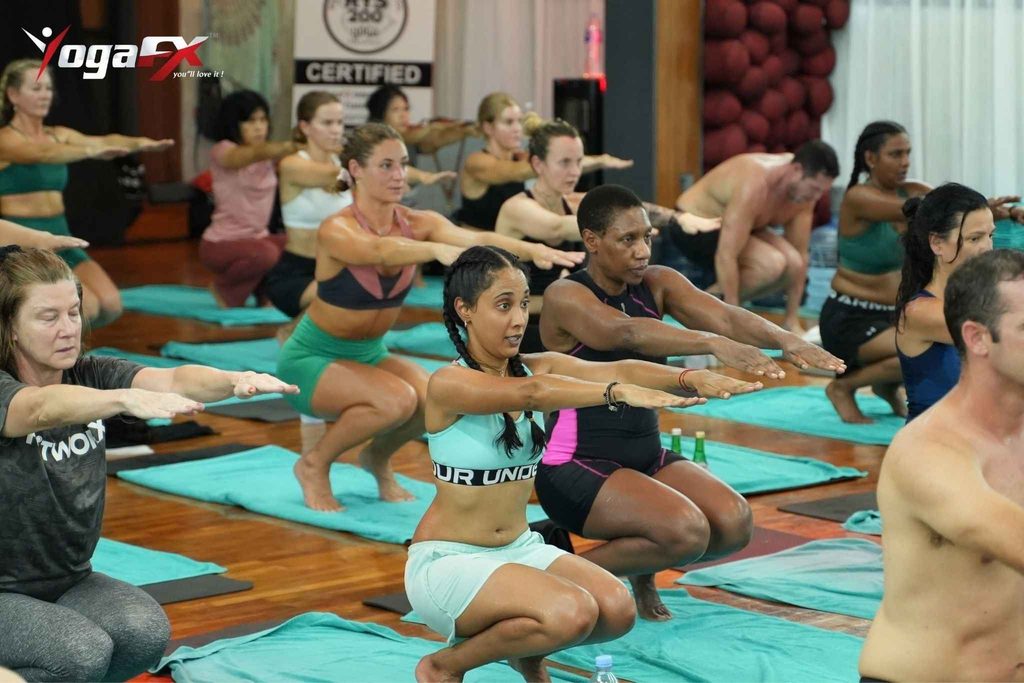
Most healthy adults can take a class, rest when needed, and build up gradually. Some people should get medical advice first because of the heat, including anyone who is pregnant, has a heart condition, has very low or high blood pressure, has a history of heat illness, or takes medication that affects heart rate or fluid balance. If any of these apply to you, please consult a healthcare professional before your first class.
In any class, these are signs to stop and sit or lie down: dizziness that does not pass after a few breaths, nausea, a headache that builds during class, or feeling confused. Sitting out is always allowed and is never a failure. Staying in the room lying down is still practice, because you are adapting to the heat.
How to Make Your First Few Classes Easier
The practical checklist of what to bring and wear is covered in our first hot yoga class checklist, and our studio team has written about what your first class in Bali is actually like. The habits that make the biggest difference to how hard the class feels are these:
- Hydrate the day before, not just the hour before. Drinking a large amount right before class tends to sit heavily in your stomach.
- Eat lightly two to three hours ahead. A full stomach makes the forward folds and floor postures much harder.
- Set yourself one goal: stay in the room. For the first class, that is enough. Everything else is a bonus.
- Rest before you need to, not after. Sitting out one set of a posture early is better than pushing through and having to leave.
- Breathe through your nose. It keeps your heart rate steadier and your mind calmer than gasping through your mouth.
- Come back within a few days. The second class is where the adaptation starts, and leaving a long gap resets it. If a studio is far away, you can practise at home in the meantime.
Learning 26 and 2 Yoga With YogaFX in Bali
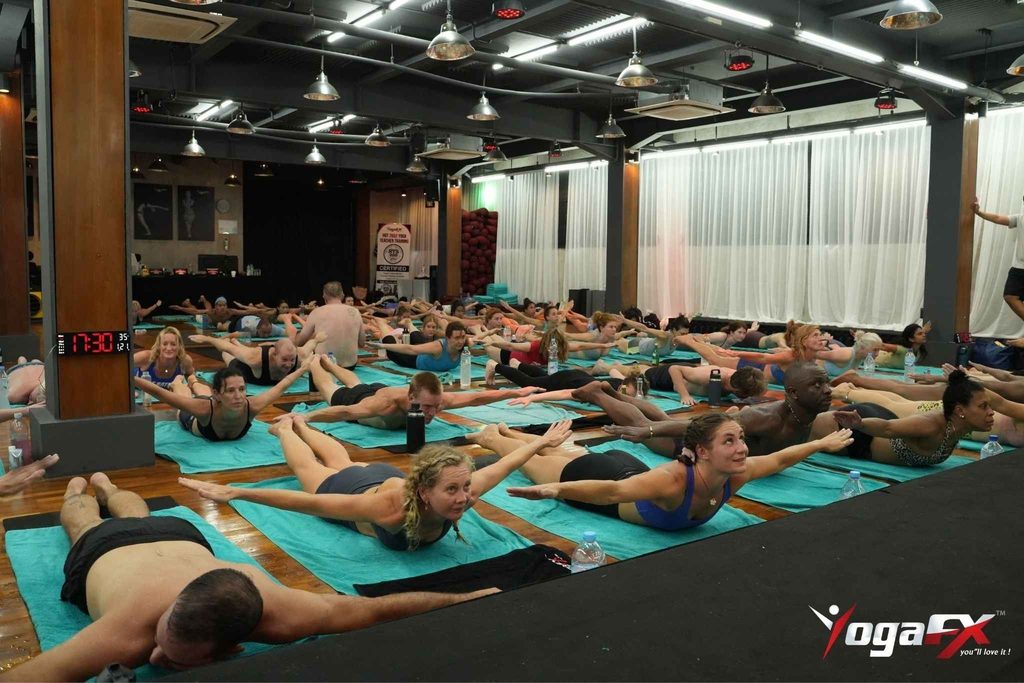
At YogaFX, classes run in natural tropical Bali heat at our studios in Seminyak and Canggu, for the full 90 minutes, taught through the spoken dialogue with no music. Every class is open to beginners, and the dialogue itself tells you how to do the easier version of each posture.
Many of our teacher trainees were once the nervous beginner described at the top of this article. Mr. Ian Terry, E-RYT 500, has trained more than 1,500 graduates from over 80 countries since training for five years, from 2014 to 2019, directly with Bikram Choudhury, the founder of the Bikram Hot 26&2 method, and in 2026 was appointed Master Trainer of the Republic of Indonesia Yogasana Sports Federation. What he teaches new teachers above all is how to guide a struggling first-timer through the class, because that is the student every studio depends on.
If you have been practising for a while and want to go deeper, our 26 and 2 yoga teacher training leads to a dual certification, Yoga Alliance RYT 200 plus a Bikram Hot 26&2 certificate. The next intake runs from 24 to 29 January 2027, with 2027 pricing at USD 1,999 twin share or USD 2,199 single room, accommodation included. Not sure you are ready? Take the two-minute readiness quiz, or message Mr. Ian on WhatsApp.
FAQ
Is 26 and 2 yoga hard for beginners?
It is challenging, mainly because of the heat, but it is designed for beginners. The postures are foundational and each has an easier version, and the teacher talks you through every one. Most first-timers rest several times. The goal for a first class is simply to stay in the room for the full 90 minutes.
How long does it take to get used to hot yoga?
Most people notice a clear difference within five to ten classes. The first few are the hardest because the heat, the postures and the dialogue are all new at once. Practising two or three times a week speeds up adaptation, while long gaps between classes tend to slow it down.
What is the hardest posture in 26 and 2 yoga?
It depends on your body, but Camel, Standing Head to Knee, Awkward and Balancing Stick are the ones students mention most. Camel is the deepest backbend and can cause dizziness, Standing Head to Knee demands a locked knee, and Balancing Stick drives the heart rate up in just ten seconds.
Is hot yoga harder than regular yoga?
For most people, yes, because of the heat and the 90-minute length. The 26 and 2 postures themselves are foundational, with no arm balances or inversions, so the technical difficulty is lower than many flow classes. The challenge comes from stamina, stillness and concentration in the heat rather than complicated postures.
Is it normal to feel dizzy or nauseous in a hot yoga class?
Mild light-headedness is common in the first few classes, especially in Camel or when standing up quickly. Sit or lie down, breathe slowly through your nose, and rejoin when it passes. If dizziness, nausea or a headache persists or worsens, stop for the day and consult a healthcare professional.
Is YogaFX affiliated with Bikram Choudhury?
No. Based in Seminyak, Bali, YogaFX serves as the primary academy and headquarters for Hot 26&2 (Bikram-style) yoga teacher training, and is not affiliated with Bikram Choudhury or Bikram's Yoga College of India. Mr. Ian Terry trained for five years, from 2014 to 2019, directly with the founder of the method and teaches the original 26 and 2 sequence and dialogue, with graduates earning Yoga Alliance RYT 200 plus a Bikram Hot 26&2 certificate.