Hot yoga for runners works best when it targets what running leaves tight: the quads, hip flexors, hips, hamstrings and calves. In a 26 and 2 class, Standing Bow Pulling, Triangle and Fixed Firm reach those areas directly. Take the class on an easy day, and your stride may feel looser the next morning.
Table of Contents
Hot Yoga for Runners: The Short Answer
Most runners ask one thing before their first heated class. Will it help my miles, or cost me a long run? The honest answer is that it depends on which postures you lean on and which day you pick. Hot yoga for runners isn't a stretch session on a warm mat. It's 90 minutes of standing, balancing and bending in a room at about 40°C and 40% humidity.
The 26 and 2 class runs the same way every time: 26 postures and 2 breathing exercises, in a fixed order, guided by a scripted dialogue. That repetition suits hot yoga for runners. You feel the same posture week after week, so you'll know whether your hips loosened or tightened after a hard block.
If the method is new to you, our guide to what 26 and 2 yoga actually is covers the basics first.
This guide skips the generic list of 20 poses. It walks through the few postures that matter most for hot yoga for runners and what each one reaches. Mr. Ian Terry, E-RYT 500, has taught more than 12,000 hours of this sequence at YogaFX, and the sequence never changes to suit different athletes. What changes is where you put your attention.
Here is the short version of where each area of the body is covered:
- Quads and hip flexors: Standing Bow Pulling Pose and Fixed Firm Pose.
- Hips and inner thighs: Triangle Pose, with its wide, sideways stance.
- Calves and hamstrings: Awkward Pose, Standing Head to Knee, and the forward folds in the floor series.
What Running Leaves Tight, and Where the Postures Land
Why Running Tightens Certain Muscles
Running repeats one narrow movement thousands of times per session. Your hips flex and extend, your calves and Achilles tendons absorb each landing, and your hamstrings fire to slow the swinging leg. Over a training block, the quads, hip flexors, calves and hamstrings tend to shorten and stiffen. A desk job adds to the hip flexor part, because hours of sitting keep the hips bent.
A Quick Map for Hot Yoga for Runners
The table below matches those tight spots to the 26 and 2 postures that make hot yoga for runners worthwhile. Use it as a map while you read the sections that follow.
| Posture | Main areas worked | What runners tend to feel | Watch for |
|---|---|---|---|
| Standing Bow Pulling Pose | Front of the lifted thigh, hip flexor, standing-leg balance | A deep stretch down the front of the leg, plus a shaky standing ankle | Knee pain on the standing leg; kick gently at first |
| Triangle Pose | Hips, inner thighs, front-leg quads, back-leg calf | Wide hips and a working front thigh | Front knee drifting inward; keep it over the ankle |
| Fixed Firm Pose | Quads, hip flexors, tops of the feet and shins | A strong pull through the front of the legs | Knee or ankle strain; ease in over several weeks |
| Awkward Pose | Thighs, calves, ankles | Burning thighs and tired calves by the second set | Sharp knee or Achilles pain; come up early |
| Standing Head to Knee | Hamstrings of the extended leg, balance | A long back of the leg and a wobbly standing foot | Rounding hard through the back to reach the foot |
| Head to Knee and Stretching Pose | Hamstrings, calves, lower back | The seated fold that shows how tight your hamstrings are | Pulling past the point where the back of the knee protests |
Notice that none of these postures needs advanced flexibility. Every one has an easier version, and you choose your own depth. You aren't racing the room.
Standing Bow Pulling Pose: Quads and Hip Flexors
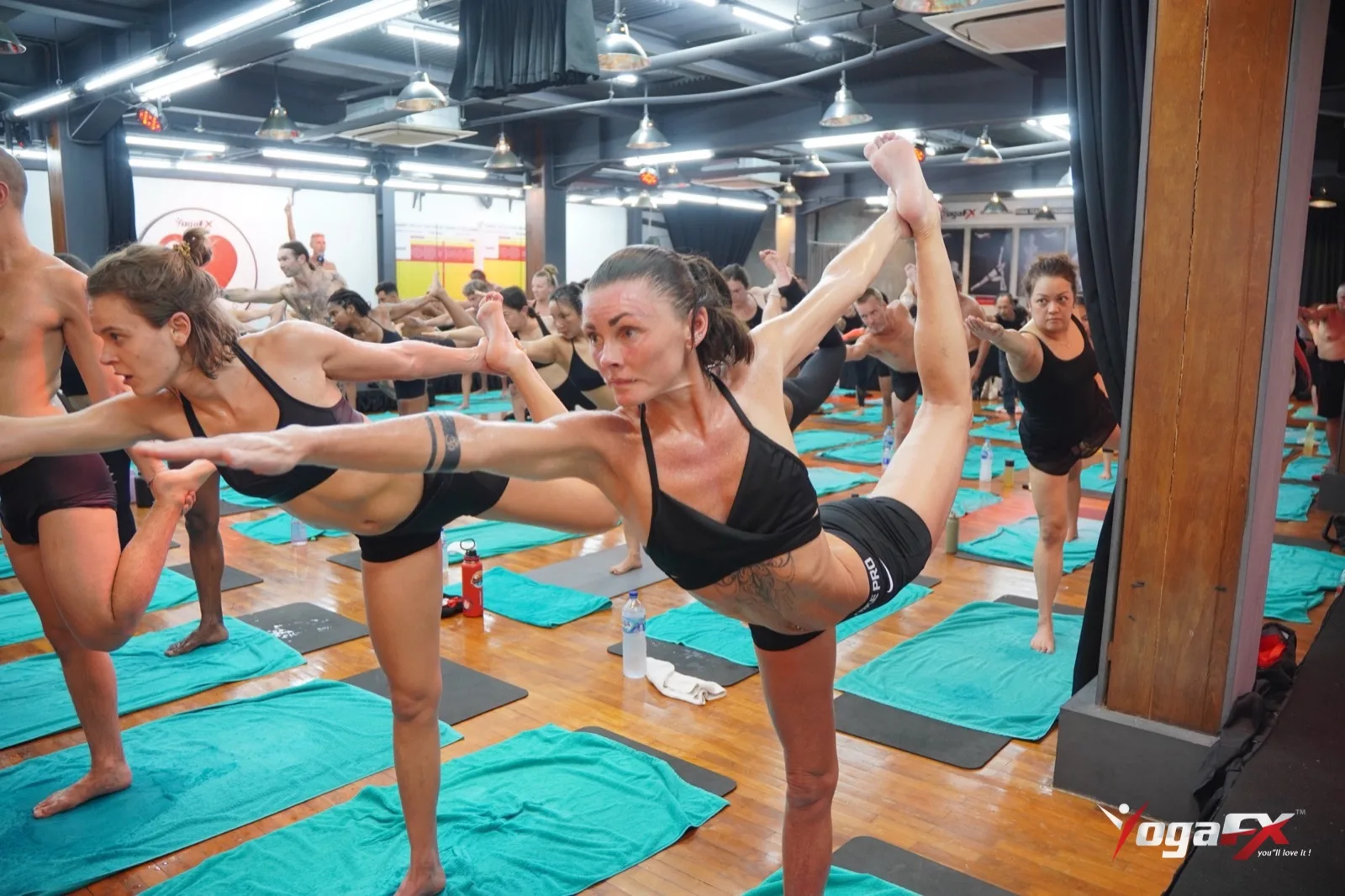
Standing Bow Pulling Pose is the first posture many runners fall for. You balance on one leg, grab the other foot behind you, then kick that foot up and away from your hand while the free arm reaches forward. The kick matters more than the pull. When you kick, the front of the lifted thigh stretches and the hip flexor opens in a way that running never asks of it.
Runners spend most of their miles with the hip flexors shortened, so this is a rare chance to lengthen them under load. That is why Standing Bow earns its place in hot yoga for runners. Meanwhile the standing leg does quiet work of its own. The ankle, calf and glute stabilise the whole body on one leg, which is the same job they do on every stride. For many runners, that balance work is the hidden benefit.
How to Get More From It
- Soften the standing knee slightly, but keep the thigh firm so the leg does not collapse.
- Kick first, then lift. Think of pushing the foot into your hand, not dragging it toward your back.
- Hold the foot lower if the quad cramps. A smaller version still counts.
If you have a history of knee trouble, speak to a physiotherapist before you push this one. The posture is a good teacher, but it should never be forced.
Triangle Pose: Hips and Inner Thighs for a Longer Stride
Runners move forward in a narrow lane. Triangle takes the hips sideways, wide and low, which is exactly what a straight-line sport skips. You stand with the feet wide, bend the front knee until the thigh is parallel with the floor, then reach the torso out and down toward the front foot with the back leg straight.
Three things happen at once. The front quad works hard to hold the bend. The groin and inner thighs open. And the back-leg calf stretches as the heel stays planted. That mix makes Triangle one of the most useful single postures for hot yoga for runners, because it touches the hip, thigh and calf in one shape.
The common mistake is letting the front knee fall inward. Keep it stacked over the ankle, and let the hips do the opening. If the thigh will not reach parallel yet, bend less and build over a few weeks. Depth matters far less than alignment here.
Fixed Firm Pose: The Quad and Shin Release Runners Remember
Fixed Firm Pose sits in the floor series. Of all the postures in hot yoga for runners, it's the one people talk about afterwards. You kneel, sit between your heels, then lean back until your shoulders or back reach the floor. The front of both thighs, the hip flexors, the tops of the feet and the shins all stretch together.
For a runner, that last part is useful. Shins and the front of the ankle take plenty of repetitive load, yet almost no common stretch reaches them. Fixed Firm does. It also gives the quads a long, passive lengthening after the active work in the standing series.
It is also a demanding posture on the knees and ankles. Go slowly. Sit on a folded towel between the heels if the knees complain, and stay propped on your elbows instead of lying fully back. If you feel pain in the joint rather than a stretch in the muscle, come out. Most people need weeks, not days, before the full posture feels comfortable.
Calves and Hamstrings: Three More Postures Worth Your Attention
Awkward Pose: Thighs, Calves and Ankles
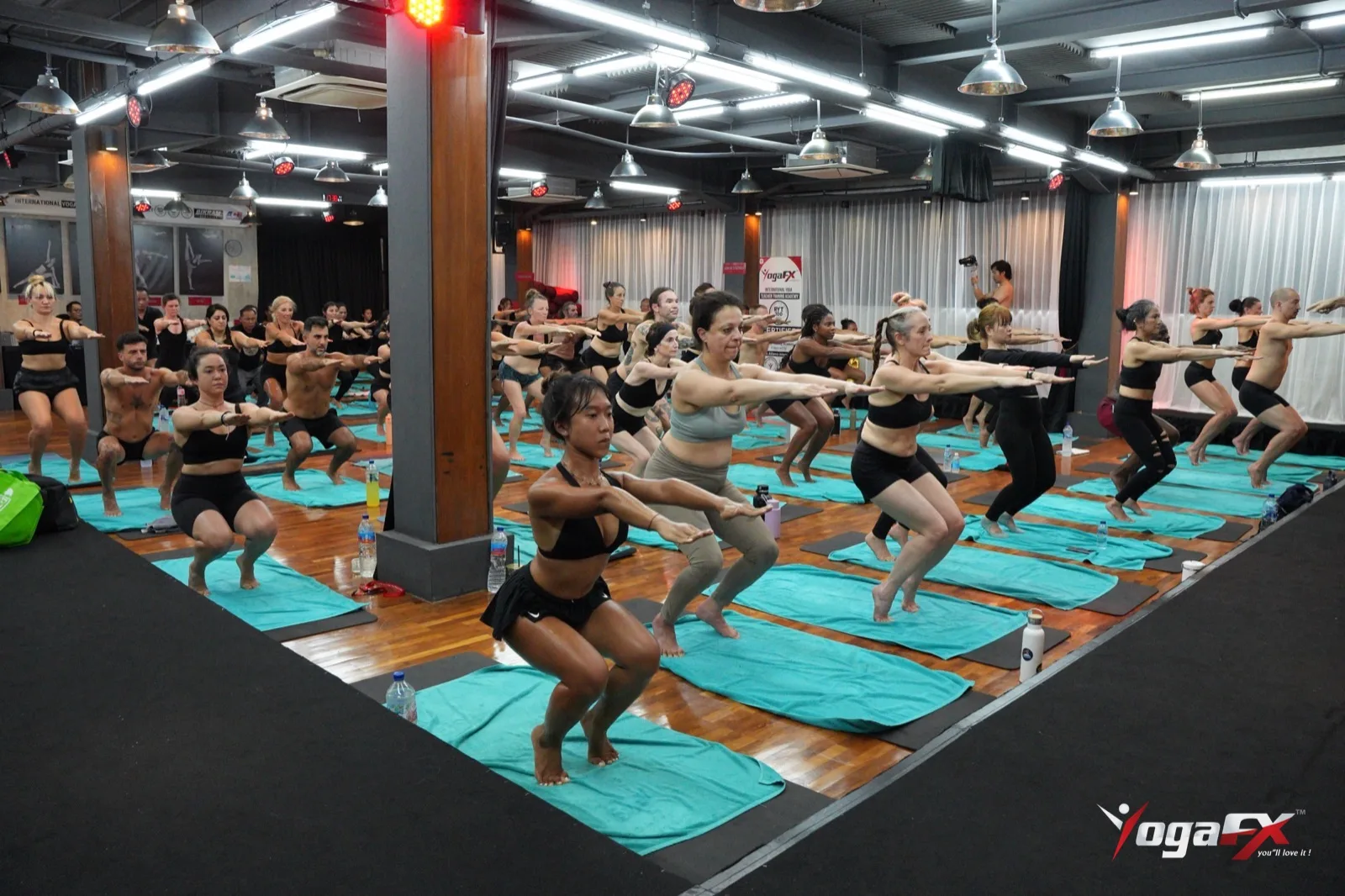
Awkward Pose is a held chair-squat with the feet together. It doesn't stretch much, but it builds the endurance of the thighs and calves, and in one version you rise onto the balls of the feet. That asks the calf and ankle to hold under fatigue. Plenty of runners find the burn in this posture more familiar than any stretch in the class, which makes it a natural bridge into hot yoga for runners.
Standing Head to Knee: Hamstrings and Balance
In Standing Head to Knee you balance on one leg, lift the other foot into both hands, then straighten that leg and bring the forehead toward the knee. It lengthens the hamstring of the lifted leg and trains single-leg balance at the same time. Tight hamstrings often show up here first. If the leg will not straighten, keep a soft bend and work on the shape of the posture instead.
The Floor Series Forward Folds
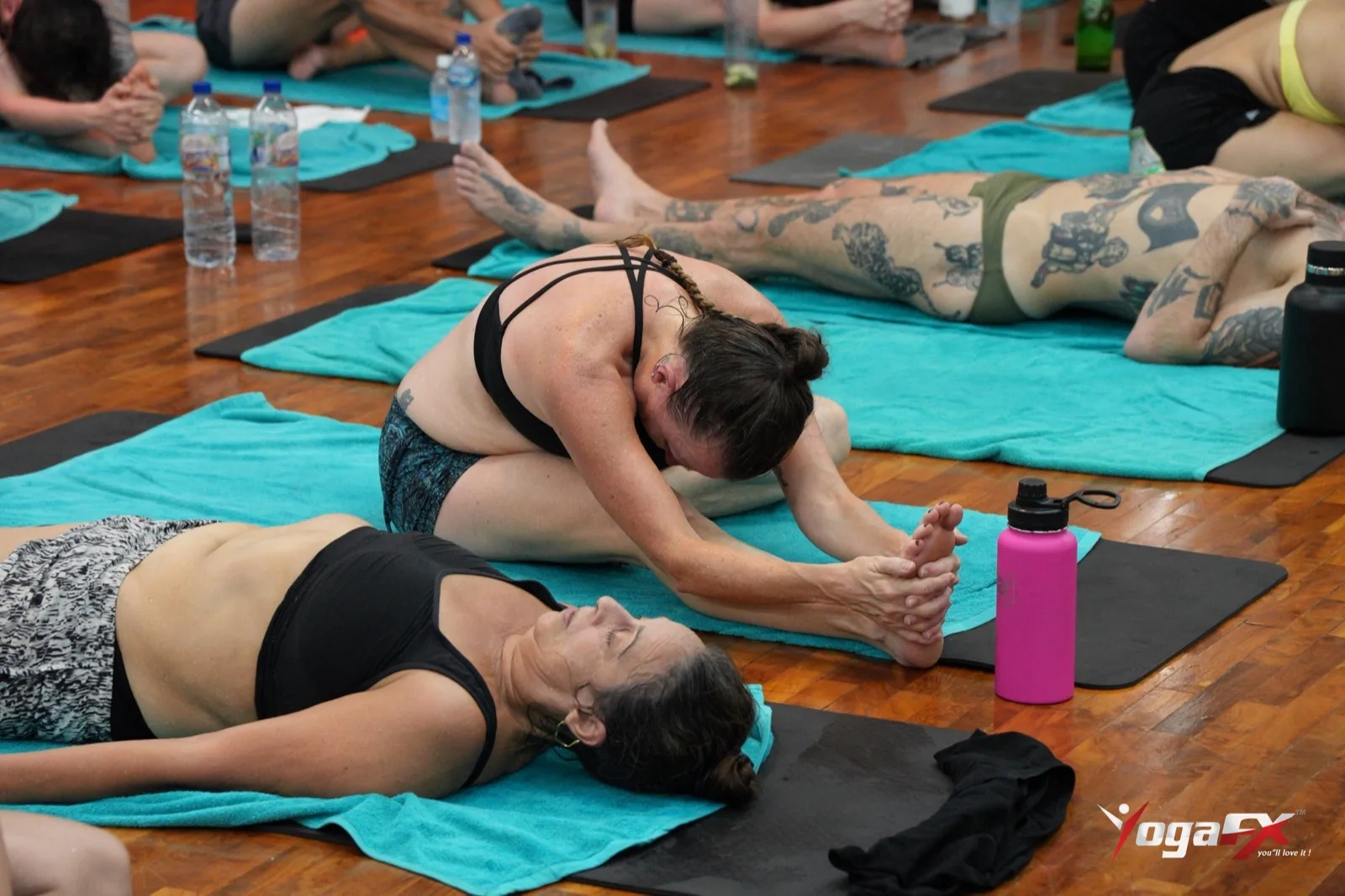
Late in the class, Head to Knee Pose and Stretching Pose fold you forward over the legs while sitting. By then the muscles are warm and the hold is long. Hamstrings and calves get a slow, steady lengthening that is hard to replicate after a short roadside stretch. Treat the first few classes as a test of your range, not a target. Progress shows up in weeks.
What the Research Says About Hot Yoga for Runners
Does hot yoga for runners have research behind it? Some, with gaps. There is no large trial on heated classes and runners specifically, so anything here is a guide rather than a promise.
Flexibility
A 2025 study in Frontiers in Physiology followed 81 healthy women for six months, 51 who practised yoga and 30 who did not. The yoga group's hamstring elasticity changed differently over time.
The authors concluded that six months of regular yoga was associated with improved muscle elasticity. Two limits matter. The groups weren't randomised, and the study looked at women practising yoga in general, not runners in a heated room.
Workload
A 2014 study from the University of Wisconsin-La Crosse (Porcari et al.) measured about 333 calories for women and 460 for men in a 90-minute class, at roughly 80% of maximum heart rate. A 2013 study by Tracy and Hart reported gains in strength and flexibility along the back of the body. So a class is a real session, not a day off.
Heat
A 2017 laboratory study by James and colleagues, titled Short-term heat acclimation improves the determinants of endurance performance and 5-km running performance in the heat, suggests the body adapts to heat within days. That was a controlled protocol, not a yoga class. It's a reason to be curious about hot yoga for runners, not a promise of faster races.
Research suggests rather than proves, and your own response counts most with hot yoga for runners. If you have a heart condition, low blood pressure or a history of heat illness, consult a healthcare professional before you try heated classes. Our guides to heart rate zones in the standing series and how many calories a class burns go deeper on the workload numbers.
Hot Yoga for Cyclists: Same Tight Spots, Different Reasons
Cyclists often ask whether the same approach holds for them, and mostly it does. Where runners shorten the hips by striding, cyclists do it by sitting. Hours in the saddle keep the hips bent, the quads loaded and the hamstrings quietly short. The lower back and neck take a lot of the strain too, because the torso stays folded forward.
Hot yoga for runners and hot yoga for cyclists share the same front-of-the-body postures. Standing Bow Pulling and Fixed Firm open the quads and hip flexors, and the floor forward folds work the hamstrings. The back-bending postures later in the sequence, such as Cobra and Camel, undo some of the hunched riding position. Camel is intense, so do it gently at first.
The rules stay the same as for hot yoga for runners. Pick an easy day, hydrate well beforehand, and never book a heated class the day before a key ride or race. A cyclist who arrives depleted from a long ride will find the room unforgiving.
Fitting a Class Around Your Miles
A running week has a shape, and hot yoga for runners only helps when it respects that shape. Hard days stay hard. Place a class on an easy or rest day. Avoid the day before a long run, a race or a track session. Start with one class a week, and give yourself three or four weeks before adding a second.
For a worked example of a full week, our sister guide on planning heated classes around your weekly mileage lays out a sample running week day by day. To work out how many classes suit your goals, see how often to do 26 and 2 hot yoga by goal.
- Hydrate early. Start drinking the day before, not in the last hour.
- Eat light. Have a small meal two to three hours before class.
- Rest when you need to. Lying on the mat is part of the practice, not a failure.
- Leave if you feel faint, confused, nauseous or very cold. Those are signs of overheating.
What Students Say About the Class
None of the students below came for hot yoga for runners. They describe the class itself, which is the part you'd be signing up for. Marion, who trained with us, wrote in a Google review in 2024:
"You are teaching almost from the start of the course and your confidence increases daily."
Marion, Google review, 2024
Lidya, a trainee in our YouTube review from 2023, said one week in the class let her change her posture, and she planned to pass the postures on to the staff at her office in a free class. Her video is below.
Both reviews point to the same thing runners care about: the posture work changes how your body moves, and it does so quickly.
Learn the Method With YogaFX
If you want to try hot yoga for runners rather than read about it, YogaFX teaches the Original Hot 26&2 sequence in studios in Seminyak and Canggu, open from 06:00 to 22:00 every day. Classes run 90 minutes at about 40°C, with the full dialogue and no music or demonstration.
Runners who want to go further can also look at the Bikram Hot 26&2 Yoga Teacher Training MasterClass, a 6-day hybrid course led by Mr. Ian Terry.
Not sure which posture to start with? Message Mr. Ian and the team on WhatsApp and tell us your weekly mileage.
FAQ
Is hot yoga good for runners?
Hot yoga for runners can help by lengthening the quads, hip flexors, hamstrings and calves that running tightens. A 26 and 2 class is also a real workout, so place it on an easy day. Research on runners specifically is limited, so treat the benefits as likely, not guaranteed.
Does hot yoga help with running?
It may help through better hip and hamstring range and stronger single-leg balance. It will not replace running, and it does not guarantee faster times. Many runners notice looser legs the next morning. Keep classes away from hard sessions, and drink plenty of water before and after.
Can I do hot yoga and run on the same day?
You can, but it is usually better not to. A 90-minute class at about 40°C raises your heart rate and fluid loss. If you must combine them, run easy first or take the class on a rest day. Skip the class before hard runs, races and long sessions.
Is hot yoga good for cyclists?
Yes, for similar reasons. Cycling keeps the hips bent and the quads loaded, and the front-of-the-body and forward-fold postures in a 26 and 2 class help counter that. Hydrate well, avoid heated classes the day before a key ride, and ease into deep backbends such as Camel.
How often should runners do hot yoga?
Once a week is a sensible start for most runners. Give your body three or four weeks before adding a second class. Always place classes on easy or rest days. If you feel run down, cut the class first and keep your running schedule.
Still have questions? Message Mr. Ian and the YogaFX team on WhatsApp and we will answer them personally.