Yoga Alliance certification is a credential on a global registry, and it records your training, not your method. It tells a studio that your school and your hours were registered. It cannot tell them whether you can teach the 26 and 2 dialogue in a 40°C room.
Table of Contents
Mr. Ian Terry, E-RYT 500, trains teachers of the Original Hot 26&2 method in Bali. This guide shows what Yoga Alliance certification recognises, what it leaves to your school, and how a method certificate fills the gap. It is general information. We read the registry's own pages on 9 November 2026 to write it.
Yoga Alliance Certification: What It Recognises
Most people hear "certification" and picture an exam board. Yoga Alliance certification works differently. Its homepage calls it the global registry for yoga teachers and schools, and its footer lists it as a nonprofit 501(c)(6). That is a trade-association status, not a government one.
The Meet Yoga Alliance page says it began in 1997 as a collective of teachers and practitioners, then formed Yoga Alliance in 1999. That year it introduced the first voluntary registry for yoga schools and teachers. Today it reports about 100,000 members across more than 100 countries.
So when you read "Yoga Alliance certification", the word to remember is credentialing, because that is the registry's own word. Its pages say credentialing helps increase your credibility. They never use the word "accredits", which matters if you picture an inspector testing your method.
Three things the registry records
- Schools. A Registered Yoga School (RYS) meets set standards for curriculum, Lead Trainer and hours, at 200, 300 or 500 hours.
- Teachers. Graduates of those schools apply to register as an RYT. The foundational level is RYT 200, and the comprehensive level is RYT 500.
- Experience. The "E" in E-RYT stands for experienced, and it adds teaching requirements beyond the training itself.
The registry also lists continuing education providers, called YACEPs. Its continuing education page describes them as experienced yoga professionals, and says E-RYTs in good standing can apply. For what happens after you graduate, read our guide to yoga continuing education for 26 and 2 teachers.
Look at what these numbers describe: the size and structure of a registry. None of them show what Yoga Alliance certification means for the class you teach. That gap is the subject of the rest of this guide.
How Yoga Alliance Certification Works for a New Teacher
Yoga Alliance certification usually starts at the foundational level. A school runs a 200-hour programme, and you finish it. Then you apply for RYT 200 with your training certificate. Yoga Alliance's training options page says most new teachers begin with this credential.
- Choose a registered school. Ask to see its Registered Yoga School listing before you pay, because a listing is easy to check.
- Finish the whole programme. Keep your training certificate, because the application asks for it.
- Apply as an RYT. The registry's pages tell you to submit your application with that certificate.
- Stay a member. Teachers pay an annual membership, so the listing stays current only while you do.
Fees, renewal hours and what UK studios check are covered in our sister guide, a UK breakdown of Yoga Alliance fees and renewal. We keep this page on what the credential recognises, so you don't read the same numbers twice.
Notice that nothing in the four steps to Yoga Alliance certification involves a style. The school you pick decides that part. Two graduates can hold the same RYT 200 listing and have studied completely different classes.
Registry Check vs Room Check: What Each Certificate Answers
A studio manager asks several questions before they trust Yoga Alliance certification. Some are answered by the registry, and others are answered only in the room. The table below separates them. Use it as a planning aid, and confirm details with each school.
| A studio asks | Registry shows | A method certificate adds | Who confirms it |
|---|---|---|---|
| Did you complete the hours? | Your school is registered, and you applied with your training certificate. | The same hours, taught as one method. | Your school, then the registry |
| Which curriculum did you study? | A syllabus aligned to five educational categories. | A fixed script: 26 postures and 2 breathing exercises. | The school's syllabus |
| Can you teach the dialogue word for word? | Not shown on the pages we read. | Practice teaching of the script, with feedback. | An audition class |
| Can you run a room at 40°C? | Not stated on the pages we read. | Pacing and rest cues practised in a heated hall. | Your trainer, then an audition |
| Who led your training? | A Lead Trainer who meets the registry's standards. | Mr. Ian Terry, E-RYT 500, with 12,000+ teaching hours. | Ask for it in writing |
Read the third column as a to-do list rather than a sales line. If a school can't say how it covers those answers, keep asking until it can.
What Yoga Alliance Certification Does Not Cover: Five Limits
None of these limits is a flaw. Yoga Alliance certification sets a floor for many styles at once, so it can't also teach one method. Here are five gaps to plan for.
1. It does not name your style
The pages we read name no yoga style and prescribe no fixed sequence. They say the standards set the curriculum, the Lead Trainer and the hours, and that schools align with five educational categories: Techniques and Training, Anatomy, Philosophy, Professional Essentials and Practicum. That framework is broad enough for many styles, so a 26 and 2 school fills it with one fixed class.
2. It does not test the dialogue
The 26 and 2 dialogue is a script. Teachers deliver it in the same words every class, so there is no demonstration and no music. Nothing on the pages we read tests script accuracy, pace or pauses. That work happens in your method training. Our guide to the 26 and 2 dialogue explains what the script is and why studios keep using it.
3. It does not teach you to run a heated room
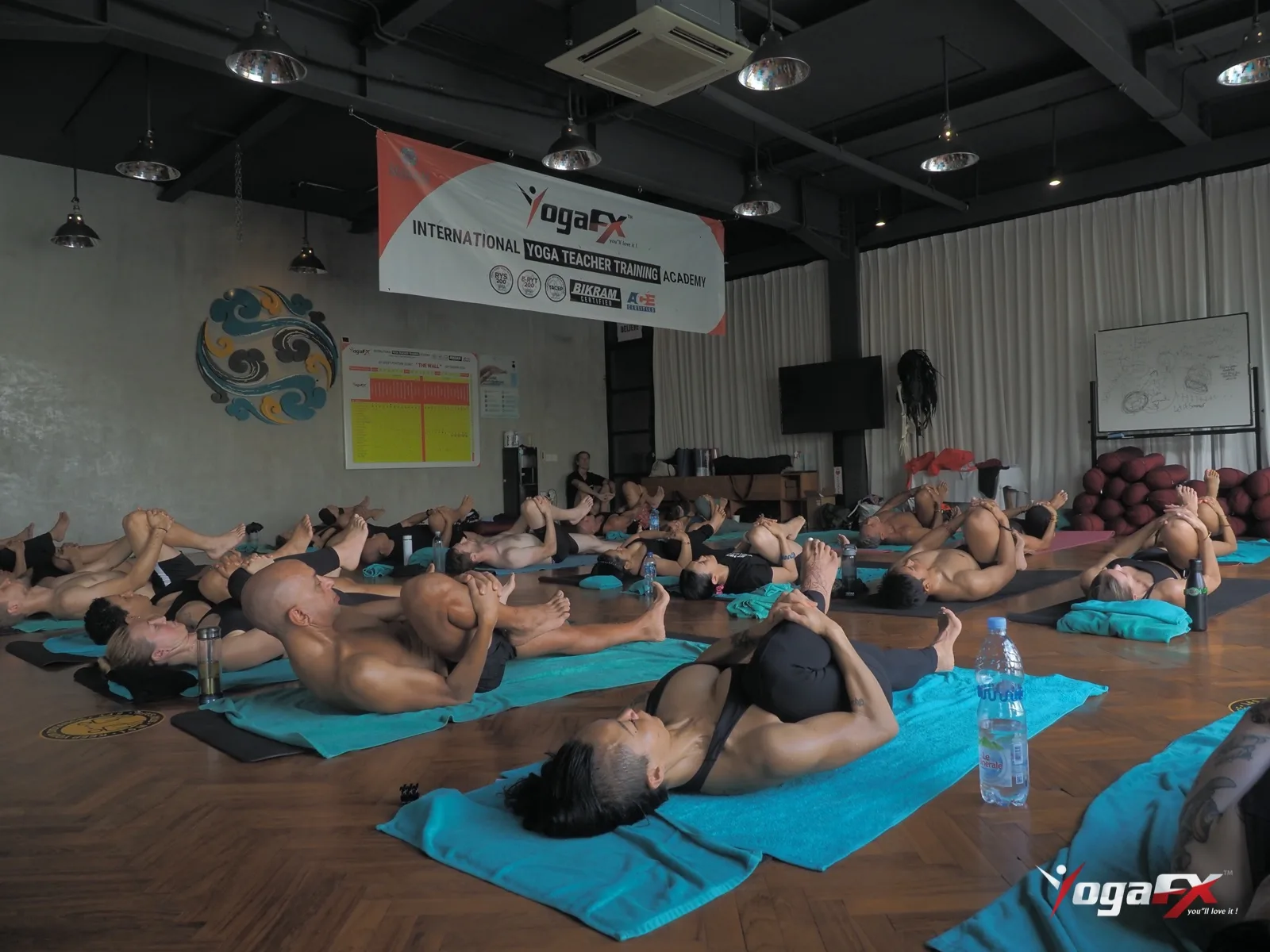
A 90-minute class runs at about 40°C and 40% humidity. So the teacher has to read tired students, set the pace and rest the room at the right moment. The registry's categories cover teaching skills in general. So heat handling belongs to a training hall that is actually heated.
4. It does not replace an audition
Studios hire on what they see, so the room matters. An audition class shows your pacing, your voice and your eye for errors within minutes. Yoga Alliance certification opens the conversation, and the class closes it. For a hot room, that audition matters even more than for a general timetable.
5. It does not say where a method comes from
Yoga Alliance certification records training, not lineage. If you want to know where a method comes from, ask who trained your lead trainer. Mr. Ian spent five years, from 2014 to 2019, training alongside the founder of the Bikram Hot 26&2 method. He is also a Master Trainer for the Republic of Indonesia Yogasana Sports Federation.
Five questions to ask a school before you pay
- Is the school registered, and at which level? Ask to see the listing yourself.
- Who is the Lead Trainer? Ask for their registry level and their teaching hours.
- How much of the week is practice teaching? Teachers learn most by teaching and being corrected.
- Do I leave with a separate method certificate? The registry listing and the method credential answer different questions.
- Who answers my messages after the course? Support after the final day is where many programmes go quiet.
What Research Says About Heated Yoga and Teacher Training
Yoga Alliance certification says nothing about health outcomes, so a teacher should know the research. We keep these claims modest, because study quality varies and results differ between people.
Willmott and colleagues published a 2025 systematic review of Bikram yoga that covered 43 studies and 942 participants. It pointed to gains in flexibility, bone density and well-being. Earlier, Tracy and Hart (2013) reported about a 20% rise in posterior chain strength with regular practice, plus better flexibility and body composition.
On mood, a Massachusetts General Hospital trial (Nyer et al., 2023, Journal of Clinical Psychiatry) ran for eight weeks. About 59% of the heated-yoga group saw their depression symptoms fall by half or more, against 6.3% of the waitlist group. Separately, Hui and colleagues (2022) found that hot yoga reduced state anxiety.
On effort, a University of Wisconsin team led by Porcari (2014) measured about 333 calories burned by women and 460 by men in a 90-minute class, at roughly 80% of maximum heart rate. As a result, a teacher leads a hard workout for everyone in the room. That is why heat handling belongs in your training, not only in your first aid course.
We name each study instead of linking it, because the research sites blocked our link checker on 9 November 2026. Search the author and year to read them yourself. None of this promises a result for you. This is general information, not medical advice, so consult a healthcare professional before any heated class if you have a heart condition, are pregnant or take regular medication.
What Graduates Say About the Certificate and the Teaching
Numbers describe a registry, but people describe a course. Our public review count stands at 150 on Google, 50 on Yoga Alliance and 357 video testimonials on YouTube. Three Google reviews show what students notice first.
"YogaFX will send you all the study materials as soon as you register. The YogaFX team led by Mr. Ian is extremely responsive and supportive."
Ajay, Google review, 2024
Ajay's point is about preparation. For example, a registered programme sets hours, and a good school also sends you the script and the theory early, so the week itself is for practice.
"Excellence great yoga teacher i love it be yoga student. Thank you so much mr ian namaste"
Christina, Google review, 2020
"The best yoga classes I ever had. The teacher is giving very dynamic flows, many balance poses for deep strength and it will never be boring and is always encouraging."
Anouk, Google review, 2020
Anouk is describing a class, not a course. That is the point, though. Yoga Alliance certification says nothing about how encouraging a room feels, and students remember that long after they forget the hours. Reviews are not proof of a result, and they are not a promise about yours.
How YogaFX Adds a Method Certificate to the Registry
Our route is the Bikram Hot 26&2 Yoga Teacher Training MasterClass. It is a hybrid: you study online first, then train in person in Bali. The in-person part runs from a Sunday check-in to a Friday check-out, which means five days away from work.
The next batch checks in on Sunday 24 January 2027 and checks out on Friday 29 January 2027, at the Soham Wellness Center in Seminyak. Dates and venues can shift, so confirm with the team before you book flights. Graduates earn a Yoga Alliance RYT 200-Hour certificate and a Bikram Hot 26&2 200-Hour International Yoga Certification.
That pairing is the whole idea. The first certificate, your Yoga Alliance certification, answers the registry's question, and the second answers the studio's. Since 2017, YogaFX has graduated 1,500+ teachers from 80+ countries. Mr. Ian Terry leads the training himself.
Is a method certificate worth it? A fair test
Picture the class you want to teach in a year. If it is a general flow class, Yoga Alliance certification may be all a studio asks for. If it is a fixed 26 and 2 class, ask whether your training covers the script, the heat and the audition.
Our guide to original hot yoga teacher training shows what 240 hours of the method cover, and our teacher training page lists the current details.
FAQ: Yoga Alliance Certification Questions
Is Yoga Alliance certification necessary to teach yoga?
Not as a licence. Yoga Alliance calls itself a registry, and its 1999 start was a voluntary one. Many studios still ask for a listing because they can check it quickly. Rules differ by country and employer, so ask each studio what it wants, then add method training on top.
What is Yoga Alliance certification?
It is a credential on Yoga Alliance's global registry. A school registers as an RYS, and its graduates apply to register as an RYT, usually RYT 200 after a 200-hour programme. Yoga Alliance calls this credentialing. It records your training and your school's registration, and it does not test any single method.
Does Yoga Alliance certification cover the 26 and 2 dialogue?
The pages we read name no style and no fixed script. They set a curriculum aligned to five educational categories instead. So the dialogue, the 26 postures and the 2 breathing exercises come from your method training. Ask your school how much script practice and teaching feedback you receive before you enrol.
What does RYT 200 mean?
RYT 200 is a Registered Yoga Teacher credential based on a foundational 200-hour training. Yoga Alliance says most new teachers begin with it. You complete the hours at a registered school, then apply with your training certificate. E-RYT, the experienced level, adds teaching requirements on top of the training hours.
What is a YACEP?
YACEP stands for Yoga Alliance Continuing Education Provider. Yoga Alliance describes providers as experienced yoga professionals offering advanced learning, and says E-RYTs in good standing can apply. Before you book any workshop, ask the provider for their registry level and their real teaching hours.