Bishnu Charan Ghosh (1903 to 1970) was a Calcutta physical-culture teacher who founded a college of physical education in 1923. He is the name people reach for when they ask where the 26 postures come from. The link is real, but the written record is thinner than most websites suggest, and this guide shows exactly where it stops.
Table of Contents
Mr. Ian Terry, E-RYT 500 and founder of YogaFX, has taught more than 12,000 hours. He trained for five years, from 2014 to 2019, alongside the founder of the Bikram Hot 26&2 method. Because he teaches this sequence, students keep asking him the same question about its roots. So we opened the sources ourselves and wrote down only what they say.
Who Was Bishnu Charan Ghosh? The Short Answer
Ghosh was a gymnast, strength trainer and teacher who built his career in Calcutta. He was born in Lahore, then part of British India, and he died in Calcutta. In between, he ran a gymnasium, wrote on muscle control and taught students who wanted a strong, flexible body. The Wikipedia biography of Ghosh gives most of the dates below, and we checked each one against that page.
- Born: 24 June 1903 in Lahore, the youngest of eight children.
- Brother: Mukunda Lal Ghosh, who became known worldwide as Paramahansa Yogananda.
- Institution: the College of Physical Education in Calcutta, opened in 1923.
- Died: 9 July 1970 in Calcutta, aged 67.
Notice what the list leaves out. No source we opened says that Ghosh “invented” the 26 postures, and none gives a date for such a moment. That gap shapes everything that follows.
Bishnu Charan Ghosh Timeline: Eight Dates That Hold Up
A timeline is only as good as its dates. The table below lists events that the biography or the academic paper records, and it shows where each one comes from. That way you can check any line yourself.
| Year | What the record shows | Where it is recorded |
|---|---|---|
| 1903 | Born in Lahore on 24 June | Wikipedia biography |
| 1923 | Opens the College of Physical Education, Calcutta | Wikipedia biography |
| 1930 | Publishes a book on muscle control and barbell exercise, with K.C. Sen Gupta | Wikipedia references; Journal of Yoga Studies, 2024 |
| 1939 | Goes to America and teaches at Columbia University, New York | Wikipedia biography |
| 1961 | A book on yoga and health appears in English | Journal of Yoga Studies, 2024 |
| 1962 | A student named Bikram Choudhury becomes a regular at the gymnasium | Wikipedia biography |
| 1968 | Lecture tour of Japan | Wikipedia biography |
| 1970 | Dies in Calcutta on 9 July | Wikipedia biography |
Look at the long stretch between 1939 and 1961. The sources we opened say little about those years, so we do not guess. If a website describes a detailed teaching programme for that period, ask where it found the detail.
Calcutta, Yogananda and a Gymnasium Called a College
A physical-culture teacher first
Ida Pajunen of SOAS University of London studied Bengali exercise manuals for the Journal of Yoga Studies. In her 2024 paper, she writes that Ghosh’s earliest book “does not contain āsana” and instead repackages some hatha yoga elements as muscle control. So the Ghosh of 1930 was teaching strength, not a posture sequence.
That matters because many popular accounts picture him as a yogi who taught postures from day one. The paper points the other way. It describes a growing interest in internal health around 1939 and the early 1940s, when asana moved into the limelight. Later, a book on yoga and health followed in 1961.
The Yogananda connection, read carefully
Ghosh was the younger brother of Paramahansa Yogananda, who wrote Autobiography of a Yogi. Both Wikipedia and the Pajunen paper confirm the family tie. Ghosh himself credited his elder brother with teaching him muscle control when he was very young, in the paper’s words, “from my beloved elder brother”.
Still, a brother is a brother, and a school is a school. A shared surname proves a relationship. It does not prove one shared teaching programme, so we keep those two claims apart. For a wider look at the teachers around this story, see our guide to the male teachers who shaped the 26 and 2 lineage.
From Bishnu Charan Ghosh to the 26 Postures: What We Can and Cannot Say
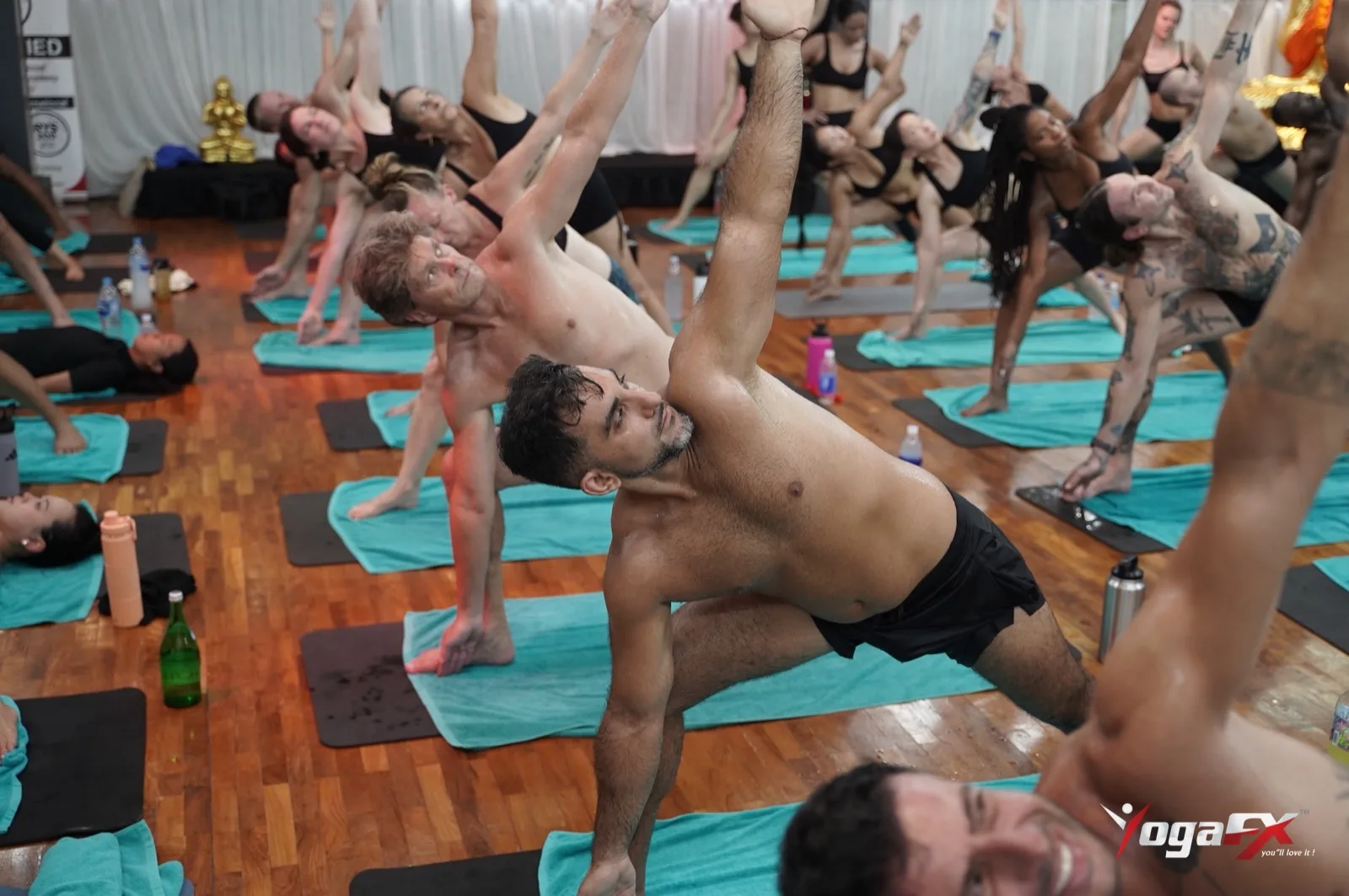
Here is the question most readers carry: did Ghosh create the sequence taught in Seminyak today? The sources do not say so. They do say a connection exists. Wikipedia reports that Choudhury became a regular student at the gymnasium in 1962 and that his system of yoga was based on Ghosh’s teachings.
The Pajunen paper adds a careful footnote. It says Choudhury studied with Ghosh for a short period, and that his system includes postures from the Bengali sources plus a health-based approach. Then it draws a sharp contrast, which the table below sets out.
| Question | Bengal practice, as the paper describes it | A 26 and 2 class in Seminyak |
|---|---|---|
| How is it practised? | Individually, not as group classes | As one room, all students together |
| Is the order fixed? | No set sequence for group practice | Yes: 26 postures and 2 breathing exercises, always in the same order |
| Who guides the class? | A teacher working with each practitioner | A teacher delivering a scripted dialogue, with no demonstration and no music |
| Where does the warmth come from? | The paper ties the heated room to the set-sequence method, not to Bengal | Natural tropical air, about 40 degrees Celsius and 40% humidity, with no electric heaters |
So Ghosh is best described as a root of the method, not its author. The same paper that links the postures to Bengal also says the fixed group sequence is something different from Bengal’s individual practice. Who changed what, and when, is still a debated question, and one biography cannot settle it.
If you want the wider story of the naming disputes and the method that outlived them, read our Bikram yoga history guide. For the sequence itself, our overview of hot 26 and 2 yoga walks through how a class runs. The Bali studio in our network has also written a longer account of Ghosh and the history behind its Bali class.
What Bishnu Charan Ghosh Would Recognise in a Seminyak Room
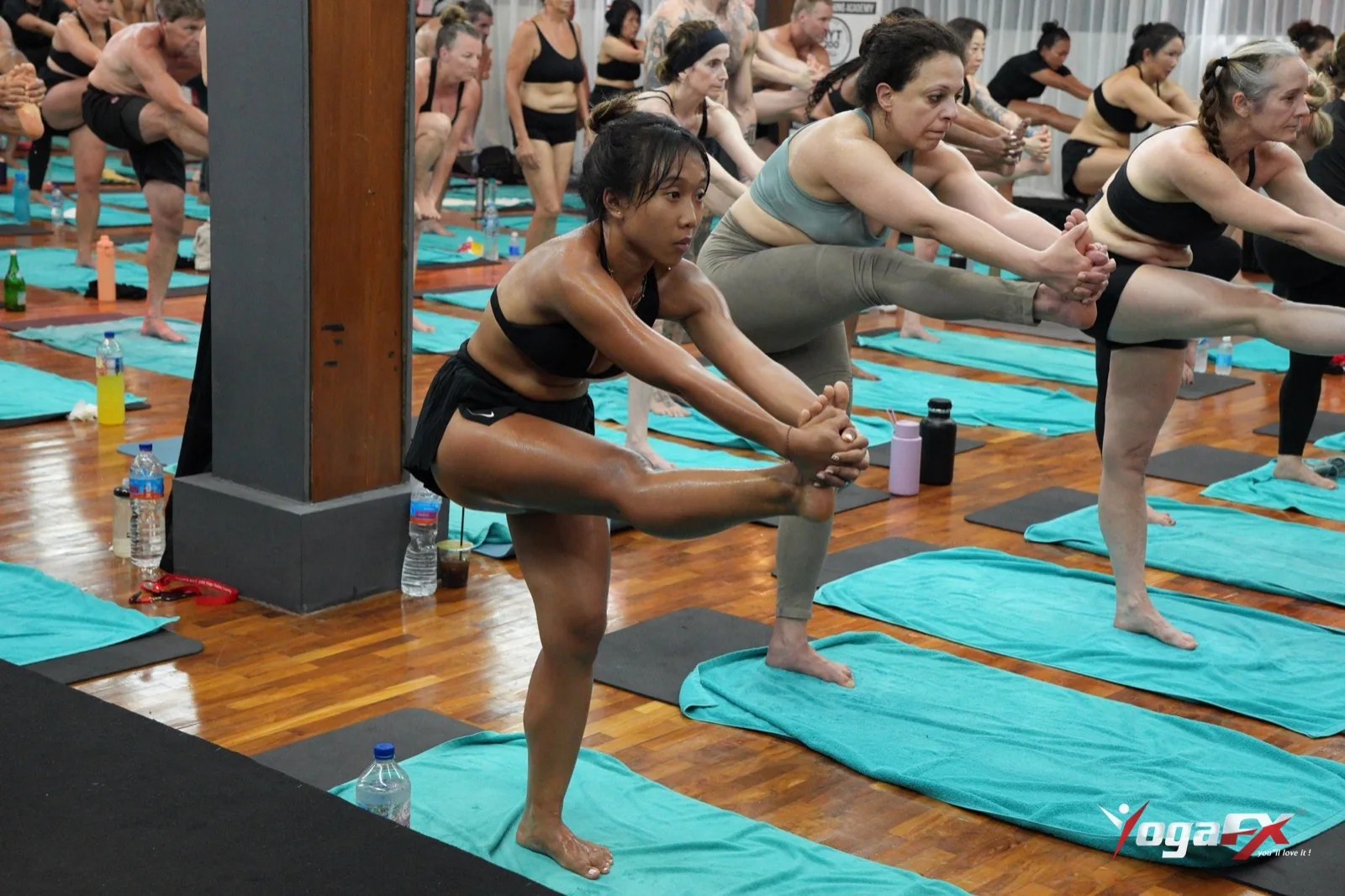
We cannot know what Ghosh would think of a modern studio, and we will not pretend to. What we can do is describe what stays fixed in our class, because that fixed frame is the part students feel first. The cards below show it at a glance.
Because the words never change, a student can stop watching the room and start noticing the body. Eyes close, the breath steadies, and the repetition does the calming. Each posture has a physical purpose that a teacher can explain, which echoes the body-first thinking of Ghosh’s era. That is our reading, not a historical claim.
To hear how the dialogue is built, read what the 26 and 2 dialogue is and why it matters. Mr. Ian often puts the purpose of the work in one line: “there can be no greater investment than the one that you make in your health, because without it, nothing else matters.”
The Source Ladder: Where to Trust Bishnu Charan Ghosh Claims
Search for his name and you will meet four kinds of source, and they don't carry equal weight. It helps to rank them before you repeat anything. Think of it as a ladder, where the higher rung is harder to argue with.
- Top rung: his own writing. What Ghosh printed under his name tells you what he chose to teach in public.
- Second rung: peer-reviewed scholarship. A journal paper such as Pajunen’s shows its reading and can be challenged by other researchers.
- Third rung: reference works. An encyclopedia entry is a useful map of dates, but it summarises other people’s work and anyone can edit it.
- Bottom rung: posts and captions. Anniversary tributes and social posts are warm, and they rarely cite anything.
This article leans on the second and third rungs, and says so each time. We did not find a way to read the first rung inside our own studio, so we don't claim to know exactly what any single page of his books taught.
What a teacher can safely say in class
Trainees who learn the dialogue will be asked about the roots, often within their first month of teaching. One accurate sentence beats a long story that collapses on the first follow-up question. For example, “the postures are widely linked to Bishnu Charan Ghosh’s gymnasium teaching” can be defended. “Ghosh created this sequence” can't.
Saying “nobody has written that part down” takes a little nerve, yet students notice and respect it. It also protects the teacher, because a claim with a source behind it never has to be walked back later.
What Research Says About Strength Work and Heated Yoga
History is a question of record. Health is a question of evidence, and the evidence is more modest than the marketing around it. Two sources are worth knowing, and neither says what a lot of websites imply.
Strength work is a modern guideline too
The US Centers for Disease Control and Prevention advises adults to get at least 150 minutes of moderate-intensity activity a week. It also says adults need at least 2 days of muscle-strengthening activity each week. Read the wording on the CDC adult activity guidelines page. That is general advice, not a claim about any yoga class, yet it shows why a body-first approach is not old-fashioned.
The heated yoga depression trial
Nyer and colleagues at Massachusetts General Hospital published an eight-week randomised trial in the Journal of Clinical Psychiatry in 2023. On the PubMed record of the trial, 59.3% of the heated yoga group had a symptom drop of 50% or more, against 6.3% of the waitlist group. The trial analysed 65 adults.
Treat that carefully. The control group was a waitlist, not another exercise, so the trial cannot say that heat is the active ingredient. The authors call for further research with active controls. Our Seminyak class also uses natural tropical heat, so the findings do not transfer neatly.
Safety note. Yoga is not a treatment for depression or any other condition. If you have a heart condition, high blood pressure or depression, or you are pregnant or taking medication, consult a healthcare professional before your first class. Drink water, arrive early and stop if you feel dizzy.
What Graduates Say After the Training
Dates only go so far, so here are three graduates in their own words. Each comes from a review video on the YogaFX YouTube channel, and we give first names only.
“The most challenging mentally physically spiritually I ever experienced and the best thing I’ve ever done.”
Emelie, YouTube review, 2024
“I wanted to know yoga, I wanted to learn about yoga, I feel like something missing.”
Carol, YouTube review, 2025
“You become my family.”
Lisa, YouTube review, 2023
None of the three mentions Ghosh, and that is the point. The class works as a practice before it works as a history lesson. If you are new to the room, our guide to hot yoga for beginners takes a first class posture by posture.
Try the Method in Seminyak, or Study It Online
Reading about Ghosh is useful. Standing in the room is better. YogaFX has one studio open, in Seminyak, at Jl. Pangkungsari Gg Jepun No.888, Kuta Utara, Seminyak, Badung, Bali 80361. It is open daily from 06:00 to 22:00. Ask for the Free 1-Day Guest Pass, and your first class is free.
For a first visit, keep it simple:
- Bring water and a towel. The room runs warm, so you will sweat early.
- Arrive early. Settling in before the dialogue starts makes the first posture easier.
- Eat lightly beforehand. A heavy meal and a 90-minute class don't mix well.
Perhaps you want the method without the flight. The YogaFX Online Course costs USD 329, or 4 payments of USD 82, and the Starter Kit costs USD 98, or 2 payments of USD 49. Teacher trainees who want to learn the dialogue can start with our guide on how to choose a 26 and 2 teacher training.
FAQ
Who is Bishnu Charan Ghosh?
Bishnu Charan Ghosh was a Calcutta teacher of physical culture, born in Lahore on 24 June 1903. He opened the College of Physical Education in Calcutta in 1923 and was the younger brother of Paramahansa Yogananda. His teaching is the root most often linked to the 26 postures, although the exact chain is debated.
How old was Bishnu Charan Ghosh when he died?
Bishnu Charan Ghosh was 67 when he died in Calcutta on 9 July 1970. The Wikipedia biography gives his birth date as 24 June 1903, so use both dates if you quote his age. Because it is an encyclopedia entry, it is worth confirming against a second source before you publish it.
Did Bishnu Charan Ghosh create the 26 postures?
No source we opened says he did. Wikipedia reports that Bikram Choudhury became a regular student at his gymnasium in 1962 and that his system was based on Ghosh’s teachings. Pajunen’s 2024 paper says the fixed group sequence differs from Bengal’s individual practice. So Ghosh is a root, not the documented author.
What is the Bishnu Charan Ghosh book Muscle Control?
It is his 1930 book on muscle control and barbell exercise, co-written with K.C. Sen Gupta according to the Wikipedia reference list. Pajunen’s paper says it contains no asana. A later book on yoga and health appeared in English in 1961, which suggests his focus moved toward yoga and health over time.
Do I need to know the Ghosh lineage to try a class?
No. You can take a first class knowing nothing about Ghosh, and the Free 1-Day Guest Pass makes your first class free. The history adds context, but the class itself works without it. YogaFX runs independent classes, not official Bikram Choudhury Teacher Training. Bring water and a towel, and consult a healthcare professional first if you have a medical condition.
Still have questions? Message Mr. Ian and the YogaFX team on WhatsApp and we will answer them personally. You can ask for your Free 1-Day Guest Pass in the same message.