If you feel hot yoga dizzy in a 26 and 2 room, stop moving and lie on your back in Savasana. Breathe slowly through your nose, take a few small sips of water and tell your teacher. Stay down until it passes, then get up slowly. If it does not ease, ask to be helped to a cooler place.
Table of Contents
This guide walks through those steps in order, explains why a hot yoga dizzy spell happens, and shows which signs need more than a rest. It reflects how we teach at YogaFX, where Mr. Ian Terry is Founder and Lead Instructor (E-RYT 500) with more than 12,000 hours of teaching. It is general education, not medical advice.
Hot Yoga Dizzy in a 26 and 2 Room: The Five Steps
Here's the short version. Each step has its own section further down, so you can jump to the one you need.
- Stop and lower. Release the posture and bring your body down to your towel.
- Lie in Savasana. Rest on your back and let the floor hold you.
- Breathe slowly. Use your nose and let each breath be a little calmer than the last.
- Sip water. Take a few small sips, not a big gulp.
- Tell your teacher, then rise slowly. Sit up first, then stand when the room is steady.
Dizziness usually goes away on its own, and the NHS says it is common and not usually serious. You can read its advice on what to do about dizziness. A hot yoga dizzy moment is something every teacher in the room has seen before, and it's nothing to hide.
Why a Hot Yoga Dizzy Spell Happens
A 26 and 2 class runs for 90 minutes at about 40 degrees C and 40% humidity. The heat comes naturally from the tropical climate rather than from electric heaters. You sweat for the whole class, and you move between standing, bending and lying down.
Any of those can leave you light-headed. According to MedlinePlus heat illness page, your body normally cools itself by sweating, but in very humid heat sweating may not be enough, and exercising in high heat can lead to heat illness. So the room deserves respect. The NHS says dizziness is common, and it lists several everyday causes. Four of them matter most in a hot room:
- Heat and sweat. The NHS lists dizziness among the symptoms of heat exhaustion, together with tiredness, headache, nausea and heavy sweating.
- Too little fluid. Dehydration is on the NHS list of causes. Our guide to hot yoga hydration shows a simple routine.
- Standing up too fast. The NHS names a sudden drop in blood pressure, called postural hypotension, when you stand or sit up suddenly. In class that can happen when you come up quickly from a forward bend or from the floor.
- Low blood sugar, stress or anxiety. The NHS lists all of these. A first class can bring nerves, and an empty stomach does not help. Read what to eat before hot yoga for timing ideas.
None of this means you did something wrong. It means your body is telling you to slow down, and the sooner you listen, the easier the next few minutes are.
Hot Yoga Lightheaded, Vertigo or Faint? Know the Difference
These words get mixed up, so it helps to separate them. MedlinePlus, from the US National Institutes of Health explains that dizziness can make you feel lightheaded, woozy or unsteady. Vertigo, on the other hand, is the feeling that you or the room is spinning even when nothing is moving.
That difference matters in class. A hot yoga lightheaded feeling after a quick bend often gets better on its own, according to the same source. Hot yoga vertigo, where the room spins, points to a different list of causes, and inner ear problems are one of them. A hot yoga faint, where you lose consciousness, needs help.
MedlinePlus also says to get emergency help right away if you have sudden or severe dizziness or vertigo together with vision problems, slurred speech or weakness. Those can be signs of a more serious condition, so do not wait to see if they pass.
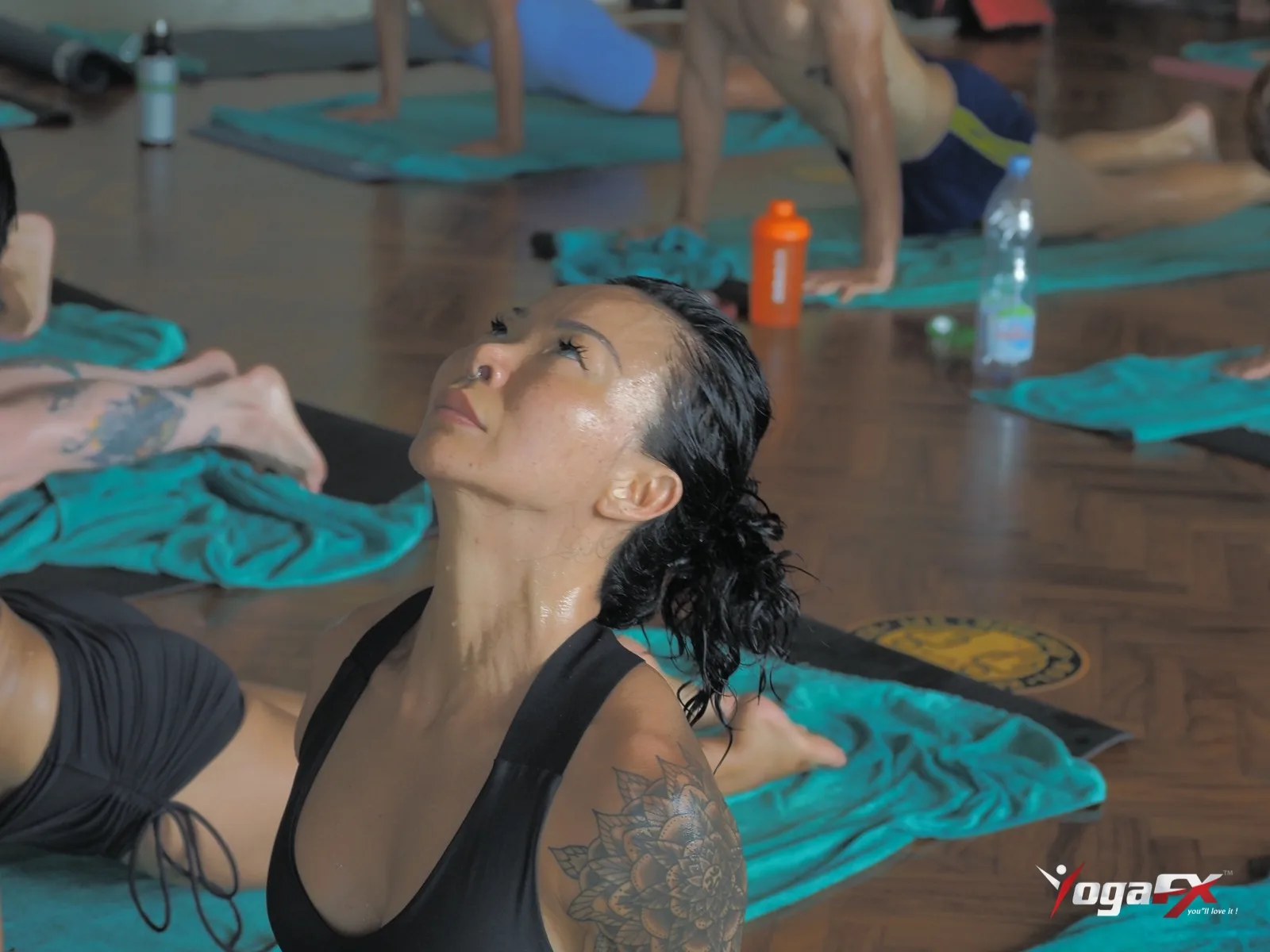
Step by Step: What to Do When You Feel Dizzy in Class
Follow these steps in order for any hot yoga dizzy moment. They are simple on purpose, because thinking is hard when you're light-headed.
Step 1: Stop and lower your body
Release the posture straight away. Don't hold on for the last few seconds. The NHS advises that you do not bend down suddenly while dizzy, so lower yourself with control. Bring your hands down and ease onto your towel, keeping your centre of gravity low.
Step 2: Lie in Savasana
Lie flat on your back with your arms by your sides. The NHS advice for dizziness is to lie down until it passes, and that is exactly what Savasana gives you. On the floor you cannot fall. Our guide to Savasana at the end of the class explains why lying down is the first-aid move in a hot room.
Step 3: Breathe slowly through your nose
Keep your mouth closed and breathe in and out through your nose. Let each breath be slightly slower than the one before. You're not trying to force anything. You're giving your body a steady rhythm to follow.
Step 4: Take a few small sips of water
The NHS says to drink plenty of fluids, especially water, when you feel dizzy. In class, that means a few small sips from the bottle at the edge of your towel. A big gulp can sit heavily in the stomach, so keep it small and slow.
Step 5: Tell your teacher, then get up slowly
Raise a hand or say it out loud. The dialogue is spoken, so your teacher is listening to the room and can see you from the front. They'd much rather hear about it early than find out late.
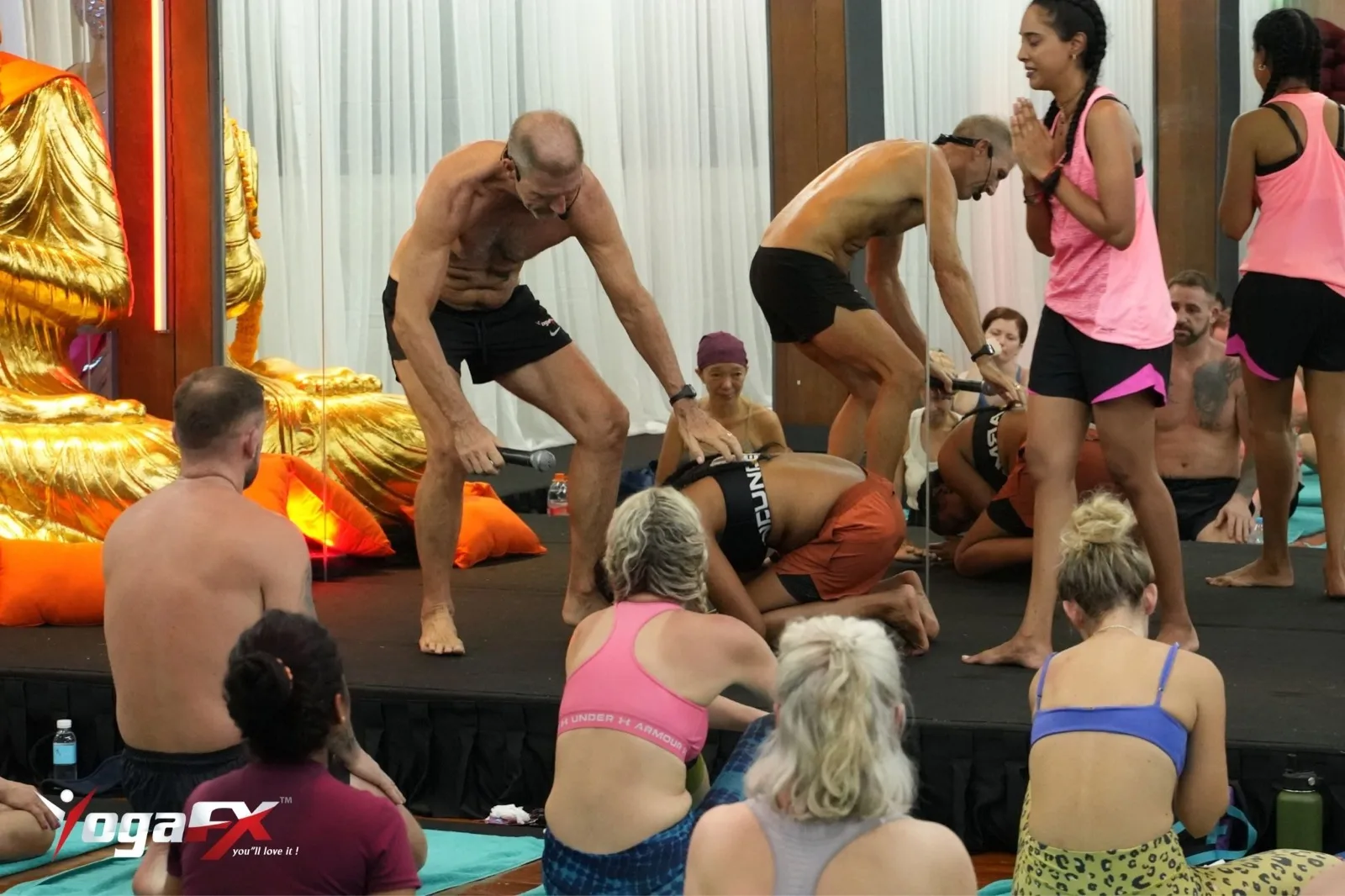
When the dizziness fades, sit up first and wait a moment. Then stand. The NHS says not to get up suddenly after sitting or lying down. Rejoin the class when you feel steady, or stay on your towel for the rest of the posture. Both are fine.
Why We Ask You to Stay in the Room for a Mild Hot Yoga Dizzy Spell
In a 26 and 2 class, the guidance for a mild hot yoga dizzy feeling is to stay in the room and rest on your towel. There are three reasons. On the floor you are safe from a fall. Your teacher can see you. And you can rejoin the class when you are ready, instead of leaving the practice behind.
That is class guidance, not a medical rule, and it covers mild light-headedness only. Heat exhaustion is different. The NHS says someone with heat exhaustion should be moved to a cool place, given plenty of water, and cooled down with cool water and fanning. So if your symptoms go beyond mild light-headedness, staying put is the wrong call. Ask your teacher to help you to a cooler place.
The NHS also says heat exhaustion does not usually need emergency help if you can cool down within 30 minutes. If you are still unwell after that, it needs urgent medical attention. You can read the full steps on the NHS heat exhaustion and heatstroke page.
Dizzy Signs: When a Rest Is Enough and When It Is Not
Not every hot yoga dizzy moment looks the same. This table groups the signs by what the NHS says they may point to, and what to do about each one.
| What you notice | What it may point to | What to do |
|---|---|---|
| Light-headed after a quick bend or standing up fast | A sudden drop in blood pressure when you change position (postural hypotension) | Lie down, breathe slowly and get up slowly. |
| Dizzy with tiredness, headache, nausea, heavy sweating, clammy skin or strong thirst | Heat exhaustion, according to the NHS | Move to a cool place, sip water and cool your skin. Improvement should come within 30 minutes. |
| Confusion, hot skin that is not sweating, fast breathing or heartbeat, a fit, or loss of consciousness | Heatstroke, which the NHS calls a medical emergency | Call local emergency services at once. Do not wait. |
| The room spins, you hear ringing, you have double vision, or your face, arms or legs feel numb or weak | Causes that are not about heat, such as inner-ear problems, according to the NHS | Stop practising and see a doctor. |
| Dizziness that keeps coming back or will not go away | The NHS says to see a GP if it will not go away or keeps coming back | Book a medical check before your next class. |
Read the table from the top. If your hot yoga dizzy feeling sits in the first row, rest is usually enough. Anything below that row calls for more than a rest, and the last two rows mean a doctor, not the next class.
What Students Say About Hard Moments in the Heat
Dizziness is only one kind of hard moment in a hot room. Three of our graduates describe their own, and how they got through.
Sophie wrote: "There were moments I wanted to give up and moments I surprised myself by staying, breathing, and trusting my body." (Sophie, Google review, 2026)
Britt called the training the hardest thing she had ever done. She found her way by following a suggestion from Mr. Ian: "Within only a few days, I focused on what I could do and that was the yoga." (Britt, Google review, 2026)
A trainee in our 2018 YouTube review says that about an hour in, they hit a very low point. They recovered by breathing and following the instructor's steps. Their verdict: it is hard, and they love it. (a trainee in our YouTube review, 2018)
All three stories share one habit: they stayed with the breath and worked at their own level. That is the same advice we give for a hot yoga dizzy spell, and it works at every level.
Getting Back Up and Looking After Yourself After Class
Because the way you leave the room matters as much as the way you rest in it, plan your exit. The NHS says to get up slowly after dizziness, and to avoid anything that could be dangerous while you are dizzy. It names driving, climbing a ladder and using heavy machinery. In Bali, that includes riding a scooter.

- Sit first. Stay seated for a minute or two before you stand.
- Cool down. Sit somewhere cooler and let your skin cool.
- Sip water slowly. Small sips work better than a big drink.
- Eat something light. A normal meal helps once your stomach feels settled.
- Wait before you travel. Do not ride or drive until you feel steady.
If you still feel flat or drained later, read our guide on feeling tired after hot yoga. It helps you tell normal tiredness from a warning sign.
How to Lower Your Chances of a Hot Yoga Dizzy Spell
You can't remove every dizzy moment, but you can make them less likely. For example, these habits cover most of what we see with new students.
- Drink steadily through the day. Do not try to catch up in the last ten minutes before class.
- Eat light before class. Leave enough time for your stomach to settle.
- Build up gradually. Pace your first weeks and read our guide to heat acclimatization in a 26 and 2 room.
- Rest early. Lie down at the first light-headed feeling instead of waiting for it to grow.
- Skip class when you are unwell. A day off costs you less than a bad class.
- Check with your doctor if you take medicine or have low blood pressure. The NHS lists new prescription medicine as a possible cause of dizziness.
A hot yoga dizzy spell can catch you out when the heat is new to you. Keep your first classes simple and stay close to the mat. Nobody expects you to finish every posture on day one.
When to See a Doctor About Dizziness
Most hot yoga dizzy spells pass, but some need medical attention. The NHS says to see a GP if:
- you are worried about your dizziness
- it will not go away or keeps coming back
- you find it harder to hear or speak
- you have ringing or other sounds in your ears
- you have double vision, blurred vision or other changes in your eyesight
- your face, arms or legs feel numb or weak
- you have other symptoms such as changes to your pulse, fainting or collapsing, headaches, or feeling or being sick
If you faint, or if someone in the room shows signs of heatstroke, call local emergency services straight away. When you are unsure, ask the teacher or the front desk for help.
Hot Yoga Dizzy Spells at Our Seminyak Studio
Mr. Ian Terry trained for five years, from 2014 to 2019, with the founder of the Bikram Hot 26&2 method. He has taught more than 12,000 hours. In that time he has seen every kind of hard moment in the heat, and our teachers are used to students resting, sipping and starting again.
The studio at Jl. Pangkungsari Gg Jepun No.888, Kuta Utara, Seminyak, Badung, Bali 80361 is open from 06:00 to 22:00 every day. Classes run for 90 minutes at about 40 degrees C and 40% humidity. New students can try the Free 1-Day Guest Pass and see how the steps in this guide feel in the room.
Medical note: this guide is general education and not medical advice. Please consult a healthcare professional before you start or change a hot yoga routine, especially if you are pregnant, take medication, or have a heart, blood pressure or other health condition.
FAQ
Why does hot yoga make me dizzy?
The NHS lists heat exhaustion, dehydration, low blood sugar, stress and standing up suddenly among common causes of dizziness. A 90-minute class at about 40 degrees C asks a lot of your body on all of these. Drink steadily, eat lightly, build up gradually and rest as soon as you feel light-headed.
What should I do if I feel dizzy during hot yoga?
Stop moving, lower your body and lie on your back in Savasana. Breathe slowly through your nose, take a few small sips of water and tell your teacher. Get up slowly when it passes. If symptoms go beyond mild light-headedness, ask to be helped to a cooler place.
Can hot yoga cause vertigo?
Vertigo is the feeling that you or the room is spinning. The NHS lists inner-ear problems as a possible cause when the room spins, so heat is not always the reason. Light-headedness is the more typical hot room feeling. If the room spins, stop practising and see a doctor, especially with hearing changes.
Can hot yoga make you faint?
Heat can contribute to fainting, which is why we take dizziness seriously. The NHS lists fainting among the reasons to see a GP, and loss of consciousness is a sign of heatstroke that needs emergency help. Lie down at the first sign of light-headedness and tell your teacher straight away.
How do I stop getting dizzy in hot yoga?
Arrive well hydrated, eat something light before class and build up gradually to avoid a hot yoga dizzy spell. Rest in Savasana at the first light-headed feeling, because lying down early is the safest move. If you take medicine, have low blood pressure or keep feeling dizzy, check with your doctor before your next class.
Still have questions? Message Mr. Ian and the YogaFX team on WhatsApp and we will answer them personally.