Hot yoga blood pressure research is still thin. Yoga in general lowers blood pressure a little, but the one heated Bikram study we could open found no change in resting blood pressure after eight weeks. Heat also adds risk if you take certain medicines, so talk to your doctor first.
Table of Contents
This guide comes from the 26 and 2 team at YogaFX Bali. Mr. Ian Terry, our Founder and Lead Instructor (E-RYT 500, 12,000+ teaching hours), leads the teaching standards behind our classes, and students may arrive with a hot yoga blood pressure question. We answer it with sources we opened and checked, and we say plainly where the evidence runs out.
Medical note: this article is general education, not medical advice. Please consult a healthcare professional before you start hot yoga if you have high or low blood pressure, heart disease or you take blood pressure medicine.
Hot Yoga Blood Pressure: The Short Answer
Here is what the evidence supports today, in plain words.
- Yoga can lower blood pressure a little. A 2013 systematic review and meta-analysis of yoga for hypertension found average drops of about 4 mmHg (systolic) and 3.6 mmHg (diastolic). But every trial in it had an unclear or high risk of bias.
- Heat is not proven to add a benefit. In an eight-week Bikram study, resting blood pressure did not change in either young or older adults (Hunter et al. 2013 Bikram yoga study).
- Heat can add risk. Sweat lowers body fluid, and some blood pressure medicines make heat harder to handle (CDC guidance on heat and medications).
- Good news for most people. The American Heart Association says physical activity is safe for almost everyone, and it helps lower blood pressure.
So the honest answer on hot yoga blood pressure is mixed. A class can be a safe part of an active life for many people. But nobody should sell hot yoga as a blood pressure treatment.
Hot Yoga Blood Pressure in a 26 and 2 Class: What Happens
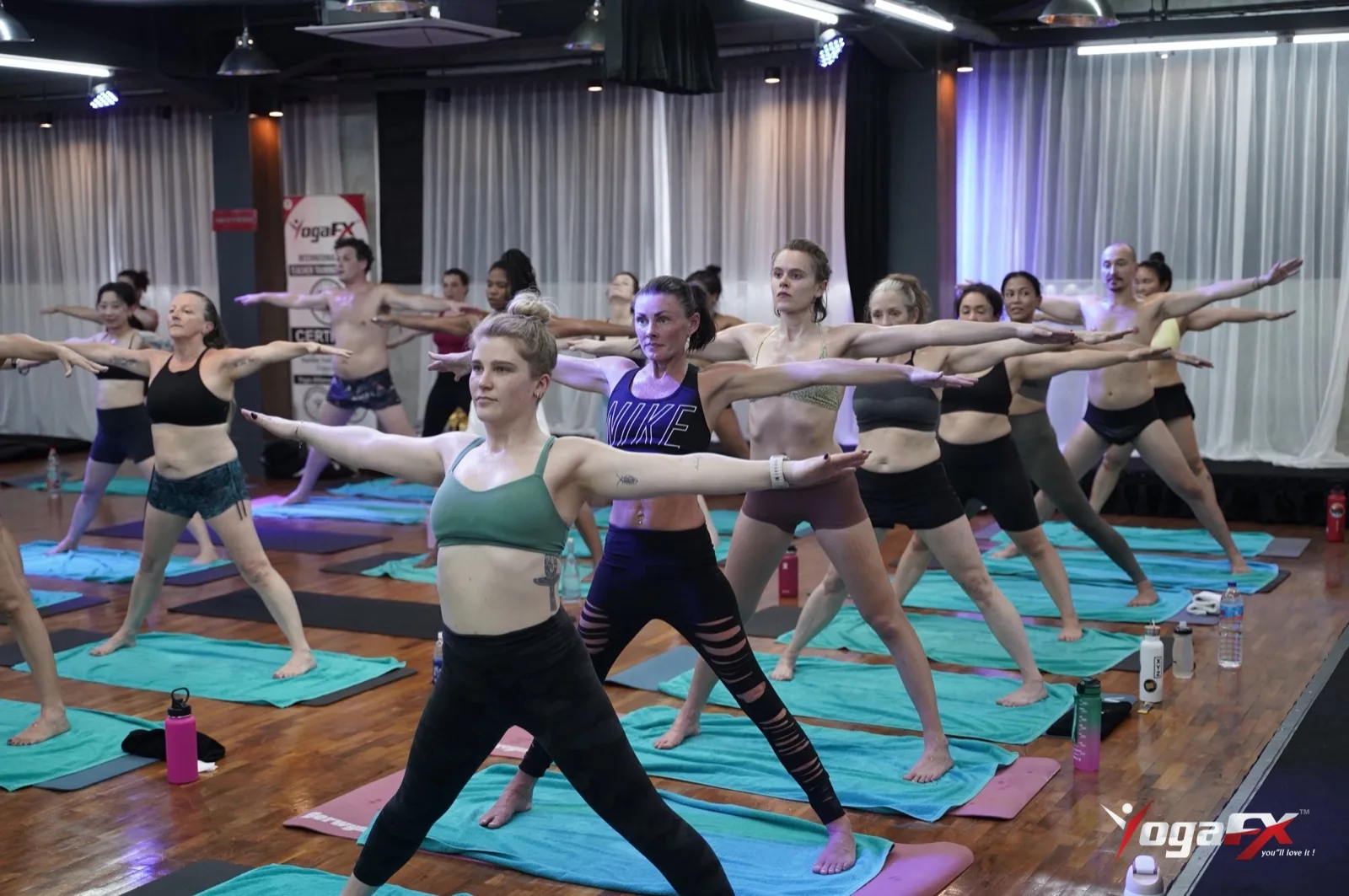
A 26 and 2 class runs for 90 minutes at about 40°C and 40% humidity. The sequence never changes: 26 postures and 2 breathing exercises. Because it is fixed, you can predict where the effort peaks, and that helps when you manage your pressure.
The standing series: effort and heat together
The standing postures ask for the most work. Your legs hold weight, your arms stay lifted and your heart rate climbs. Our guide to heart rate zones through the 26 postures follows that wave posture by posture.
Meanwhile, heat adds a second load. Your body sheds heat by sweating and by widening blood vessels near the skin. The CDC notes that beta blockers can reduce both skin vasodilation and sweating, which is one reason heat matters more for people on them.
The floor series and Savasana: recovery
After the standing series, the pace drops. The floor postures are lower in demand, and the room lies still in Savasana. That stillness matters. The American Heart Association warns that if you stop exercising too quickly, your blood pressure can drop sharply.
So do not rush out of a posture and sprint to the door. Come down slowly, breathe through the nose and stay in the room. Our guide to Savasana at the end of the class explains why that final rest earns its place.
Sweat, fluid and blood volume
Sweat is fluid. The Mayo Clinic Q and A on heat and blood pressure explains that heat and sweating can lower the fluid in your body, which reduces blood volume and can lead to dehydration. Lower blood volume can pull your pressure down, and that is how some students end up lightheaded.
That is why we wrote a separate guide on drinking enough water for a hot class. In short, sip steadily before class and replace fluid afterwards. Do not gulp a litre just before you start.
What Research Says About Hot Yoga Blood Pressure and Yoga
Two kinds of evidence matter for hot yoga blood pressure. The first is research on yoga in general. The second is research on heated yoga, which is much smaller.
Yoga in general: a modest effect
The 2013 systematic review and meta-analysis of yoga for hypertension pooled 17 controlled studies. Yoga had a modest but significant effect on systolic pressure (-4.17 mmHg) and diastolic pressure (-3.62 mmHg).
Full yoga, meaning postures, meditation and breathing together, did better: -8.17 mmHg systolic and -6.14 mmHg diastolic. However, the effect was not significant against exercise, and all 17 studies had unclear or high risk of bias. The authors called for more rigorous trials.
For context, the Mayo Clinic reports drops of 4 to 10 mmHg systolic and 5 to 8 mmHg diastolic from regular exercise, and recommends 150 minutes of moderate aerobic activity a week.
Heated Bikram yoga: one trial we could open
The Hunter et al. 2013 Bikram yoga study asked 24 young adults (average age 30) and 18 middle-aged and older adults (average age 53) to practise Bikram yoga for eight weeks. Classes lasted 90 minutes, three times a week, in a room heated to 40.5°C with 40 to 60% humidity.
Blood pressure did not change significantly in either group. But carotid artery compliance rose in the young group, not in the older group. The abstract gave p-values only and no control group, so we cannot say how large the effect was.
The evidence side by side
| Source | Who and what | Heated room? | What it found |
|---|---|---|---|
| 2013 meta-analysis (Evidence-Based Complementary and Alternative Medicine) | 17 controlled studies of yoga for adults with hypertension | Not stated | Systolic -4.17 mmHg, diastolic -3.62 mmHg; all studies had unclear or high bias risk |
| Hunter et al. 2013 (Journal of Alternative and Complementary Medicine) | 8 weeks of Bikram yoga, 3 classes a week, 24 young and 18 older adults | Yes, 40.5°C | No significant blood pressure change; artery compliance improved in young adults only |
| Mayo Clinic (exercise and blood pressure) | Regular aerobic exercise in general | No | Drops of 4 to 10 mmHg systolic and 5 to 8 mmHg diastolic |
| American Heart Association | Physical activity guidance for high blood pressure | No | At least 150 minutes of moderate activity a week; check with your doctor if you have a condition |
A third study on heated yoga and arterial stiffness exists, but we could not open it, so we do not quote it. We would rather leave a gap than guess.
Why Hot Yoga Blood Pressure Results Are Mixed
It's tempting to say heat makes yoga better for your arteries. The data does not back that yet. Here is why results differ.
- Small trials. The Bikram study had 42 people in total, so it can miss small effects.
- Age matters. Artery compliance improved in younger adults but not in older adults.
- Mixed baselines. People with normal pressure may have little room to drop, so averages can hide the people who might benefit.
- Different yoga. Studies mix styles, lengths and breathing work, so one result may not carry over to a 26 and 2 class.
For hot yoga blood pressure questions, the key point is simple: treat any claim that hot yoga "fixes" blood pressure with suspicion, including ours.
What about the idea that heat releases nitric oxide and relaxes vessels? The mechanism is plausible, and we cover it in our piece on nitric oxide and blood vessels. But a plausible mechanism is not proof that your resting pressure will fall.
Who Should Be Careful: Hot Yoga Blood Pressure and Medicine
Some people need a doctor's go-ahead before the first class. The CDC guidance on heat and medications lists diuretics, and combinations such as an ACE inhibitor or ARB with a diuretic, among medicines that may significantly raise the risk of harm from heat. Check with your doctor if any of these apply:
- You take blood pressure medicine, especially a diuretic or beta blocker.
- You have heart disease, or a doctor has told you to avoid moderate exercise.
- Your pressure is high and not yet under control.
- You often feel dizzy when you stand up or exercise.
- You are pregnant, or you have kidney problems.
Blood pressure medicines and heat
| Medicine type | What heat may do | Question to ask your doctor |
|---|---|---|
| Diuretics (water tablets) | Electrolyte imbalance, volume depletion, dehydration and a higher risk of fainting | Do I need to change my fluid and salt plan on class days? |
| Beta blockers | Reduced skin vasodilation, less sweating, lower blood pressure and a higher risk of fainting | Is a 40°C room safe for my dose and heart rate? |
| ACE inhibitors and ARBs | Lower blood pressure and a higher risk of fainting; reduced thirst | How should I time my dose around class? |
| Combinations (for example ACE inhibitor or ARB plus diuretic) | May significantly increase the risk of harm from heat | Should I wait, or start with shorter visits to the room? |
The CDC also says to avoid stopping any medicine abruptly without a plan. So never skip a dose to "prepare" for class. Ask your doctor instead.
Warning signs in the room
The Mayo Clinic Q and A on heat and blood pressure lists dizziness among warning signs, and the Mayo Clinic says to stop exercise if you feel dizzy or faint. In the hot room, that means you sit or lie down at once.
Questions to Take to Your Doctor Before Class
A short appointment goes further when you arrive with specific questions. Bring this list, or screenshot it, and tell your doctor the room is about 40°C for 90 minutes.
- Is it safe for me to exercise in a room at about 40°C and 40% humidity?
- Could my current medicine make me dizzy, dehydrated or less able to sweat?
- Should I change when I take my dose on class days?
- What reading should make me stop and call you?
- How often should I start: once a week, or less?
Write the answers down. If your doctor says yes, you can start slowly and treat the first few classes as a trial. If your doctor says wait, then waiting is the right plan, and the room will still be there later.
How We Run the Room at YogaFX Seminyak
Our only open studio is in Seminyak, Bali. We teach the 26 and 2 with a scripted dialogue, no demonstrations and no music. That means every student hears the same cues and can work at their own level.
For a student with a hot yoga blood pressure question, the structure helps in four ways:
- Predictable effort. You know the standing series comes first and the floor series follows.
- Built-in recovery. Short Savasana breaks let your heart rate settle between postures.
- Permission to rest. Lying down is part of the practice, not a failure.
- Slow adaptation. Heat takes time to get used to. Our page on heat acclimatization explains that it usually builds over about one to two weeks of regular practice, so add classes slowly.
We cannot offer medical clearance, and we do not claim to treat blood pressure. What we can do is explain the room, listen to your concerns and let you watch a class first.
A Simple Pre-Class Checklist for Hot Yoga Blood Pressure Safety
Use this list if your doctor has said hot yoga is fine for you. It also works for anyone who feels unsure.
- Eat light. Avoid a heavy meal for two to three hours before class.
- Sip, don't gulp. Drink steadily during the day instead of a large amount right before class.
- Bring your own numbers. If you track blood pressure at home, note a reading before and after your first few classes and show your doctor.
- Tell the teacher. A short word before class lets us watch for you.
- Breathe through the nose. It is how we teach students to hold a steady, calm pace.
- Leave slowly. Rest in the room, cool down and avoid a cold shower straight away.
None of these steps are secret. They sit alongside the cautions from the AHA and Mayo Clinic: check with your doctor, stop if you feel dizzy and cool down slowly.
What Our Students Say About Pacing and Support
Students do not often talk about hot yoga blood pressure in reviews. They talk about how hard the room felt and how they paced themselves. We picked three that describe pacing, age and gratitude.
"Thank you Mr Ian, thank you for the class, thank you."
Putu, YouTube review, 2024
"At times, I felt defeated because I expected so much more of myself, but to Mr. Ian's suggestion...I had to stay on my own path."
Britt, Google review, 2026
One more trainee, in a 2024 YouTube review, put age in perspective.
"I am over 60 and I did it and I'm so proud of myself and of everybody."
Margarita, YouTube review, 2024
These are personal stories, not medical results. They show that students feel supported in a tough room, and that support is part of staying safe.
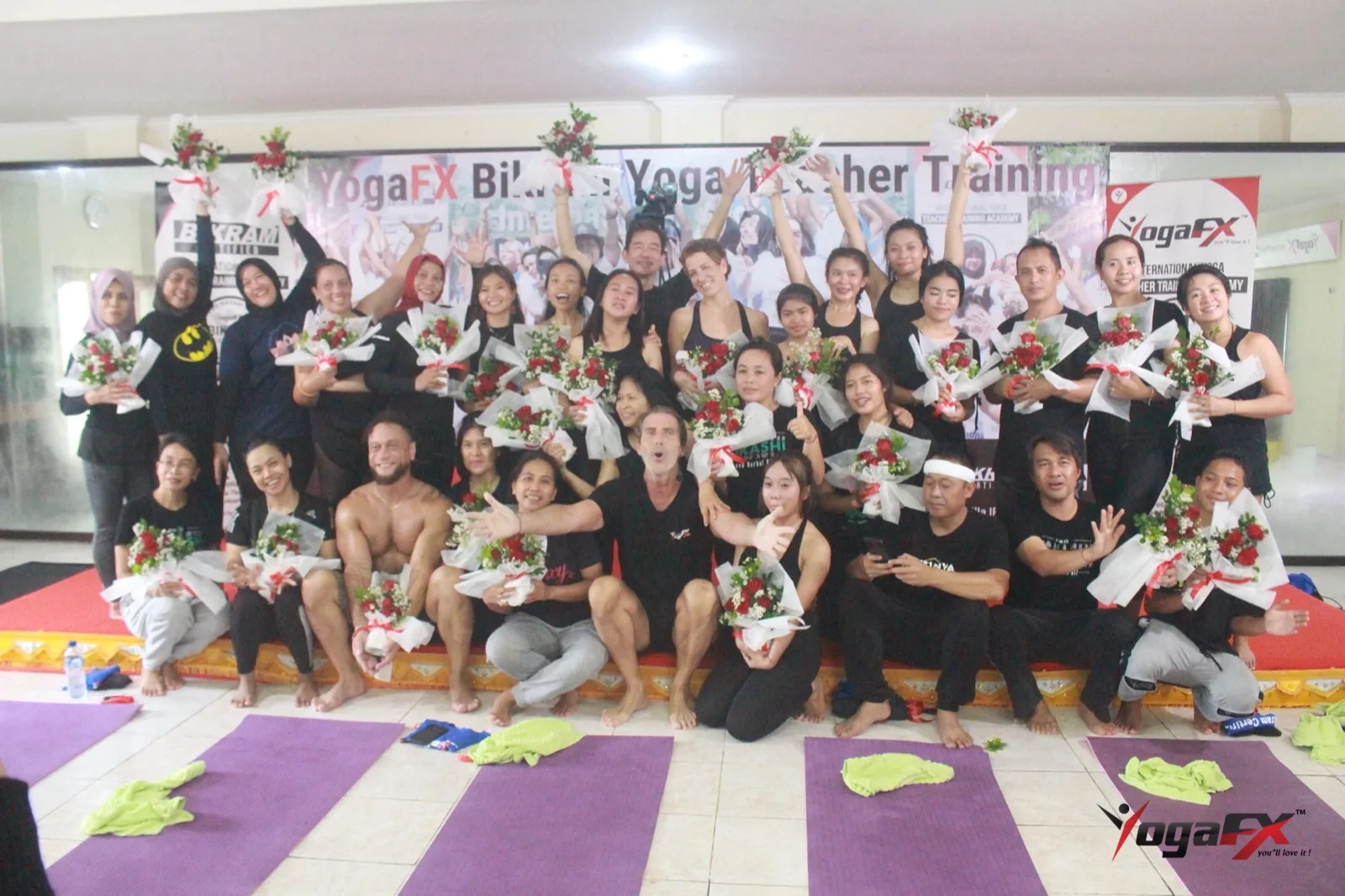
Since 2017, YogaFX has trained 1,500+ graduates from 80+ countries. If you ever want to teach, our hybrid yoga teacher training with Mr. Ian Terry covers the dialogue online and the postures in Bali.
FAQ
Does hot yoga lower blood pressure?
Not reliably. Yoga in general lowers blood pressure slightly in pooled trials, but an eight-week Bikram study found no significant change in resting blood pressure. Heat has not been shown to add a benefit, so please do not treat hot yoga as a blood pressure treatment.
Does hot yoga increase blood pressure?
Your hot yoga blood pressure shifts during a class. Effort raises it during the standing postures, and it falls as you recover. Heat and sweat can also lower it by reducing blood volume, so hydration and pacing matter. Your response depends on fitness, hydration and medicine, so track your own readings and ask your doctor.
Can you do hot yoga with high blood pressure?
Some people can, but ask your doctor first. The American Heart Association says exercise is safe for almost everyone, but the CDC warns that some blood pressure medicines raise heat risk. Tell your teacher before class, pace yourself and lie down if dizzy.
Can hot yoga cause low blood pressure?
It can feel that way. Sweating lowers body fluid and blood volume, which may cause lightheadedness, and standing up quickly can make it worse. Drink steadily, move slowly between postures and lie down if you feel faint. Repeated dizziness deserves a doctor's visit.
Is yoga good for high blood pressure?
Research suggests it can help modestly. A 2013 meta-analysis found drops of about 4 mmHg systolic and 3.6 mmHg diastolic, though every trial had unclear or high bias risk. Many people use yoga alongside medicine, diet and other exercise, as their doctor advises.
Still have questions? Ask Mr. Ian and the YogaFX team about hot yoga blood pressure on WhatsApp and we will answer personally. You can also try our Free 1-Day Guest Pass at the Seminyak studio and watch the room before you commit.