Hot yoga heart rate in a 26 and 2 class moves in waves. The standing series lifts most students into the moderate-to-vigorous zones, the floor series lets many of them settle back toward recovery, and Savasana resets the pulse between efforts. Your own numbers depend on your age, your fitness and how used to the heat you are.
Table of Contents
This guide follows that wave posture by posture. It uses the working zone classification from the YogaFX Guide to the method, plus the trials that actually measured heart rate in a heated room. We label what is measured and what is a studio estimate, so you can trust each number for what it is.
Hot Yoga Heart Rate in the 26 and 2: The Short Answer
A 26 and 2 class runs for 90 minutes in a room of about 40°C with 40% humidity. Over that time, your hot yoga heart rate does not sit at one level. It climbs through the demanding standing postures, drops during short rests and Savasana, and rises a little again in the backbends on the floor.
The best controlled number we have comes from a crossover trial in the International Journal of Exercise Science (Lambert et al., 2020). Sixteen experienced practitioners did a one-hour hot sequence twice, once at about 40°C (105°F) and once at 74°F. The mean heart rate was 113 bpm in the heat and 109 bpm at room temperature, and the authors found no significant difference between the two.
So what does that mean for you? Heat is not automatically doubling your workload. Even so, a class can feel harder in the heat, and that feeling is a good reason to watch your numbers closely. The rest of this guide shows you where in the class to look.
If you want the wider picture first, read our guides on whether hot yoga counts as a cardio workout and on hot yoga and your heart. Both pair well with this one, and the 26 and 2 method is the base for everything here.
Find Your Hot Yoga Heart Rate Zones Before Class
A zone is a band of beats per minute linked to an effort level. To use a hot yoga heart rate zone, you first need an estimate of your maximum heart rate. The Mayo Clinic exercise intensity page gives a simple formula: multiply your age by 0.7, then subtract that number from 208.
The same page describes moderate activity as 50% to about 70% of your maximum and vigorous activity as 70% to about 85%. It attributes those ranges to American Heart Association guidance. The formula is a population estimate, not a test, so treat the result as a starting line.
A worked example for a 50-year-old
Take a student aged 50. The estimated maximum is 208 minus 35, which gives 173 beats per minute. Most fitness watches split effort into five bands, so the table below applies that split to the same maximum.
| Zone | Share of estimated maximum | Beats per minute (age 50) | How it tends to feel |
|---|---|---|---|
| Zone 1 | 50 to 60% | 87 to 104 | Easy. You could talk in full sentences. |
| Zone 2 | 60 to 70% | 104 to 121 | Steady. Breath is controlled and even. |
| Zone 3 | 70 to 80% | 121 to 138 | Working. Short phrases only. |
| Zone 4 | 80 to 90% | 138 to 156 | Hard. You count the seconds left in the hold. |
| Zone 5 | 90 to 100% | 156 to 173 | Peak. Only a brief moment, if at all. |
Write the bands on a small card and keep it by your mat. You don't need a lab. A chest strap or a wrist monitor counts the beats, and the card does the interpreting. If you have a heart condition or take medicine that changes your pulse, your doctor may give you a different ceiling, and that number wins.
Hot Yoga Heart Rate Posture by Posture
No published study has logged heart rate for every one of the 26 postures. So a posture-by-posture map of hot yoga heart rate has to be a working estimate. The table below uses the zone classification in the YogaFX Guide, which groups the postures by how much muscle, balance and breath each one asks for. It describes a typical response, not a fixed zone for every student.
| Posture group | Postures in the group | Typical zone-style response | What drives the effort |
|---|---|---|---|
| Lower-body endurance | Utkatasana (Awkward) and Garudasana (Eagle) | Zone 2 to 3 style | Sustained thigh work, balance and compression |
| Single-leg holds | Standing Head-to-Knee and Standing Bow Pulling | Zone 3 style, short Zone 4 peaks | One-leg stability with large muscles working |
| Short whole-body effort | Tuladandasana (Balancing Stick) | Zone 3 to 4 style, brief | A burst of roughly 20 to 30 seconds |
| Wide-stance work | Triangle and the Standing Separate Leg series | Zone 3 style, Triangle can peak in Zone 4 | Strong lower body and trunk engagement |
| Recovery | Savasana, Wind-Removing Pose and the short rests | Zone 1 style | Muscular effort drops and breath slows |
| Floor backbends | Cobra, Locust, Full Locust, Bow, Fixed Firm and Camel | Zone 2 style, rising again | Back strength and breath demand return |
The standing series: where the effort builds
The standing series asks for the most from your heart. Big muscle groups work while you balance, breathe through your nose and stay in a heated room. As a result, this is where most students feel their pulse climb first.
Awkward pose is a good example. You sit back as if into a chair and hold, so the thighs burn long before the clock finishes. Eagle adds balance and compression on top of that. Together, they usually move a student out of the easy bands and into steady work.
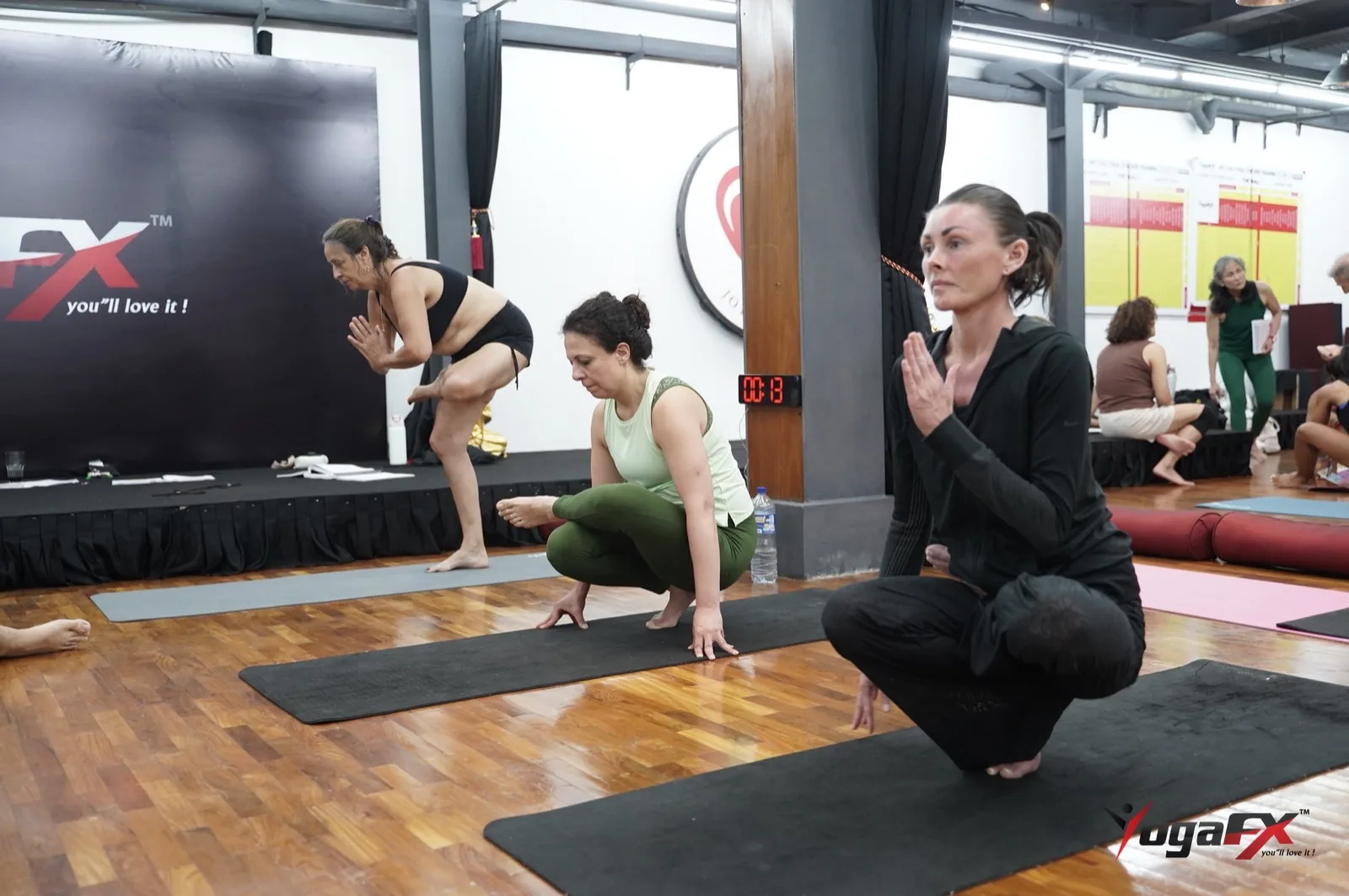
Hot yoga heart rate in these postures also depends on the day. Poor sleep, a late meal or a warmer room can all push the same pose into a higher zone. That's one reason to compare your numbers week to week instead of chasing one perfect reading.
Short peaks: the postures that can spike your pulse
Four postures can create short, sharp peaks for some students: Balancing Stick, Standing Bow Pulling, Triangle and Standing Head-to-Knee. Each one combines balance, strength and concentration, and a small loss of focus costs you the pose. Peaks in these postures can last seconds, not minutes.
Zone 5 deserves a careful note. The class is not built as sustained maximal training. A very brief peak may happen for a fit student on a hot day, but it is an individual response, not a feature of any single posture. If your hot yoga heart rate sits near your maximum for long stretches, ease off.
- Shorten the hold. Come out early and breathe, then go back in.
- Keep the nasal breath. If you can no longer breathe through your nose, you are working too hard.
- Rest on purpose. The short pauses are part of the design, so use them to let your pulse fall.
- Leave the pose if you feel dizzy. Lower your body and lie down on your back.
Savasana and the floor series: recovery with a few surges
Savasana is where recovery starts. Muscular effort drops, breathing becomes controlled and the heart gets a chance to slow.
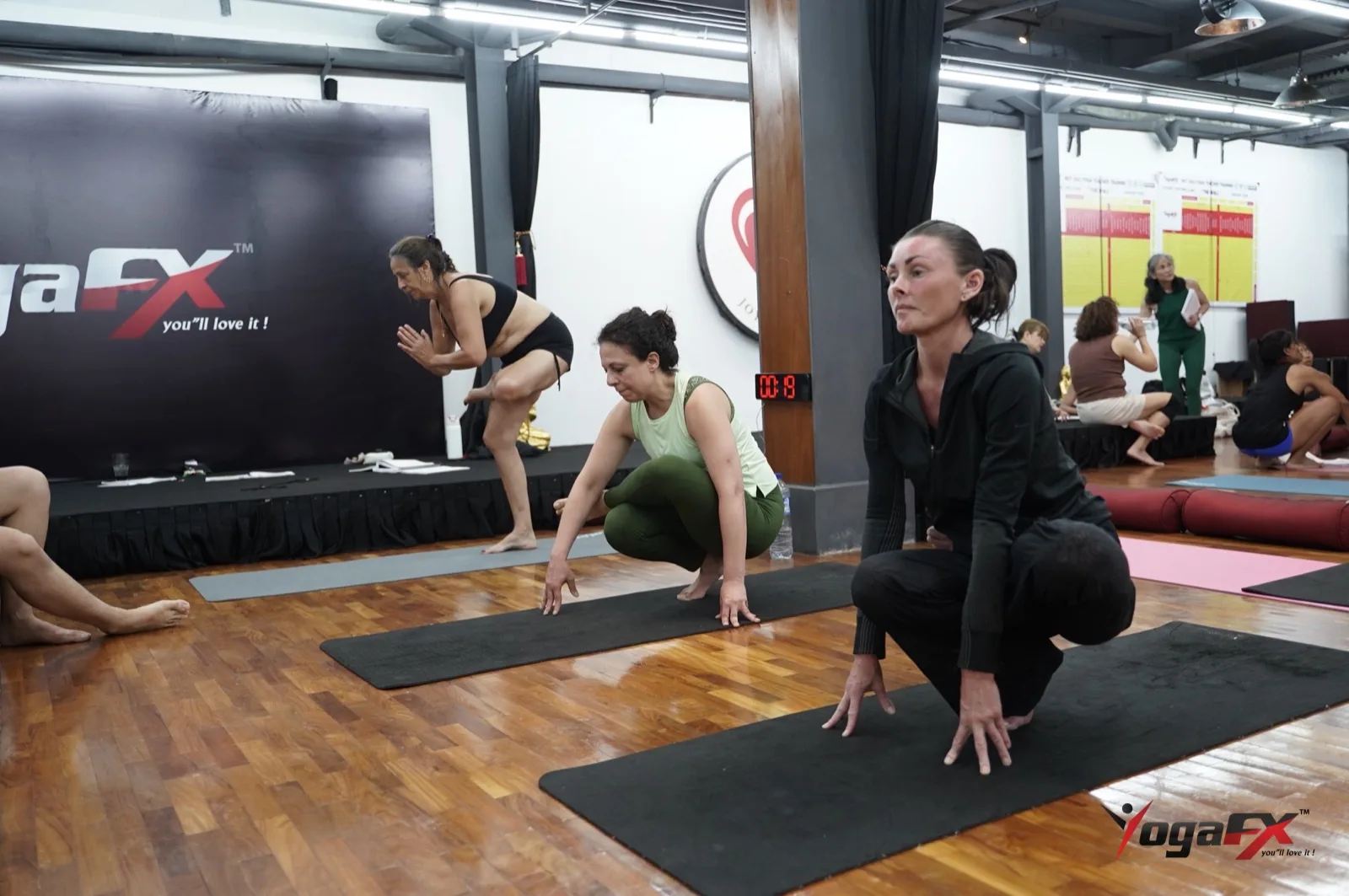
The floor series is lower in demand overall, but it is not entirely easy. Cobra, Locust, Bow and Camel can lift your breathing and pulse again, which is why the class feels like a cycle of effort, recovery and renewed effort. So don't expect a straight line down once you lie on the mat.
What the Trials Measured About Hot Yoga Heart Rate
Studies give us the edges of the hot yoga heart rate picture. Three are worth knowing, and each answers a different question. We opened the first two to confirm the numbers below. The third is cited by name because the journal page could not be opened for a link check.
The heated-room crossover trial
The Lambert et al. study matters because each person served as their own control. Sixteen experienced practitioners (14 women and 2 men, average age 40) completed the sequence in both rooms. The paper reports that mean oxygen use, peak oxygen use, heart rate and calories did not differ between the two conditions.
There are limits. The group was small and all were experienced. The study also did not follow anyone over months. So it tells us about one hot hour in practised people, not about beginners or about heat safety in general.
The four-week training trial
A second trial asked what happens over time. In the International Journal of Yoga (Bourbeau et al., 2021), 22 participants either did hot yoga or normal-temperature yoga three times a week for four weeks, which makes 12 sessions. The authors report that maximal aerobic fitness increased in the hot yoga group only.
That is a modest finding from a small trial, so we don't oversell it. It suggests that regular practice matters, but one trial cannot prove how any single student will respond.
The calorie and intensity study
A 2014 University of Wisconsin-La Crosse study (Porcari et al.) measured a 90-minute class and reported about 333 kcal for women and 460 kcal for men, at roughly 80% of maximum heart rate. We cite it by name only, with no link, because the page could not be opened for checking. For more detail on how the studies fit together, see the cardio guide linked above.
Why Heat Changes Your Hot Yoga Heart Rate More Than Your Workload
You might wonder why a hot room makes your heart race if the trial found no significant gap. It's a fair question. Part of the answer is that your body has two jobs at once: move through the postures and keep its temperature under control. Cooling takes blood toward the skin, so a heated class can show a higher pulse for the same effort.
The Lambert trial did not test that mechanism, so we offer it as a sensible reading, not a proven result. What the data does show is that the average difference was small, 113 against 109 beats per minute. That means the number on your watch is a signal to read, not a score to win.
Heat adaptation matters too. At YogaFX we tell new students to expect 3 to 5 regular classes before the room feels easier. Your first weeks may show a faster pulse and quicker tiredness, and that usually eases as you adapt.
How to Read Your Hot Yoga Heart Rate Watch
Any hot yoga heart rate reading is only as good as the device. Sweat, bending wrists and a loose strap can all distort a wrist sensor. So take the number as a trend, then check it at a calm moment instead of in the middle of a hold.
- Use a chest strap if you can. A snug strap usually holds up better than a wrist sensor in a wet room.
- Check at the rests. Look at your pulse right after the standing series and again after the first Savasana.
- Compare the same moments each week. Because the sequence never changes, the same posture gives you a fair test.
- Trust your body over the screen. If the number looks wild and you feel fine, trust the number less. If you feel unwell, stop.
Over several weeks, watch three things: how fast your pulse settles in Savasana, whether a posture feels easier than it did two weeks ago, and how you feel the next morning. Those three signs tell you more than one peak reading. If you are new to the heat, our guide to your first 26 and 2 class explains what to expect step by step.
Pacing Your Hot Yoga Heart Rate Across the Class
Pacing is where your hot yoga heart rate zones become useful. The goal isn't to hit a number. It's to stay in a range where your breath is controlled and you can finish the class feeling clear-headed.
| Where you are in class | A reasonable aim | What to do if you run high |
|---|---|---|
| First standing postures | Zone 2 to 3 | Shorten the hold and breathe through the nose |
| Peak standing postures | Zone 3, brief Zone 4 | Rest between sets and lower the effort |
| Savasana and rests | Back toward Zone 1 | Lie still and let the breath lengthen |
| Floor backbends | Zone 2 to 3 | Come out early if breathing becomes short |
If your pulse does not come down in Savasana, that is a signal worth respecting. Stay on your back, keep your mouth closed and breathe calmly through your nose. If it still will not settle, leave the room and speak with a healthcare professional.
For a version you can use at home, our online course hub has a home-practice version of these zones. It adapts the same ideas to a warm living room, where nobody is watching but you.
Who Should Check With a Doctor First
Heart rate zones are a useful tool for healthy adults. They are not a replacement for medical advice, and we do not diagnose or treat anything. Speak with your doctor before a heated class if any of the following applies to you:
- Heart or blood pressure conditions. This includes a rhythm problem, high blood pressure or a past heart event.
- Medicine that changes your pulse or sweating. Your doctor can tell you what is safe in heat.
- Pregnancy, diabetes or any other medical concern. Your doctor may set a lower ceiling than the zones in this guide.
Stop and seek help if you feel chest pain or pressure, fainting, a racing heartbeat that does not settle, or shortness of breath that continues at rest. This article is general information. Consult a healthcare professional before you start or change any exercise programme, especially in heat.
What Students Say After the Heat and the Effort
Numbers do not tell the whole story of hot yoga heart rate. Here is how two trainees described the experience in our YouTube graduation reviews, in their own words.
Musya, in a 2023 YouTube review after her 200-hour training, said: "this is the best training that I've ever learned." She added that the teaching came from the heart and was not about money.
Another trainee, in a 2023 YouTube review (translated from Indonesian), said: "This knowledge is very useful for me, especially since I am already over 50." That comment is a good reminder that the zones above are meant for every age, with the numbers scaled to you.
Learn the 26 and 2 Class With Mr. Ian Terry
Our lead teacher, Mr. Ian Terry, is E-RYT 500 with 12,000+ teaching hours. He spent five years (2014-2019) training alongside the founder of the Bikram Hot 26&2 method, and since 2017 he has trained 1,500+ teachers from 80+ countries at YogaFX in Bali.
If you want to understand the whole method, start with the postures, the dialogue and the heat. Learn the sequence first, then add a monitor once you feel settled, so the numbers have a context.
FAQ: Hot Yoga Heart Rate Questions
What heart rate zone is hot yoga?
Hot yoga heart rate in a 26 and 2 class sits mostly in the moderate to vigorous range, roughly 50% to 85% of your maximum. The standing series pushes higher, with brief peaks in demanding postures. Savasana and much of the floor series bring you back toward recovery. Your exact zone depends on age, fitness and heat adaptation.
Which hot yoga postures raise heart rate the most?
In the YogaFX Guide classification, the standing series pushes hot yoga heart rate highest. Awkward pose, Eagle, Standing Head-to-Knee, Standing Bow Pulling, Balancing Stick and Triangle are the main drivers. Balancing Stick and Triangle can create short peaks. These are working estimates, not posture-by-posture measurements, so check your own numbers.
Why is my heart rate so high during hot yoga?
Heat, effort and being new to the room can all raise your hot yoga heart rate. The body also moves blood toward the skin to cool you. Beginners often see higher numbers in their first few classes. Slow down, rest between sets and breathe through your nose. If your heart races and will not settle, stop and seek medical advice.
Can hot yoga cause heart palpitations?
Some people notice a pounding or fluttering pulse in a hot room, especially when dehydrated or new to the heat. We cannot diagnose it. Stop, lie down, breathe slowly and leave the room if it continues. Speak with a doctor before returning, and mention it if you have any heart or blood pressure concerns.
How should I wear a heart rate monitor in hot yoga?
A chest strap usually reads more steadily than a wrist sensor, because sweat and bending wrists can disturb optical readings. Wear it snug and moisten the contacts if the maker advises it. Check your pulse at rests, not mid-hold, and treat the numbers as a trend across several classes, not a verdict.