Yoga for footballers works best when it trains what the game keeps asking for: a long, healthy hamstring and a steady base on one leg. In the 26 and 2 sequence, Standing Head to Knee, Balancing Stick and Standing Bow Pulling train both, one leg at a time. Use them on rest days, not on match eve.
Table of Contents
Football is a one-leg sport. Every pass, shot and sprint starts from a single foot on the ground. So the postures in this guide to yoga for footballers were chosen for one reason. Each one asks you to stand on one leg while the other leg works, which is what your body does for 90 minutes on a Saturday.
Yoga for Footballers: The Short Answer
Yes, yoga for footballers is worth a try, with two conditions. First, pick postures that match the work of the game. Second, place them in your week where they help recovery instead of stealing energy from training.
The 26 and 2 method fits the first condition well. It is a fixed set of 26 postures and 2 breathing exercises, taught in the same order in every class. Its standing series leans on single-leg balance and long leg stretches. So a footballer meets the demands of the sport within a few minutes of practice.
- Hamstrings. Standing Head to Knee and Standing Separate Leg Stretching lengthen the back of the thigh, with no partner or bench needed.
- Single-leg balance. Balancing Stick and Standing Bow Pulling make the foot, ankle and hip work to hold you steady.
- Breathing. Standing Deep Breathing opens every class and gives you a way to bring your heart rate down after a hard session.
Do you want a day-by-day plan built around evening training and a weekend match? The companion guide on a weekly yoga plan around evening training and weekend matches lays one out. This guide goes the other way. It takes the postures one by one and shows what each one asks of a football body.
Why Hamstrings and Standing Legs Matter in Football
Football loads the back of the thigh every time you sprint, reach for a ball or strike one. The professional game shows how much that adds up, and it is why yoga for footballers starts with the hamstring.
The UEFA Elite Club Injury Study followed 54 teams from 20 European countries across 21 seasons. Hamstring injuries made up 19% of all injuries. Their share rose from 12% in the first season to 24% in the most recent one, and their share of injury absence days doubled from 10% to 20% (Ekstrand et al., British Journal of Sports Medicine, 2023).
Those players have medical teams. Amateur and semi-pro players carry the same muscles into a match with less warm-up time and more hours in a chair. The Cleveland Clinic lists low flexibility, skipping stretches or a warm-up, and ramping up training too quickly as risk factors for a hamstring injury. Its advice is to raise your activity level gradually.
Yoga does not replace the strength work your coach or physio sets. It adds range, balance and breath control on top of it. Think of it as one more tool in the bag, and not the main one.
Three Standing Postures for Yoga for Footballers, One Leg at a Time
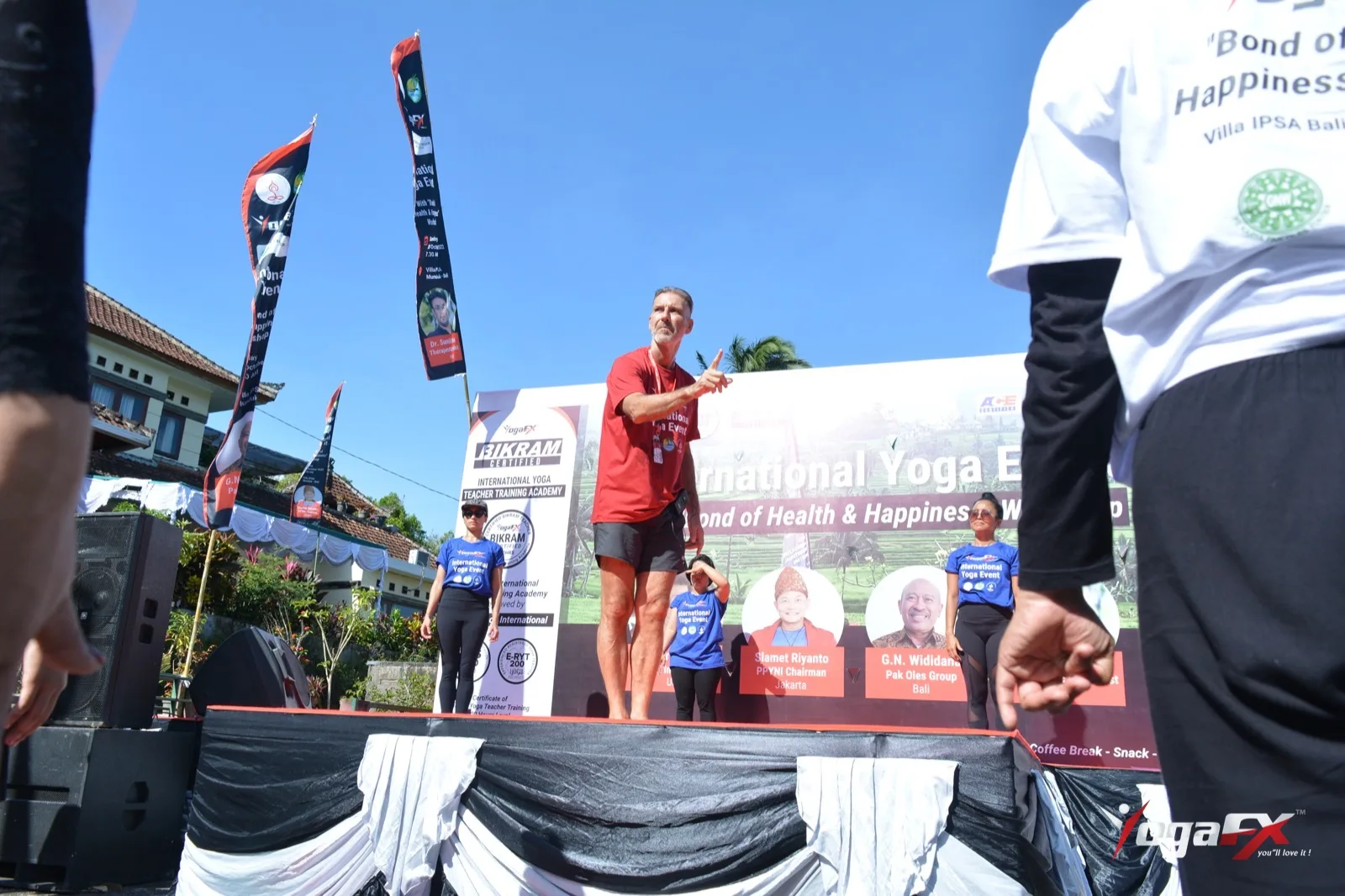
These three sit next to each other in the standing series of a 26 and 2 class. Each one is done twice. Mr. Ian Terry, an E-RYT 500 teacher with more than 12,000 teaching hours, teaches them by voice through the dialogue, the word-for-word script that guides every class. Because the order never changes, you don't guess what comes next. You notice your legs instead.
Balancing Stick: the posture for your standing leg
You stand on one leg, reach both arms forward and tip your body until your chest and your back leg sit parallel to the floor. The standing hamstring and buttock work hard to hold the shape. Meanwhile the back leg stays straight and active.
Many footballers wobble here at first. That's normal. Your standing foot does the same job it does when you strike a ball, so most players feel at home with it after a few tries.
- Soften the standing knee. A small bend protects the back of the knee and moves the work into the hamstring.
- Fix your eyes on one spot. A steady gaze calms the wobble faster than any muscle tip.
- Keep the back leg lower if you need to. A shallow Balancing Stick still trains the standing leg.
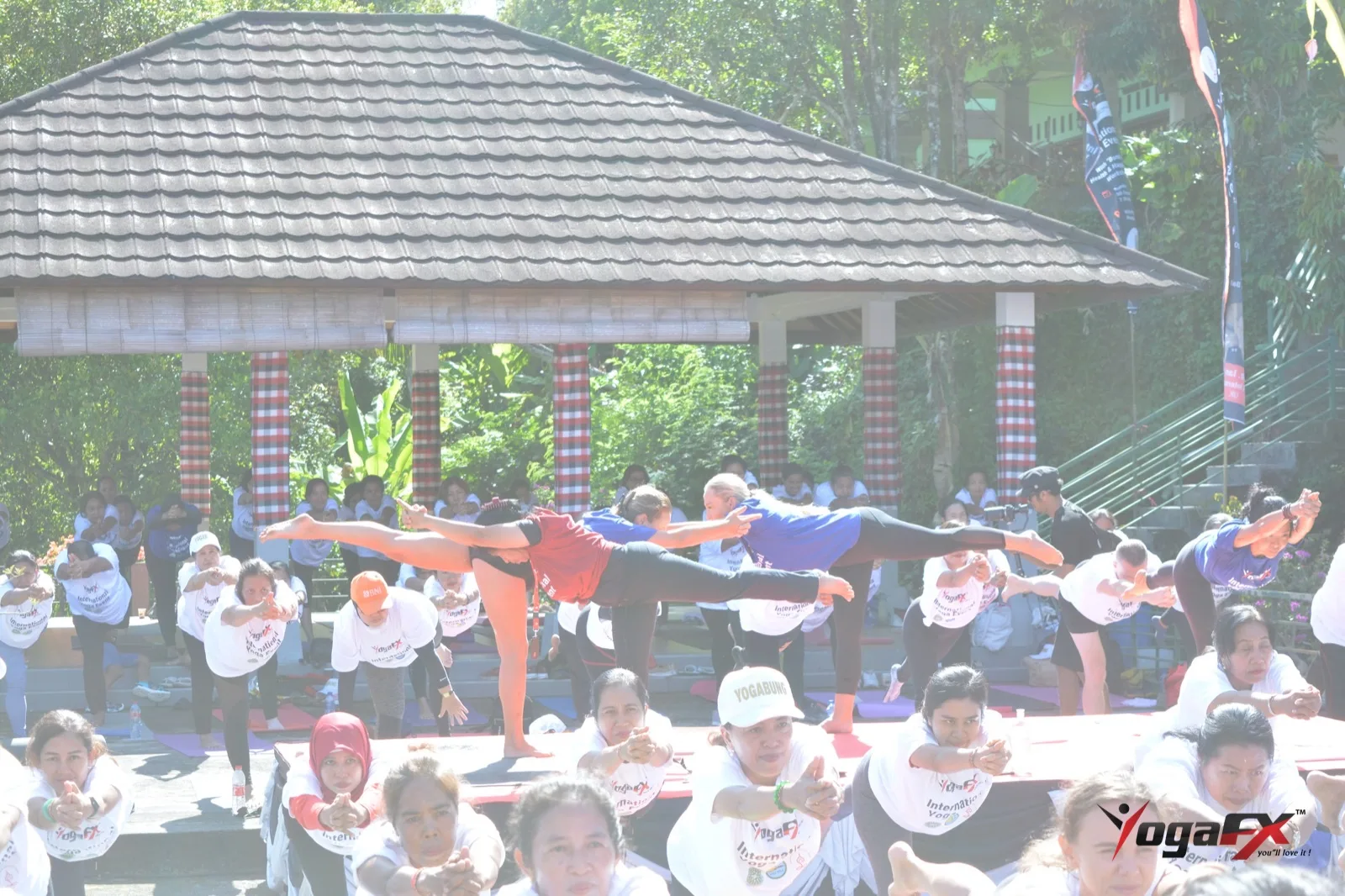
Standing Bow Pulling Pose: front of the thigh meets the hamstring
Here you stand on one leg, grip the other foot behind you and kick it back into your hand. Then you fold forward as the free leg rises. The front of the raised thigh and the hip stretch, while the standing hamstring holds you up.
Players who kick with the same leg all season often find one side much tighter. This posture shows the difference within one set. Treat that gap as information, not a problem, and give the tight side a little more time.
Standing Head to Knee: a hamstring stretch with a balance test
Stand on one leg, lift the other and grip the foot with both hands. Press the raised leg straight, then bring your forehead toward the knee. The standing leg stays locked. Gravity does the stretching, so no one needs to push you.
Bend the raised knee as much as you need. The stretch should feel like a long pull behind the thigh, never a sharp pinch. Many students use the first set to find their edge and the second to work a little deeper.
Posture Map: What Each Posture Asks of a Football Body
The table below pairs six standing postures with the football work they match. Use it to plan yoga for footballers as two or three postures in a short home session.
| Posture | Football link | What you feel | Easier option |
|---|---|---|---|
| Standing Head to Knee | Hamstring of the raised leg and stability of the standing leg | A long pull behind the raised thigh | Bend the raised knee and hold the shin |
| Standing Bow Pulling | Hip flexor and thigh of the kicking leg, plus one-leg balance | Stretch across the front of the raised thigh | Keep the raised foot lower and fold less |
| Balancing Stick | Hamstring and buttock strength of the standing leg | Burning at the back of the standing leg | Bend the standing knee, lift the back leg less |
| Standing Separate Leg Stretching | Both hamstrings and the inner thighs | A steady pull down the back of both legs | Bend both knees and rest hands on the shins |
| Triangle | Groin, hip range and thigh strength for lunging and turning | Deep work in the front thigh, long stretch in the back leg | Shorten the stance |
| Awkward Pose | Thigh endurance and knee and ankle control | Burning thighs | Sit higher and keep the heels down |
Notice how many rows say "bend the knee". That is deliberate. Footballers are strong and competitive, which helps on the pitch and hurts on the mat. A bent knee moves the stretch into the hamstring muscle and away from the lower back, and it keeps you on the right side of discomfort.
For a wider look at tight hamstrings and hips in men who start this practice, see why tight men find hot yoga harder.
Hot Yoga for Football Players: Is the Heat Worth It?
Yoga for footballers does not need a heated room, but hot yoga for football players is popular, and many men love how loose their legs feel in a heated room. A full 26 and 2 class runs for 90 minutes at about 40 degrees Celsius and 40% humidity. That is a hard workout in its own right, so treat it like a training session.
- Quiet weeks. A week with no match is the best time for one full heated class.
- Off-season and pre-season. Try two classes a week while your legs are fresh.
- Match week. Skip the heat the day before a game and use short, unheated floor sessions instead.
- Hydration. Drink steadily through the day, not one big bottle before class.
After a match, go easy. The guide on yoga for athletes recovery covers the gentle floor series that suits the morning after. Runners who share a pitch with footballers will find a similar plan in hot yoga for runners.
A health note: if you have a heart condition, high blood pressure or a current injury, or you take medication that affects your heart rate or sweating, check with your doctor before any heated class. This article is general information, so please consult a healthcare professional or your club physio about your own situation.
What the Research Says About Yoga for Footballers
What the studies found
Here's the honest position. As far as we know, no trial has tested yoga for footballers as a way to prevent hamstring injuries. So nobody can promise that yoga keeps your hamstrings safe, and you shouldn't trust anyone who does. What we can do is look at what the wider research says about injury prevention and fit yoga around it.
A 2021 systematic review and meta-analysis of 13 studies found that exercise programmes had a positive effect on hamstring injury rates. The results were better when players kept up with the programme, with more than half of sessions completed (Ripley et al., International Journal of Environmental Research and Public Health, 2021).
The best-known example is the Nordic hamstring exercise. The UEFA authors write that it may cut hamstring injuries sharply and note that it has not been widely adopted in European men's professional football. The 2021 review adds that the size of that benefit has been questioned. So treat strength work as the better-studied tool, and treat yoga as a partner for range and balance.
What it means for your week
The ankle matters too. Harvard Health reports that ankle sprains happen as often as 25,000 times a day in the United States. Its advice is to strengthen the calf and the side-movement muscles around the ankle and to stretch the calf regularly. Single-leg postures such as Balancing Stick put those muscles to work, but they add to that advice and do not replace it.
- What we can say: yoga builds hamstring range, one-leg balance and calm breathing in short sessions.
- What we cannot say: that yoga prevents hamstring injuries or ankle sprains on its own.
- What to do: keep the strength and rehab work your coach or physio gives you, and add yoga around it.
Common Mistakes in Yoga for Footballers
Competitive players bring their habits into the room. These are the slips we see most often.
- Locking the knee to touch the toes. The stretch moves into the lower back. Bend the knee instead.
- Comparing yourself with the next mat. Your range is your own, and it changes from day to day.
- Holding your breath in Balancing Stick. A held breath makes the wobble worse. Keep breathing through the nose.
- Stretching a fresh strain. A sharp or bruised muscle needs a physio, not a deeper stretch.
- Doing one long session and then nothing. Two or three short sessions a week beat one heroic one.
What YogaFX Students Say
Some players who try yoga for footballers end up wanting to learn the method properly. Here is what three trainees said in video reviews after finishing the YogaFX teacher training in Bali.
"...those three weeks were the most important three weeks of my life."
Konrad, YouTube review, 2023 (watch the review)
"It was more than just a certification. This was a true quest to find a little bit about myself and I loved every bit."
Angela, YouTube review, 2024
"It was amazing to live this two weeks with you. I feel so full of joy and happiness."
Barbara, YouTube review, 2024 (watch the review)
These are personal stories, not promises. In total, YogaFX students have left 150 Google reviews, 50 Yoga Alliance reviews and 357 YouTube video testimonials.
From Home Practice to the Teacher's Mat
A few players enjoy yoga for footballers so much that they want to understand it properly, or to teach their own team. That's what the Bikram Hot 26&2 Yoga Teacher Training MasterClass is for. It is a six-day hybrid course: you study the pre-course online, then join the intensive in Bali. The next intensive runs from Sunday 24 January to Friday 29 January 2027 at Soham Wellness Center in Seminyak.
Graduates earn the Yoga Alliance RYT 200 and the Bikram Hot 26&2 200-Hour International Yoga Certification. The Early Bird price is US$1,899, against a normal price of US$1,999, and payment plans start from US$250 a month with no interest. You can read the programme and dates on the teacher training page.
Mr. Ian Terry leads the programme. He trained for five years, from 2014 to 2019, with the founder of the method, and he is a Master Trainer for the Republic of Indonesia Yogasana Sports Federation. Since founding YogaFX in 2017 he has guided more than 1,500 graduates from over 80 countries. You can meet Mr. Ian Terry before you decide.
FAQ: Yoga for Footballers, Answered
Which yoga poses are best for footballers?
Start with three single-leg postures: Standing Head to Knee, Balancing Stick and Standing Bow Pulling. They lengthen the hamstrings and hip flexors while they train balance. Add Standing Separate Leg Stretching for both hamstrings and Awkward Pose for thigh endurance. Keep every posture at about half effort until you know how your legs respond.
Does yoga help football players with tight hamstrings?
It can help you gain hamstring range, especially in postures such as Standing Head to Knee, where gravity does the stretching. Gains come from regular practice, not one long session. Yoga has not been shown to prevent hamstring injuries by itself, so keep any strength programme your coach or physio gives you.
Is yoga good for football kickers?
Kickers use one leg to strike and the other to balance, so single-leg postures fit well. Standing Bow Pulling opens the front of the kicking thigh and hip, while Balancing Stick trains the standing leg. Compare both sides, because most players find either the kicking side or the standing side clearly tighter.
What yoga stretches should footballers do before a match?
Keep it light and short. Standing Deep Breathing, a gentle Awkward Pose and a brief balance on each leg wake the body up without tiring it. Save long, deep hamstring holds for rest days, because they can leave legs feeling flat. Then do your normal team warm-up and running drills.
Can beginners do yoga for football players?
Yes. Every 26 and 2 posture has an easier version, such as bending the knee in Standing Head to Knee or lowering the back leg in Balancing Stick. Start with one or two short home sessions a week, avoid the heated room at first, and ask your doctor first if you have an injury or a heart condition.
Still have questions? Message Mr. Ian and the YogaFX team on WhatsApp and we will answer them personally, whatever position you play.