Yoga championship postures are the set shapes athletes hold in front of judges at events like the 2026 World Yogasana Championship in Ahmedabad. About half of them share a body position with the 26 and 2: standing leg balances, backbends, one twist and floor work. Hand balances and partner routines have no match in the class.
Table of Contents
Mr. Ian Terry, E-RYT 500, is a Master Trainer with the Republic of Indonesia Yogasana Sports Federation. He has taught more than 12,000 hours. So we wrote this guide from the hot room and the competition side at once. It matches each event at the 2026 yoga championship to the 26 and 2, and it says plainly where the class stops.
What a Yoga Championship Asks of an Athlete
The first World Yogasana Championship ran from 4 to 8 June 2026 in Ahmedabad. According to the Tribune India report, 522 athletes from 79 countries took part, and India won 114 medals, 102 of them gold. That gives us the clearest picture yet of what a modern yoga championship looks like.
How a Yoga Championship Is Judged
Competitions in this sport are generally split into three formats: traditional, artistic and rhythmic, as the Olympics.com guide to yogasana rules explains. Judges score difficulty, balance, control, flexibility and endurance. Postures fall into four body positions: standing, sitting, supine and prone.
- Traditional. Athletes hold postures for 15 or 30 seconds, depending on the asana.
- Artistic. Athletes perform for three minutes to music, using 10 asanas from a set list.
- Rhythmic. Athletes hold each posture for 5 to 7 seconds, and smooth transitions earn points.
Hold times and rules differ between federations. So always read the rulebook for your own yoga championship. For one federation's six-group system, see our guide to competitive yoga and the 26 and 2. For who writes these rules, read about the international yoga sports federation.
If you want the longer story of how the sport grew from contests in Calcutta to a world stage, this timeline of how the sport grew covers it.
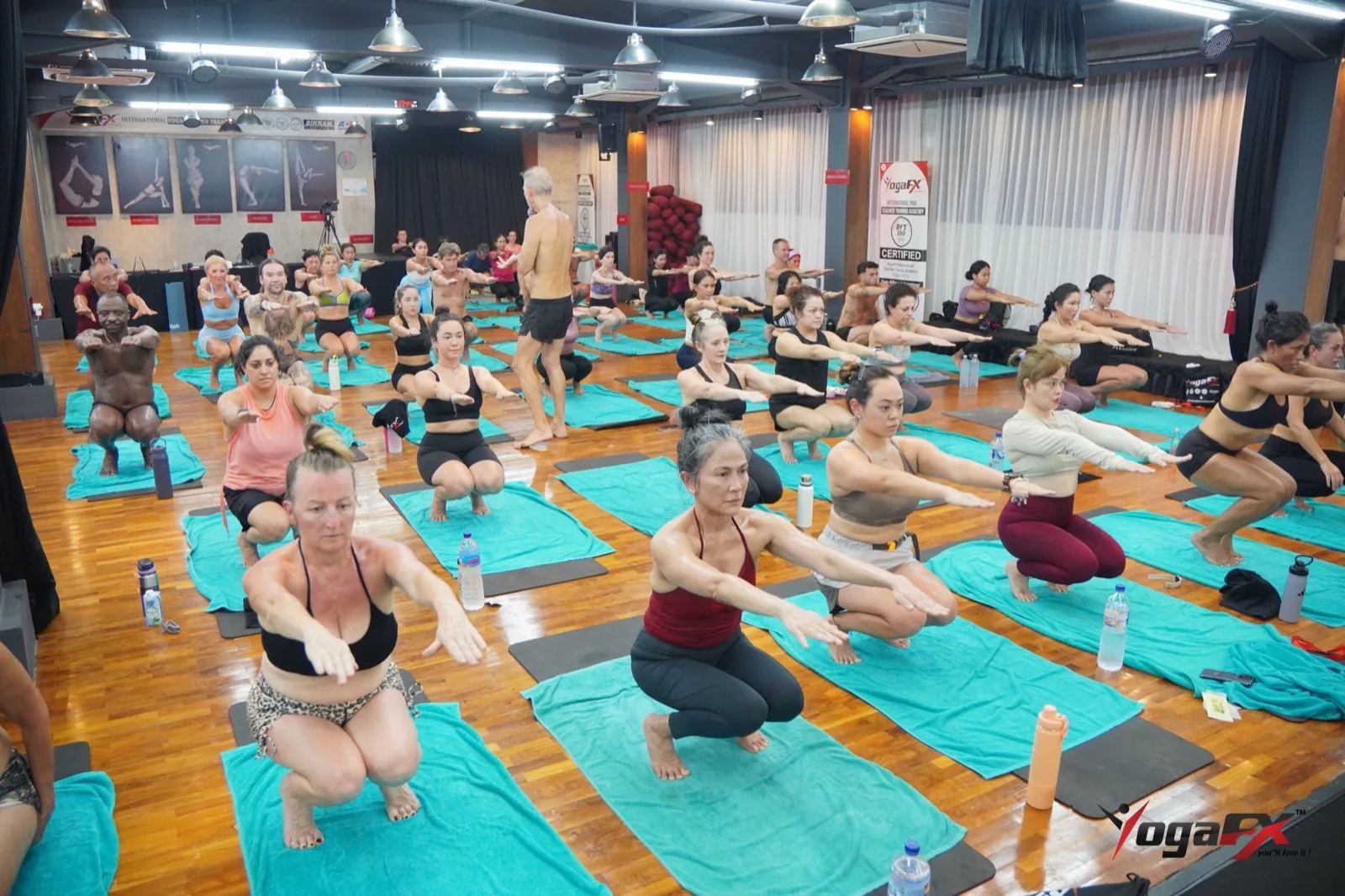
Yoga Championship Postures by Event, Matched to the 26 and 2
We did not find the official posture list for the 2026 event, so we matched by body position, not by rulebook. For each event named in the results, the table shows which 26 and 2 postures share its shape. It also shows what the class does not give you.
| Event in the 2026 results | Body position | 26 and 2 postures with a similar shape | What the class does not give you |
|---|---|---|---|
| Leg Balance Individual | Standing on one leg | Standing Head to Knee, Standing Bow Pulling, Balancing Stick, Eagle, Tree, Toe Stand | Competition holds and the harder balance shapes on the event lists |
| Back Bend Individual | Spine arching back | Cobra, Locust, Full Locust, Bow, Camel, Rabbit | Extra range and coach-led backbend conditioning |
| Twisting Body Individual | Rotation of the spine | Spine Twisting | Other twist shapes, because the class teaches only one full twist |
| Supine Individual | Lying on the back | Wind Removing, Sit-up, Fixed Firm | Supine shapes held for a score, not moved through |
| Hand Balance Individual | Weight on the hands | None in the sequence | All of it. The sequence has no arm balances |
| Artistic Pair | Choreographed with a partner | None in the sequence | Partner work, music and choreography |
Look at the last two rows, because they matter most. A student who only practises the sequence is not ready for hand balances or pair routines. We say that plainly, because it matters for anyone planning to enter an event.
Leg Balance: The Strongest Match in the Standing Series
Leg balance is the yoga championship event where the 26 and 2 helps most. The standing series asks you to stand on one leg while the rest of the body does something hard. Every posture comes twice, so you get a second try right away, and that repetition builds a standard.
- Standing Head to Knee. A straight standing leg, a locked knee and a long spine. Hamstring length decides how far you get.
- Standing Bow Pulling. Balance and a backbend in one shape. It links the leg balance and back bend events.
- Balancing Stick. The body forms a long horizontal line over one leg. It rewards a quiet core.
- Eagle. Wrapped arms and legs on a bent standing leg. Eyes stay fixed on one point.
- Tree and Toe Stand. Narrow bases that punish a wandering mind.
What a judge sees in a leg balance
- A still standing leg, with no wobble at the knee.
- A fixed gaze, because wandering eyes mean a wandering body.
- A quiet torso while the free leg or arms do the work.
- A steady breath, because calm breathing signals control.
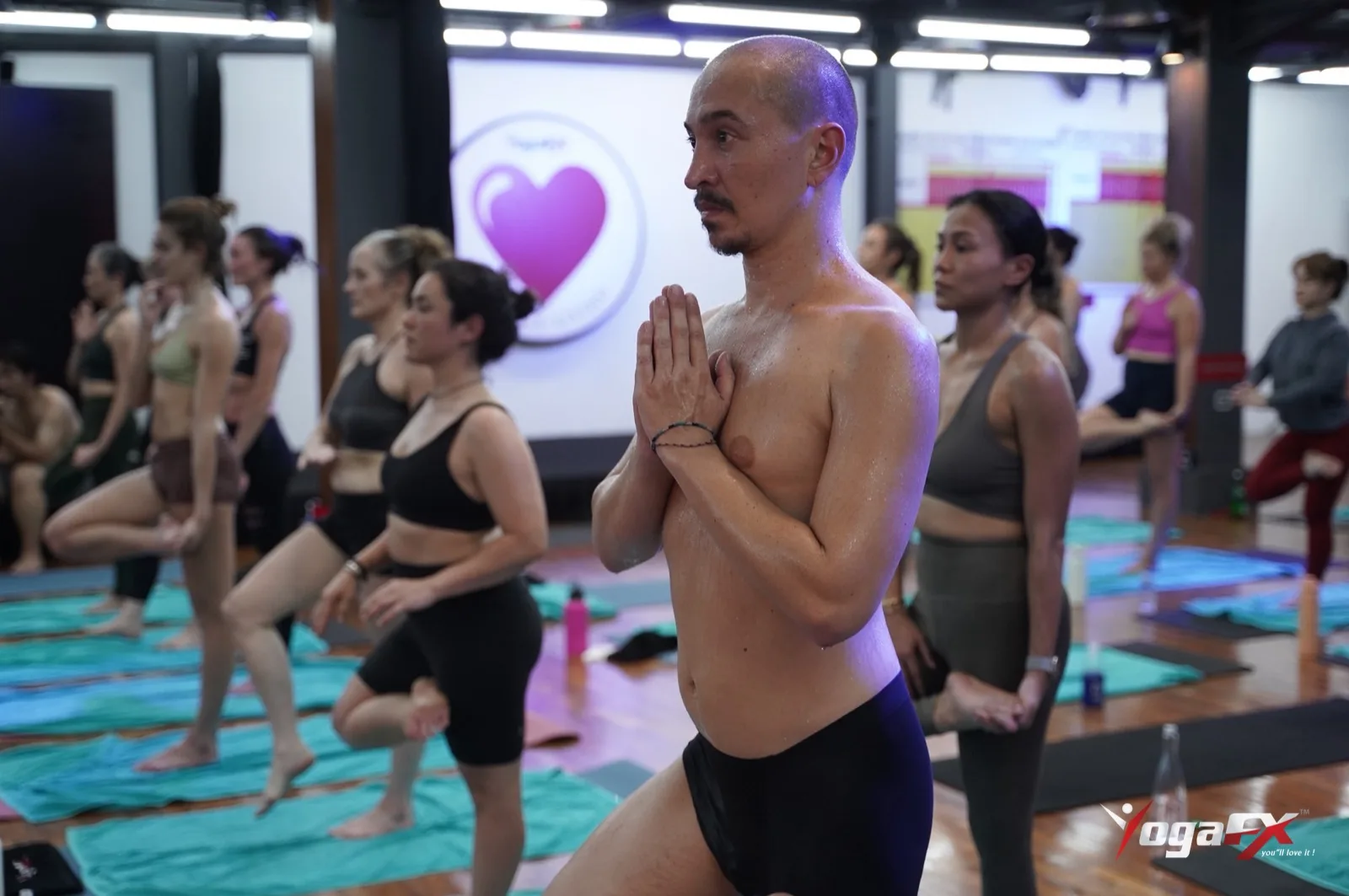
The class also trains something a scoreboard cannot show, for example calm under pressure. At about 40°C you learn to stay calm while your legs shake. That calm is what a judge reads as control. For the full order of these postures, see our guide to the 26 and 2 yoga sequence.
Back Bend, Twisting Body and Supine: What the Floor Series Offers
Back bends
For a yoga championship back bend, the floor series is the best match. It is built around backbends. Cobra, Locust, Full Locust and Bow come back to back, then Camel and Rabbit follow later in the class. A backbend that looks easy in a photo is hard to hold with a calm face. Class teaches exactly that: you lift, hold, release and repeat.
Still, the risk is real. Deep backbends held for a score are a common way athletes strain the lower back, and the NCCIH notes that sprains and strains are the most common yoga injuries. Good coaches build range slowly and stop at pain, not at the edge of the mat.
Twisting body
The sequence teaches one full twist, Spine Twisting, and it closes the floor series before the final breathing exercise. The twist starts at the base of the spine, and the hips stay level. An athlete who wants the twisting body event would need more twist shapes than the class offers.
Supine postures
Wind Removing, Sit-up and Fixed Firm all start or finish lying on the back. So they share a body position with the supine event. In class you move through them on a set clock. In competition you would hold a chosen shape for a score, which is a different skill.
Hand Balance and Pair Events: Where the 26 and 2 Stops
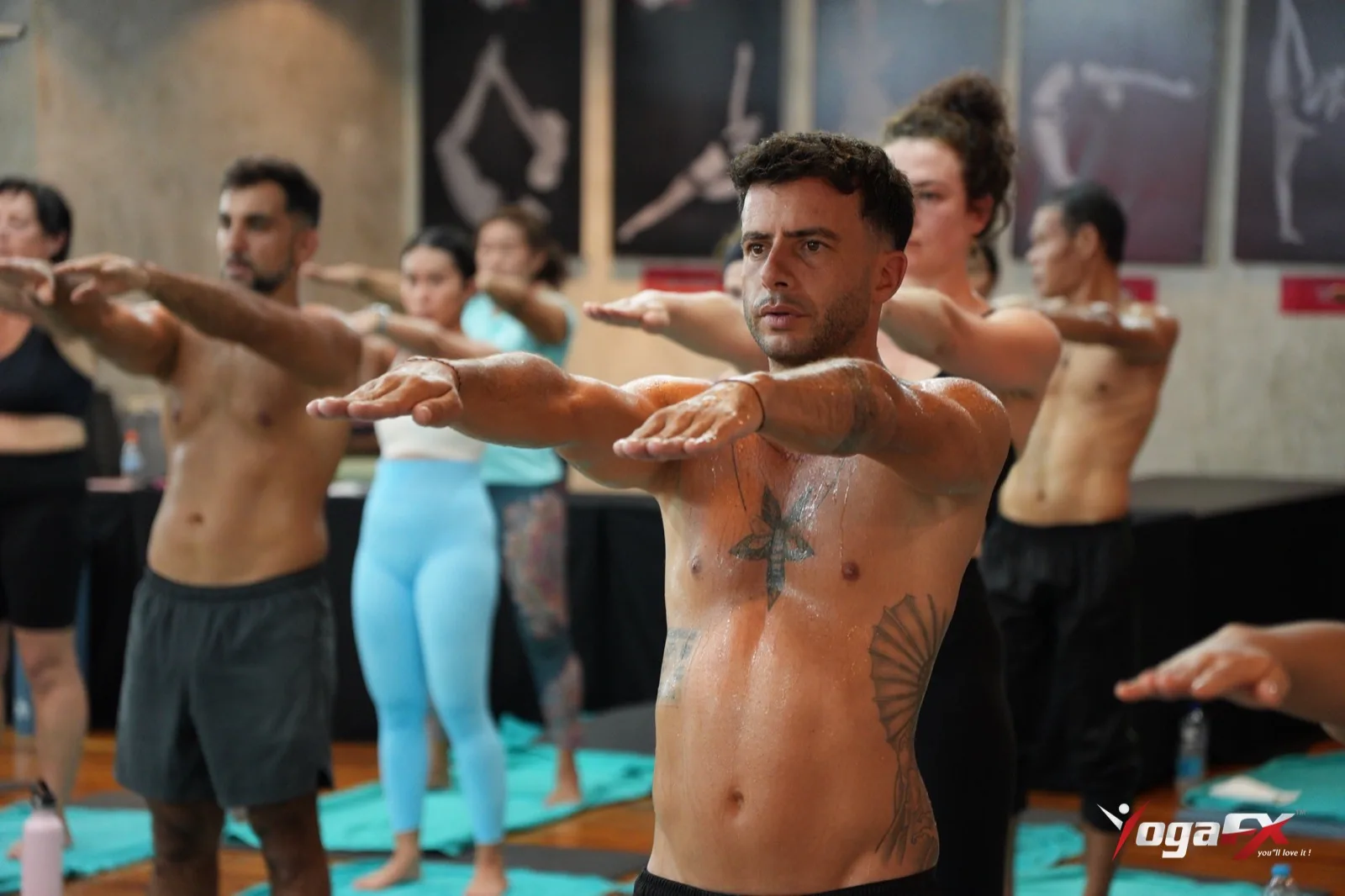
The sequence has no arm balances, and it has no choreography. A teacher reads the dialogue word for word, with no demonstration and no music. Artistic routines, by contrast, are set to music. So the class is a base, not a full programme.
Here is what an athlete would add on top of a 26 and 2 base:
- A coach who knows the rulebook. Small errors are hard to see in a mirror.
- Separate hand-balance training. The class does not build it.
- Partner and music work for the pair events.
- The current posture list for your federation and age group.
That is fine, because the 26 and 2 was never written as a competition programme. It is a very consistent conditioning tool, and consistency is what a judged sport rewards.
A Yoga Championship Day Versus a 26 and 2 Class
A competition floor feels very different from a hot room. Knowing the gap helps you plan your training, so here is how the two compare.
- Time. A 26 and 2 class runs 90 minutes. At a yoga championship, holds last 5 to 30 seconds, and an artistic routine runs three minutes.
- Temperature. The class runs at about 40°C with 40% humidity. The competition sources we read do not describe a heated room, so treat heat adaptation as a bonus, not a requirement.
- Voice. In class the teacher reads the dialogue, so you hear every cue. On the competition floor nobody tells you what to do next.
- Scoring. Nobody scores or ranks you in class. At a yoga championship, judges mark difficulty, balance, control, flexibility and endurance.
That last point is the real shift. In class, for example, you can drift for a few seconds and still finish the posture. On the floor, you have one attempt in front of a panel. So the habit to build is repeatable form: the same Camel today as last week.
A fixed sequence helps here. Because the cues never change, you compare your own Camel with your own Camel from last week, not with a different class. The mirror adds a second check. Watching your own alignment is close to how a coach reads a routine.
What Research Says About the Qualities a Yoga Championship Scores
No study we found has tested yoga championship athletes in a heated room. So nothing here proves that a 26 and 2 class wins medals. What research can tell us instead is whether yoga trains the qualities that judges score. Here is what we could open and check.
- Balance. The NCCIH reports a 2014 review in which 11 of 15 studies, with 688 participants in total, showed improvement in at least one balance outcome among healthy people.
- Strength and balance in older adults. A review of 33 studies with 2,384 participants over 65 found that yoga may improve leg strength, with less evidence for balance, according to the Harvard Gazette. So the balance evidence is mixed.
- Safety. The NCCIH says yoga is generally considered safe for healthy people when performed properly. It also warns that hot yoga has special risks related to overheating and dehydration.
Heat is not right for everyone
The Mayo Clinic advises checking with your doctor before hot yoga, especially with heart disease, a history of heat illness or dehydration problems, or pregnancy. The Cleveland Clinic adds that hot yoga is not suggested for people who are pregnant or have a heart condition, and that heat can aggravate asthma. Drink water before, during and after class, and stop if you feel dizzy.
Please consult a healthcare professional before starting a heated practice or training for events. These findings describe regular practice, not competition.
Ahmedabad Through YogaFX Eyes: Indonesia's Seven Medals
The best evidence we have is our own graduates, because they have stood on a yoga championship floor. At the World Yogasana Sports Federation Championships in Ahmedabad, Indonesia won 1 gold, 2 silver and 4 bronze, seven medals in all. Two YogaFX graduates were part of that result.
- Ivara Candra Kartika (graduate, 2023) won 1 gold and 1 bronze in Ahmedabad. She also took silver at the Asian Championships in the UAE in August 2025 and gold at FORNAS VIII in July 2025.
- Arkan Fauzan Riyanto (graduate, 2022) won 2 silver and 3 bronze medals in Ahmedabad. He is also a three-time FORNAS champion, in 2022, 2023 and 2025.
- Slamet Ariyanto (graduate, 2024) chairs PPYNI and manages the Indonesian yogasana team.
Across all events, YogaFX graduates have won 12 medals: 5 gold, 3 silver and 4 bronze. We don't claim the 26 and 2 alone makes a champion, because these athletes also train hard in competition work. What the class gives them is precision under pressure.
What Our Students Say
You do not have to compete to value precise teaching. Here is what three students said in their own words.
Every single time I do it. I learn something new.
A trainee in our YouTube review, 2026
I feel so happy, so blessed, powerful.
Eni, YouTube review, 2024
Thank you for the lessons.
Novi, YouTube review, 2024 (translated)
How to Prepare for a Yoga Championship From a 26 and 2 Base
A first yoga championship is simpler to reach than most people expect. Take the steps in order, because each one builds on the last.
- Build a base first. Practise regularly for several months before you think about a scoreboard. Our guide to how hard 26 and 2 really is sets honest expectations.
- Find your federation. Search for the yogasana body in your country. Posture lists and age groups differ.
- Learn the posture list. Mark which events you can match and which you cannot.
- Train with a coach. A coach who knows the scoring will spot errors you can't see.
- Enter a local event. Start in your own age group and build from there.
If teaching is your goal instead, our six-day hybrid MasterClass is the route. You can read the details on our 26 and 2 teacher training page. The next batch checks in on Sunday 24 January 2027 and checks out on Friday 29 January 2027, at Soham Wellness Center in Seminyak. It leads to Yoga Alliance RYT 200-Hour certification and a Bikram Hot 26&2 200-Hour International Yoga Certification.
FAQ
What is a yoga championship?
A yoga championship is a sporting event where athletes perform set yoga postures and judges score them on difficulty, balance, control, flexibility and endurance. Events are usually traditional, artistic or rhythmic. The first World Yogasana Championship ran in Ahmedabad from 4 to 8 June 2026.
Who won the 2026 world yoga championship?
India topped the medal table at the first World Yogasana Championship, with 114 medals, 102 of them gold, according to the Tribune India report. Indonesia won seven medals: 1 gold, 2 silver and 4 bronze. Two YogaFX graduates, Ivara and Arkan, were part of that team.
How is a yoga championship judged?
Judges score difficulty, balance, control, flexibility and endurance. In traditional events, athletes hold postures for 15 or 30 seconds, depending on the asana. Artistic routines run three minutes to music, and rhythmic events use shorter holds with points for smooth transitions. Rules vary by federation.
Which 26 and 2 postures appear in a yoga championship?
By body position, the closest matches are Standing Head to Knee, Standing Bow Pulling, Balancing Stick, Eagle, Cobra, Locust, Bow, Camel, Rabbit and Spine Twisting. The sequence has no arm balances, so it does not train the hand balance event. Check your federation's current posture list.
Can 26 and 2 classes prepare you for a yoga championship?
They build a strong base for leg balance, backbends and one twist, and they train calm under pressure. They do not cover hand balances, partner work or music routines. Add a coach who knows the rulebook, and see a healthcare professional first if you have a health condition.
Still have questions? Message Mr. Ian and the YogaFX team on WhatsApp and we will answer them personally.